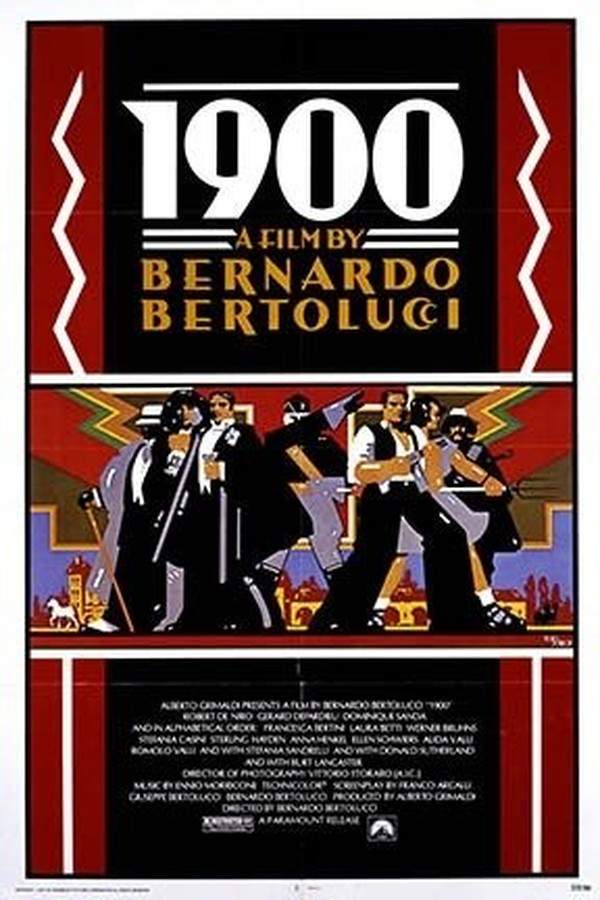
What Is 1900 About?
The premise of 1900 in 357 words, with nothing given away. The full story follows below.
In the sun‑baked fields of early‑20th‑century Emilia‑Romagna, a sprawling estate becomes the quiet stage for a nation on the brink of upheaval. The film paints a richly textured portrait of rural Italy, where the rhythm of harvests and the murmurs of the nearby towns coexist with the growing unease of political change. Light filters through wheat, yet shadows linger, hinting at the social currents that will soon surge beneath the surface. The atmosphere is both lyrical and taut, inviting viewers to linger in a world where tradition and modernity clash with a measured, almost poetic intensity.
At the heart of this world are two newborn boys whose lives are destined to mirror the country’s own contradictions. Alfredo Berlinghieri arrives into a family of affluent landowners, his lineage steeped in privilege and a sense of inherited responsibility. Across the fields, Olmo Dalcò is born to a peasant mother, his roots tangled with the laboring class that tills the very soil his future friend will inherit. As children, their unlikely camaraderie blossoms, their games and conversations bridging the vast gulf between aristocracy and the working poor. Their bond is gentle yet charged, a living emblem of the possibilities and tensions that define their era.
Both men grow under the weight of their divergent inheritances. Alfredo is drawn into the expectations of stewardship, grappling with the comforts and constraints of his status. Olmo, meanwhile, feels the pull of collective solidarity, his world shaped by the struggles and hopes of those who labor beneath the canopy of the estate. Their paths begin to diverge as personal ambitions and societal pressures nudge them toward different horizons, setting the stage for a nuanced exploration of loyalty, morality, and the ever‑shifting balance of power.
Against this backdrop, the rise of fascism looms like a gathering storm, its presence felt in whispered conversations and the tightening grip of authority. The film’s tone remains contemplative, offering a sweeping yet intimate look at how class, ideology, and friendship intertwine. It teases the question of whether bonds forged in youth can withstand the relentless march of history, leaving the audience poised on the edge of an inevitable reckoning.
What Happens in 1900?
The complete story of 1900, from the first scene to the last, in 700 words (about 3 minutes). Spoilers throughout. Names in the text link to 4 cast member pages.
Spoilers ahead
The film begins on April 25, 1945, marking the liberation of Italy from fascist rule. On a rural estate in Emilia-Romagna, the local peasants are rallying to arrest the landowner, Alfredo Berlinghieri. Amid this turmoil, a fraught middle-aged man, Attila, and a woman named Regina attempt to escape but are thwarted by laborers wielding pitchforks. The story then flashes back to the early 20th century.
On January 27, 1901, the day of renowned composer Giuseppe Verdi’s death, two infants come into the world minutes apart: Alfredo Berlinghieri and Olmo Dalcò. They represent starkly different social backgrounds; Alfredo hails from a wealthy landowning family led by his tyrannical grandfather, Alfredo the Elder (played by Burt Lancaster), while Olmo is the illegitimate son of a peasant girl and the grandson of Leo Dalcò (played by Sterling Hayden), the foreman who skillfully challenges the authority of the landowner without resorting to violence.
As children, Alfredo (portrayed by Paolo Pavesi) resents the deceit of his family, especially his weak father, Giovanni (played by Romolo Valli). During this time, he forms a friendship with Olmo (played by Roberto Maccanti), who is raised with strong socialist ideals. Under the guidance of his grandfather, Leo, Olmo participates in labor strikes against the oppressive conditions imposed on the estate.
The boys enjoy a heartfelt childhood friendship despite their disparities. Tragedy strikes in 1908 when Alfredo’s grandfather takes his own life. Subsequently, Giovanni inherits the estate. Shortly after, Olmo leaves to join a socialist youth group and later enlists in the Italian army during World War I, while Alfredo remains to manage the plantation.
In 1919, Olmo (now portrayed by Gérard Depardieu) returns from war and quickly renews his bond with Alfredo (now Robert De Niro). However, their reunion is overshadowed by the arrival of a sadistic new foreman, Attila Mellanchini (played by Donald Sutherland), a man who embraces fascist ideology following its rise in 1922. Attila treats the Berlinghieri workers with brutal disdain, leaving a trail of violence in his wake.
As the years go by, their personal lives reveal the stark contrasts between Alfredo and Olmo’s relationships. In one awkward encounter, their attempt at a romantic encounter is interrupted by a local prostitute’s sudden seizure. However, in 1930, love finds Alfredo when he marries the beautiful Frenchwoman Ada Chiostri Polan (played by Dominique Sanda). Meanwhile, Olmo finds love with Anita (portrayed by Stefania Casini), another socialist aligned with his beliefs. Tragically, Anita dies during childbirth, leaving Olmo as a single father to their daughter, aptly named after her mother, who grows to embody her father’s socialist values.
As Olmo becomes a leader in the fight for workers’ rights, tensions mount with Attila, whose cruelty escalates. During the frigid winter of 1935, Alfredo, a weak leader, is drawn into a web of despair, unable to confront the injustices occurring on his estate. When Attila and Regina, who share a twisted nature, commit murder and theft, the situation spirals out of control.
By the early 1940s, as World War II intensifies, the villagers, led by Olmo, confront Attila, throwing manure and resisting his oppressive tactics. In a desperate bid for survival, Olmo and his daughter go into hiding. Alfredo, finally breaking free from his passivity, dismisses Attila but discovers that Ada has abandoned him.
As the narrative circles back to April 25, 1945, the climax arrives: Alfredo, captured, stands before a tribunal of workers where Anita the Younger takes on a pivotal role in the trial. Amid accusations of neglect and complicity in suffering inflicted by Attila, Alfredo’s fate hangs in the balance. When Olmo intervenes, highlighting that Alfredo’s social class has been eclipsed by the fall of the old regime, the tide of change takes form.
Ultimately, the film closes on a contemplative note as Alfredo and Olmo, now older, engage in a playful tussle reminiscent of their youth. Fast-forwarding to 1976, we find them walking along an abandoned railway track. In a symbolic act, Alfredo lays down in the path of an approaching train, resembling a childhood game but tinged with a dark desire for finality. The screen fades as the train roars past, leaving viewers to ponder the enduring struggle between the ruling and working classes.
1900 Timeline: Every Key Event in Order
15 key events in the order they happen, from “Liberation of Italy” to “Final Moments”.
- 1
Liberation of Italy
On April 25, 1945, Italy is liberated from fascist rule, marking a significant turning point in the nation’s history. This event serves as a backdrop to the unfolding drama in a rural estate in Emilia-Romagna.
When:April 25, 1945 Where:Emilia-Romagna
- 2
Confrontation at the Estate
In the chaos of liberation, local peasants rally to arrest their oppressive landowner, Alfredo Berlinghieri. Amid this turmoil, Attila and Regina make an attempt to escape but are stopped by laborers brandishing pitchforks, showcasing the rising tensions between the oppressed and their oppressors.
Where:Emilia-Romagna
- 3
Birth of Alfredo and Olmo
On January 27, 1901, two infants are born moments apart, Alfredo Berlinghieri and Olmo Dalcò, representing drastically different social classes. Alfredo is the heir of a wealthy family, whereas Olmo is born to a peasant girl, setting the stage for their future contrasting paths.
When:January 27, 1901
- 4
Childhood Friendship
Despite their vastly different upbringings, Alfredo and Olmo develop a deep childhood friendship. They share innocent adventures, but tensions brew as Alfredo begins to feel the weight of his family's secrets and peer pressures.
- 5
Tragedy Strikes
In 1908, Alfredo's grandfather, overwhelmed by despair, commits suicide, leaving the estate to Alfredo's father, Giovanni. This familial tragedy marks a turning point in Alfredo's life as he grapples with his impending responsibilities.
When:1908
- 6
Olmo's Departure
After his grandfather's death, Olmo leaves the estate to join a socialist youth group and later enlists in the Italian army during World War I. His departure signifies a divergence in their paths and his commitment to fighting for the rights of the oppressed.
When:World War I
- 7
Post-War Reunion
In 1919, after returning from war, Olmo reunites with Alfredo, but their meeting is clouded by the presence of Attila, the sadistic new foreman. The grim atmosphere foreshadows the increasing brutality that will engulf both their lives.
When:1919
- 8
Attila's Arrival
Attila Mellanchini, embracing fascist ideology, takes over as the foreman in 1922, treating the workers with increasing brutality. His presence creates a hostile environment that further deepens the divide between Alfredo and Olmo.
When:1922
- 9
Alfredo's Marriage
In 1930, Alfredo marries the beautiful Ada Chiostri Polan, marking a personal victory amidst the chaos around him. Their union represents a brief moment of solace before the harsh realities of life intrude once again.
When:1930
- 10
Olmo's Loss
Olmo finds love but suffers a tragic loss when Anita, his partner, dies during childbirth. This sorrow thrusts him into the role of a single father and further galvanizes his commitment to fighting for workers' rights.
Show the other 5 events of 1900 Hide the last 5 events
- 11
Growing Tensions
By 1935, tensions escalate between Alfredo, who is paralyzed by fear and helplessness, and Attila, whose cruelty reaches new heights. This conflict culminates in violent confrontations as the workers start to resist under Olmo's leadership.
When:1935
- 12
Resistance Against Attila
In the early 1940s, as World War II intensifies, Olmo leads the villagers in a revolt against Attila, resulting in acts of defiance, including throwing manure at him. This resistance reflects the growing unrest among the working class in the face of oppression.
When:Early 1940s
- 13
Alfredo's Reckoning
As the story circles back to April 25, 1945, Alfredo faces a tribunal of workers led by Anita the Younger. The trial brings forth debates about his complicity in the suffering inflicted by Attila, presenting a moment of reckoning for Alfredo.
When:April 25, 1945 Where:Emilia-Romagna
- 14
Confrontation and Revelation
During the tribunal, Olmo intervenes to plead for Alfredo, emphasizing that class distinctions are now irrelevant in light of the regime's fall. This pivotal moment signifies a shift towards social consciousness among individuals of varied backgrounds.
- 15
Final Moments
The film concludes with a contemplative scene of Alfredo and Olmo walking along an abandoned railway track, reminiscing about their childhood. In an act that combines nostalgia and despair, Alfredo lays down in the track's path as a train approaches, symbolizing their lifelong struggles.
When:1976
Who Are the Main Characters in 1900?
4 characters, among them Alfredo Berlinghieri, Olmo Dalcò and Attila Mellanchini: who each one is and the part they play in the story. 2 of them link to the actor’s page.
-

Alfredo Berlinghieri
Played by Robert De Niro
Alfredo is a conflicted character raised in privilege but is deeply affected by the injustices he witnesses. His internal struggles with his identity and responsibility culminate in a desperate quest for redemption, especially as he confronts the price of his class background.
- 👑 Aristocracy
- 🏛️ Conflict
-

Olmo Dalcò
Played by Gérard Depardieu
Olmo is the illegitimate son of a peasant who carries strong socialist ideals. His character represents the fight for workers' rights and social justice, standing in stark contrast to Alfredo's reluctant nature as a landowner.
- ✊ Revolution
- 🌹 Socialism
- AM
Attila Mellanchini
Attila embodies the brutality of fascist ideology, portraying a sadistic foreman whose oppressive tactics create a climate of fear among the laborers. His character is pivotal in escalating the conflict and tension within the film.
- 💣 Violence
- ⚔️ Oppression
- R
Regina
Regina plays a critical role in the narrative, intertwined with Attila's dark actions. Her character highlights the complexities of relationships in a time of conflict, revealing layers of manipulation and complicity.
- 🌀 Complexity
- 🌪️ Turmoil
Where and When Is 1900 Set?
1900 is set in Emilia-Romagna (1901-1945). Here is why the time and place matter to the story.
When
1901-1945
The film spans from the early 20th century through World War II, capturing a period of significant change in Italy. It depicts the rise of class struggles, the impact of fascism, and the shifting dynamics of social relationships during a time marked by war and transformation.
Where
Emilia-Romagna
Emilia-Romagna is a region in northern Italy known for its rich agricultural landscape and historical estates. The film's rural estate acts as a microcosm of the socio-economic divides in Italian society, highlighting the stark contrasts between the lives of the wealthy landowners and the impoverished peasants.
- 🌾 Rural
- 🏰 Estate
What Are the Themes of 1900?
3 ideas the story keeps returning to, among them Class Struggle, Friendship and Betrayal and The Passage of Time.
-
01
Class Struggle
The theme of class struggle is central to the narrative, illustrating the conflict between the oppressive landowners and the laborers fighting for their rights. It reflects the historical tensions in Italy, particularly as socialist ideals clash with fascist authoritarianism.
-
02
Friendship and Betrayal
The story intricately weaves themes of friendship and betrayal, particularly between Alfredo and Olmo. Their bond is tested by societal pressures, personal losses, and broader political contexts, ultimately shaping their destinies.
-
03
The Passage of Time
The narrative spans decades, showcasing how the characters evolve with the changing socio-political landscape. The passage of time in the film emphasizes the enduring impact of past decisions on present realities, culminating in a poignant reflection on mortality and legacy.
What Kind of Film Is 1900?
Bleak in tone, with variable pacing and a complex story, going by the plot summary.
- Tone
- Bleak
- Pacing
- Variable
- Story
- Complex
- Intensity
- High
- Ending
- Bittersweet
A sprawling and brutal epic that charts the decades-long, emotionally draining conflict between friends divided by class, set against the oppressive rise of fascism and culminating in a somber, contemplative reflection on a lifetime of struggle.
- epic
- oppressive
- somber
- melancholic
- brutal
- contemplative
- class struggle
- political conflict
- friendship tested
- fascism
Content notes: implied child rape, murder, suicide, war violence, fascist brutality.
Quiz
How well do you remember 1900? Test yourself on the story.
Where to Watch 1900
Rent or buy it from Apple TV Store and Fandango At Home. US availability and prices from JustWatch.




Streaming availability in the US, powered by