Margrete: Queen of the North 2021


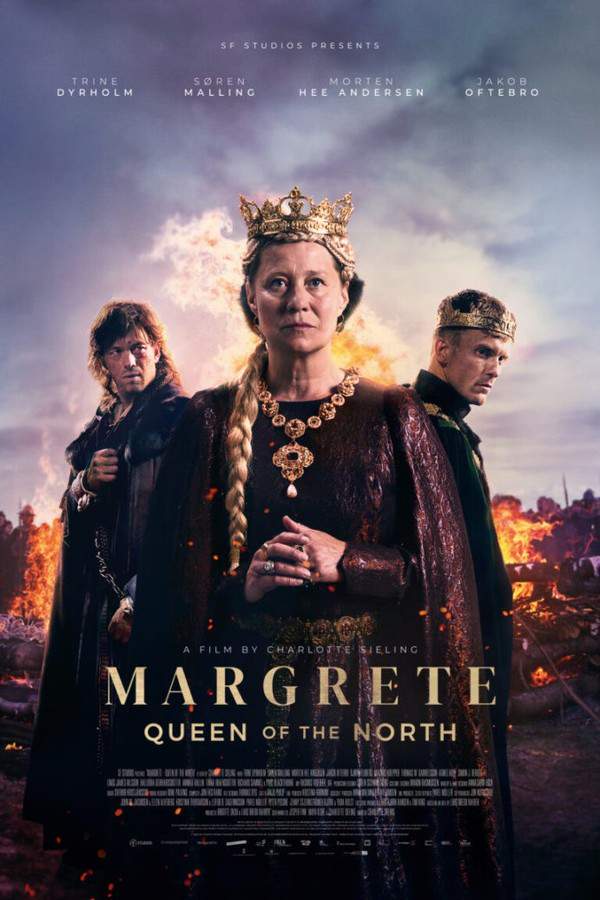
In 1402, the union of Denmark, Norway, and Sweden forged by Margrete faces a perilous crisis. Political intrigue and treachery threaten to shatter her carefully constructed realm. As she guides her young heir, Erik, Margrete seeks to secure a strategic marriage alliance with England to strengthen her power. However, a web of conspiracies emerges, and she must confront those plotting to destroy the kingdom she has fought so hard to build, risking everything she has achieved.


Does Margrete: Queen of the North have end credit scenes?
No!
Margrete: Queen of the North does not have end credit scenes. You can leave when the credits roll.
Where to Watch Margrete: Queen of the North
See current US streaming, rental, and purchase options for Margrete: Queen of the North (2021) via JustWatch.

Amazon Prime Video
HD
Amazon Prime Video with Ads
HD
Viaplay Amazon Channel
HD
Fawesome
HD
Hoopla
SD
Kanopy
HD
Plex
HD
Plex Channel
HD
Pluto TV
SD
Tubi TV
SD
Amazon Video
SD
Apple TV Store
HD
Fandango At Home
SD
Google Play Movies
SD
YouTube
SD Streaming availability powered by 
Meet the Full Cast and Actors of Margrete: Queen of the North
Explore the complete cast of Margrete: Queen of the North, including both lead and supporting actors. Learn who plays each character, discover their past roles and achievements, and find out what makes this ensemble cast stand out in the world of film and television.






External Links and Streaming Options
Discover where to watch Margrete: Queen of the North online, including streaming platforms, rental options, and official sources. Compare reviews, ratings, and in-depth movie information across sites like IMDb, TMDb, Wikipedia or Rotten Tomatoes.









Ratings and Reviews for Margrete: Queen of the North
See how Margrete: Queen of the North is rated across major platforms like IMDb, Metacritic, and TMDb. Compare audience scores and critic reviews to understand where Margrete: Queen of the North stands among top-rated movies in its genre.

The Movie Echo Score
Margrete: Queen of the North delivers strong performances and impressive visual craftsmanship, yet its storytelling suffers from uneven pacing. Critics commend the film's direction, production design, and Trine Dyrholm's nuanced acting, while users echo admiration for the acting and period scenery. However, repeated references to a plodding first hour and occasional plot bogging temper the overall experience. Consequently, the film stands as a solid historical drama whose strengths are offset by narrative drag, reflected in a 73 score.
The Movie Echo Score Breakdown for Margrete: Queen of the North

Art & Craft
The film excels in production design and cinematography, offering a richly detailed visual palette. Critics highlight the grandly gloomy sets, elaborate costuming, and atmospheric authenticity, noting the visual richness despite narrative sluggishness. Users reinforce this view, praising beautiful scenery, intricate costumes, and effective visual effects. Overall, the craftsmanship of art and technical execution stands as a leading strength of the movie.

Character & Emotion
Performance quality is a clear high point, anchored by Trine Dyrholm's nuanced portrayal. Critics describe her acting as an affecting blend of regality and fragility, and several reviews commend the reliable ensemble cast. Users report strong emotional engagement and commend the entire cast for compelling performances. This consistent praise across sources elevates the character dimension to a top-tier rating.

Story & Flow
Narrative pacing and plot cohesion are uneven, limiting overall impact. Critics point to a slow first hour, plodding sections, and moments where the story feels bogged down by facts, while RogerEbert notes a lack of energizing momentum. User feedback mirrors this, citing repetitive back‑and‑forth and a low plot rating, though some acknowledge sustained tension. The mixed reception results in a modest story score.

Sensory Experience
Sensory elements, including sound, music, and visual style, are generally well realized. Critics commend the atmospheric production design and authentic costume work, noting the brooding visual tone. Users add praise for striking scenery, detailed hair and jewelry, and effective visual effects. While sound design receives limited comment, the overall sensory experience is cohesive and supportive of the film's period setting.

Rewatch Factor
The film offers moderate replay value, balancing entertainment with narrative constraints. Critics describe it as rewarding and engaging, though some view it as a historical reenactment lacking fresh energy. Users express enjoyment and edge‑of‑seat engagement, yet mention repetitive plot aspects that may diminish repeat viewings. This blend of positive and cautionary feedback yields a respectable yet not outstanding rewatch factor.

68
Metascore
6.3
User Score


95%
TOMATOMETER

74%
User Score

6.6 /10
IMDb Rating

65
%
User Score

3.3
From 4 fan ratings

3.00/5
From 2 fan ratings
Take the Ultimate Margrete: Queen of the North Movie Quiz
Challenge your knowledge of Margrete: Queen of the North with this fun and interactive movie quiz. Test yourself on key plot points, iconic characters, hidden details, and memorable moments to see how well you really know the film.
Margrete: Queen of the North Quiz: Test your knowledge about the historical drama 'Margrete: Queen of the North' and its intricate plot involving politics, power, and betrayal.
In what year does the film 'Margrete: Queen of the North' begin?
Full Plot Summary and Ending Explained for Margrete: Queen of the North
Read the complete plot summary of Margrete: Queen of the North, including all major events, twists, and the full ending explained in detail. Explore key characters, themes, hidden meanings, and everything you need to understand the story from beginning to end.
The film commences in 1361, where the infant Princess Margrete of Denmark is an unwilling witness to the violent consequences of her father, King Valdemar IV’s victory during the Battle of Visby. Fast forward to 1402, and we see Margrete, now a formidable queen regnant, traversing the breathtaking Hardangervidda plateau in Norway alongside her loyal retinue. Accompanying the journey is a caption revealing her significant achievement: she has unified Denmark, Norway, and Sweden under her rule, governing through her adopted son, King Erik. This historic moment has ushered in an era of unprecedented peace across the Nordic countries, a rarity that hasn’t been seen for centuries.
As she arrives at a majestic fjord, Margrete addresses a gathering of the leading Nordic magnates. She emphasizes the peace that the Kalmar Union has brought over the past decade but insists that it is now essential to establish a Union army. In a bold announcement, she reveals plans for Erik to be betrothed to Princess Philippa, the daughter of King Henry IV of England. Margrete explains that a robust military force is vital for securing a military alliance with England, which would serve to deter the looming threats posed by German forces, particularly the Teutonic Order, especially after their recent seizure of the Swedish island of Gotland. Each of the magnates agrees to contribute troops to this noble cause.
In a strategic move, Margrete enlists the help of Roar, a pirate from Kullen in Scania, tasking him with blockading Gotland. She also takes under her wing Astrid, a Swedish girl who has been rescued from a German vessel, bringing her to Kalmar Castle in Sweden. Here, she confides in her friend and financial backer, Peder Jensen Lodehat (Søren Malling), the Bishop of Roskilde, about the fruitful outcome of her travels.
Months later, Margrete gathers the magnates again in Kalmar to welcome Princess Philippa and Sir William Bourcier, an English lord charged with negotiating the terms of the marriage agreement. During a celebratory feast, Asle Jonsson (Bjørn Floberg), leader of the Norwegian Council, brings disconcerting news from Graudenz in Prussia: he believes he has seen King Oluf, Margrete’s son, who has been presumed dead for 15 years. Despite her assurances that Oluf is no longer alive, Asle is adamant, claiming that the Man from Graudenz is indeed “my King” and he has brought him to Smedby. Margrete suspects that this so-called ‘false Oluf’ might be part of a devious plot devised by the Teutonic Knights and, needing Norway’s pledge of troops, she orders Asle to bring the man to Kalmar for interrogation.
As rumors swirl during the feast, Margrete is faced with a rising tide of mistrust, especially after Astrid overhears troubling stories about Erik being Margrete’s sister’s grandson and whispers regarding Margrete’s alleged involvement in Oluf’s death years before. Constrained by her role, Margrete reluctantly declares that the pretender’s claim is an act of treason against the Union, assuring everyone that he will receive a fair trial.
However, negotiations with Bourcier soon hit a roadblock due to the sudden question surrounding Erik’s legitimacy as king. While the Man from Graudenz stands accused in handcuffs, claiming to be Oluf, Margrete remains skeptical yet resolute: “My son died,” she responds coldly. The man states that he was meant to have been killed by Esge Vind, a retainer who ultimately spared his life but allowed him to be captured by the Germans. As this shocking tale unfolds, Danish Council leader Jens Due (Thomas W. Gabrielsson) dismisses the man’s claims as mere fantasy, while the Norwegian magnates rally behind Asle’s insistence that they are in the presence of their legitimate king.
As the drama intensifies, Margrete grapples with her predicament. If the Man from Graudenz is truly Oluf, it could mean Erik’s throne is in jeopardy. As tension mounts, Peder urges her to execute the pretender swiftly to maintain peace among the three realms, while Bourcier warns that negotiations would end if Erik’s status remains unresolved. Amidst the chaos, Margrete’s growing dialogue with the Man from Graudenz leads her to ponder whether he truly might be her long-lost son. Doubts further deepen when she learns that none of her advisors were present during Oluf’s burial, nor did they open his coffin due to fears of plague.
In her quest for the truth, Margrete instructs her Swedish retainer Jakob Nilsson (Simon J. Berger) to seek out Roar for additional insights into this complex situation. She proposes a desperate solution: if the Man from Graudenz renounces his claim as Oluf, she will allow him to live. However, he remains obstinately unwilling to claim falsehood. Meanwhile, Bishop Peder argues that as long as the pretender lives, he poses an ongoing threat to their unity.
With time running out, Margrete experiences a sudden realization: the Man from Graudenz’s assertion of an assassination order may be crucial. She confronts Peder, who ultimately confesses his role in this tragic affair, having conspired to eliminate Oluf for what he deemed the greater good. He explains that Oluf’s temperament would never have been accepted by the Swedes, thereby justifying his drastic actions to secure Margrete’s reign over Denmark-Norway and subsequently Sweden.
Convinced of the man’s identity as Oluf, Margrete’s resolve is tested when Erik, desperate to maintain his grip on power, produces a false witness who claims to have taught the imposter how to mimic Oluf. The court is swayed, and Oluf is found guilty of treason, condemned to death despite Margrete and the Norwegian magnates’ desperate protests. The Danish and Swedish factions rally behind Erik, compounding Margrete’s isolation.
That fateful evening, Margrete contrives a plan to rescue Oluf with the help of Asle. Yet, things take a dramatic turn when Jakob Nilsson and Roar return with alarming news: the Teutonic Order is preparing to invade mainland Sweden, deliberately manipulating Oluf’s situation to disrupt the fragile alliance with England and jeopardize the Kalmar Union. Confronted with this dire threat, Margrete makes a heart-wrenching decision—she betrays her son, leading to his recapture. Although she manages to plead for Asle’s safety, Oluf is publicly executed by fire, casting a haunting shadow over Margrete as she puts the greater good of the Union above her personal sorrow.
In the end, the film closes with a poignant reminder: the legacy of the Kalmar Union endured for an additional century following Margrete’s death, underscoring her pivotal role in forging lasting connections among the three Nordic nations, an affinity that resonates even to this day.

Coming soon on iOS and Android
The Plot Explained Mobile App
From blockbusters to hidden gems — dive into movie stories anytime, anywhere. Save your favorites, discover plots faster, and never miss a twist again.
Sign up to be the first to know when we launch. Your email stays private — always.
Explore the mobile appWatch Trailers, Clips & Behind-the-Scenes for Margrete: Queen of the North
Watch official trailers, exclusive clips, cast interviews, and behind-the-scenes footage from Margrete: Queen of the North. Dive deeper into the making of the film, its standout moments, and key production insights.
Margrete: Queen of the North Themes and Keywords
Discover the central themes, ideas, and keywords that define the movie’s story, tone, and message. Analyze the film’s deeper meanings, genre influences, and recurring concepts.
Margrete: Queen of the North Other Names and Titles
Explore the various alternative titles, translations, and other names used for Margrete: Queen of the North across different regions and languages. Understand how the film is marketed and recognized worldwide.
Similar Movies To Margrete: Queen of the North You Should Know About
Browse a curated list of movies similar in genre, tone, characters, or story structure. Discover new titles like the one you're watching, perfect for fans of related plots, vibes, or cinematic styles.






Quick Links: Summary, Cast, Ratings, More

What's After the Movie?
Not sure whether to stay after the credits? Find out!
Check out our other apps:

SAT Sphere
Build confidence for the Digital SAT.

Mori Atlas
Discover wild places worth protecting.

Luntero
Search smarter for a home in Amsterdam.

Plot Explained
Unravel movie endings and hidden clues.

Pokechamp
Dive into Pokémon data and battle logic.

Driving Theory
Get ready for your European theory test.

Movie Dust
Plan your next cinema trip with ease.

Musemap
Find art and culture as you travel.

Selkobase
Compare credentials before committing.

Local Manual
Turn an unfamiliar country into practical next steps.

Lernavi
Compare school systems before your next move.

GymRoam
Find a workout stop wherever your plans take you.
Explore Our Movie Platform
New Movie Releases (2026)
Famous Movie Actors
Top Film Production Studios
Movie Plot Summaries & Endings
Major Movie Awards & Winners
Best Concert Films & Music Documentaries
Movie Collections and Curated Lists
© 2026 What's After the Movie. All rights reserved.
Privacy Policy