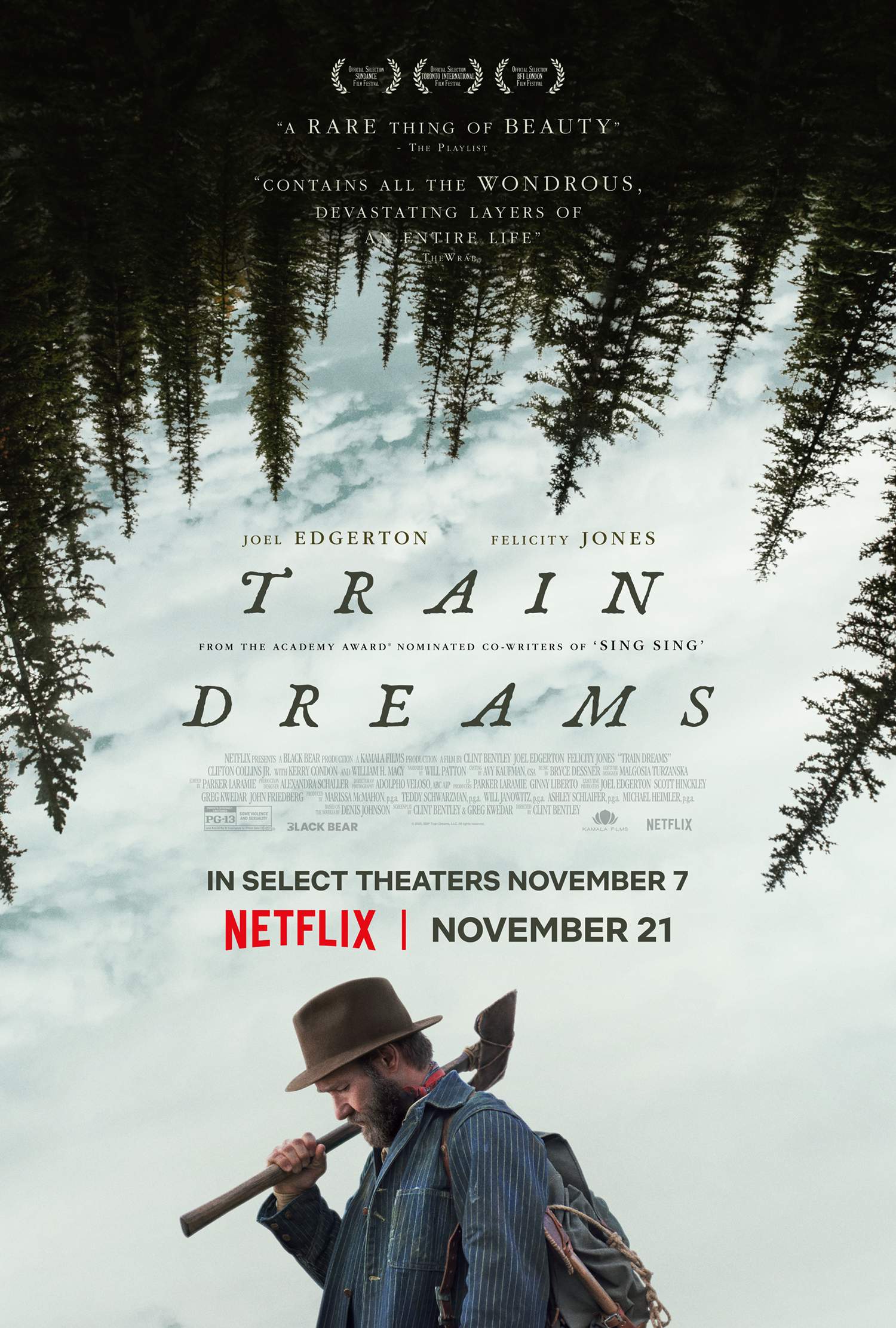
Train Dreams 2025

Directed by

Clint Bentley
Made by

Black Bear
Where to Watch Train Dreams
See current US streaming, rental, and purchase options for Train Dreams (2025) via JustWatch.


Streaming availability powered by 
Train Dreams Plot Summary
Read the complete plot summary and ending explained for Train Dreams (2025). From turning points to emotional moments, uncover what really happened and why it matters.
Robert Grainier grows up as an orphan arriving near Bonners Ferry, Idaho, aboard the Great Northern Railway. He drifts through his youth without direction until a life-changing meeting with Gladys Grainier leads to a steady, weathered life built on wood and land. They marry, settle into a log cabin along the Moyie River, and welcome a daughter, Kate. The early days are simple and stubborn, framed by the quiet rhythm of seasons and the hard labor that keeps a family fed. The film traces the texture of their days, the small rituals that keep hope alive, and the stubborn faith that a life built with sweat and care can endure.
Robert’s work soon takes him into railroad construction for the Spokane International Railway, a world of iron, timber, and risk. A single, brutal incident—where a Chinese worker is shoved from a bridge by a group of white workers—haunts him and seeds disturbing visions of the man, as if the memory of that moment could derail him at any time. The haunting sense of danger follows him into the next chapter of his life, reminding him of the fragility of every choice and every breath.
As time passes, he moves into seasonal logging, a life that pulls him away from Gladys and Kate for long stretches. Along the way he meets many men who imprint themselves on his memory, yet the work is riddled with tragedy. A vigilante, seeking to avenge a brother’s murder, claims a life; other workers fall to the dangers of the forest, and their graves are starkly marked by a pair of boots nailed to a tree—a haunting symbol of loss and memory that lingers in the timber and in the mind. In this harsh world, he grows close to a fellow logger, Arn Peeples, whose own fate is sealed by a falling branch.
With the post-World War I economy, Robert tries to pull his life closer to home. He and Gladys decide to farm and even plan a lumber mill so he can quit logging. But when he returns from his final season, the cabin is scorched by a wildfire, and Gladys and Kate are missing. A desolate Robert finds a quiet companion in his friend, Ignatius Jack, who stays by his side as he rebuilds the cabin and steels himself for whatever comes next.
He tries to chart a path that keeps him tethered to the land, but the world around him keeps changing. He returns to logging only to discover he’s out of place among newer technologies and rougher, younger men, and so he makes the difficult choice to step back entirely. A new line of work calls him, this time as a carriage driver for townspeople. In town he meets Claire Thompson of the United States Forest Service, who is in town to conduct a survey and encourages him to see new possibilities beyond the trees and timber. Her encouragement plants a faint hope that life can bend toward something steadier, something that doesn’t demand the brutal pace of the woods.
Even as the days grow longer and the world changes around him, he walks the woods with a quiet, almost spiritual resolve, sometimes believing he hears the faint voices of his wife and daughter among the pines. He clings to the possibility that they might return, and sometimes a dream seems to offer a glimpse. One night he believes he sees an injured Kate return to the cabin and tends to her wounds, but by morning there is no sign she was ever there. He chooses to remain in the cabin, convinced that staying might keep them close if they ever come back.
As the years roll on, the world shifts from steam to space-age television. He rides the Great Northern into Spokane and bears witness to John Glenn’s flight into space, a distant shimmer of the future painted on a small screen. The life he has lived—woven with love, loss, hard labor, and the quiet endurance of a man who refused to abandon the land—culminates in a final, upward moment. In a spring day that feels like a last, luminous memory, he climbs into a biplane. As the plane loops over the valley, the sights and sounds of a lifetime cascade through his mind. The narrator concludes with the sense that the man who lived so long, lived so fully, dies in his sleep in the cabin in November 1968, leaving no heirs, yet in that spring moment, he feels himself finally, completely, connected to it all.
Train Dreams Timeline
Follow the complete movie timeline of Train Dreams (2025) with every major event in chronological order. Great for understanding complex plots and story progression.
Arrives in Bonners Ferry as an orphan
Robert Grainier arrives in the Bonners Ferry area as an orphaned child after traveling on the Great Northern Railway. He drops out of school and spends his youth without direction or purpose. This early start threads a solitary, drifting path through his life.
Meets Gladys Olding and starts a family
He meets Gladys Olding and they marry, beginning a life together. They build a log cabin along the Moyie River and soon welcome a daughter named Kate. This family becomes Robert's anchor amid his later years of work and wandering.
Works on Spokane International Railway; haunted by tragedy
Robert takes to railroad construction for the Spokane International Railway. He witnesses a Chinese worker being thrown off a bridge by white workers, an act whose motive remains unclear. He is haunted by visions of the man and dreams of him being struck by a train.
Begins seasonal logging; long separations from family
Robert shifts to seasonal logging, taking him away from Gladys and Kate for long stretches. He meets many men who leave impressions on him, but the work brings its own tragedies. The isolation plants seeds for the episodes that haunt him later.
Worksite violence and eerie graves
In the camps a worker is killed by a vigilante avenging his brother's murder, and several others die when a tree collapses. Their graves are marked by a pair of boots nailed to a tree, a stark symbol of the dangers around him. The losses deepen Robert's sense of life’s fragility.
Arn Peeples dies in a fall
Robert grows close to fellow logger Arn Peeples, who is killed by a falling branch. The accident underscores the ever-present peril of the work and the price paid by his companions. The event becomes another haunting memory in his lifetime.
Plans to stay closer to home; farm and mill idea (post-WWI)
Seeking stability after World War I, Robert and Gladys decide to farm and build a lumber mill so he can quit logging. The plan marks a shift toward domestic life and a potential return to the land. Yet the dream is disrupted by disaster and loss.
Wildfire destroys cabin; Gladys and Kate vanish
When Robert returns from his final logging season, he discovers their cabin burned by wildfire and that Gladys and Kate are missing. The loss shatters his world and leaves him desolate. With the help of a friend, Ignatius Jack, he begins to rebuild what remains.
Rebuilds cabin with Ignatius Jack; considers next chapter
Despondent Robert is consoled by his friend Ignatius Jack and begins rebuilding the cabin. He resumes living in the cabin and keeps faith that his family might someday return. This period marks tentative resilience after catastrophe.
Return to logging; decides to stop
Robert goes back to logging but feels out of place among younger, rougher men and advancing technology. The changes of the industry push him toward leaving the trade for good. He starts to seek quieter work away from the forest.
Carriage driver encounter with Claire Thompson
He takes a job as a carriage driver for townspeople and meets Claire Thompson of the United States Forest Service, who is in town to conduct a survey. She offers encouragement and a new perspective on his life. Their encounter provides a spark of purpose in his aging years.
Walks the woods; spirits of wife and daughter
Robert continues walking through the woods, feeling the presence of his wife and daughter. He believes the spirits visit him, and he hopes he is not driving them away. The boundary between memory and reality blurs as years pass.
Rides the Great Northern to Spokane; sees John Glenn
As decades pass, the world changes and Robert rides the Great Northern into Spokane. He watches John Glenn's flight into space on a television, a moment that connects his lifetime to a new era. The scene emphasizes the scale of time and memory in his life.
Spring plane flight; death and final connection
On a spring day he decides to fly in a biplane, and memories of his life pass through his mind as the plane loops. The narrator reveals that he dies in his sleep in November 1968, leaving no heirs. Yet in that spring moment, he feels finally connected to it all.
Train Dreams Characters
Explore all characters from Train Dreams (2025). Get detailed profiles with their roles, arcs, and key relationships explained.
Robert Grainier (Joel Edgerton)
An aging, weathered railroad worker and logger whose life spans eight decades of frontier Idaho. He is introspective and haunted by visions of a murdered worker and the loss of his wife and daughter. His resilience and quiet, methodical nature anchor him as the world around him shifts.
Gladys Grainier (Felicity Jones)
Robert's partner in the early years, she helps build a life along the Moyie River. Her presence provides warmth through happiness and tragedy alike, including the wildfire that separates the family. Her memory lingers in Robert, fueling his longing for home and family.
Arn Peeples (Clifton Collins Jr)
A fellow logger who becomes Robert's close friend in the woods. He embodies rugged camaraderie and the perilous nature of frontier labor, ultimately meeting a violent end that deeply affects Robert. His death marks a turning point in Robert's view of danger and loyalty.
Claire Thompson (Kerry Condon)
A United States Forest Service investigator who offers guidance and introduces Robert to the possibility of belonging beyond the cabin. She symbolizes a bridge between old life and a changing world, encouraging adaptation while respecting memory.
Kate (Zoe Rose Short)
Robert and Gladys's daughter, whose memory haunts Robert as a symbol of family and loss. She appears in dreams and memories, guiding Robert's longing for connection even after her disappearance. Her imagined return becomes a touchstone for hope.
Train Dreams Settings
Learn where and when Train Dreams (2025) takes place. Explore the film’s settings, era, and how they shape the narrative.
Time period
Late 19th century – 1968
The narrative spans eight decades, beginning with Robert as a child arriving with the railroad and ending with his death in the late 1960s. It moves from frontier isolation to post-war economic shifts and the dawn of modern technology. Throughout, the pace of progress contrasts with the slower, cyclical rhythms of forest life.
Location
Bonners Ferry, Idaho; Moyie River; Spokane, Washington
Set in the Idaho frontier around Bonners Ferry, the Moyie River, and remote logging camps, with brief forays toward Spokane. The rugged landscape and changing seasons frame the daily lives and hard-won routines of loggers and railroad workers. The Great Northern Railway era and nearby towns anchor the story in a world where nature and industry collide.
Train Dreams Themes
Discover the main themes in Train Dreams (2025). Analyze the deeper meanings, emotional layers, and social commentary behind the film.
🕰️
Memory
Memory governs Robert's decisions as he carries the weight of loss and haunting visions from the frontier era. The film interweaves recollections of Gladys and Kate with the sight of the murdered worker, blurring dream and reality. Across the decades, memories tether him to the cabin and the forest, shaping his identity. These memories drive his persistent longing for connection even as the world changes.
🏞️
Frontier Life
The Idaho frontier provides a backdrop of logging camps, river cabins, and rough camaraderie. Work is perilous, with accidents and violent episodes that punctuate daily life. Isolation deepens bonds among men like Robert and Arn Peeples, while time and progress pull the community apart. The frontier struggle against the encroaching modern world defines the character dynamics.
⚙️
Modernity
Technological and institutional changes reshape the landscape, from rail work to the emergence of the US Forest Service survey. Robert finds his skills and sense of purpose tested by younger, tougher men and newer equipment. The story culminates in symbols of progress, like a biplane flight, while reminding us that modernization can erode long-standing community bonds. The tension between the old ways and new systems runs through the entire film.
💪
Resilience
Despite wildfires, loss, and isolation, Robert rebuilds and keeps moving forward. He clings to memories of Gladys and Kate as fuel for perseverance and renewal. Claire's presence offers a renewed sense of purpose and belonging, signaling a possible path through change. The ending suggests that resilience keeps him connected to life, even as he fades into memory.

Coming soon on iOS and Android
The Plot Explained Mobile App
From blockbusters to hidden gems — dive into movie stories anytime, anywhere. Save your favorites, discover plots faster, and never miss a twist again.
Sign up to be the first to know when we launch. Your email stays private — always.
Explore the mobile appTrain Dreams Ending Explained
Unravel the ending of Train Dreams (2025) with our detailed explanation. Understand the final scenes, character fates, and unresolved questions.
In the film’s closing moments, an elderly Robert discovers a young girl wandering wounded in the forest. Believing—perhaps desperately—that she is his long‑lost daughter Kate, he brings her back to his cabin, splints her broken leg and tends to her through the night. By morning the girl is gone, slipping away as silently as she had appeared. Robert spends the following years lingering in that same place, waiting for her return, the hope that sustains him even as the world moves on.
During this time he watches the world’s milestones—John Glenn’s rocket launch, a traveling circus act, a brief plane ride—each a reminder of life’s relentless march. He continues to help the townspeople, driving a small taxi for forest‑service workers like Claire, caring for stray dogs, and maintaining his friendship with the storekeeper Ignatius. When his own strength finally wanes, he returns to his cabin and dies quietly, having found a fragile peace in the small gestures that linked him to others, even if the reunion he longed for never came.
Train Dreams Spoiler-Free Summary
Discover the spoiler-free summary of Train Dreams (2025). Get a concise overview without any spoilers.
In the early‑twentieth‑century wilderness of northern Idaho, the rhythm of towering pines and the clatter of steel rails shape everyday life. The film opens on a vast, slowly modernizing landscape where railroads carve new pathways through the frontier and logging camps pulse with the relentless hum of industry. Against this backdrop, the world feels both expansive and intimate, a place where the passage of time is measured by the seasons, the sound of a train, and the quiet growth of a river‑side cabin.
At its heart is Robert Grainier, an orphan who arrives as a child on the Great Northern Railway and grows into a man whose hands are as familiar with timber as they are with the cadence of locomotive whistles. His life is marked by a steady, unpretentious labor—building tracks, felling trees, and tending to the land—yet beneath the surface lies a persistent yearning for connection and purpose. As he moves from one season of work to the next, he encounters a cast of fellow laborers whose brief friendships hint at the larger tapestry of community that threads through these remote towns.
Robert’s relationships, especially the love he finds with a local woman and the family they forge together, give his otherwise solitary existence a resonant core. Their shared cabin by the river becomes a modest haven where the ordinary moments of daily life—quiet evenings, simple meals, and the rhythm of work—are infused with a profound sense of belonging. The couple’s aspirations and the small triumphs of building a home echo the broader American dream, even as the world around them shifts rapidly.
The film’s tone is contemplative and lyrical, blending the raw, elemental beauty of the wilderness with the subtle melancholy of a life lived in the margins of history. As new technologies emerge and younger, rougher hands arrive, Robert finds himself at a crossroads, feeling both the weight of his past and the pull of an uncertain future. Through measured pacing and evocative cinematography, the story invites viewers to linger on the quiet moments that define a lifetime, suggesting that even the most ordinary lives can ripple with unexpected depth.
Movies with Similar Twists and Themes
Uncover films that echo the narrative beats, emotional arcs, or dramatic twists of the one you're exploring. These recommendations are handpicked based on story depth, thematic resonance, and spoiler-worthy moments — perfect for fans who crave more of the same intrigue.


Featured on this page

What's After the Movie?
Not sure whether to stay after the credits? Find out!
Check out our other apps:

SAT Sphere
Build confidence for the Digital SAT.

Mori Atlas
Discover wild places worth protecting.

Luntero
Search smarter for a home in Amsterdam.

Plot Explained
Unravel movie endings and hidden clues.

Pokechamp
Dive into Pokémon data and battle logic.

Driving Theory
Get ready for your European theory test.

Movie Dust
Plan your next cinema trip with ease.

Musemap
Find art and culture as you travel.

Selkobase
Compare credentials before committing.

Local Manual
Turn an unfamiliar country into practical next steps.

Lernavi
Compare school systems before your next move.

GymRoam
Find a workout stop wherever your plans take you.
Explore Our Movie Platform
New Movie Releases (2026)
Famous Movie Actors
Top Film Production Studios
Movie Plot Summaries & Endings
Major Movie Awards & Winners
Best Concert Films & Music Documentaries
Movie Collections and Curated Lists
© 2026 What's After the Movie. All rights reserved.
Privacy Policy