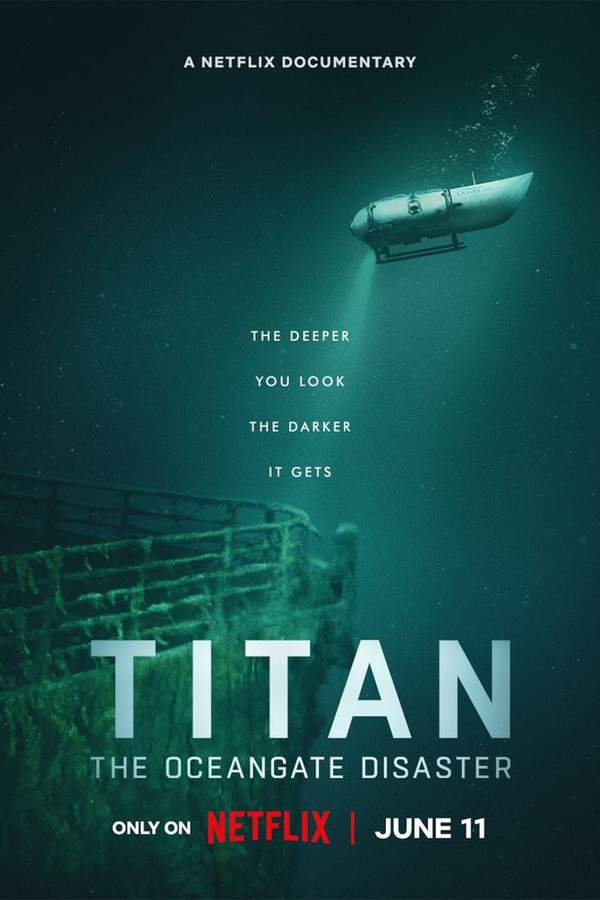
Titan: The OceanGate Disaster 2025


Directed by

Mark Monroe
Made by

Diamond Docs
Where to Watch Titan: The OceanGate Disaster
See current US streaming, rental, and purchase options for Titan: The OceanGate Disaster (2025) via JustWatch.


Streaming availability powered by 
Titan: The OceanGate Disaster Plot Summary
Read the complete plot summary and ending explained for Titan: The OceanGate Disaster (2025). From turning points to emotional moments, uncover what really happened and why it matters.
On 18 June 2023, Titan, a submersible operated by OceanGate, imploded during an expedition to the Titanic wreck site in the North Atlantic off Newfoundland, Canada. Aboard were five people: Stockton Rush, the CEO of OceanGate; Paul-Henri Nargeolet, a renowned French deep-sea explorer; Hamish Harding, a British businessman; Shahzada Dawood, a Pakistani-British businessman; and Dawood’s son, Suleman. The film follows not only the tragedy itself but the series of decisions, ambitions, and warnings that preceded it, drawing on whistleblower accounts, archival footage, Coast Guard hearings, internal audio, and numerous interviews to rebuild OceanGate’s evolution and the choices that culminated in disaster.
The investigation and early reporting form a central thread. Former OceanGate employees—including David Lochridge, the former Director of Marine Operations and the primary whistleblower; Emily Hammermeister, an assistant to the lead engineer; and Tony Nissen, the Director of Engineering—provide firsthand perspectives on the ship and its design. Sydney Nargeolet, Paul-Henri’s daughter, offers testimony as a family member touched by the loss, while investigative journalist Mark Harris from Wired contributes context. The film carefully layers these voices to present a portrait of a company under pressure to deliver groundbreaking experiences while contending with deep concerns about safety and process.
Communication and the moment of loss anchor the timeline. Roughly an hour and a half into the dive, Titan lost contact with its mother ship, MV Polar Prince. As authorities mobilized, the initial fear focused on a dwindling air supply, and a Coast Guard aircraft picked up sounds tied to the search area. After four grueling days, a remotely operated vehicle (ROV) uncovered a debris field near the Titanic, about 500 meters from the bow. The broader search area was informed by naval sonar detecting an acoustic signature consistent with an implosion around the time communications ceased, indicating the pressure hull failed during descent and that all five occupants died instantly.
The official findings frame the broader lesson. The U.S. Coast Guard’s investigation concluded the tragedy was preventable, pinpointing OceanGate’s failure to adhere to established engineering protocols for safety, testing, and maintenance of their submersible. The report also highlighted long-standing practices within the company—intimidation tactics, a permissive approach to scientific work, and a reputation that helped curb regulatory scrutiny. Taken together, these elements cast a stark light on how ambition and a culture of risk can overwhelm rigorous safety standards.
The film digs into the business case, design choices, and mounting tensions. Stockton Rush conceived Titan to commercialize deep-sea exploration, starting with voyages to the Titanic as early as 2011–2018, with ticket prices around six figures. The hull’s carbon fiber design promised lighter weight and lower operating costs but carried serious depth-related risks, especially under the immense pressures of thousands of meters underwater. Early plans featured a partnership with Boeing on a carbon fiber hull, but the collaboration ended after test results signaled a high risk of failure well before Titanic depths.
When Boeing stepped away, OceanGate pushed ahead with in-house engineering. Rush often controlled critical technical decisions, even when concerns were raised by others. A test dive in Cyclops 1, aimed at the Andrea Doria wreck, saw Rush replace the designated pilot at the last moment and proceed into a debris-strewn field, a moment that underscored the precarious balance between leadership risk-taking and crew safety. Lochridge voiced specific worries about the hull and the need for independent inspection and certification, but those concerns sparked anger from Rush, who reacted defensively and sometimes shifted blame.
Whistleblowers and safety data reveal a troubled pattern. Lochridge’s detailed risk report was met with resistance, followed by his departure and later a legal fight with OceanGate over whistleblower protections and labor claims. He eventually faced governmental and legal scrutiny, with results that pointed to insufficient protection for whistleblowers and slow regulatory action. Emily Hammermeister witnessed testing sessions in the Bahamas where the Titan attempted a 4000-meter depth, and a crack, accompanied by loud popping noises at depth, suggested a fragile hull. Despite warnings, development continued, with attempts to refine the hull through multiple iterations and a timeline stretched by COVID-19 disruptions.
The narrative returns to performance and public perception. In 2022, as OceanGate opened up about its operations to the press, the film presents a picture of a safety culture that could be seen as obsessive and defiant, especially given Rush’s role as pilot on many dives and the involvement of Paul-Henri Nargeolet, whose decades of Titanic exploration lent credibility to the project. The crew’s complicated dynamics—earlier tensions, shifting responsibilities, and the pressure to demonstrate success—are shown against the backdrop of mounting technical concerns and a growing disconnect between ambition and verifiable safety.
Ultimately, the film presents a layered, cautionary account. It juxtaposes the awe of deep-sea exploration with the stark realities of engineering risk, corporate pressure, and the human cost of decisions made in pursuit of a vision. Through each interview, archival clip, and investigative detail, the narrative invites viewers to weigh the allure of groundbreaking adventure against the imperative of rigorous safety, transparent testing, and accountability—lessons that extend far beyond a single expedition and into the broader world of extreme exploration.
Titan: The OceanGate Disaster Timeline
Follow the complete movie timeline of Titan: The OceanGate Disaster (2025) with every major event in chronological order. Great for understanding complex plots and story progression.
Boeing partnership yields carbon-fiber hull concept and risk warning
In 2013, OceanGate's collaboration with Boeing produced an initial carbon-fiber hull concept. Boeing concluded there was a major risk of failure well before the Titanic's depth, and the partnership ended. Stockton Rush then moved to pursue in-house engineering for the submersible.
2016: UW APL tests carbon-fiber hull to great depth
The Applied Physics Lab at the University of Washington provided engineering support and tested the carbon-fiber hull to depths of 4100 meters. The tests showed the hull survived but highlighted significant risks and potential failure modes. This fed ongoing safety debates.
2018: Hull concerns lead to firing and whistleblower tensions
Lochridge warned about hull design flaws and demanded independent inspection; Stockton fired him after a detailed risk report. Lochridge's whistleblower complaint and subsequent legal actions against OceanGate followed, with government investigations slow and ultimately inconclusive. The company continued under pressure from internal concerns.
Emily Hammermeister travels to Bahamas amid testing concerns
Emily was sent to the Bahamas where Titan was being tested. The hull popped and cracked as depth increased, confirming earlier warnings. Nissen had warned of this exact risk, but Stockton hid the hull data from public view, and the plan to redevelop the hull continued.
2020: Third-scale model tests reveal ongoing weaknesses
A 3rd scale model was tested in July 2020 and failed at 3000 meters, showing persistent structural weaknesses. Despite repeated failures, Stockton proceeded with building a full-scale hull while the COVID-19 pandemic delayed some activities. The project pressed on with urgency.
2021: First dives to the Titanic prove feasibility
The first dives to the Titanic occurred in 2021 and initial attempts were described as successful. Paul-Henry Nargeolet joined the expedition as a Titanic expert, lending credibility to the venture, while Stockton often piloted dives himself. Public attention grew as early successes framed the project.
2022: Media spotlight highlights safety culture and leadership
In 2022, OceanGate invited the press to cover Operations Season 2 and portrayed a flashy safety culture. The presence of Nargeolet added credibility to the enterprise, but critics noted the growing risk and Stockton's hands-on piloting of many dives. The film documents tensions between ambition and safety.
2023: Dive 80 signals trouble with a loud bang on ascent
On dive 80 in 2023, a loud bang occurred during ascent and the 'pop' noises intensified on subsequent dives. The submersible subsequently failed, signaling a breakdown that would culminate in disaster. The crew faced mounting signs something was wrong.
2023: Communications lost; search and rescue underway
Communications with Titan and the mother ship MV Polar Prince were lost 1 hour 33 minutes into the dive; authorities were alerted when Titan failed to resurface later the same day. A search and rescue effort by the US Coast Guard and others unfolded as air resources and underwater assets were deployed. The urgency to locate survivors dominated the narrative.
2023: Debris field found confirming a catastrophic failure
After four days missing, a remotely operated vehicle discovered a debris field containing Titan components about 500 meters from the Titanic's bow. The United States Navy sonar detected an acoustic signature consistent with an implosion, indicating instantaneous deaths for all five occupants. The tragedy was confirmed.
2023: USCG investigation cites preventable disaster
The US Coast Guard investigation concluded the implosion was preventable and blamed OceanGate's failure to follow established engineering, safety, and maintenance protocols. The report also noted intimidation tactics and regulatory evasion used by the company to avoid scrutiny. The findings highlighted systemic safety failures.
Stockton Rush: leadership style and risky culture
Stockton Rush is portrayed as an arrogant leader who sought to commercialize deep-sea access and wanted to classify the vessel in the Bahamas to sidestep US jurisdiction. He tended to blame others and often took the pilot's seat, putting himself at risk. The film suggests a culture where safety concerns were suppressed.
Economic push: Titanic dives planned with a fixed price
OceanGate had already taken payments from customers for Titan dives and planned to start offering voyages from 2018, with tickets priced at $105,129. The urgency to complete the vessel was driven by business goals and bookings. The timeline shows how commercial aims intersected with safety concerns.
Titan: The OceanGate Disaster Characters
Explore all characters from Titan: The OceanGate Disaster (2025). Get detailed profiles with their roles, arcs, and key relationships explained.
Stockton Rush
OceanGate's chief executive portrayed as an ambitious, sometimes defensive founder who treated safety questions as obstacles to progress. He designed Titan to commercialize deep-sea access and aimed to start Titanic dives as early as 2018. He tended to blame others when pressed on safety, and sought to avoid U.S. oversight by classifying the vessel for operations outside traditional regulatory bounds.
Paul-Henri Nargeolet
A celebrated deep-sea explorer and Titanic expert with numerous dives, invited to OceanGate by Rush to lend credibility to the mission. He had 37 Titanic descents and represented a high level of expertise the project relied upon. His presence added prestige and a sense of authority to the expeditions.
Hamish Harding
British businessman and one of the Titan passengers. He embodies the profile of high-profile participants drawn to extreme deep-sea exploration. His involvement underscores the intersection of wealth, risk, and adventure in these expeditions.
Shahzada Dawood
Pakistani-British businessman and father of Suleman who joined the Titan voyage. His participation highlights the family-money dimension of the project and the allure of unprecedented access to deep-sea exploration.
Suleman Dawood
Shahzada Dawood's son and Titan passenger, whose presence on the mission emphasizes the personal stakes of the expedition. The film frames the voyage as a high-risk, high-profile endeavor affecting families.
David Lochridge
OceanGate's former Director of Marine Operations and the primary whistle-blower. He warned about hull safety and the risks of the design, and he was subsequently targeted by legal action. His efforts illustrate the costs faced by insiders who raise safety concerns.
Emily Hammermeister
Assistant to the OceanGate Lead Engineer who traveled to the Bahamas for Titan testing. She observed test results at depth and reported hull issues, providing a whistleblower-like perspective on the test program.
Tony Nissen
OceanGate Director of Engineering involved in overseeing Titan's engineering. He warned about the risks associated with the hull and is connected to the tension between engineering caution and leadership decisions.
Sydney Nargeolet
Daughter of Paul-Henri Nargeolet, who provided testimony as a victim's family member. Her participation adds a personal and ethical dimension to the narrative surrounding the tragedy.
Mark Harris
Investigative journalist for Wired who contributed reporting on OceanGate and the disaster. He is shown in the film as providing a informed, critical perspective on the company and its safety culture.
Titan: The OceanGate Disaster Settings
Learn where and when Titan: The OceanGate Disaster (2025) takes place. Explore the film’s settings, era, and how they shape the narrative.
Time period
2021–2023
The narrative tracks key developments from initial attempts and tests in the mid-2010s through the first successful dives in 2021, culminating in the 2023 Titan disaster. It weaves in earlier hull developments, regulatory tensions, and whistleblower warnings that shaped the events. The timeline emphasizes the period of rapid escalation in deep-sea tourism and the ultimate implosion in 2023.
Location
North Atlantic Ocean, Titanic wreck site, off the coast of Newfoundland, Canada
The events unfold in the icy depths of the North Atlantic near the Titanic wreck site. The location is remote, extreme, and known for deep-sea exploration of historic shipwrecks. The film centers on a high-stakes expedition that brings luxury-tourism ambitions into the perilous environment of deep ocean pressure.
Titan: The OceanGate Disaster Themes
Discover the main themes in Titan: The OceanGate Disaster (2025). Analyze the deeper meanings, emotional layers, and social commentary behind the film.
⚖️
Ethics
The film critiques the ethics of commercializing dangerous deep-sea travel without robust safety oversight. Whistle-blower accounts illustrate how safety concerns were raised and dismissed in favor of progress and publicity. Investigations cited a culture that prioritized ambition and revenue over established engineering protocols.
🧭
Exploration vs Risk
A central tension is the human drive to push the boundaries of exploration against the tangible risks of cutting corners. The narrative shows how prestige and potential profits can overshadow precautionary checks. The dangers inherent to extreme underwater ventures are laid bare through firsthand accounts and failed tests.
🧰
Engineering Controversy
The carbon fiber hull and its testing are at the heart of the controversy, highlighting debates over material choice, certification, and reliability at extreme depths. The film details multiple test failures, the push to proceed, and concerns raised by engineers that were not fully addressed. It also covers how leadership structure and decision-making affected safety practices.

Coming soon on iOS and Android
The Plot Explained Mobile App
From blockbusters to hidden gems — dive into movie stories anytime, anywhere. Save your favorites, discover plots faster, and never miss a twist again.
Sign up to be the first to know when we launch. Your email stays private — always.
Explore the mobile appTitan: The OceanGate Disaster Spoiler-Free Summary
Discover the spoiler-free summary of Titan: The OceanGate Disaster (2025). Get a concise overview without any spoilers.
In a world where the ocean’s depths still feel like uncharted frontiers, this documentary follows the daring venture of a privately‑run submersible racing toward the legendary wreck of the Titanic. Set against the stark, blue‑black expanse of the North Atlantic, the film immerses viewers in the sleek, experimental craft that promised to democratize deep‑sea tourism while spotlighting the allure—and the peril—of pushing technology to its limits. The tone is simultaneously reverent and uneasy, echoing the awe of historic discovery and the quiet weight of uncertainty that hangs over any extreme undertaking.
At the heart of the story is Stockton Rush, the charismatic founder and chief executive of OceanGate, whose vision for affordable, high‑risk exploration drives the project forward. He is joined by celebrated explorer Paul‑Henri Nargeolet, whose decades of dives lend credibility and gravitas, as well as a cadre of seasoned professionals and would‑be adventurers whose varied motivations range from scientific curiosity to personal ambition. Voices from within the organization, such as former marine‑operations director David Lochridge and engineering assistant Emily Hammermeister, offer an insider’s perspective on the team’s dynamics, while Tony Nissen, the director of engineering, provides a technical lens on the challenges of pioneering new materials. Independent voices like investigative journalist Mark Harris weave external commentary into the narrative, sharpening the film’s probing edge.
Through archival footage, coast‑guard recordings, and candid interviews, the documentary crafts a tension‑filled portrait of modern exploration. It balances the exhilaration of venturing into a realm few have seen with a sober contemplation of the responsibilities that accompany such ambition. The resulting mood is one of quiet suspense, inviting the audience to ponder how far humanity should reach when the ocean itself becomes both a frontier and a reminder of our vulnerability.
Movies with Similar Twists and Themes
Uncover films that echo the narrative beats, emotional arcs, or dramatic twists of the one you're exploring. These recommendations are handpicked based on story depth, thematic resonance, and spoiler-worthy moments — perfect for fans who crave more of the same intrigue.

Featured on this page

What's After the Movie?
Not sure whether to stay after the credits? Find out!
Check out our other apps:

SAT Sphere
Build confidence for the Digital SAT.

Mori Atlas
Discover wild places worth protecting.

Luntero
Search smarter for a home in Amsterdam.

Plot Explained
Unravel movie endings and hidden clues.

Pokechamp
Dive into Pokémon data and battle logic.

Driving Theory
Get ready for your European theory test.

Movie Dust
Plan your next cinema trip with ease.

Musemap
Find art and culture as you travel.

Selkobase
Compare credentials before committing.

Local Manual
Turn an unfamiliar country into practical next steps.

Lernavi
Compare school systems before your next move.

GymRoam
Find a workout stop wherever your plans take you.
Explore Our Movie Platform
New Movie Releases (2026)
Famous Movie Actors
Top Film Production Studios
Movie Plot Summaries & Endings
Major Movie Awards & Winners
Best Concert Films & Music Documentaries
Movie Collections and Curated Lists
© 2026 What's After the Movie. All rights reserved.
Privacy Policy