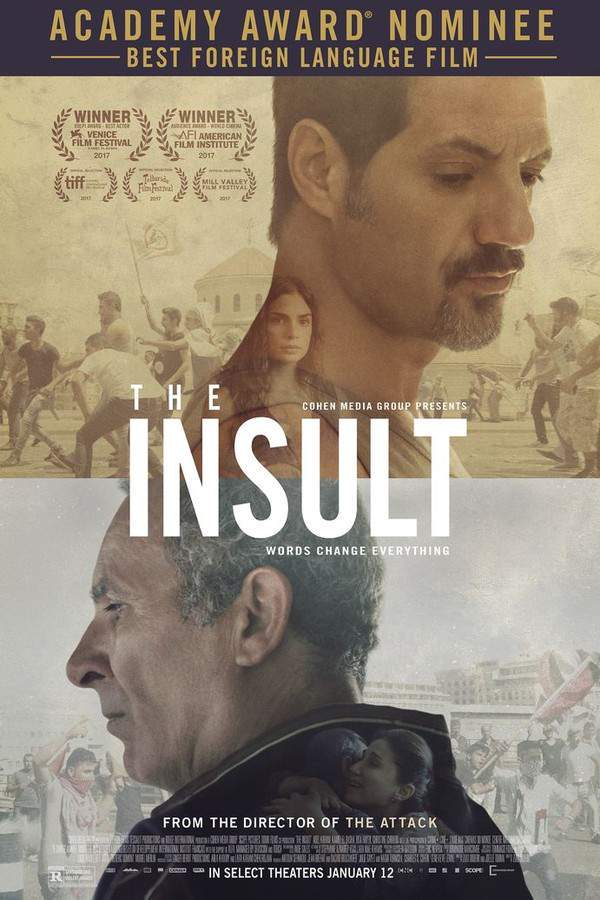
The Insult 2018


Directed by

Ziad Doueiri
Made by

Cohen Media Group
Where to Watch The Insult
See current US streaming, rental, and purchase options for The Insult (2018) via JustWatch.









The Insult Plot Summary
Read the complete plot summary and ending explained for The Insult (2018). From turning points to emotional moments, uncover what really happened and why it matters.
Tony Hanna is a Lebanese Christian and a devoted member of the Lebanese Forces, living with his pregnant wife, Shirine Hanna. From the start, his world is defined by a strict sense of order around his property: he doesn’t want workers near Shirine, especially when she is at home, and he notices contractors tinkering with the gutter on his balcony. In a burst of anger, he smashes the gutter, an act that triggers a chain of clashes and harsh judgments. The worker involved, Yasser Abdallah Salameh, dubs him a “fucking prick,” a moment that crystallizes the deep-seated tension between Tony’s world and the realities of a divided country. Tony instantly recognizes Yasser by his Palestinian accent, and his daily life becomes entangled with anti-Palestinian propaganda and a growing wish that Palestinians would leave the country. Though the balcony work violated building codes, Tony’s demand for an apology escalates the incident rather than defusing it.
The confrontation spills into the legal arena. The employers bring Yasser to Tony’s garage to offer a personal apology, but a recorded speech by Christian leader Bachir Gemayel interrupts what feels like a path toward reconciliation. In a311 moment of provocation, Tony expresses a violent, sweeping thought about Ariel Sharon’s supposed plan to exterminate Palestinians, which triggers a brutal punch from Yasser that leaves Tony with two fractured ribs. The incident becomes a lawsuit, and Tony chooses to represent himself with determination, hoping to win restitution and vindication.
The courtroom drama is caught between passion and evidence. When neither Tony nor Yasser can repeat the exact words Tony used about Sharon, the case is dismissed for inconclusive evidence by Judge Chahine. Tony erupts, accusing the judiciary of corruption and bias, and is removed from the courtroom, vowing to appeal. The physical strain of the day weighs on him; he collapses, Shirine rushes to his side, and soon she gives birth. The baby’s condition becomes dire, placed on life support, a consequence the family attributes to the contractions Shirine experienced during the shock of the assault. The trial is put on hold and reopens with the risk of manslaughter for Yasser if the child dies.
In this fragile moment, a new advocate enters the picture. Wajdi Wehbe, a pro-Christian attorney who carries memories of the Lebanese Civil War, takes on Tony’s case, while Wajdi’s daughter, Nadine Wehbe, with a less vivid memory of the conflict, represents Yasser. The dynamics of litigation shift as the courtroom becomes a stage for wounded histories and competing interpretations of what constitutes harm, responsibility, and speech. Tony’s remarks about Sharon are now presented in the courtroom again, but this time the argument centers on emotional distress provoked by the actions of others, and the broader trauma of a nation still healing from civil conflict. It is revealed that Shirine has a history of miscarriages, adding a personal dimension to the legal and emotional stakes. The case and the public discourse it fuels rekindle memories of the civil war, sparking clashes on the streets between Christians and Muslims and exposing the fault lines that still run through everyday life.
Throughout the retrial, Wajdi emphasizes a distinction between private thoughts and public action, contending that Tony’s words, however controversial, reflect private expression rather than intent to incite violence or libel. The defense strategy leans on freedom of thought, while the prosecution emphasizes the real-world harm caused by inflammatory statements in a charged environment. As the courtroom case unfolds, researchers and witnesses uncover a deeper, more personal history: Tony was born in Damour in 1970 and left in January 1976, making him a Damour refugee who survived a massacre with help from PLO units. This revelation, kept hidden from Tony’s legal team, is shown in documentary footage that Wajdi reveals in the courtroom, breaking Tony down with the weight of memory.
A pivotal confrontation occurs when Yasser and Tony meet again; Yasser claims that Christian suffering in the civil war was minor compared to Palestinian suffering, and Tony responds with a punch, prompting a sincere apology from Yasser. As the legal and emotional battles continue, Shirine and Tony’s child begin to recover, and the mood in the courtroom shifts from outright hostility to a tentative, fragile possibility of reconciliation. When the final verdict arrives, the judges declare Yasser not guilty of assault. The drama closes with a quiet, human moment: the two men exchange a wary smile and part ways, hinting at a future where past wounds might soften, even if the present remains complex and unresolved.
The Insult Timeline
Follow the complete movie timeline of The Insult (2018) with every major event in chronological order. Great for understanding complex plots and story progression.
Balcony gutter incident and insult
Tony discovers workers modifying the gutter on his balcony and smashes it in anger. He identifies the contractor Yasser by his Palestinian accent and grows hostile toward Palestinians after consuming anti-Palestinian propaganda. The confrontation establishes Tony's deep-seated bias and sets the stage for the feud.
Apology in the garage and assault
The employers bring Yasser to Tony's garage to apologize in person. After hearing Bachir Gemayel's recorded speech, Yasser begins to leave; Tony states he wishes Ariel Sharon had exterminated all Palestinians. Yasser punches Tony, breaking two ribs.
First court case dismissed
Tony represents himself and sues Yasser, but the judge dismisses the case for inconclusive evidence since neither man can repeat Tony's remark. Tony shouts the judge is corrupt and biased and is removed from the courtroom, vowing to appeal.
Collapse and birth
Tony collapses in the wake of the courtroom setback; Shirine helps him up, and she later gives birth. The newborn is placed on life support due to contractions and the emotional shock of the assault.
Retrial begins and risk
The case goes to retrial with heightened stakes, as Yasser risks guilt of manslaughter if the child dies. The courtroom atmosphere grows tense as the families face potential tragedy.
New representation and emotional arguments
Wajdi Wehbe becomes Tony's new representative while Nadine Wehbe handles Yasser's case. In court, Tony's comments about Sharon are introduced, along with Shirine's miscarriages, arguing emotional distress.
Civil war memories ignite clashes
Courtroom debates trigger memories of Lebanon's civil war, fueling street clashes between Christians and Muslims outside. The tension escalates as Tony becomes linked to pro-Sharon stances and receives death threats.
Damour origins revealed
During background research, Wajdi learns Tony was born in Damour in 1970 and fled in 1976 during the Damour massacre. He reveals this by showing documentary footage in the courtroom, and Tony breaks down.
Meeting and renewed tension
Tony and Yasser eventually meet; when Yasser repeats that Christian suffering is minor compared to Palestinian suffering, Tony punches him again and Yasser apologizes. The moment deepens the rift yet hints at unresolved feelings.
Family recovery
Shirine and the child recover from the earlier crisis; the family begins to regain stability as the life-support situation stabilizes. The tenderness of their resilience provides a counterpoint to the courtroom drama.
Not guilty verdict for Yasser
Back in court, the judges find Yasser not guilty of assault. The verdict comes as memories of the war loom over the proceedings and the public mood grows more volatile.
Final reconciliation
In the closing moments, Tony and Yasser exchange a faint smile before parting, suggesting a fragile, uneasy reconciliation amid the lingering shadows of Lebanon's civil conflict.
The Insult Characters
Explore all characters from The Insult (2018). Get detailed profiles with their roles, arcs, and key relationships explained.
Tony Hanna (Adel Karam)
A hot-tempered Lebanese Christian and devoted member of the Lebanese Forces, Tony’s privileged position clashes with his prejudice against Palestinians. His impulsive outburst sets off a complex legal battle that dredges up personal and communal traumas. Throughout the story, his instincts for control are challenged by the consequences of his words and actions.
Shirine Hanna
Tony’s pregnant wife, whose collapse and the baby’s life-or-death condition intensify the stakes of the case. She embodies the personal cost of public conflict and becomes a touchstone for family resilience amid legal and social turmoil.
Yasser Abdallah Salameh
A Palestinian refugee whose confrontation with Tony escalates into violence. His perspective highlights the human impact of prejudice and the fragility of promises for safety and dignity in a divided society.
Wajdi Wehbe
Tony’s new representative, a pro-Christian lawyer with deep memories of the Civil War. He uses historical footage to frame the case and argues for expanding the interpretation of Tony’s statements beyond intent.
Nadine Wehbe
Wajdi’s daughter, who has less memory of the war and serves as a foil to the older generation’s trauma. Her presence contrasts personal history with evolving attitudes toward conflict.
Judge Chahine
A courtroom judge who dismisses the initial case for inconclusive evidence, later tied to the retrial. His rulings reflect the pressures of public opinion and the limits of legal proof in a charged atmosphere.
Judge Colette Mansour
A second judge whose presence frames the retrial and the ongoing debate over whether Tony’s statements constitute libel or protected thought. Her decisions frame the balance of truth and consequence in the courtroom.
Manal Salameh
A member of the Salameh family whose role in the case sheds light on social ties and the personal networks that influence legal battles in Lebanon.
Samir Geagea
A real-world political figure whose appearance in the courtroom backdrop heightens the stakes of sectarian politics and the way history is used in present-day conflicts.
The Insult Settings
Learn where and when The Insult (2018) takes place. Explore the film’s settings, era, and how they shape the narrative.
Time period
Late 2010s
The action takes place in contemporary Lebanon, with memory of the civil war seeping into every argument and courtroom exchange. Flashbacks and documentary footage reference events from the 1970s through the 1990s, informing characters' fears and loyalties. The period setting emphasizes how past traumas influence present-day disputes and media narratives. The legal drama unfolds in a modern era where words have real consequences.
Location
Beirut, Damour, Lebanon
The story unfolds across modern Lebanon, centered on Beirut and the coastal town of Damour, places shaped by a history of sectarian conflict yet alive with everyday life. The urban setting features courts, streets, and homes where Christian and Muslim communities intersect. Damour's memory of past violence and the broader Lebanese Civil War looms over present-day disputes, coloring perceptions and reactions. The film uses these locations to juxtapose intimate domestic life with public political tensions.
The Insult Themes
Discover the main themes in The Insult (2018). Analyze the deeper meanings, emotional layers, and social commentary behind the film.
⚖️
Justice
The case tests whether the legal system can deliver fairness when personal grievances and collective memories color perception. Tony and Yasser’s testimonies reveal how emotion, bias, and misinterpretation shape what counts as evidence. The courtroom becomes a battleground where private insults and public loyalties collide. The film questions whether truth and accountability can coexist with long-standing sectarian tensions.
🕊️
Memory of War
The narrative shows how civil war memories haunt present-day identities, influencing loyalties, mistrust, and political rhetoric. Wajdi’s reminiscences of the Lebanese Civil War surface in courtroom strategy and personal memory, while younger characters like Nadine process history differently. The Damour massacre and refugee experiences illuminate how trauma is carried forward. The plot uses memory as a force that can both inflame and humanize conflict.
🗣️
Freedom of Thought
The dialogue surrounding Tony’s controversial remarks tests the boundaries between private belief and public accountability. The film examines whether expressing a dangerous sentiment is protected as free thought, or whether it becomes incitement when it triggers violence. Characters debate the impact of words on real lives, including the safety of individuals and communities. The courtroom struggle frames speech as a political instrument with consequences.

Coming soon on iOS and Android
The Plot Explained Mobile App
From blockbusters to hidden gems — dive into movie stories anytime, anywhere. Save your favorites, discover plots faster, and never miss a twist again.
Sign up to be the first to know when we launch. Your email stays private — always.
Explore the mobile appThe Insult Spoiler-Free Summary
Discover the spoiler-free summary of The Insult (2018). Get a concise overview without any spoilers.
In modern‑day Beirut, the city’s bustling streets pulse with a quiet, ever‑present tension between its many communities. The film opens on a tightly ordered neighborhood where a small, everyday disagreement between a Lebanese Christian contractor and a Palestinian refugee quickly becomes a mirror for the country’s deeper fissures. Tony Hanna, a devout member of the Lebanese Forces, lives with his pregnant wife Shirine Hanna, while Yasser Abdallah Salameh, a worker with a distinctive accent, navigates the precarious existence of refugees in the capital.
Both men carry personal histories that shape their outlooks: Tony is rooted in a worldview shaped by his community’s longing for stability, whereas Yasser embodies the lingering grievances of a displaced people. Their clash, sparked by a seemingly minor incident, spirals into a public controversy that draws the attention of neighbors, journalists, and the legal system. As the dispute moves from the balcony to the courtroom, Wajdi Wehbe, a seasoned attorney with memories of the civil war, steps in to represent one side, while his daughter, an aspiring lawyer, finds herself on the opposite bench, highlighting how the next generation inherits the unresolved wounds of the past.
The film’s tone is a measured blend of quiet observation and simmering intensity, using tight framing and the clamor of Beirut’s streets to create a backdrop where personal and collective anxieties intersect. Through nuanced performances, the story explores how ordinary lives are forced to confront prejudice, justice, and the weight of history without resorting to sensationalism. The narrative invites the audience to linger on the fragile possibility of understanding amid a society still grappling with the echoes of its own divisions.
Movies with Similar Twists and Themes
Uncover films that echo the narrative beats, emotional arcs, or dramatic twists of the one you're exploring. These recommendations are handpicked based on story depth, thematic resonance, and spoiler-worthy moments — perfect for fans who crave more of the same intrigue.





Featured on this page

What's After the Movie?
Not sure whether to stay after the credits? Find out!
Check out our other apps:

SAT Sphere
Build confidence for the Digital SAT.

Mori Atlas
Discover wild places worth protecting.

Luntero
Search smarter for a home in Amsterdam.

Plot Explained
Unravel movie endings and hidden clues.

Pokechamp
Dive into Pokémon data and battle logic.

Driving Theory
Get ready for your European theory test.

Movie Dust
Plan your next cinema trip with ease.

Musemap
Find art and culture as you travel.

Selkobase
Compare credentials before committing.

Local Manual
Turn an unfamiliar country into practical next steps.

Lernavi
Compare school systems before your next move.

GymRoam
Find a workout stop wherever your plans take you.
Explore Our Movie Platform
New Movie Releases (2026)
Famous Movie Actors
Top Film Production Studios
Movie Plot Summaries & Endings
Major Movie Awards & Winners
Best Concert Films & Music Documentaries
Movie Collections and Curated Lists
© 2026 What's After the Movie. All rights reserved.
Privacy Policy