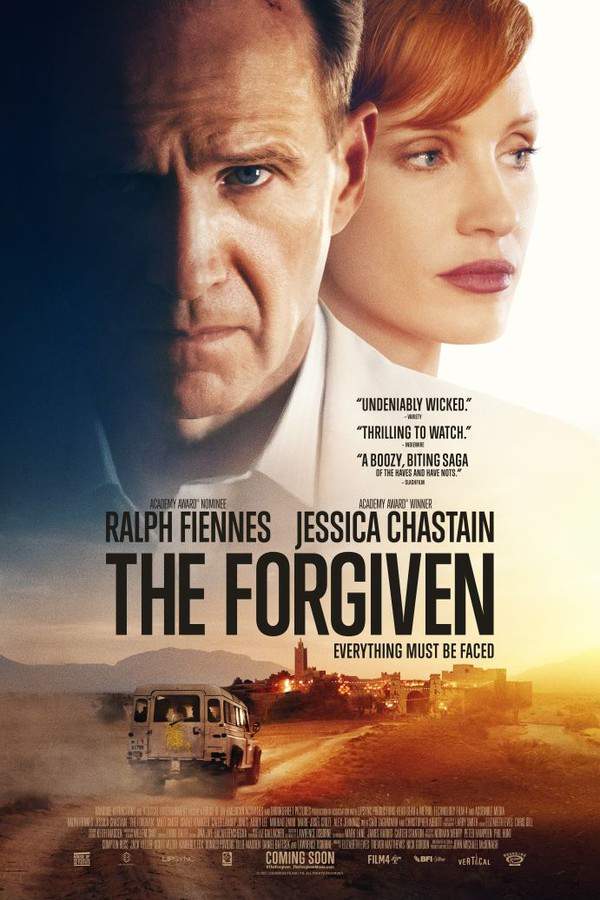
The Forgiven 2018


Directed by

Roland Joffé
Made by

Saban Films
Where to Watch The Forgiven
See current US streaming, rental, and purchase options for The Forgiven (2018) via JustWatch.

Amazon Prime Video
HD
Amazon Prime Video with Ads
HD
Lionsgate+ Amazon Channels
HD
Amazon Prime Video Free with Ads
HD
Fandango at Home Free
HD
The Roku Channel
HD
Tubi TV
SD
Amazon Video
HD
Apple TV Store
HD Fandango At Home
HD
Google Play Movies
SD
YouTube
SD Streaming availability powered by 
The Forgiven Plot Summary
Read the complete plot summary and ending explained for The Forgiven (2018). From turning points to emotional moments, uncover what really happened and why it matters.
In the wake of apartheid, Desmond Tutu leads the Truth and Reconciliation Commission and travels to Pollsmoor Maximum Security Prison to meet Piet Blomfeld, an ex-security police officer and Afrikaner Weerstandsbeweging member, to assess his candidacy for amnesty. The film follows Blomfeld as a potential witness to murders from the era, including the tragedy surrounding the teenage daughter of Mrs. Morobe, who pleads for answers and closure. Blomfeld initially shows little remorse, using the early encounters to hurl insults at the Archbishop and to project defiance rather than confession. Yet a pivotal moment arrives when the Archbishop presents a photograph of a young black girl from Blomfeld’s file and reminds him that he is trapped in two prisons—the one outside and the one inside his own heart—sparking a slow, unsettling shift in his attitude.
Francois Schmidt, Blomfeld’s fellow officer and fellow participant in the brutal acts of the past, launches a desperate bid to silence Blomfeld by hiring a black gang to kill him. Blomfeld, moved by the Archbishop’s words, spares the life of the prisoner sent to execute him and earns a surprising degree of respect from the gang, who ultimately tell Schmidt to fight his own battles. During this tense period, Blomfeld also forms a fragile bond with the prisoner named Benjamin, adding a layer of complexity to his evolving stance. The tension intensifies as Howard Varney(/actor/rob-gough) discusses Blomfeld’s past with [Mrs. Van der Berghe] but learns more about the insinuations of his childhood—how Piet once had a friend, a young girl, whose fate is tangled with his own family history. Blomfeld’s backstory unfolds further when it’s revealed that his father, Rian, did not approve of that friendship and murdered the girl and her family before leaving Blomfeld with a brutal beating that damaged his arm. The Blomfeld family later relocated to Zimbabwe, and the murders of the rest of his relatives appear to be retaliatory acts linked to Rian’s crimes.
As the narrative advances, Blomfeld reaches a turning point and decides to confess, summoning the Archbishop to witness his admission. In a dramatic turn, Schmidt orders a lockdown and then attacks Blomfeld with riot troopers; Blomfeld is beaten to death, yet he has managed to transmit an audio confession detailing the murder of Mrs. Morobe’s daughter and her boyfriend, a confession that is later played at the Truth and Reconciliation Commission. Blomfeld also leaves Benjamin with what little money remains in his account, a quiet gesture toward care for someone he once mistreated. The revelation ripples through the room as Mrs. Morobe confronts Hansi Coetzee, another participant in her daughter’s murder, and ultimately finds a path to forgiveness.
The story then returns to the Archbishop’s circle of understanding as Linda Coetzee(/actor/debbie-sherman) meets him, offering thanks for his work and admitting that she had not wanted to face what her husband had done. This moment of acknowledgment underscores the film’s central tension between accountability and mercy, memory and healing. In the closing sequence, the Archbishop and his wife visit the beach he had cherished as a child, a poignant reminder of a life that has begun to integrate into a broader, more hopeful reality. Boldly, quietly, the film closes on a note that forgiveness and reconciliation can coexist with overwhelming truth, and that personal and collective histories can begin to move toward a more inclusive future.
The Forgiven Timeline
Follow the complete movie timeline of The Forgiven (2018) with every major event in chronological order. Great for understanding complex plots and story progression.
Archbishop assesses Blomfeld for amnesty
Archbishop Desmond Tutu opens the Truth and Reconciliation Commission in Pollsmoor Prison to evaluate Blomfeld’s suitability for amnesty. The exchange frames truth-telling and accountability as the path to healing rather than mere punishment. Blomfeld’s future hinges on whether he can reveal his actions with candor under the Commission's scrutiny.
Blomfeld resists accountability
Blomfeld greets the Archbishop with scorn, using insults and showing little remorse for his crimes. He resists probing questions and tries to maintain control of the interview. The confrontation highlights the moral tension at the heart of the amnesty process.
The photo and the two prisons
The Archbishop shows Blomfeld a photo of the young black girl and explains the concept of two prisons—the physical jail and the prison within oneself. The image unsettles Blomfeld and sparks a moment of self-reflection. It marks a turning point in his willingness to confront the truth.
Blomfeld earns respect and bonds with a prisoner
Blomfeld spares the life of a fellow prisoner sent to kill him and, in doing so, earns the reluctant respect of a black gang. He also forms a fragile bond with a prisoner named Benjamin. This shift alters the prison’s dynamics and hints at potential reconciliation beyond violence.
Varney investigates Blomfeld’s past
Howard Varney speaks with Mrs. Van der Berghe, who knew Blomfeld as a child. She reveals that Blomfeld once had a friend who was a young black girl and recounts the brutal acts of her father, Rian, which led to deeper family tragedy. The interview provides crucial context for understanding Blomfeld’s current testimony.
Blomfeld’s past exposed: Zimbabwe years
The backstory unfolds: Blomfeld’s father, Rian, murders the girl and her family, and Blomfeld is beaten. The family later moves to Zimbabwe, where further violence shapes his history. The revelation explains the long shadow of guilt that haunts him.
Blomfeld decides to confess
Blomfeld decides to confess and calls the Archbishop, signaling a shift toward truth-telling. He records his thoughts privately for the sake of the TRC. The decision marks a dramatic turn from denial toward accountability.
Schmidt orders a prison lockdown and attack
Francois Schmidt schemes to eliminate Blomfeld by coordinating with riot troopers to attack him during lockdown. The plan escalates the tension inside the prison as security forces close in. The confrontation foreshadows the violence that will follow Blomfeld’s confession.
Blomfeld is beaten to death
During the assault, Blomfeld is beaten to death by riot troopers after his decision to confess. His death cuts short his pursuit of amnesty, even as his recorded confession remains in play. The violence underscores the brutal costs of the apartheid era’s legacy.
Audio confession broadcast to the TRC
An audio recording of Blomfeld confessing to the murder of Mrs. Morobe’s daughter and her boyfriend is sent and later played to the Truth and Reconciliation Commission. The revelation forces the Commission to reckon with the full scope of past crimes. The confession becomes a focal point of the proceedings.
Forgiveness comes for Mrs. Morobe
Mrs. Morobe confronts Hansi Coetzee, one of the perpetrators of her daughter's murder, and ultimately forgives him. The act of forgiveness embodies the restorative aim of the Commission. It is presented as a moment of healing within a long shadow of violence.
Linda Coetzee thanks the Archbishop
Linda Coetzee meets the Archbishop and expresses gratitude for his work, acknowledging the difficult truths that have been faced. She embodies a personal resolution amid national reconciliation. The encounter underscores the human cost behind the legal and moral debates.
Final scene: beach and integration
The Archbishop and his wife visit the beach he had fretted about as a child, now symbolizing a society that has moved toward integration. The film closes on a note of cautious hope, with personal and national healing intertwined. The setting reinforces the film’s themes of forgiveness and social unity.
The Forgiven Characters
Explore all characters from The Forgiven (2018). Get detailed profiles with their roles, arcs, and key relationships explained.
Desmond Tutu (Forest Whitaker)
The Archbishop and head of the Truth and Reconciliation Commission, Tutu embodies moral authority and compassion. He seeks a path to truth with patience, guiding Blomfeld toward confession while offering resilience to victims seeking answers. His presence foregrounds reconciliation as a collective, spiritual project rather than a purely legal process.
Piet Blomfeld (Eric Bana)
An ex security police officer and member of a far right faction, Blomfeld is initially defiant and coarse. Through the Archbishop s dialogue and the weight of the past, he moves toward confession and a fragile shift in loyalty, even as he faces a violent confrontation in the prison.
Mrs. Morobe
The mother of a murdered girl, she embodies grief and insistence on answers. She confronts the trauma of losing her daughter and seeks accountability, but also grapples with the possibility of forgiveness.
Linda Coetzee (Debbie Sherman)
Linda is the widow of the man involved in the crimes. She expresses relief and gratitude toward the Archbishop for guiding the truth process and acknowledges that she did not want to face the full extent of her husband s actions until confronting it in the commission.
Francois Schmidt (Jeff Gum)
A fellow officer and party to the murders, Schmidt attempts to manipulate the system by paying off a black gang to kill Blomfeld. His role highlights the callousness that obscured accountability, and his arc ends in violent conflict with the truth.
Benjamin
An inmate who forms a sort of bond with Blomfeld, representing a glimmer of humanity within the prison walls. His interactions underscore the possibility of connection even among those who have committed grave crimes.
Howard Varney (Rob Gough)
A member of the Truth and Reconciliation Commission who investigates Blomfeld s past. Varney discovers the backstory of Blomfeld along with the girl in the photograph, contributing to the slow uncoupling of silence and pretense.
Mogomat (Osbert Solomons)
A fellow inmate who occupies space within the prison world. His presence helps to populate the environment of the Truth and Reconciliation conversations and the pressure cooker of the institution.
Kruger (Warrick Grier)
A prison figure who appears in the broader security context of the story. His appearance contributes to the tension and the eventual confrontation with the past.
The Forgiven Settings
Learn where and when The Forgiven (2018) takes place. Explore the film’s settings, era, and how they shape the narrative.
Time period
1990s
The events occur in the post apartheid era in South Africa, during the Truth and Reconciliation Commission period. Cape Town and its prison system are undergoing a transition from retribution toward healing and accountability. The narrative emphasizes memory, confession, and the possibility of forgiveness within a society trying to reconcile its brutal past.
Location
Pollsmoor Maximum Security Prison, Cape Town; Cape Town beaches
The film unfolds primarily within Pollsmoor Prison in Cape Town, a real maximum security facility known for housing high risk inmates during the apartheid era and after. It also moves to the surrounding Cape Town area, including a beach that the Archbishop visits at the end, symbolizing openness and reconciliation. The setting contrasts stark institutional spaces with the open, healing landscape of the coast, highlighting the space for moral reckoning.
The Forgiven Themes
Discover the main themes in The Forgiven (2018). Analyze the deeper meanings, emotional layers, and social commentary behind the film.
🕊️
Forgiveness
Forgiveness drives the central transformation of the film as the Archbishop encourages Blomfeld to own his crimes and seek absolution. The story shows how mercy can coexist with accountability, enabling victims to confront pain while offering a path to healing. The resolution hinges on the power of apology and the possibility of grace between enemies.
⚖️
Accountability
The Truth and Reconciliation framework casts a light on accountability beyond punishment. Blomfeld's eventual confession and the use of his audio recording illustrate how truth can surface through personal confrontation and collective memory. The narrative juxtaposes legal processes with moral responsibility.
🧭
Memory
Memory functions as a moral compass, recalling past violence and the people affected by it. The photograph of the young girl and the stories of families haunt the present, forcing characters to face what has been forgotten or denied. The film uses memory to reframe guilt, forgiveness, and the possibility of reconciliation.

Coming soon on iOS and Android
The Plot Explained Mobile App
From blockbusters to hidden gems — dive into movie stories anytime, anywhere. Save your favorites, discover plots faster, and never miss a twist again.
Sign up to be the first to know when we launch. Your email stays private — always.
Explore the mobile appThe Forgiven Ending Explained
Unravel the ending of The Forgiven (2018) with our detailed explanation. Understand the final scenes, character fates, and unresolved questions.
The ending of The Forgiven is haunting and thought-provoking. After the tense journey to Abdellah’s village, David has a moment of emotional connection and regret, which temporarily shifts his attitude toward the locals. He shows a rare act of kindness by giving Abdellah’s son money, symbolizing a break from his usual selfishness. However, just as the story seems to find a flicker of empathy or redemption within David, tragedy strikes unexpectedly. On the way back to the resort, David is confronted by the same boy who witnessed his involvement in his brother’s death. Instead of forgiving him, the boy, overwhelmed by anger and loss, shoots and kills David right there on the road. This brutal act serves as a stark reminder of the irreversible consequences of one’s actions and the deep-seated pain that transcends superficial conflicts. The film’s powerful conclusion underscores the randomness and cruelty of life, illustrating how privilege and indifference can be shattered in a moment, leaving only the harsh reality behind. It leaves viewers with a haunting reflection on morality, guilt, and the elusive nature of redemption, emphasizing that sometimes, justice can come in the most unexpected and tragic form.
The Forgiven Spoiler-Free Summary
Discover the spoiler-free summary of The Forgiven (2018). Get a concise overview without any spoilers.
In a remote town where a centuries‑old church stands as both sanctuary and battlefield, a sudden, violent siege shatters the fragile peace. The atmosphere crackles with dread and an unmistakable sense of urgency, as echoing gunfire and looming shadows turn sacred space into a crucible of survival. The film’s visual tone leans heavily on stark lighting and claustrophobic composition, emphasizing the thin line between order and chaos that everyone inside must walk.
At the heart of the turmoil is Lieutenant Morgan, a seasoned officer whose calm authority is tested by the unpredictable nature of the crisis. He must marshal a disparate team, balancing tactical discipline with the raw desperation that bubbles beneath the surface. His leadership is both a anchor and a catalyst, forcing each member to confront their limits while searching for a path through the turmoil.
Among the trapped civilians, James finds himself standing at a crossroads, his instinct to flee clashing with a deeper, unspoken drive to stay and fight for something greater than himself. His internal struggle is mirrored by the surrounding panic, and his choices ripple outward, influencing those around him in subtle but powerful ways.
Beside him, Elizabeth embodies fierce resolve, her protective instincts propelling her into the heart of danger. Her determination to safeguard James and the others creates a tense, often tender dynamic that underscores the human capacity for courage when faced with overwhelming odds. Together, the trio and the wider group must navigate a maze of uncertainty, each obstacle amplifying the stakes and revealing hidden strengths. The film sustains an atmosphere of relentless tension, inviting the audience to wonder how far conviction can carry a person when the walls are closing in and every decision may be the difference between hope and despair.
Movies with Similar Twists and Themes
Uncover films that echo the narrative beats, emotional arcs, or dramatic twists of the one you're exploring. These recommendations are handpicked based on story depth, thematic resonance, and spoiler-worthy moments — perfect for fans who crave more of the same intrigue.


Featured on this page

What's After the Movie?
Not sure whether to stay after the credits? Find out!
Check out our other apps:

SAT Sphere
Build confidence for the Digital SAT.

Mori Atlas
Discover wild places worth protecting.

Luntero
Search smarter for a home in Amsterdam.

Plot Explained
Unravel movie endings and hidden clues.

Pokechamp
Dive into Pokémon data and battle logic.

Driving Theory
Get ready for your European theory test.

Movie Dust
Plan your next cinema trip with ease.

Musemap
Find art and culture as you travel.

Selkobase
Compare credentials before committing.

Local Manual
Turn an unfamiliar country into practical next steps.

Lernavi
Compare school systems before your next move.

GymRoam
Find a workout stop wherever your plans take you.
Explore Our Movie Platform
New Movie Releases (2026)
Famous Movie Actors
Top Film Production Studios
Movie Plot Summaries & Endings
Major Movie Awards & Winners
Best Concert Films & Music Documentaries
Movie Collections and Curated Lists
© 2026 What's After the Movie. All rights reserved.
Privacy Policy