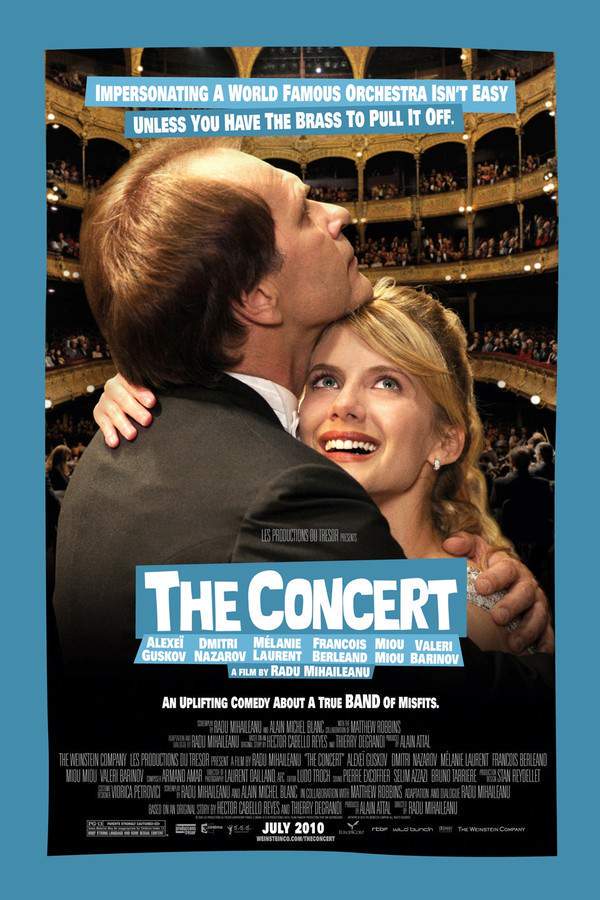
The Concert 2010

Directed by

Radu Mihaileanu
Made by

Weinstein Company, The
Where to Watch The Concert
See current US streaming, rental, and purchase options for The Concert (2010) via JustWatch.




Streaming availability powered by 
The Concert Plot Summary
Read the complete plot summary and ending explained for The Concert (2010). From turning points to emotional moments, uncover what really happened and why it matters.
Andrey Simonovich Filipov is a former world‑famous conductor of the Bolshoi Theatre orchestra, once at the pinnacle of his craft, who fell from grace after standing up for Jewish musicians and was publicly discredited during the Brezhnev era. The fallout left him working as a janitor in the same theatre he once ruled, and his career spiraled into alcoholism. When fate drops a last‑chance opportunity into his lap, he seizes it with a plan that could restore his old glory: reunite his long‑disbanded ensemble, a group of Jewish and Gypsy musicians now eked out in menial jobs, to perform in Paris and finish the long‑delayed realization of Tchaikovsky’s Violin Concerto.
The invitation arrives as a lifeline from the prestigious Théâtre du Châtelet in Paris, where a canceled Los Angeles Philharmonic concert has left a gap that Filipov believes only his reconstructed orchestra can fill. To make the scheme work, he enlists the unexpected aid of a former KGB agent, Ivan Gavrilov, who becomes the orchestra’s manager and executes the plan with cold efficiency. But Gavrilov’s so‑called help is veiled with his own ambitions, unsettling the orchestra’s principal cellist, [Sasha Abramovich Grossman]—a detail that hints at hidden agendas behind the Paris project.
The plan hinges on one dramatic condition: the solo violinist will be Anne-Marie Jacquet, a virtuoso who has never played the concerto because she fears it. She has long dreamed of performing it with the Bolshoi, and especially under Filipov’s baton, whose renown outside Russia remains strong. Anne‑Marie’s agent, Guylène de La Rivière, is wary due to Filipov’s controversial past, but she yields to the inevitability of the moment when the opportunity aligns with Anne‑Marie’s deepest aspirations. The ensemble also agrees to a provocative sponsorship from a Russian mafia boss who wants to join the orchestra, bringing an unsettling edge to the musical project as a whole.
Arriving in Paris, the orchestra swiftly abandons discipline for life’s everyday rhythms, melting away into taxi driving, moving, and translation work as party atmospheres replace rehearsals. Anne‑Marie’s initial sense that the project is more about Filipov’s catharsis than a true artistic comeback grows stronger, and she begins to pull away. Yet La Rivière appeals to a more personal motive: the concert holds a key to Anne‑Marie’s past and to her missing parents, scientists who disappeared in the Alps when she was a child. The story digs deeper, uncovering that Filipov and his wife Irina were close friends with Lea and Yitzhak Strum, an accomplished violinist and the original soloist in the interrupted Moscow concert. Lea’s life after the humiliation she and her husband faced under the regime spiraled into tragedy, and her memory becomes a powerful force driving the Paris performance.
In a backstory that gradually comes to light, Lea—Anne‑Marie’s mother—lost her sanity after those years, clinging to the imagined cadence of the concerto until her death in 1981, while her husband died soon after. Guylène’s escape with baby Anne‑Marie hidden in a cello case becomes a pivotal thread that ties the present to the past, revealing the way survival and memory intersect in art. The revelation reframes the Paris concert as not merely a comeback, but a chance to honor Lea’s memory and the generations of musicians who suffered for their truth.
On the night of the performance, the orchestra answers a late SMS summons to appear, drawn by the memory of Lea and the promise of something transcendent. They arrive at the Théâtre with little rehearsal, while the Bolshoi’s real manager, who happened to be vacationing in Paris, shows up intending to stop the show; Gavrilov intercepts him, leaving him locked in a broom closet. The concert begins shakily, and even Gavrilov wonders aloud if a higher power might intervene to salvage the moment. Yet the musicians find their footing, guided by Anne‑Marie’s luminous interpretation of the solo, inspired by her mother’s annotated score. The sound grows in confidence, and the performance slowly coalesces into a genuine magical moment of spontaneous harmony.
What follows is more than a single triumph on stage. The performance becomes a catalyst for Filipov to reclaim his career under a new banner—the Andreï Filipov Orchestra—while Anne‑Marie joins him on a widening world tour. The show’s emotional arc blends memory, resilience, and the healing power of music, illustrating how art can bridge past wounds and forge a hopeful future.
The Concert Timeline
Follow the complete movie timeline of The Concert (2010) with every major event in chronological order. Great for understanding complex plots and story progression.
Fall from grace of The Maestro
Decades earlier, Andrey Filipov, once a world-famous Bolshoi conductor, was publicly ruined by Brezhnev after defending Jewish musicians. He lost his position and became a janitor, spiraling into alcoholism. His reputation as a maestro persisted in whispers, even as his career stalled.
Lea and Yitzhak Strum deportation
Lea and Yitzhak Strum, close friends of Filipov, were deported to Siberia after speaking out against the regime. Lea’s mind deteriorated, and she imagined the Tchaikovsky concerto daily for her husband. Lea died in 1981, followed by Yitzhak six months later.
Escape with Anne-Marie
Guylène de La Rivière smuggled baby Anne-Marie out of Russia by hiding her in a cello case during the escape to France. Irina, Filipov, and Sasha arranged the escape to save the child’s life. The infant’s fate becomes tied to a future Paris concert.
Filipov intercepts Paris invitation
Filipov intercepts an official invitation from Théâtre du Châtelet in Paris to replace a canceled Los Angeles concert. He plans to reunite his old Jewish and Gypsy musicians to perform Tchaikovsky’s Violin Concerto. The mission marks his return to the conductor’s podium.
Gavrilov becomes manager and negotiates terms
Gavrilov is brought in as the new manager and actively supports Filipov’s plan. He negotiates with the Châtelet on favorable conditions, including unusual demands and sponsorship. His efficiency masks a hidden agenda that unsettles the ensemble.
Anne-Marie chosen as soloist
The orchestra insists Anne-Marie Jacquet must be the soloist. She has never played Tchaikovsky’s concerto because she fears it, but she longs to perform it with the Bolshoi. Guylène reluctantly accepts the deal to give her a chance at the stage.
An open mafia sponsorship
An open Russian mafia boss offers sponsorship, despite being a poor cellist himself. His presence signals the chaotic, morally gray path to the Paris concert. The orchestra’s finances become as dramatic as the music.
Paris arrival and party nights
The Bolshoi orchestra arrives in Paris only to disappear from view, taking on taxi-driving, moving, and translating work to survive. The unprofessionalism of the musicians clashes with Filipov’s belief that the concert can heal old wounds. Anne-Marie’s reservations grow as the project spirals.
Anne-Marie questions participation
Anne-Marie initially wants to back out after seeing the chaos. The concert is a chance to connect with her missing parents and a past she never knew. Guylène and Filipov press on, framing the performance as a cathartic life choice.
The past resurfaces: Lea and Anne-Marie's heritage
La Rivière explains the connection between Lea, the violinist mother, and Filipov’s circle. Lea’s deportation and the daily performance of the imagined concerto shaped Anne-Marie’s identity. The revelation deepens her resolve to join the concert.
SMS summons the orchestra to honor Lea
At the last moment, a text summons the entire orchestra to the stage to honor Lea. They arrive without rehearsals, balancing nerves with hope. The atmosphere tightens as the music awaits its chance.
Bolshoi manager is detained backstage
The legitimate Bolshoi manager, vacationing in Paris, arrives to derail the performance. Gavrilov intercepts him and locks him in a broom closet to keep the show on track. The improvised night becomes a testament to resilience.
Concert breakthrough and unity
Despite a shaky start, Anne-Marie’s performance inspires the orchestra to find spontaneous harmony. Filipov’s leadership resurges as the ensemble reaches a truthfully unified sound. The concert ends in a huge emotional triumph.
A new chapter: career resurgence
The concert restores Filipov’s career as conductor of a new Andreï Filipov Orchestra. Anne-Marie agrees to join him on a world tour, signaling a reconciliation of past pain and a hopeful future. The film closes on the promise of continued music and healing.
The Concert Characters
Explore all characters from The Concert (2010). Get detailed profiles with their roles, arcs, and key relationships explained.
Anne-Marie Jacquet (Mélanie Laurent)
A renowned violinist who has never played Tchaikovsky's Violin Concerto due to fear, she is drawn into the Bolshoi's comeback through Filipov's invitation. She carries the weight of her family's history, including her mother's memories, and becomes the emotional anchor of the plan. Her choice to perform the concerto with the orchestra tests her courage and opens a path to her own identity.
Andrey Simonovich Filipov (Aleksei Guskov)
A former world-renowned Bolshoi conductor who was publicly ruined for defending Jewish musicians, he now works as a janitor and battles alcoholism. He is fiercely determined, charismatic, and capable of orchestrating a risky reunion of his old musicians. His pursuit of a comeback and reconciliation drives the story and tests loyalties within the group.
Ivan Gavrilov (Dmitri Nazarov)
A former KGB agent who acts as the adjunct manager of the plan, he has his own agenda while publicly shaping the orchestra's Paris performance. He is cunning, pragmatic, and relentlessly efficient, often clashing with Filipov and Sasha as the plan unfolds. His role blurs lines between ally and manipulator in the pursuit of control.
The Concert Settings
Learn where and when The Concert (2010) takes place. Explore the film’s settings, era, and how they shape the narrative.
Time period
late 2000s
The present-day storyline unfolds in the late 2000s as Filipov scrambles to revive his career. The action interweaves memories of the Brezhnev era and the decades of oppression that scattered his musicians. The film uses these time shifts to contrast personal redemption with political history.
Location
Moscow, Paris
Set in Moscow at the Bolshoi Theatre, the film roots its history in a legendary center of Russian classical music. In Paris, the Théâtre du Châtelet is the stage for a high-stakes comeback that crosses cultural borders. The places reflect a history of state power, exile, and artistic resilience.
The Concert Themes
Discover the main themes in The Concert (2010). Analyze the deeper meanings, emotional layers, and social commentary behind the film.
🎶
Music as Catharsis
The concert in Paris becomes a catharsis that unlocks old traumas and heals broken relationships. Music acts as a bridge between generations, guiding the ragtag ensemble toward coherence despite their flaws. Anne-Marie's solo performance catalyzes change, validating the musicians' shared memory and purpose.
🧭
Memory and Identity
Personal and collective memory drive the characters, linking Lea and Yitzhak Strum to Anne-Marie's past. The diaspora experience and political exile shape who they are, while the Alps and Siberia memories underscore the costs of artistic and political oppression. The film uses memory to define present choices and loyalties.
🕊️
Redemption and Second Chances
Filipov's plan offers him a pathway back to conducting and public respect. The ensemble's reunified performance becomes a testament to resilience and reconciliation across generations. Anne-Marie's acceptance of the role marks a personal and artistic renewal, culminating in a triumphant, emotional finale.

Coming soon on iOS and Android
The Plot Explained Mobile App
From blockbusters to hidden gems — dive into movie stories anytime, anywhere. Save your favorites, discover plots faster, and never miss a twist again.
Sign up to be the first to know when we launch. Your email stays private — always.
Explore the mobile appThe Concert Spoiler-Free Summary
Discover the spoiler-free summary of The Concert (2010). Get a concise overview without any spoilers.
In a Europe still echoing with the reverberations of history, a Parisian concert hall becomes the unlikely stage for a daring artistic experiment. The city’s elegant streets and cosmopolitan cafés provide a backdrop where memories of distant political turmoil mingle with the timeless allure of classical music. The film’s tone balances wistful melancholy with a determined optimism, inviting the audience to feel both the weight of the past and the electric possibility of renewal.
Andrei Filipov is a once‑renowned conductor whose career was shattered by the very forces he refused to betray. Reduced to menial work and haunted by the loss of his former glory, he clings to a singular vision: to reunite the musicians he once led—artists from Jewish and Gypsy backgrounds whose lives have been scarred by circumstance. His plan is audacious, seeking to summon these scattered talents back into a single ensemble, a gesture that promises both personal redemption and a bold statement about art’s power to transcend oppression.
At the heart of the venture stands Anne‑Marie Jacquet, a violin virtuoso whose reputation is matched only by the inner hesitation that keeps her from tackling the concerto that defines the project. Drawn to the prospect of playing under Filipov’s baton, she represents the bridge between a storied lineage of musical brilliance and the unresolved shadows that linger in the lives of the performers. As rehearsals loom and the ensemble grapples with the challenges of disparate pasts, the film hints at a fragile harmony waiting to emerge—one that could transform a momentary concert into a lasting testament to resilience, heritage, and the transformative spirit of music.
Movies with Similar Twists and Themes
Uncover films that echo the narrative beats, emotional arcs, or dramatic twists of the one you're exploring. These recommendations are handpicked based on story depth, thematic resonance, and spoiler-worthy moments — perfect for fans who crave more of the same intrigue.

Featured on this page

What's After the Movie?
Not sure whether to stay after the credits? Find out!
Check out our other apps:

SAT Sphere
Build confidence for the Digital SAT.

Mori Atlas
Discover wild places worth protecting.

Luntero
Search smarter for a home in Amsterdam.

Plot Explained
Unravel movie endings and hidden clues.

Pokechamp
Dive into Pokémon data and battle logic.

Driving Theory
Get ready for your European theory test.

Movie Dust
Plan your next cinema trip with ease.

Musemap
Find art and culture as you travel.

Selkobase
Compare credentials before committing.

Local Manual
Turn an unfamiliar country into practical next steps.

Lernavi
Compare school systems before your next move.

GymRoam
Find a workout stop wherever your plans take you.
Explore Our Movie Platform
New Movie Releases (2026)
Famous Movie Actors
Top Film Production Studios
Movie Plot Summaries & Endings
Major Movie Awards & Winners
Best Concert Films & Music Documentaries
Movie Collections and Curated Lists
© 2026 What's After the Movie. All rights reserved.
Privacy Policy