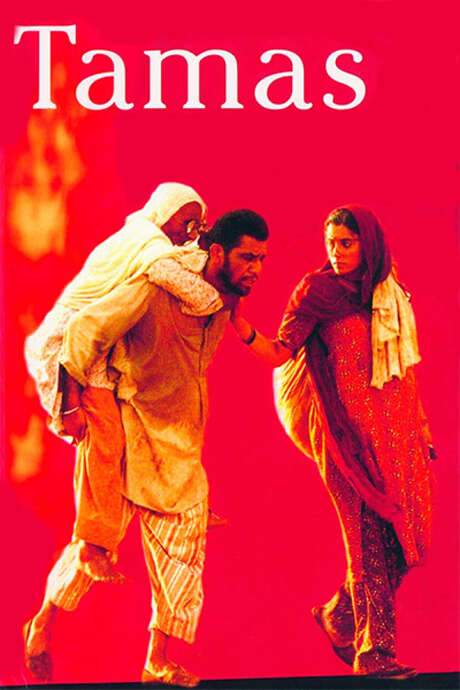
Tamas 1988

Directed by

Govind Nihalani
Made by

Blaze Film Enterprises
Tamas Plot Summary
Read the complete plot summary and ending explained for Tamas (1988). From turning points to emotional moments, uncover what really happened and why it matters.
Nathu, a Chamar, is finishing his work in his shop when the thekedar walks in and asks him to kill a pig for the veterinary doctor who needs it for medical purposes. Nathu declines, saying he has never killed a pig before and doesn’t possess the necessary skill, offering instead to tan the hide if the piggery people kill it. The thekedar presses him, hands over 5 rupees, and walks away, promising that by morning the jamadar will come to take the carcass.
Early the next morning, Bakshiji and a small band of political supporters go to a Muslim mohalla to clean drains as propaganda, singing patriotic songs to win goodwill. The residents welcome them and join in the communal cleanup, but the mood shifts when an old Muslim man asks them to leave for their own safety. Soon, stones fly from neighboring houses and the party members flee in confusion. The attackers later discover someone has thrown a pig carcass at the steps of a mosque, deepening the tension and fear around the neighborhood.
Fearing wider unrest, Hayat Baksh, the spokesman of the Muslim League, and Bakshiji visit Deputy Commissioner Richard at his home and urge preemptive measures to restore order. Richard, however, refuses to deploy police or impose a curfew, telling the party leaders to urge their communities to maintain peace and calm instead. This decision props up a fragile sense of normalcy that soon shows cracks as rumors and suspicions spread.
Nathu, having seen the pig carcass and witnessing the growing unease, wonders whether it was the same pig he killed the previous night. When he encounters the thekedar in the street, the man dashes away, a moment that confirms Nathu’s guilt in his mind. He returns home and confesses everything to his pregnant wife, Kammo. From a distance, the scene shows burning houses and the couple’s fear and shame, underscoring how one act of guilt can inflame an entire town into violence.
With danger looming, Nathu decides to flee the city, taking Kammo and his aging, crippled mother along. Their march is brutal and heartbreaking: the mother dies during the journey and must be burned in the forest without proper funeral rites, a cruel blow that brutalizes Nathu’s conscience and deepens his sense of responsibility for the unfolding disaster.
In a nearby village, Harnam Singh and his wife, Banto, the sole Sikh family, seek safety as they too travel toward a Sikh village. They find shelter briefly in the home of a Muslim, Ehsan Ali, but are forced to flee again when they are discovered by Ehsan’s son. They continue their journey with Nathu and Kammo, eventually reaching a gurudwara where Jasbir and other Sikhs have taken refuge.
Inside the gurudwara, the tension rises as the Sikh leadership, headed by Teja Singh (the leader of the Sikh council), learns that Muslims are arming themselves and advises arming the Sikhs in return. A junior granthi informs Teja Singh that the Muslims know the Sikhs are outnumbered and proposes a truce for a hefty price—2 lakh rupees. The council deems the demand unacceptable and sends the granthi and Nathu to negotiate with the Muslims. From the terrace, the leaders watch as the negotiation turns violent: the Muslim mob closes in, and the Sikhs are forced into battle, shouting their slogans in defiance. In a desperate act of courage and despair, Jasbir guides Sikh women to a tragic collective suicide by leaping into a well, some with their children in their arms.
Later, Deputy Commissioner Richard addresses a gathering of city leaders, outlining relief measures and proposing the creation of an Aman Committee to promote peace. Bakshiji and Hayat Baksh are named vice presidents of this committee, signaling a shift toward reconciliation even as the city remains scarred by fear and division. The film then pivots back to the fates of those who sought shelter and safety as the conflict rages—the thekedar’s calls for communal harmony echoing despite the violence around him.
At the refugee camp, the fates of Nathu, Kammo, and their companions become starkly personal. Harnam Singh, Banto, and Kammo await news of Nathu, hoping to be reunited with him; a government employee is asked to help locate him. Kammo, peering through the rows of dead bodies, recognizes Nathu’s corpse and collapses in grief. Her labor begins moments later, and she is rushed into a hospital tent by nurses. Outside the tent, the muffled cries of a newborn mingle with distant cries of “Allahu Akbar” and “Har Har Mahadev,” a haunting reminder of the violent collision of faiths that has engulfed the community.
In the end, the film lingers on the human cost: guilt that gnaws at those who survive, the brutal toll on families who lose loved ones, and the uneasy aftershocks of communal hatred that refuse to fade. The final images reveal a country divided and the fragile thread of peace stretched to its limit, the echoes of suffering and resilience resonating long after the flames have died down.
Tamas Timeline
Follow the complete movie timeline of Tamas (1988) with every major event in chronological order. Great for understanding complex plots and story progression.
Nathu declines to kill the pig
Nathu finishes his work in his shop when the thekedar walks in with a demand to slaughter a pig for the Veterinary doctor. He declines, saying he has never killed a pig and lacks the necessary skill. He offers to tan the pig's hide if needed, implying the piggery workers could handle the carcass. The thekedar leaves, noting that the jamadar will collect the carcass by morning.
Propaganda drains cleaning in the Muslim mohalla
Bakshiji and several members of the political party go to a Muslim mohalla to clean drains as propaganda, singing patriotic songs. They are warmly received and joined by residents who help with the work. The scene shows a temporary display of peace, but an old Muslim man later confronts them and asks them to leave for their own good. Soon stones fly from neighboring houses and the party members flee, and they learn a pig carcass has been dumped at the steps of a mosque.
Pig carcass at mosque sparks unrest
The party members flee after the confrontation, and someone throws a pig carcass at the steps of a mosque. The incident marks the escalation of communal tension in the town. The air grows tense as residents react to the symbol of the carcass at a religious site.
Deputy Commissioner urged to intervene; declines
Bakshiji and Hayat Baksh visit the Deputy Commissioner Richard at his house to urge deployment of police and a curfew to prevent unrest. Richard declines the requests, urging leaders to keep the peace and promising to call a meeting for peace. He advises them to mobilize peacefully rather than impose measures.
Nathu's guilt and confession
Nathu, having seen the pig carcass and sensing the unrest, wonders if it was the same pig he killed. He tries to approach the hurried thekedar, who escapes. Overcome with guilt, he confesses everything to his pregnant wife Kammo. Outside, houses burn and cries fill the air as violence erupts around them.
Escape from the city with family
Fearing danger, Nathu decides to leave the city with his wife and his crippled mother. They begin traveling on foot, with Nathu carrying his mother on his back. The family moves away from the escalating violence together.
Mother dies and is burned in the forest
During the journey, Nathu's mother dies and is burned in the forest because there is no proper funeral rite. This event devastates his conscience and strengthens his sense of responsibility for the suffering around him. The forest becomes a somber backdrop to the tragedy.
Sikh family seeks shelter in Muslim home
Harnam Singh and his wife Banto, a Sikh family, travel to a village seeking shelter. They stay at the home of their friend Ehsan Ali, a Muslim. They hide during the day but are discovered by Ehsan’s son at night and told to leave immediately.
Gurudwara gathering; arms and truce demands
The group joins Nathu and Kammo at a gurudwara where Jasbir and other Sikhs have taken shelter. Teja Singh, the leader of the Sikh council, warns that Muslims are arming themselves and Sikhs should do the same. A junior granthi later reports that Muslims know Sikhs are outnumbered and are demanding 2 lakh rupees for a truce. The council deems the demand excessive and sends the granthi and Nathu to negotiate.
Negotiation turns violent; Sikh women take action
Nathu and the granthi negotiate with Muslims and are surrounded and attacked. The Sikhs retaliate by taking up arms to fight. Back at the gurudwara, Jasbir leads the Sikh women to a collective suicide by jumping into a well, some with their children.
Aman Committee formed to promote peace
Richard addresses prominent city figures about relief measures and proposes the formation of an Aman Committee to send a message of peace. Bakshiji and Hayat Baksh are named vice presidents of the committee. The scene ends with the thekedar shouting communal harmony slogans.
Refugee camp; search for Nathu ends in tragedy
Harnam Singh, Banto, and Kammo are at a refugee camp, anxious to learn of Nathu's fate. A government employee urges them to check the hospital tent for his status. Kammo discovers Nathu's dead body among the corpses and collapses, then goes into labor. Outside, the newborn's cries mix with slogans of Allahu Akbar and Har Har Mahadev echoing in the distance.
Tamas Characters
Explore all characters from Tamas (1988). Get detailed profiles with their roles, arcs, and key relationships explained.
Nathu (Om Puri)
A humble pig handler who initially refuses to kill the animal yet is coerced by the thekedar. He commits the act, wrestles with immense guilt, and ultimately becomes a casualty of the ensuing violence. His journey mirrors the collapse of personal ethics under communal pressure, ending with his death in the riot aftermath.
Kammo (Deepa Sahi)
Nathu’s pregnant wife who bears the weight of the crisis with quiet resilience. She witnesses suffering, endures trauma, and goes into labor amid chaos. Her perspective centers the human cost of violence on families and unborn futures.
Harnam Singh (Bhisham Sahni)
A Sikh elder and father who, along with his wife Banto, seeks shelter and safety for his family. He embodies the tension between communal identity and humanitarian bonds, navigating danger while maintaining a sense of dignity.
Banto (Dina Pathak)
Harnam Singh’s wife, a Sikh woman who travels with her husband and finds herself within refugee dynamics. She endures the uncertainty of displacement and the strain of protecting family members amid chaos.
Jasbir (Uttara Baokar)
Daughter of Harnam Singh who embodies the fear and determination of Sikh communities. She becomes a symbol of collective action, including tragic choices that underscore the desperation of those cornered by violence.
Teja Singh (Amrish Puri)
Leader of the Sikh council who pushes for armament and organized defense. He represents political and martial responses to threat, complicating fragile attempts at peace and exacerbating cycles of retaliation.
Ehsan Ali (Iftekhar)
A Muslim friend who shelters the Sikhs in danger and later faces pressure to turn away. He embodies cross-community solidarity and the precarious choices that preserve humanity amidst hostility.
Bakshiji (A.K. Hangal)
A local political figure who moves among communities to avert violence. He helps steer the Aman Committee and advocates for peaceful coexistence, reflecting political maneuvering during crises.
Richard (Barry John)
The Deputy Commissioner who oscillates between restraint and responsibility. He delivers public statements about relief measures and the formation of an Aman Committee, highlighting the administrative attempt to manage chaos.
Thekedar (Pankaj Kapur)
The contractor who pressures Nathu into killing the pig, acting as a catalyst for the initial act that sparks the violence. His role exposes the manipulation of fear and economic interests in communal conflict.
Tamas Settings
Learn where and when Tamas (1988) takes place. Explore the film’s settings, era, and how they shape the narrative.
Time period
1947
Set during the Partition of India in 1947, the film tracks how religious loyalties and political rhetoric collide with ordinary lives. Colonial and local authorities struggle to contain outbreaks of violence, while leaders attempt to broker peace. Families are forced to flee their homes as unrest spreads.
Location
Northern India, Punjab region (Partition-era town)
The story unfolds in a small town in the Punjab region during the lead-up to Partition. The town houses a Muslim mohalla, a gurudwara, and a Sikh council, all within close reach of one another. The everyday life here becomes a powder keg as rumors and fear feed intercommunal conflict.
Tamas Themes
Discover the main themes in Tamas (1988). Analyze the deeper meanings, emotional layers, and social commentary behind the film.
🔥
Violence
A petty act—a pig carcass—triggers a wave of mob violence across the town, pulling in neighbors from different communities. The escalation is fueled by fear, rumor, and political manipulation, turning ordinary streets into battlegrounds. The film shows how violence destroys homes, trust, and basic humanity, leaving survivors haunted by what they have done and witnessed.
🕊️
Peace & Reconciliation
Amid the flames, attempts to calm tensions surface in the form of Aman Committee and calls for restraint. Local leaders on both sides publicly advocate peace, while the Deputy Commissioner hesitates to deploy stricter measures. The narrative suggests that peace requires sustained courage from individuals, not just decrees from authorities.
😔
Guilt
Characters grapple with moral culpability as their actions ripple outward. Nathu’s reluctant killing of the pig and his subsequent confession to Kammo anchor a meditation on personal responsibility. The film probes how one impulsive act can precipitate collective tragedy, leaving lives shattered and consciences forever wracked with guilt.
🚶
Displacement
As violence erupts, families flee the town in search of safety, often with little more than hope. The death of loved ones and the destruction of homes intensify the sense of loss, forcing people to abandon familiar places and identities. The refugee experience becomes a central thread, marking the human cost of communal hatred.

Coming soon on iOS and Android
The Plot Explained Mobile App
From blockbusters to hidden gems — dive into movie stories anytime, anywhere. Save your favorites, discover plots faster, and never miss a twist again.
Sign up to be the first to know when we launch. Your email stays private — always.
Explore the mobile appTamas Spoiler-Free Summary
Discover the spoiler-free summary of Tamas (1988). Get a concise overview without any spoilers.
In the sweltering heat of North India on the brink of 1947, a city teeters between ordinary life and the crackling spark of communal unrest. Streets pulse with the chatter of political rallies, the clatter of market stalls, and an undercurrent of fear that can turn everyday encounters into tinder for larger conflagrations. The film paints this volatile backdrop with a sprawling, lyrical realism, letting the audience feel the weight of history pressing down on every doorstep while hinting at the personal storms that will soon follow.
At the heart of this charged world is Nathu, a skilled but socially marginalized craftsman whose livelihood depends on the tangible work of his hands. He lives with his pregnant wife Kammo and his frail, aging mother, a small family bound together by love and the constant pressure of survival. When a modest commission forces Nathu to confront an act that sits uncomfortably with his caste and conscience, the ripple effect begins to shape his sense of responsibility, pulling him toward a crossroads he never imagined.
Around them, the city’s diverse tapestry is woven from the ambitions of leaders like Bakshiji and Hayat Baksh, the watchful presence of Deputy Commissioner Richard, and the quiet resilience of ordinary citizens such as Harnam Singh and his wife Banto. Even the homes of neighbors like Ehsan Ali become temporary sanctuaries, underscoring how fragile alliances can be when suspicion looms. These characters, each embodying a slice of the larger communal mosaic, suggest a world where personal choices are magnified by the surrounding turbulence.
The story follows Nathu as he grapples with the moral weight of his decision, choosing a path that leads him, Kammo, and his mother away from the city’s simmering tension. Their journey becomes a meditation on guilt, survival, and the fragile thread of humanity that persists amid the looming specter of division. The film’s tone remains intimate yet epic, inviting viewers to feel the anxious breath of a nation on the edge while staying rooted in the quietly powerful lives of those who must decide whether to stay or flee.
Movies with Similar Twists and Themes
Uncover films that echo the narrative beats, emotional arcs, or dramatic twists of the one you're exploring. These recommendations are handpicked based on story depth, thematic resonance, and spoiler-worthy moments — perfect for fans who crave more of the same intrigue.





Featured on this page

What's After the Movie?
Not sure whether to stay after the credits? Find out!
Check out our other apps:

SAT Sphere
Build confidence for the Digital SAT.

Mori Atlas
Discover wild places worth protecting.

Luntero
Search smarter for a home in Amsterdam.

Plot Explained
Unravel movie endings and hidden clues.

Pokechamp
Dive into Pokémon data and battle logic.

Driving Theory
Get ready for your European theory test.

Movie Dust
Plan your next cinema trip with ease.

Musemap
Find art and culture as you travel.

Selkobase
Compare credentials before committing.

Local Manual
Turn an unfamiliar country into practical next steps.

Lernavi
Compare school systems before your next move.

GymRoam
Find a workout stop wherever your plans take you.
Explore Our Movie Platform
New Movie Releases (2026)
Famous Movie Actors
Top Film Production Studios
Movie Plot Summaries & Endings
Major Movie Awards & Winners
Best Concert Films & Music Documentaries
Movie Collections and Curated Lists
© 2026 What's After the Movie. All rights reserved.
Privacy Policy