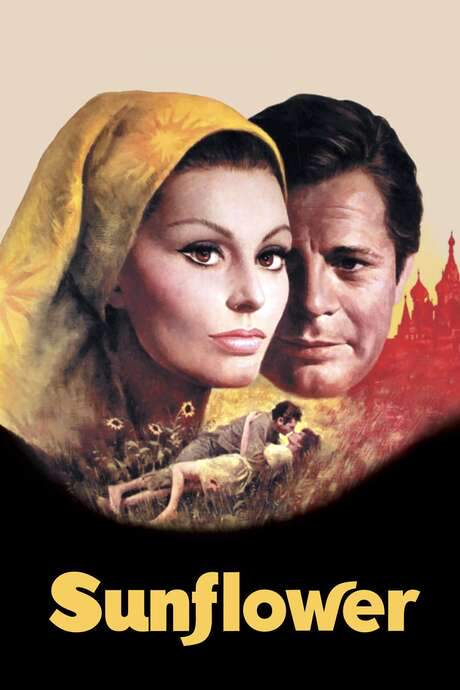
What Is Sunflower About?
The premise of Sunflower in 303 words, with nothing given away. The full story follows below.
In the quiet aftermath of World War II, a small Italian town still trembles with the echo of lost futures. Against a backdrop of ruined streets and hopeful reconstruction, two young lovers defy the looming draft by marrying in a burst of spontaneous devotion. Their brief, radiant twelve days together become a tender sanctuary, a promise that the war cannot erase. The film unfolds with a lyrical, almost lyrical rhythm, letting memory and present‑day longing bleed into one another as the audience feels the weight of a love that has already been tested by history.
Giovanna carries that promise like a photograph pressed to her chest, convinced that the man listed as missing on the Russian front is still alive somewhere beyond the Iron Curtain. Her determination turns the ordinary post‑war landscape into a terrain of quiet pilgrimage: the vast Soviet countryside, fields of sunflowers that whisper of countless fallen soldiers, and villages where the scars of conflict linger in the air. The tone is both wistful and resilient, a meditation on the stubborn hope that can sustain a person through years of uncertainty, while the cinematography pools soft light and muted colour to mirror her inner world.
Antonio exists now only in the shadows of official reports and the fragile recollections that Giovanna nurtures. Their story is told through interwoven flashbacks that flicker like photographs, hinting at a marriage forged in urgency and a clever ruse that once saved them both from a harsher fate. As she boards a train heading east, the audience senses the pull of unfinished chapters and the tension between what was promised and what may yet be discovered. The film invites viewers to sit with the ache of waiting, the beauty of devotion, and the uncertain horizon that beckons beyond the borders of both nations and hearts.
What Happens in Sunflower?
The complete story of Sunflower, from the first scene to the last, in 513 words (about 2 minutes). Spoilers throughout. Names in the text link to 2 cast member pages.
Spoilers ahead
“A woman born for love. A man born to love her. A timeless moment in a world gone mad.”
Giovanna Sophia Loren and Antonio Marcello Mastroianni marry to delay Antonio’s deployment during World War II. In those early days, they share a spark of happiness that lasts twelve days—a brief, radiant pause before the war reshapes their lives. They even hatch a bold scheme where Antonio pretends to be a crazy man, a desperate ruse born of love and fear, a sign of how far they will go to stay together. Yet the conflict tears them apart as Antonio is sent to the Russian Front, leaving Giovanna to cling to memory and hope.
When the fighting ends, Antonio is listed as missing in action. With a stubborn faith in their bond, Giovanna travels to the Soviet Union, convinced that her true love survived and remains somewhere in the vast landscape of war. In the Soviet countryside she confronts the stark consequences of war: sunflowers that are said to stand as one blossom for every fallen Italian soldier, and the grim memory of the Germans forcing Italians to dig their own mass graves. Her journey becomes a test of endurance and devotion as she pushes beyond fear to search for the man she loves.
Eventually, Giovanna finds Antonio, but the reunion comes with a wrenching truth: he has started a second life with a woman who saved his life, and they have a daughter together. Although she remains faithful to what they once shared, Giovanna returns to Italy, heartbroken yet unwilling to disrupt the life that has sprouted around him. Her path back is quiet and solitary, and she carries the weight of unresolved love into her days, trying to rebuild a life that honors the memory of their first, unbroken dream.
Years pass before Antonio returns to Giovanna, asking her to come with him back to the Soviet Union. But she has begun to move on—she leaves their first home behind, takes up work in a factory, and shares a life with a man with whom she has a baby boy. Antonio visits and speaks candidly about how war can change a man, how safe he felt with his new partner, and how difficult it is to reconcile a vanished past with a present that refuses to let go. Giovanna, torn between memory and responsibility, chooses not to uproot the lives of the children involved. She refuses to depart Italy, choosing stability over the possibility of reunion, at least for the moment.
As their separate paths diverge, Antonio offers a final, symbolic gesture—a fur he had promised years before. It becomes a quiet symbol of longing and unfinished business between two souls who once believed they could defy fate. The train’s whistle cuts through the distance as Antonio’s locomotive carries him away, leaving Giovanna standing on the platform, eyes meeting his one last time. In that silent moment, the past and present collide, and the love that endured through war and separation remains a guiding memory, traveling with him away from Italy, forever.
Sunflower Timeline: Every Key Event in Order
12 key events in the order they happen, from “Marriage to delay Antonio's deployment” to “Final farewell as Antonio departs”. 12 events name a place, across 4 locations.
- 1
Marriage to delay Antonio's deployment
Giovanna and Antonio marry to delay his World War II deployment. Their union begins a brief period of happiness amid the chaos of war, described as twelve days of happiness. The act sets the stage for the couple's later schemes and sacrifices.
When:Early World War II Where:Italy
- 2
Antonio's plan to delay again by faking madness
After their brief happiness, they attempt to postpone his deployment again by Antonio pretending to be crazy. The ruse buys them more time, allowing them to savor a few more days together before reality intrudes.
When:Early World War II Where:Italy
- 3
Antonio is sent to the Russian Front
Antonio departs for the Eastern Front where the war rages on. Giovanna stays behind, hoping for news and clinging to the belief that love can endure the distance.
When:World War II Where:Eastern Front, Europe
- 4
War ends; Antonio is missing in action
The war ends and Antonio does not return. He is listed as missing in action, leaving Giovanna to navigate grief and uncertainty.
When:Postwar (1945–1946) Where:Europe
- 5
Giovanna travels to the Soviet Union to find him
Despite the odds, Giovanna remains convinced Antonio survived and heads to the Soviet Union to search for him. Her journey is driven by love and an unwavering hope that transcends the war's destruction.
When:Postwar era Where:Soviet Union
- 6
Sunflower fields and the horrors of war
In the Soviet countryside, Giovanna visits sunflower fields believed to mark fallen Italian soldiers and learns of the horrors where Italians were forced to dig their own mass graves. Her journey grows into a search for Antonio amid stories of tragedy and endurance.
When:Postwar years Where:Soviet Union
- 7
Giovanna finds Antonio with a second family
Giovanna eventually finds Antonio, but he has begun a new life with a woman who saved his life, and they have a daughter together. The revelation shatters Giovanna's ideal of shared destinies while underscoring the costs of war.
When:Postwar years Where:Soviet Union
- 8
Giovanna returns to Italy rather than disrupt his life
Despite the discovery, Giovanna returns to Italy heartbroken and declines to disrupt Antonio's life. She chooses to safeguard his family's stability and her own dignity instead of forcing a reunion.
When:Postwar years Where:Italy
- 9
Years pass; Giovanna builds a life in Italy
Years pass and Giovanna moves into her own apartment, works in a factory, and builds a life with a new partner, even birthing a baby boy. She continues to carry the memory of her first love while embracing a different future.
When:Years after the war Where:Italy
- 10
Antonio returns and asks her to join him
Antonio returns years later and asks Giovanna to come back with him to the Soviet Union. He explains how the war changed him and that he found safety with his new partner after years of hardship.
When:Years after the war Where:Italy
- 11
Giovanna refuses to leave Italy
Giovanna refuses to leave Italy, unwilling to disrupt the lives of Antonio's daughter or her own newborn son. She chooses to protect their burgeoning families and to honor the vows she believed in before the war.
When:Years after the war Where:Italy
- 12
Final farewell as Antonio departs
Antonio gives Giovanna the fur he had promised years earlier, a symbol of their long-cherished memory. Their eyes lock as his train pulls away from Italy, sealing their separation and the bittersweet end of their love.
When:Final departure Where:Italy
Who Are the Main Characters in Sunflower?
3 characters, among them Giovanna (Sophia Loren), Antonio (Marcello Mastroianni) and Valentina (Galina Andreeva): who each one is and the part they play in the story. Every profile links to the actor’s page.
-

Giovanna (Sophia Loren)
Played by Sophia Loren
A devoted, resilient woman who endures years of separation and heartbreak in her unwavering belief that Antonio survives. Her journey to the Soviet Union is driven by love and memory, showing quiet strength and moral resolve as she refuses to abandon hope. She moves forward yet remains defined by the wartime vow she keeps.
- ❤️ Love
- 🕊️ Resilience
- 🇮🇹 Italian Spirit
-

Antonio (Marcello Mastroianni)
Played by Marcello Mastroianni
A man shaped by war, he evades military service by feigning madness, then returns from the front changed by hardship. He builds a life with another woman and their daughter, while keeping a place in his heart for Giovanna. The war reveals complexities of fidelity, memory, and the cost of survival.
- 💔 War impact
- 🪖 Soldier
- 💘 Love across distance
- V(
Valentina (Galina Andreeva)
Played by Galina Andreeva
The Soviet woman who saves Antonio and becomes part of his life after the war, bearing his daughter. She represents a different world and the complexities of love shaped by war. Her presence complicates Giovanna's choices and highlights the cross-cultural consequences of conflict.
- 🌟 Courage
- 🇷🇺 Soviet Connection
Where and When Is Sunflower Set?
Sunflower is set in Italy and Soviet Union (1940s). Here is why the time and place matter to the story.
When
1940s
The events unfold during World War II and its aftermath. The early years are defined by deployment, separation, and longing, while the postwar years chronicle the long struggle to rebuild lives. The timeframe centers on the 1940s, with the war's memory influencing every decision.
Where
Italy, Soviet Union
The story starts in Italy, where Giovanna and Antonio's wartime marriage unfolds amid rationing and uncertainty. It then moves to the Soviet Union, where the lovers' fates play out far from home, among sunflower fields and the shadows of occupation. The setting contrasts a homeland scarred by war with a distant, memory-soaked landscape that shapes their choices.
- 🇮🇹 Italy
- 🇷🇺 Soviet Union
What Are the Themes of Sunflower?
3 ideas the story keeps returning to, among them Love and Loss, War and Identity and Memory and Hope.
-
01
Love and Loss
A lifelong passion is tested by war, separation, and the impossibility of simple happiness. Giovanna and Antonio endure years apart, choosing fidelity to memory even as new lives emerge around them. The film examines whether love can survive the violence of history and the lure of competing loyalties.
-
02
War and Identity
The conflict reshapes who the lovers are and what they want from life. Antonio's experiences in the war alter his sense of belonging and loyalties, pushing him into new relationships. War becomes a catalyst that exposes the fragility of personal identity under pressure.
-
03
Memory and Hope
Sunflower imagery anchors the narrative as a reminder of fallen soldiers and the persistence of memory. Giovanna's quest across borders embodies hope against the odds, and the film treats memory as both solace and burden. In the end, hope refuses to erase the past.
What Kind of Film Is Sunflower?
Bittersweet in tone, with slow pacing and a moderate story, going by the plot summary.
- Tone
- Bittersweet
- Pacing
- Slow
- Story
- Moderate
- Intensity
- Medium
- Ending
- Bittersweet
A heartbreaking and deeply melancholic journey of devotion and loss, where the lingering trauma of war shatters a perfect love, ultimately leaving a quiet, resigned ache of what could have been.
- melancholic
- nostalgic
- heartbreaking
- resigned
- devotional
- quiet
- war separation
- unfaithfulness
- post-war trauma
- search for lost love
Content notes: war violence, trauma, emotional infidelity.
Quiz
How well do you remember Sunflower? Test yourself on the story.