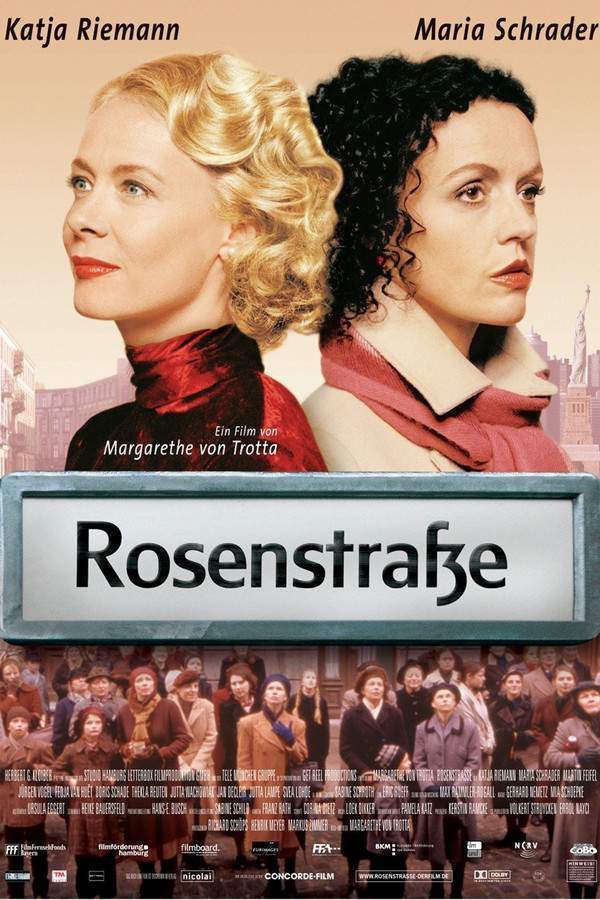
What Is Rosenstrasse About?
The premise of Rosenstrasse in 330 words, with nothing given away. The full story follows below.
In a quiet, modern apartment the steady hum of a television is gone, its screen covered and every mirror draped in cloth. The house feels like a shrine to absence, as its owner mourns the loss of a life‑long partner and retreats into rituals that hint at a deeper, unspoken past. The subdued lighting and lingering silence create a contemplative mood, suggesting that the grief is intertwined with memories that have long been kept hidden.
Her adult children, accustomed to a bustling home, sense something profoundly changed. One of them, Hannah, a daughter whose curiosity has always matched her mother’s quiet strength, begins to ask questions that are met with gentle resistance. When she discovers the name of a woman who once intervened during the darkest days of the war, her determination sharpens. The promise of a story buried beneath decades of silence drives her toward an unexpected journey across continents, seeking answers that might finally illuminate the shadows that linger in her family’s present.
The path leads her to Lena, a German who lived through those turbulent years. In a modest café outside Berlin, Lena opens a window onto a world of wartime Berlin, where ordinary lives were entangled with extraordinary acts of courage. Through her recollections, the film weaves a tapestry of flashbacks that pulse with the tension of a city under siege, hinting at a remarkable protest where women stood together to safeguard those they loved. The conversation between past and present is intimate, each revelation a thread that ties personal loss to collective resistance.
Together, the present‑day search and the haunting recollections create a film that feels both intimate and expansive. Its tone balances the quiet melancholy of a grieving household with the fierce, almost reverent energy of a hidden history waiting to be spoken. The story invites the audience to consider how the echoes of bravery and sacrifice can shape the lives of those who stumble upon them, long after the original voices have faded.
What Happens in Rosenstrasse?
The complete story of Rosenstrasse, from the first scene to the last, in 390 words (about 2 minutes). Spoilers throughout.
Spoilers ahead
In the present day, a widow mourns the loss of her husband and takes a private stance of shielding herself from the world by covering the TV set and every mirror in the house. This quiet ritual stands in stark contrast to the bustling life outside, hinting at a burden she has carried for decades and a privacy she has clung to as a way to cope with memory.
Her grown children are puzzled by this sudden shift in her behavior, wondering why their mother has seemingly embraced a new Orthodox Jewish routine. The mystery gnaws at them, and they press her for answers she is not ready to give. The tension between safeguarding the past and living in the present creates a quiet strain that threads through the family dynamics, inviting viewers to ponder how deeply history can shape intimate family bonds.
The daughter, driven by a longing to understand, learns of a woman who “saved” the widow’s mother during the war and travels to Germany to uncover the full story. There, she encounters a woman who bravely revisits the wartime years, sharing memories of a homeland under Nazi rule and of a mother who grew up as a Jew in those perilous times. The narrative also explores the widow’s own childhood, revealing how the persecution of Jewish families intersected with the lives of those in mixed marriages, and how the fates of generations can intertwine through love and loss.
A central thread runs through the film as it pieces together the Rosenstrasse protest, a remarkable moment in which women stood outside a Nazi jail for seven days and nights, demanding the freedom of their Jewish husbands. Set in Berlin during the winter of 1943, this sequence grounds the drama in a specific, historical act of collective courage. The film interleaves present-day revelations with this history, presenting a neutral, measured examination of memory, resilience, and the ethical complexities faced by those who lived through the era.
Throughout, the story emphasizes what happened to people in mixed marriages under the Nazi regime, painting a portrait of ordinary lives caught in extraordinary times. By weaving past and present, the film invites reflection on the personal costs of persecution, the power of solidarity among women, and the enduring importance of remembering the multitude of quiet, overlooked stories that history often leaves behind.
Rosenstrasse Timeline: Every Key Event in Order
12 key events in the order they happen, from “Widow's present-day mourning and household ritual” to “Reconciliation and acceptance of history”. 12 events name a place, across 4 locations.
- 1
Widow's present-day mourning and household ritual
In the present day, a widow mourns her husband and seals off the TV and all mirrors in the house, a ritual that hints at a hidden past she will not reveal. Her grown children are puzzled by her sudden turn to Orthodox Jewish customs and silence about the war years. The tension between present grief and past secrets drives the film's premise.
When:Present day Where:Berlin
- 2
Daughter seeks answers about her mother's past
The daughter learns of a woman named Lena who saved her mother during the war and decides to travel to Germany to uncover the truth. She confronts her mother's silence and pushes to understand how the past shapes their present. The journey marks the shift from private sorrow to public history.
When:Present day Where:Germany
- 3
Meeting Lena and hearing first wartime memories
The daughter finds Lena who begins recounting her own life in wartime Germany and her relationship with a Jewish husband. Lena explains the dangers they faced and the fragile alliances that formed under oppression. These memories begin to illuminate the mother's hidden history.
When:World War II era Where:Germany
- 4
Mother's Jewish childhood in Nazi Germany
The story flashes back to the mother's childhood as a Jew growing up in Nazi Germany, where daily life is shaped by anti-Jewish laws and suspicion. The recollections show how early experiences of exclusion would later inform her daughter's generation. The tone emphasizes the long shadow of the regime on ordinary families.
When:1940s Where:Nazi Germany
- 5
Loss of the grandmother to concentration camps
The mother loses her own mother to Nazi concentration camps, a trauma that fragments the family and seeds the memory the daughter later tries to recover. This loss compounds the complex identity of being Jewish in a hostile society. The event becomes a touchstone for the family's narrative.
When:1940s Where:Nazi Germany
- 6
Lena's act of saving the widow's mother
Lena, a German woman, is described as having saved the widow's mother during the war, forming a crucial if hidden bond between their generations. The act becomes a focal point for the daughter's investigation, illustrating how individual choices could alter fates. It also hints at the possibility of mercy amid a brutal regime.
When:World War II era Where:Nazi Germany
- 7
The focus on mixed marriages under Nazi rule
The narrative centers on what happened to couples in mixed marriages, often under surveillance or coercion, and how their children navigated contradictory identities. The film uses these histories to explore memory, guilt, and responsibility. The characters' pasts are shown to shape present attitudes and tensions.
When:1940s Where:Nazi Germany
- 8
The Rosenstrasse protest begins in Berlin
In Berlin, a group of women gathers outside a Nazi jail as winter closes in, demanding the release of their Jewish husbands. They endure seven days and nights of steadfast waiting, turning private fear into public protest. The event becomes a dramatic centerpiece of the film's historical flashbacks.
When:Winter 1943 Where:Berlin, Rosenstrasse
- 9
Protests’ pressure leads to some releases
The sustained pressure from the Rosenstrasse demonstrators leads to the release of many Jewish husbands, altering the fates of families who had faced deportation. The women’s courage is framed as a turning point in the regime's treatment of mixed marriages. The sequence emphasizes collective action as a catalyst for change.
When:Winter 1943 Where:Berlin
- 10
Aftermath in families and the war's end
The protests, the war's course, and personal losses leave lasting marks on the families involved, shaping the mother's postwar life and the daughter's understanding. The film traces how survival and memory intersect, enabling survivors to carry forward their stories. The thread of resilience is prominent as the characters rebuild their lives.
When:1940s-1950s Where:Berlin
- 11
Daughter learns the truth and the link between generations
The daughter discovers the truth about her mother's past, Lena's role, and the rescue that connected their histories. The revelation reframes affection, guilt, and forgiveness across generations. Memory becomes a shared inheritance that guides the present.
When:Present day Where:Germany
- 12
Reconciliation and acceptance of history
The family accepts the past and its heavy memories, with the mother maintaining her Orthodox practices as a living memory. The Rosenstrasse story serves as a beacon of courage that helps the family move toward healing. The film closes on a note of continued memory rather than forgetting.
When:Present day Where:Berlin
Who Are the Main Characters in Rosenstrasse?
3 characters, among them Lena, Widow and Daughter: who each one is and the part they play in the story.
- L
Lena
A German woman whose Jewish husband was persecuted by the Nazis. She embodies resilience and moral complexity as she navigates danger to help others during the war. Her memories illuminate the wartime choices that affected families shaped by persecution.
- 🕊️ Courage
- 🧭 Identity
- ❤️ Love
- W
Widow
A present-day widow who mourns her husband and hides the past, covering mirrors and a TV. She represents memory, grief, and the heavy burden of what stories remain untold. Her daughter's quest to uncover the truth drives the narrative forward.
- 🕯️ Memory
- 💔 Grief
- 👵 Legacy
- D
Daughter
The grown daughter who travels to Germany to learn what happened, seeking the full story behind her mother's childhood and the Rosenstrasse protest. She embodies curiosity, persistence, and the drive to connect present struggles with past injustices. Her journey links the family’s present to its wartime history.
- 🔎 Inquiry
- 🗺️ Journey
- 👩👧 Family ties
Where and When Is Rosenstrasse Set?
Rosenstrasse is set in Berlin and Germany (Winter 1943). Here is why the time and place matter to the story.
When
Winter 1943
Set in the wartime winter of 1943, Nazi Germany tightens its grip on Jews and those in mixed marriages. The film recalls a period of persecution, fear, and state surveillance, yet also the possibility of brave, collective action. The Rosenstraße protest becomes a focal point that anchors the narrative in this specific historical moment.
Where
Berlin, Germany
The story centers on Berlin during World War II, focusing on the Rosenstraße protest outside a Nazi jail in the winter of 1943. The city is depicted as a place of fear and repression, where ordinary women challenge the regime with a rare act of solidarity. Through present-day flashbacks, the film also situates the narrator's memory within the streets of Berlin, linking past and present.
- 🏙️ Berlin
- 🕰️ WWII Berlin
- 👪 Mixed families
What Are the Themes of Rosenstrasse?
3 ideas the story keeps returning to, among them Memory, Resistance and Identity.
-
01
Memory
Memory drives the narrative as present-day characters uncover forgotten histories. The mother’s silence about her past contrasts with the daughter’s drive to learn, forcing truth to emerge from family secrets. The film uses flashbacks to piece together how wartime choices echo into the next generation.
-
02
Resistance
The Rosenstraße protest is depicted as a powerful act of nonviolent defiance by women who refused to accept deportation of Jewish husbands. The story highlights solidarity, courage, and the moral weight of standing up to an oppressive regime. It shows how collective action can alter individual fates during oppression.
-
03
Identity
The film centers on the tension between Aryan and Jewish identities and how they affect family bonds. Cross-cultural relationships reveal vulnerability, loyalty, and the complexities of survival under Nazi rule. Personal identity becomes a battleground where love and memory collide.
What Kind of Film Is Rosenstrasse?
Bittersweet in tone, with slow pacing and a complex story, going by the plot summary.
- Tone
- Bittersweet
- Pacing
- Slow
- Story
- Complex
- Intensity
- High
- Ending
- Bittersweet
A heavy and melancholic historical drama that uses a dual timeline to uncover a story of quiet resistance amid profound loss, creating a tense yet ultimately hopeful viewing experience.
- somber
- tense
- melancholic
- hopeful
- historical
- grieving
- holocaust
- grief and loss
- historical drama
- resistance
Content notes: holocaust, persecution, death, concentration camps.
Quiz
How well do you remember Rosenstrasse? Test yourself on the story.