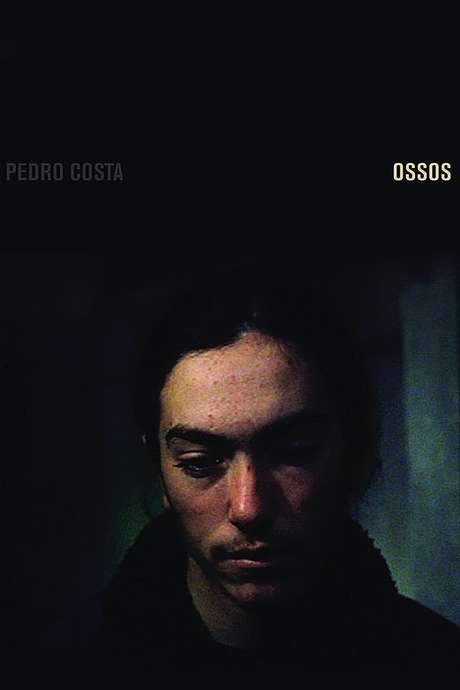
Ossos 1997

Directed by

Pedro Costa
Made by

Madragoa Filmes
Where to Watch Ossos
See current US streaming, rental, and purchase options for Ossos (1997) via JustWatch.

Streaming availability powered by 
Ossos Plot Summary
Read the complete plot summary and ending explained for Ossos (1997). From turning points to emotional moments, uncover what really happened and why it matters.
Tina, Mariya Lipkina, is a young mother who has just given birth to a newborn and lives in a cramped shanty in Fontainhas with her deadbeat live-in partner. Her sister Clotilde, Vanda Duarte, a housemaid, stays nearby with her daughter Mauda, The Girl. The damp walls and narrow corridors frame a tense daily life where care and neglect constantly collide, and the two sisters hinge their fragile routines on small acts of support.
One afternoon, the father Nuno Vaz searches for food at a local market and steadies himself by taking meals at a nearby diner. As night falls, he wanders the streets while Tina grows increasingly overwhelmed and contemplates ending her own life. In a desperate moment, she places a decompressed gas cylinder beside herself and the baby, a stark image that underscores the precariousness of their situation. When the father returns home, Tina drags him into a nearby room, seeking proximity to the child and to something that resembles family, even as the room feels more like a liminal space between hope and catastrophe. Meanwhile, Clotilde stares silently in her apartment, a quiet counterpoint to the chaotic emotions playing out in Tina’s life.
The next morning, Tina leaves the child in the father’s care. He has gone hungry for days and, with the baby in his arms, asks locals for food. A woman, later identified as Eduarda Gomes, Isabel Ruth, feeds the father and the infant a sandwich and milk from a nearby deli, a small kindness that becomes a turning point in the story. Afterward, the baby is taken to a hospital for urgent care. He sits on a bench outside and is approached by a nurse who, in turn, points to her colleague Eduarda. By nightfall, the hospital staff convey that the baby is quite ill, and Eduarda is involved in the ongoing care decisions. The father, conflicted and exhausted, returns to the hospital where Eduarda explains the severity of the child’s condition and the plan for tests with a pediatrician arriving the next day. Later, the father goes to Eduarda’s apartment where she feeds him a meal and offers a form of hospitality that hints at a deeper bond forming between them.
The following morning, Tina stays over at Clotilde’s apartment, a moment that reveals the fragility of Tina’s world when she’s apart from her infant. Back at Eduarda’s apartment, Eduarda asks the father about Tina; he responds that Tina does not seem to care about being a mother, a sentiment that casts a gray light on Tina’s motivations and fears. Eduarda then takes the child to her own apartment and becomes its new caregiver, a shift that re-routes the child’s life and the family dynamics surrounding him. Meanwhile, Clotilde continues to look after Tina, a quiet thread that ties the siblings’ destinies together.
The father returns and briefly converses with Clotilde, and soon after, the court of events marks a custody change, with the father being given custody of the child again. Later on, Eduarda hires Clotilde as a housemaid five days a week, expanding the network of daily labor and dependency around the child. That same night, Tina searches for Clotilde but is approached by her husband, Miguel Sermão, a reminder of the personal ties and obligations that complicate any attempt at rebuilding life. Clotilde returns, stating that she now works for Eduarda, and the house becomes a space where different loyalties intersect.
Sometime later, Tina arrives at Eduarda’s apartment only to find that no one is there. Instead, she discovers a list of cleaning instructions Eduarda had written for Clotilde, a stark reminder of the routines that organize their lives and the power dynamics at play. Hours later, Eduarda returns from work and finds Tina lying unconscious in the kitchen as a result of another suicide attempt. Tina begins to recover, and Eduarda offers to have Tina stay with her, a gesture that shifts the balance of safety and dependence for Tina, the child, and the whole precarious household.
Meanwhile, the father remains connected to a different form of precarious care, staying with a prostitute who offers to look after the child, a detail that underscores the multiple, sometimes conflicting, avenues people pursue to provide for a vulnerable infant. Eduarda then comes to Tina’s apartment and finds Tina alone, and the two women share a moment as they smoke cigarettes, a small but intimate connection that hints at a possible new solidarity beyond the confines of the earlier power struggles.
Clotilde returns to clean Eduarda’s apartment, a routine interruption that leads to a final quiet moment where Clotilde and Tina share a brief, fragile connection at Tina’s own apartment. In the end, Clotilde leaves and Tina shuts her door, leaving the film in a muted, unresolved space that reflects the lingering fragility of family, care, and survival in a neighborhood where every gesture toward help carries its own weight of consequence.
Ossos Timeline
Follow the complete movie timeline of Ossos (1997) with every major event in chronological order. Great for understanding complex plots and story progression.
Tina and her baby in Fontainhas
Tina, a young mother, lives in a cramped shanty in the Fontainhas district with her unnamed deadbeat partner and a newborn. The household is strained and Tina quietly battles despair while trying to care for the baby.
The father searches for food and eats at a diner
One afternoon the father leaves to search for food at a local market and later takes meals from a nearby diner. He returns to their meager home, illustrating the constant hunger and neglect surrounding the family.
Nighttime crisis and Tina's suicide attempt
That night Tina wanders the street in distress and contemplates ending her life. She places a decompressed gas cylinder beside herself and the baby, then drags the father into a nearby room to be near them.
Morning custody: father with baby and Eduarda feeds them
The next morning Tina leaves the child with the father. The father, hungry after days without food, begs for scraps on the street while holding the baby, and a woman named Eduarda feeds them a sandwich and milk.
Hospitalization and nurse hints at Eduarda
The baby is taken to the hospital for immediate care. A nurse approaches the father and recommends her colleague Eduarda as a pediatrician.
Eduarda's involvement and upcoming tests
That night at the hospital Eduarda informs him the baby is quite ill and that a pediatrician will arrive the next day to run medical tests. The father steps outside to smoke and then returns to Eduarda's apartment where she feeds him a meal.
Tina at Clotilde's and Eduarda takes the baby
The next morning, Tina stays with Clotilde, while Eduarda takes the baby to her own apartment and becomes its new caregiver. The father is left to coordinate the care and is told Tina does not seem to care about motherhood.
Custody returns to the father
Clotilde looks after Tina. The father returns and briefly chats with Clotilde, and he is given custody of the child again.
Eduarda hires Clotilde; Tina's search
Eduarda hires Clotilde as a housemaid five days a week. That night, Tina searches for Clotilde but learns she now works for Eduarda after being approached by her husband.
Tina's second crisis and Eduarda's offer
Sometime later, Tina goes to Eduarda's apartment and finds no one there, only a list of cleaning instructions for Clotilde. Hours later Eduarda returns and finds Tina unconscious in the kitchen from another suicide attempt; Tina survives and Eduarda offers her a place to stay.
Bonding and closing moments
Eduarda visits Tina's apartment and they share a rare moment of bonding while smoking together. Clotilde cleans Eduarda's apartment, then returns to Tina's place for a final moment before Tina shuts her door.
Ossos Characters
Explore all characters from Ossos (1997). Get detailed profiles with their roles, arcs, and key relationships explained.
Tina (Mariya Lipkina)
A young mother overwhelmed by poverty and despair. She oscillates between tenderness for her baby and suicidal impulses, exposing the fragility of maternal bonds in extreme conditions. Her interactions reveal a fierce determination to protect her child despite dire circumstances.
The Father (Nuno Vaz)
Tina's deadbeat partner, often hungry and drifting through the city. He depends on strangers for meals and attention, illustrating a precarious masculine role in a setting of scarcity. His actions help drive the family's crisis and the baby's medical urgency.
Clotilde (Vanda Duarte)
Tina's sister, a housemaid who moves between apartments and tries to support her own family. She is a quiet observer who gradually becomes entangled in Eduarda's care network. Her presence highlights kinship and the labor of women in hard urban conditions.
Mauda (The Girl) (Inês de Medeiros)
Clotilde's daughter, a young presence in the shifting household. She exists at the center of a network of care, illustrating how children can anchor fragile relationships. Her role underscores the vulnerability of the next generation in this environment.
Nurse Eduarda Gomes (Isabel Ruth)
A nurse who becomes the baby's caregiver and a new ally to Tina. She arranges medical testing and offers shelter, creating a complicated bond that tests boundaries of care and survival. Her pragmatic yet compassionate approach drives the baby's fate and Tina's trajectory.
Nurse (Berta Susana Teixeira)
A nurse who appears briefly in the hospital network, representing the medical system's role in the child's treatment. Her presence signals institutional support and its limits.
Prostitute (Anna Carvalho)
A sex worker who feeds the father and baby at a critical moment, reflecting the city's margins and the unpredictable forms of care that flow through the characters' lives.
Clotilde's husband (Miguel Sermão)
Clotilde's husband, a lingering presence in the couple's life who interacts with the family, illustrating the complexities of domestic relationships and male roles in the urban sphere.
Friend (Zita Duarte)
A neighbor or friend who participates in the social fabric around the apartments, offering quiet support and observation within the community.
Friend (Clotilde Montron)
Another friend in the building who exposes the intimate micro-world of Fontainhas and the constant presence of other adults in the care web.
Ana Marta
A minor character in the building's social set, contributing to the dense, interconnected lives that populate the street-level drama.
Ossos Settings
Learn where and when Ossos (1997) takes place. Explore the film’s settings, era, and how they shape the narrative.
Time period
Late 1990s
The story is set in a contemporary Lisbon environment, reflecting the society after the dictatorship and during a period of economic strain. The characters contend with scarce resources, unstable housing, and limited access to healthcare. This era underscores the immediacy and grit of life in a marginalized urban community.
Location
Fontainhas district, Lisbon
Fontainhas is a crowded, aging neighborhood in Lisbon known for its cramped flats and winding alleys. The film unfolds inside a shanty apartment in Fontainhas, highlighting urban poverty and the fragility of daily life. The setting creates a claustrophobic backdrop that shapes the characters' difficult choices and relationships.
Ossos Themes
Discover the main themes in Ossos (1997). Analyze the deeper meanings, emotional layers, and social commentary behind the film.
🏚️
Poverty
The narrative centers on poverty and precarious living in a cramped apartment. Tina's hunger, the father's constant need to scrounge for meals, and the baby's fragile health reveal how scarcity governs everyday life. The film shows how poverty constrains choices and amplifies vulnerability, especially for women who bear caregiving burdens. It also exposes the fragility of social safety nets in the city.
👩👧👦
Motherhood
Tina's role as a mother drives the plot and reveals the emotional weight of caring for a newborn under strain. Her desire to protect the child collides with desperation and a sense of abandonment by unstable partners. The story tracks the complex balance between love, responsibility, and risk in the absence of reliable support. The bond between mother and child becomes the emotional center of the drama.
💬
Care & Solidarity
Eduarda's intervention and Clotilde's evolving role show how strangers and family members form a fragile care network. The baby moves between apartments and caretakers, illustrating how communities improvise support under pressure. The film emphasizes quiet acts of kindness that sustain people when institutions fail. It also hints at power dynamics in acts of care and who controls access to help.

Coming soon on iOS and Android
The Plot Explained Mobile App
From blockbusters to hidden gems — dive into movie stories anytime, anywhere. Save your favorites, discover plots faster, and never miss a twist again.
Sign up to be the first to know when we launch. Your email stays private — always.
Explore the mobile appOssos Spoiler-Free Summary
Discover the spoiler-free summary of Ossos (1997). Get a concise overview without any spoilers.
In the cramped alleys of Fontainhas, a crumbling shantytown clings to the edges of a bustling city, its damp walls and narrow corridors echoing the quiet desperation of its residents. The film opens on Tina, a teenage mother whose recent birth has left her teetering on the edge of hope and despair. She places her newborn in the reluctant care of his father, a volatile figure whose own struggles with violence and poverty shape the bleak rhythm of daily life. Their modest dwelling becomes a pressure‑filled space where survival hangs by a thread, and the faint promise of safety feels as fragile as a newborn’s first breath.
Beyond the stark walls, the story expands through the intertwined lives of Clotilde, Tina’s older sister, and a modest housemaid who balances her own responsibilities while offering a quiet anchor for her sibling. Their relationship, marked by small acts of support and whispered encouragement, illuminates the thin line between care and neglect that defines the community. Across the street, Eduarda—a compassionate neighbor—extends a tentative hand, hinting at the fragile networks of aid that surface amid hardship. Meanwhile, Miguel, a lingering presence from Tina’s past, adds another layer of complexity to the fragile web of obligations and yearning that binds the characters together.
The tone remains unflinchingly raw, a study in muted colors and lingering shadows that mirror the characters’ inner turmoil. As the newborn’s small cries reverberate through the cramped rooms, they underscore a larger, unspoken question: can love, however precarious, carve out a sliver of stability in a world that constantly threatens to collapse? The film invites viewers to linger in the space between hope and hardship, where every gesture of kindness carries the weight of survival.
Movies with Similar Twists and Themes
Uncover films that echo the narrative beats, emotional arcs, or dramatic twists of the one you're exploring. These recommendations are handpicked based on story depth, thematic resonance, and spoiler-worthy moments — perfect for fans who crave more of the same intrigue.



Featured on this page

What's After the Movie?
Not sure whether to stay after the credits? Find out!
Check out our other apps:

SAT Sphere
Build confidence for the Digital SAT.

Mori Atlas
Discover wild places worth protecting.

Luntero
Search smarter for a home in Amsterdam.

Plot Explained
Unravel movie endings and hidden clues.

Pokechamp
Dive into Pokémon data and battle logic.

Driving Theory
Get ready for your European theory test.

Movie Dust
Plan your next cinema trip with ease.

Musemap
Find art and culture as you travel.

Selkobase
Compare credentials before committing.

Local Manual
Turn an unfamiliar country into practical next steps.

Lernavi
Compare school systems before your next move.

GymRoam
Find a workout stop wherever your plans take you.
Explore Our Movie Platform
New Movie Releases (2026)
Famous Movie Actors
Top Film Production Studios
Movie Plot Summaries & Endings
Major Movie Awards & Winners
Best Concert Films & Music Documentaries
Movie Collections and Curated Lists
© 2026 What's After the Movie. All rights reserved.
Privacy Policy