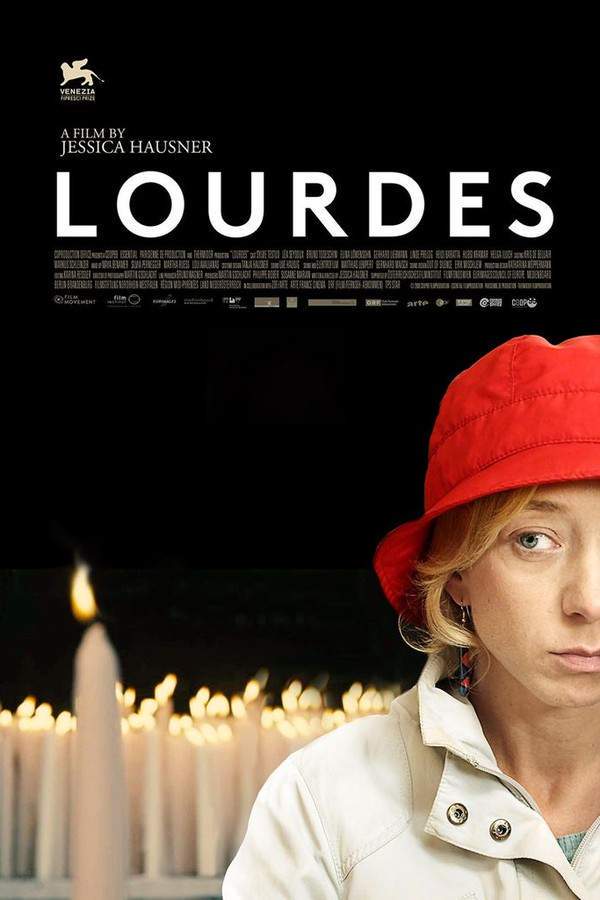
Lourdes 2010

Directed by

Jessica Hausner
Made by

Palisades Tartan
Where to Watch Lourdes
See current US streaming, rental, and purchase options for Lourdes (2010) via JustWatch.

Film Movement Plus
HD
Film Movement Plus Amazon Channel
HD
Hoopla
SD
Kanopy
HD
Amazon Video
SD
Apple TV Store
HD
Fandango At Home
SD
Google Play Movies
SD
Plex
HD
YouTube
SD Streaming availability powered by 
Lourdes Plot Summary
Read the complete plot summary and ending explained for Lourdes (2010). From turning points to emotional moments, uncover what really happened and why it matters.
Christine, a wheelchair-using woman with severe multiple sclerosis, joins a group of other disabled travelers on a pilgrimage to the Sanctuary of Our Lady of Lourdes in Lourdes, France. She is paired with a volunteer helper, Maria, who assists her with feeding and dressing. Christine admits to Maria that she is not particularly religious, but these pilgrimages give her the chance to travel and see new places.
Maria develops a crush on Kuno, one of the guards assigned to care for the group, and he is attentive to Christine. When Maria notices this, she abandons her duties and runs off, leaving Christine in the care of her roommate who is more mobile than she is. That day Christine is able to move her hand on her own.
As the group prepares to return home, the head helper Miss Cécile abruptly collapses while preparing for the final party. The following day, when Maria comes into Christine’s room to dress her for the day, she finds Christine already dressed. The other members of the group are stunned by Christine’s marked improvement and encourage her to have it officially recognized by the church.
She is seen by a doctor who verifies that, while she still struggles to walk, her improvement is outside the realm of what can be explained scientifically and tells her her case will be moved to a committee to determine whether it is a miracle or not. Christine is able to attend the last-day excursion, which Maria tries to block because it is a hike for the more able members. On the trip, other members wonder why Christine was miraculously cured while more pious people were not, and Christine remains largely oblivious to the speculation, spending some time alone with Kuno.
At the going-away party Christine dances with Kuno and then collapses. Though she recovers, others begin to doubt that she is cured. Standing on the sidelines, she initially refuses to sit down and stay seated, but eventually returns to her wheelchair.
Lourdes Timeline
Follow the complete movie timeline of Lourdes (2010) with every major event in chronological order. Great for understanding complex plots and story progression.
Arrival in Lourdes with the pilgrim group
Christine arrives in Lourdes with a group of travelers who have varying disabilities. She relies on Maria as her helper, who assists with feeding and dressing her. Christine admits she isn't particularly religious, but she travels on pilgrimages as a chance to see the world.
Maria's crush on Kuno and shifting care
Maria develops a crush on Kuno, one of the guards assigned to the group. Kuno is attentive to Christine, which leads Maria to abandon her duties. Christine, under the care of a more mobile roommate, experiences her hand moving on her own that day, hinting at improvement.
Miss Cécile collapses before the final party
As the group prepares to return home, Miss Cécile abruptly collapses while getting ready for the final party. The incident shocks the group and underscores the fragility of the journey. It also shifts the group's attention toward Christine's condition.
Next day: Christine already dressed, signaling improvement
The following morning, Maria finds Christine already dressed, indicating progress beyond what might be expected. The sight brings a mix of relief and renewed attention from the other travelers. This moment colors the rest of the pilgrimage with new possibilities.
Medical assessment and miracle committee
A doctor assesses Christine and notes that while she still has difficulty walking, her improvement cannot be fully explained by science. He informs her that her case will be submitted to a church committee to determine whether it constitutes a miracle. The prospect of official recognition weighs on the group.
Preparation for the last-day excursion
Christine is able to attend the last-day excursion, a hike reserved for the healthiest members of the group. Maria tries to block her participation, arguing that she is not fit for the strenuous trek. Despite the objections, Christine’s presence signals a dramatic shift in her perceived abilities.
Last-day excursion sparks questions about the cure
During the hike, other pilgrims wonder aloud why Christine was miraculously cured while others who are devout remain ill. The questions highlight the tension between faith, luck, and unexpected mobility. Christine remains largely unaware of the scrutiny as she continues with the excursion.
Christine spends time with Kuno during the trip
On the excursion Christine spends some time alone with Kuno, deepening their connection and complicating Maria's feelings. The private moment becomes a focal point for the group’s shifting dynamics. Christine’s attention to Kuno adds a personal layer to the miracle discussion.
Going-away party, dance, and a fall
At the going-away party Christine dances with Kuno, sharing a moment of joy. She then collapses, but recovers, though the group begins to doubt the permanence of her supposed cure. Standing on the sidelines, she initially resists sitting, signaling a struggle with her own sense of independence.
Doubt grows as the miracle narrative unfolds
The group grows increasingly stunned by Christine's improvement and begins to doubt whether the healing is truly miraculous. Some attribute it to coincidences or the power of travel rather than a genuine miracle. The mood shifts from celebration to cautious skepticism.
The miracle verdict looms over Christine
With the pilgrimage ending, Christine's case has moved to the church committee to determine whether her recovery counts as a miracle. The decision remains uncertain, casting a long shadow over the trip’s emotional arc. The outcome will depend on factors beyond the group's immediate experience.
Final moment: standing and reluctant return to the chair
In the final moment, Christine stands on the sidelines and initially refuses to sit down. After a moment of hesitation, she reluctantly returns to her wheelchair. The scene leaves the audience with mixed feelings about the nature of her improvement and the burden of uncertainty.
Lourdes Characters
Explore all characters from Lourdes (2010). Get detailed profiles with their roles, arcs, and key relationships explained.
Christine (Sylvie Testud)
A wheelchair-using woman with severe multiple sclerosis who joins the Lourdes pilgrimage with a group of other disabled travelers. She relies on a volunteer helper for daily tasks, but she also shows moments of personal initiative and a pragmatic approach to travel. The miraculous improvement later opens questions about faith, identity, and how others perceive her.
Maria (Léa Seydoux)
Christine's volunteer helper who feeds and dresses her and acts as the group's caretaker. She develops a crush on Kuno, which leads her to abandon her duties at times, revealing a conflict between personal desire and caregiving responsibilities. The dynamic with Christine, and her evolving feelings, adds complexity to the pilgrimage.
Kuno
One of the guards assigned to care for the group, he is attentive toward Christine and becomes an object of Maria's affection. His presence introduces a subtle romance within the caregiving framework and adds tension to the group dynamics.
Miss Cécile
The head helper who organizes the group’s activities and supports the pilgrims. She collapses late in the trip while preparing for the final party, signaling the fragility of the caretaking staff and the emotional toll of the journey.
Lourdes Settings
Learn where and when Lourdes (2010) takes place. Explore the film’s settings, era, and how they shape the narrative.
Location
Lourdes, France
The film is set in the town of Lourdes, centered on the Sanctuary of Our Lady of Lourdes where a group of disabled pilgrims travels with volunteers. The setting bridges religious ceremony with the practicalities of care, feeding, and mobility as the travelers navigate the sanctuary grounds. The atmosphere frames both the ritual aspects of pilgrimage and the intimate moments of vulnerability, hope, and doubt.
Lourdes Themes
Discover the main themes in Lourdes (2010). Analyze the deeper meanings, emotional layers, and social commentary behind the film.
✨
Miracle
Christine's sudden improvement during the pilgrimage challenges the boundary between faith and science. The doctors’ uncertainty and the potential miracle verdict frame healing as a question of belief, humility, and what counts as truth. The film uses this moment to explore longing, contingency, and the meaning of healing in a life marked by illness. The outcome forces the characters to confront personal faith versus the need for observable evidence.
♿
Care
The story centers on caregiving, dependence, and solidarity among a group of pilgrims with disabilities. Christine relies on Maria and other helpers, revealing both resilience and fatigue in the work of supporting mobility and dignity. The journey's rituals—feeding, dressing, and companionship—reveal the care dynamic as intimate and morally charged. The narrative invites reflection on how care can be generous yet leave caregivers emotionally exposed.
💘
Desire
Maria's crush on Kuno introduces a human longing that sits beside the group's spiritual aims. Christine's own independence and the miraculous moment complicate Maria's focus on caregiving, shaping their relationships. The dynamic adds a layer of romance to a story otherwise focused on healing and belief. The tension exposes how longing can influence loyalty, attention, and the pursuit of connection.
🤝
Doubt
Within the pilgrimage, other members question why Christine is cured while more devout individuals remain unaided, turning the miracle into a social debate. The film explores how communities assess authenticity, merit, and significance of healing in a public ritual. Doubt becomes a lens for examining the power of perception, rumor, and the politics of belief. The going-away party lingers with unresolved questions about miracle, proof, and whether healing lasts.

Coming soon on iOS and Android
The Plot Explained Mobile App
From blockbusters to hidden gems — dive into movie stories anytime, anywhere. Save your favorites, discover plots faster, and never miss a twist again.
Sign up to be the first to know when we launch. Your email stays private — always.
Explore the mobile appLourdes Spoiler-Free Summary
Discover the spoiler-free summary of Lourdes (2010). Get a concise overview without any spoilers.
In the gentle hush of the French Pyrenees lies a city that has long been a waypoint for the hopeful and the desperate alike. Lourdes, with its mist‑cloaked streets and the ever‑present scent of incense, becomes more than a backdrop; it is a living altar where pilgrimage and personal longing intersect. Travelers bound by physical limitations gather each year to walk its sacred paths, their journeys threaded together by a shared yearning for relief, redemption, or simply the chance to see beyond familiar horizons.
At the heart of this modest procession is Christine, a woman who has spent her life confined to a wheelchair by severe multiple sclerosis. Her presence on the pilgrimage is as much an escape from the monotony of her condition as it is an act of quiet defiance against a world that often defines her by her disability. Though she admits she is not deeply religious, the ritual of the pilgrimage offers her a rare freedom to explore new places and moments of unexpected connection. She travels alongside Maria, a compassionate volunteer whose own quiet affection for a guard named Kuno adds a subtle undercurrent of human tenderness to the group’s collective experience.
When an unexplainable shift in Christine’s condition appears, whispers of a miracle begin to ripple through the sanctuary’s stone corridors. The sudden possibility of healing draws a spectrum of reactions—from reverent awe to skeptical envy—casting her into an uneasy spotlight. As the pilgrimage draws to a close, the atmosphere is charged with a fragile mix of hope and uncertainty, leaving Christine to navigate a new, delicate reality that teeters between the ordinary and the extraordinary, all while the world around her watches, questions, and wonders what true miracles might look like.
Movies with Similar Twists and Themes
Uncover films that echo the narrative beats, emotional arcs, or dramatic twists of the one you're exploring. These recommendations are handpicked based on story depth, thematic resonance, and spoiler-worthy moments — perfect for fans who crave more of the same intrigue.


Featured on this page

What's After the Movie?
Not sure whether to stay after the credits? Find out!
Check out our other apps:

SAT Sphere
Build confidence for the Digital SAT.

Mori Atlas
Discover wild places worth protecting.

Luntero
Search smarter for a home in Amsterdam.

Plot Explained
Unravel movie endings and hidden clues.

Pokechamp
Dive into Pokémon data and battle logic.

Driving Theory
Get ready for your European theory test.

Movie Dust
Plan your next cinema trip with ease.

Musemap
Find art and culture as you travel.

Selkobase
Compare credentials before committing.

Local Manual
Turn an unfamiliar country into practical next steps.

Lernavi
Compare school systems before your next move.

GymRoam
Find a workout stop wherever your plans take you.
Explore Our Movie Platform
New Movie Releases (2026)
Famous Movie Actors
Top Film Production Studios
Movie Plot Summaries & Endings
Major Movie Awards & Winners
Best Concert Films & Music Documentaries
Movie Collections and Curated Lists
© 2026 What's After the Movie. All rights reserved.
Privacy Policy