Leto 2019

Directed by

Kirill Serebrennikov
Made by

Gunpowder & Sky
Leto Plot Summary
Read the complete plot summary and ending explained for Leto (2019). From turning points to emotional moments, uncover what really happened and why it matters.
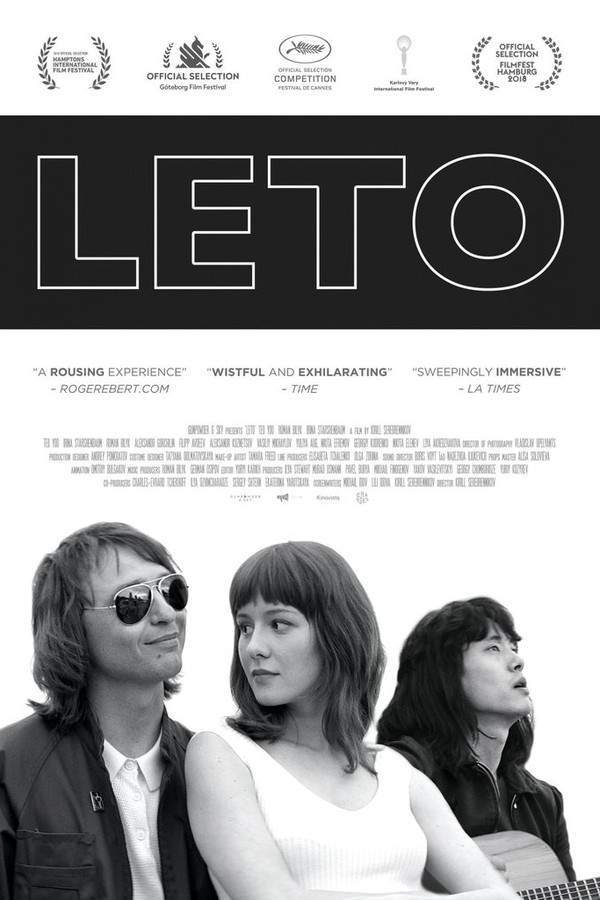
Set in the humid summer of 1981 in Leningrad, the film follows Viktor Teo Yoo, a 19-year-old with a quiet, almost otherworldly magnetism; Mike Naumenko [Roman Bilyk], a seasoned frontman; and Natalia Irina Starshenbaum, Mike’s girlfriend, as they navigate the city’s burgeoning rock scene, the formation of the Leningrad Rock Club, and Kino’s first album, 45.
One of the few state-permitted venues for rock music, the Leningrad Rock Club serves as a theater for boundary-pushing art, where audiences are instructed to sit politely and listen rather than moshing. Yet the club’s atmosphere is reframed by the narrator Skeptic Aleksandr Kuznetsov, whose interjections cast it as extravagant, hedonistic, reckless, and dangerous, adding a charged tension to each performance.
At the center is Mike Naumenko and Natalia, whose close, initially monogamous relationship stands in contrast to the public, sometimes feral life of rock stars. Into this orbit arrives Viktor, a quiet, slightly otherworldly young man with a gift for melody and a beguiling turn of phrase. Natalia is the first to notice a melancholic magic in Viktor, and the film gradually shifts its focus toward his rising star, while still sketching the lives of the other musicians who pass through the club.
The film’s musical numbers swing between diegetic stage performances and sudden, MTV-flavored lyrical flights. In one memorable moment, an altercation between musicians and more conservative citizens on a packed train escalates into a demented, carriage-traversing singalong of Psycho Killer, the hitherto realist imagery disrupted with early-MTV-style cartoon flourishes. There are a few sequences in which Mike and the other Leningrad rockers seize their moment, using their music to defy the bureaucrats and wow audiences. However, nearly all of these scenes are followed by a caption noting that “this didn’t really happen.”
Leto Timeline
Follow the complete movie timeline of Leto (2019) with every major event in chronological order. Great for understanding complex plots and story progression.
Summer in Leningrad: Introduction to the trio
In the summer of 1981 in Leningrad, Viktor Tsoi, Mike Naumenko, and Natalia become the film's central trio. Viktor is a quiet young man with a knack for melody, while Mike fronts a popular club band and Natalia is his girlfriend. The story centers on their evolving relationships and sets the stage for the city's precarious rock scene.
Leningrad Rock Club: a rare stage for rebellion
The Leningrad Rock Club is one of the few state-permitted venues where boundary-pushing rock can be performed. The audience is encouraged to sit politely and listen, but the performances push against that constraint. Narrator Skeptic periodically reframes the club as extravagant and dangerous, adding a larger-than-life aura.
Mike's band and Natalia: a closed start
Mike's band is popular in the club circuit, and his relationship with Natalia begins as deeply monogamous. Natalia starts noticing Viktor's melancholic magic and unusual lyrical phrasing, which hints at his growing importance. The film slowly redirects its focus toward Viktor.
Viktor's talent emerges
Viktor's talent, melodies, and lyrics hint at a future stardom that could transform the scene. Natalia's perception of him deepens, complicating the trio's dynamics. The film begins to reframe the story around Viktor's emergence rather than Mike's established path.
Recording Kino's first album, 45
The production of Kino's first album, 45, unfolds within studio sessions amid the club's frenetic energy. The process brings the band together, contrasting frugal living with bursts of creative output. These sessions become a touchstone for Viktor's rising profile.
Diegetic performances and stylized sequences
The film's musical numbers alternate between diegetic performances and stylized music-video sequences. In one memorable moment, a train confrontation among musicians escalates into a surreal, cartoonish singalong to Talking Heads' Psycho Killer.
The club as frugal cradle of creativity
The musicians live frugally, focusing on art rather than material wealth. The club serves as a crucible for experimentation and audience-facing moments, where boundaries are tested and ideas spread. This atmosphere defines the era's creative drive.
Skeptic's navigational frame
The film's narration by Skeptic situates events within a frame that can be read as exaggerated, hedonistic, and dangerous. This meta commentary invites the audience to question what is real and what is stylized. The Skeptic's perspective colors the entire depiction of the club and its heroes.
Viktor's rising prominence overshadows Mike
As Viktor's profile rises, the focus shifts from Mike's career to Viktor's ascent, altering group dynamics and loyalties. The film shows Viktor receiving attention from audiences and peers, signaling a turning point for the band and the scene.
Shifting love triangle and ambitions
Natalia's growing fascination with Viktor further complicates the relationships within the trio. Mike's position as frontman clashes with Viktor's emergence, triggering emotional tensions behind the music. The interplay between love and artistic ambition drives the narrative forward.
Recording wrap and bit of triumph
Late-summer sees Kino's 45 nearing completion, with the band's sound solidifying into a signature of the era. The group manages to capture the raw energy of Leningrad's scene in the studio while navigating bureaucratic constraints. The moment marks a tangible milestone in the film's arc.
Coda: history vs cinema
The film closes with reflections on the blurred line between historical fact and cinematic fantasy. The Skeptic narrator and explicit caveats remind the audience that many sequences are stylized or hypothetical, inviting interpretation rather than strict chronology.
Leto Characters
Explore all characters from Leto (2019). Get detailed profiles with their roles, arcs, and key relationships explained.
Viktor Tsoi (Teo Yoo)
Viktor is a quiet, slightly otherworldly young musician with a knack for melody and a beguiling turn of lyrical phrase. He starts as a peripheral figure in the club’s scene and gradually becomes central as Kino’s music takes off. His understated presence and poetic lines hint at a future stardom that reshapes the club’s dynamics and relationships, especially with Natasha.
Mike Naumenko (Roman Bilyk)
Mike is the frontman of one of the club’s more popular, old-guard bands. He navigates a frugal life while maintaining a close relationship with Natasha and pursuing his musical ambitions. His charisma on stage contrasts with a practical, grounded approach to life within the club’s constrained environment, and Viktor’s rise begins to challenge his status.
Natasha (Natalia) (Irina Starshenbaum)
Natasha is Naumenko’s girlfriend who notices Viktor’s melancholic magic and is drawn to the evolving dynamics of the scene. Her relationship with Mike contrasts with her growing interest in Viktor’s talent, highlighting the personal costs and desires that accompany artistic pursuit. She acts as a mirror to the shifting focus of the film’s narrative from Mike to Viktor.
Skeptic (S. Berdichevsky)
Skeptic is the narrator whose commentary occasionally reframes the club as extravagant, hedonistic, reckless, and dangerous. His perspective provides a critical counterpoint to the club’s public image and to the characters’ motivations. Through Skeptic, the film blurs the line between memory and myth, inviting reflection on what really happened versus what is remembered.
Leto Settings
Learn where and when Leto (2019) takes place. Explore the film’s settings, era, and how they shape the narrative.
Time period
Summer 1981
The events unfold in the summer of 1981 in Leningrad. The Leningrad Rock Club is depicted as a rare, state-allowed outlet for rock musicians within a controlled cultural landscape. Performances oscillate between diegetic stage moments and stylized, music-video-like sequences, reflecting a tension between rebellion and regulation. The narrative occasionally notes that some moments are more memory than literal fact, blending documentary feel with theatrical storytelling.
Location
Leningrad
The film is set in Leningrad during the summer of 1981, a city with a rich cultural history and a stark climate. The Leningrad Rock Club sits at the heart of the narrative as one of the few state-permitted venues for rock music of the time. It is portrayed as a theatrical space where boundary-pushing performances occur under strict rules, requiring audiences to sit and listen. The club’s atmosphere contrasts the wild energy of the music with official constraints, shaping how the characters interact and perform.
Leto Themes
Discover the main themes in Leto (2019). Analyze the deeper meanings, emotional layers, and social commentary behind the film.
⚡️
Music Rebellion
Music acts as a crack in the rigid cultural walls, with the club serving as a controlled stage for boundary-pushing sound. Diegetic performances mingle with cinematic flourishes to convey the electricity of a scene pushing against authority. The juxtaposition of staged spectacle and documentary narration highlights rebellion as both a personal and communal act. The film suggests that true vibrancy often lives in space between sanctioned performance and raw creativity.
🌟
Youth Stardom
Two young musicians, Viktor and Mike, navigate ambition, fame, and personal relationships in a milieu that prizes musical discovery. Viktor’s rising presence gradually shifts attention away from Mike, complicating friendships and romance within the club. Natasha becomes a reflective lens on how youth, desire, and art intersect with the lure of stardom. The era’s energy is shown as both alluring and precarious, foreshadowing the costs of ascent.
🏛️
Creativity vs Bureaucracy
The Leningrad Rock Club embodies a paradox: artistic freedom exists within a tightly controlled system. The narrator Skeptic intermittently reframes the club as extravagant, hedonistic, reckless, and dangerous, underscoring the tension between imaginative impulse and state oversight. The film uses this tension to explore how memory and myth shape our understanding of creative moments. Overall, creativity contends with bureaucracy, shaping who gets heard and who remains in the margins.

Coming soon on iOS and Android
The Plot Explained Mobile App
From blockbusters to hidden gems — dive into movie stories anytime, anywhere. Save your favorites, discover plots faster, and never miss a twist again.
Sign up to be the first to know when we launch. Your email stays private — always.
Explore the mobile appLeto Spoiler-Free Summary
Discover the spoiler-free summary of Leto (2019). Get a concise overview without any spoilers.
In the sweltering summer of 1981, Leningrad hums with a restless energy that feels both ordinary and revolutionary. Beneath the stoic façade of Soviet bureaucracy, a clandestine wave of Western rock music seeps through cramped apartments and dimly lit venues, promising an antidote to rigid conformity. The city’s cultural landscape is a patchwork of whispered conversations about forbidden records, makeshift gatherings in basements, and the rare, state‑sanctioned space of the Leningrad Rock Club—a theater where audiences are instructed to sit politely while the music tries to break free.
Mike Naumenko, a seasoned frontman with a magnetic charisma, navigates this precarious world alongside his devoted partner Natasha, whose steady presence grounds his wild artistic impulse. Their relationship, intimate yet constantly tested by the chaotic allure of the stage, offers a human counterpoint to the larger, almost mythic rise of the underground scene. Into their orbit drifts Viktor, a shy, 19‑year‑old whose quiet magnetism hints at untapped creative forces. Though he is initially an observer, his innate sense of melody and lyrical flair begin to ripple through the tightly knit circle of musicians, suggesting that the next wave of Leningrad’s rock identity may be reshaped from within.
The film’s tone flutters between gritty realism and a stylized, almost psychedelic reverie, echoing the very music it celebrates. Narration from a sardonic voice—dubbed the “Skeptic”—casts each performance as an act of extravagant rebellion, underscoring the precarious balance between artistic freedom and state oversight. The atmosphere is charged with anticipation, a palpable sense that each chord struck could reverberate far beyond the club’s walls, hinting at the transformative power of art in a time of looming change.
Movies with Similar Twists and Themes
Uncover films that echo the narrative beats, emotional arcs, or dramatic twists of the one you're exploring. These recommendations are handpicked based on story depth, thematic resonance, and spoiler-worthy moments — perfect for fans who crave more of the same intrigue.


Featured on this page

What's After the Movie?
Not sure whether to stay after the credits? Find out!
Check out our other apps:

SAT Sphere
Build confidence for the Digital SAT.

Mori Atlas
Discover wild places worth protecting.

Luntero
Search smarter for a home in Amsterdam.

Plot Explained
Unravel movie endings and hidden clues.

Pokechamp
Dive into Pokémon data and battle logic.

Driving Theory
Get ready for your European theory test.

Movie Dust
Plan your next cinema trip with ease.

Musemap
Find art and culture as you travel.

Selkobase
Compare credentials before committing.

Local Manual
Turn an unfamiliar country into practical next steps.

Lernavi
Compare school systems before your next move.

GymRoam
Find a workout stop wherever your plans take you.
Explore Our Movie Platform
New Movie Releases (2026)
Famous Movie Actors
Top Film Production Studios
Movie Plot Summaries & Endings
Major Movie Awards & Winners
Best Concert Films & Music Documentaries
Movie Collections and Curated Lists
© 2026 What's After the Movie. All rights reserved.
Privacy Policy