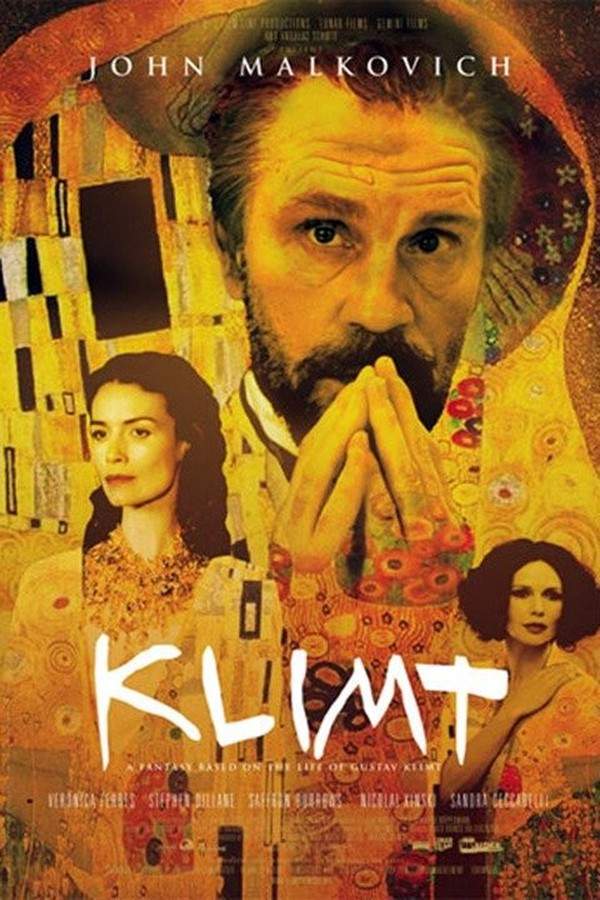
Klimt 2007


Directed by

Raoul Ruiz
Made by

Outsider Pictures
Where to Watch Klimt
See current US streaming, rental, and purchase options for Klimt (2007) via JustWatch.

Amazon Prime Video
HD
Amazon Prime Video with Ads
HD
Fawesome
HD
Kanopy
HD
Fandango at Home Free
HD
Filmzie
HD
Plex
HD
Plex Channel
HD
Tubi TV
SD
Xumo Play
HD
Amazon Video
SD Fandango At Home
SD Streaming availability powered by 
Klimt Plot Summary
Read the complete plot summary and ending explained for Klimt (2007). From turning points to emotional moments, uncover what really happened and why it matters.
This art house film unfolds as a sequence of nearly two dozen vignettes drawn from the life of Gustav Klimt, presented through his recollections while he endures mercury treatment in a hospital for advanced syphilis. The framing paints Klimt as a towering figure in late-19th to early-20th-century Vienna, where his art is celebrated across society and his name is synonymous with a daring, radiant vision.
Across the dreamlike memories, Klimt’s lifelong fascination with the beauty of the female form drives both his art and his restless personal life. His studio is a constant theater of nude models who pose for his drawings and oil paintings, and he moves with a remarkable openness about sexuality, casually forming intimate relationships with many of these muses. The film suggests that several of these relationships yield children, a theme that threads through his recollections as he navigates memory, guilt, and artistic obsession. In one striking moment, a younger man is introduced to a prostitute as Klimt’s daughter during a visit to a local brothel; when asked if this is true, Klimt calmly replies that he does not know, and the evening continues.
A recurring figure appears in the visualized episodes: an unnamed government official who seems to secure commissions from the Ministry of Culture for Klimt. When a three-panel order arises, Klimt executes the canvases and they are displayed at a grand government reception. The reception’s reception is mixed, yet Klimt’s standing as a major artist is acknowledged, bridging divides between high and low officials who observe his triumphs with equal parts admiration and scrutiny. Throughout these scenes, the presence of Egon Schiele—another Austrian artist—visits Klimt at various points, appearing as a contemporary commentator and participant within Klimt’s life’s recollections.
The film also traces Klimt’s two principal love affairs: Emilie Floege, a friend from Austria, and Lea de Castro, an actress from Paris. His attraction to both women centers on their embodiment of beauty, and at one juncture he even contemplates marriage to Emilie on the condition that it be an open marriage, illustrating a complex stance toward companionship and freedom that runs counter to conventional expectations.
A haunting sequence places Klimt with his mother and sister, both of whom are under care in an asylum for the mentally ill. They confront him with questions about rumors of illegitimate children, and Klimt reiterates that he does not know how many children he fathered or where many of them are. As his mercury treatment continues, his memories increasingly foreground the aesthetic triumphs of his art—the glow of color, the tension of line, and the beauty he sought to capture—while moral judgments linger in the background as secondary to the creative life he prizes.
The narrative crescendos with Klimt’s passing during the course of the treatment, yet his final recollections remain saturated with the splendor of art. The film leaves viewers with a meditation on memory, fame, and the enduring impulse of a man who measured life not by norms, but by the transformative power of beauty and expression.
Klimt Timeline
Follow the complete movie timeline of Klimt (2007) with every major event in chronological order. Great for understanding complex plots and story progression.
Klimt rises as Vienna's leading artist
Gustav Klimt is established as a leading artist in Vienna, with a growing reputation that attracts a steady stream of commissions and attention. His studio is constantly filled with nude models posing for his drawings and oil paintings. This period cements his fascination with the female form and his bold, inventive style.
Bohemian studio life and intimate liaisons
Klimt forms casual, intimate relationships with several models and uses their likenesses in his art. Some of these liaisons bear him children, though he does not always know all their identities. This bohemian lifestyle fuels a prolific and controversial period in his creative life.
The brothel encounter and a claimed daughter
During a night at a local brothel with a male acquaintance, Klimt is introduced to a prostitute as being his daughter, a claim tied to rumors about his past. He responds with ambiguity, saying he does not know the truth. The scene highlights how his private life becomes part of the public legend surrounding him.
A government patronage and a three-panel commission
A recurring government official arranges commissions from the Ministry of Culture for Klimt. He receives a three-panel commission for three large canvases, elevating his work into the realm of state art. Klimt completes the canvases and they are prepared for a formal government reception.
Reception and official recognition
The three large canvases are presented at a government reception, and the reception is mixed in its assessment of Klimt's quality. Nevertheless, he is acknowledged as an artist of stature by officials across society. The moment solidifies both public interest and institutional respect for his work.
Egon Schiele visits Klimt
Throughout the vignettes, the younger painter Egon Schiele visits Klimt at various points, underscoring the continuity of the Viennese modernist milieu. These visits occur while Klimt is reflecting on his life during the mercury treatment. The interactions highlight the mentorship and dialogue among Vienna's artists.
Emilie Floege – love and unconventional marriage plans
Klimt's long-standing relationship with Emilie Floege, a trusted Austrian confidante, features prominently in his recollections. He envisions marriage with Emilie, but only as an open marriage, reflecting his belief in freedom within love. This relationship informs both his personal life and his art.
Lea de Castro – love from Paris
Klimt also pursues a romance with Lea de Castro, a Parisian actress who features in his works. The Parisian connection expands his horizon and the range of female beauty he seeks to depict. Like Emilie, Lea becomes a muse who shapes his art.
Family concerns and rumors of illegitimate children
In a vision of his past, Klimt confronts his mother and sister, both held in asylum, about rumors of illegitimate children. He maintains a stance of ignorance about the number and identities of his progeny. The scene contrasts family anxieties with his singular devotion to art.
Mercury treatment begins in hospital
As his syphilis is treated with mercury, Klimt's memories become a sequence of recollections rather than a linear biography. The hospital setting frames his aging, while the art-filled visions persist. He clings to the beauty of his art even as his body suffers.
Artistic legacy in the face of mortality
With the treatment continuing, Klimt's reflections emphasize his career and the beauty he created rather than moral judgments about his personal life. The memories sustain him as his life nears its end. The film foregrounds art as the core of his identity.
Death and last recollections
Klimt expires during mercury treatment, and his final recollections revolve around the beauty of his art. The narrative closes on an affirmation that art endures beyond personal scandal. The life is framed as a meditation on artistic vocation rather than life details.
Klimt Characters
Explore all characters from Klimt (2007). Get detailed profiles with their roles, arcs, and key relationships explained.
Gustav Klimt
Renowned Austrian painter and central figure of the film; the story tracks Klimt through late life and memory. He is celebrated in Vienna yet pragmatic about his relationships with models and lovers. The vignettes reveal a prolific creator whose art is intimately tied to his sexual freedom and progeny.
Emilie Floege
A longtime confidant and lover who embodies Klimt’s romantic openness. Her relationship with Klimt is significant and influential, including an open marriage proposal. She features in his art and in his recollections as an important muse.
Lea de Castro
Parisian actress and Klimt's lover; appears as a muse from Paris and as part of his memory vignettes. Her influence threads through Klimt’s art and recollections.
Egon Schiele
Fellow Austrian artist who visits Klimt in his recollections, illustrating a dialogue between two generations of artists and their ideas.
Unnamed Government Official
Recurring figure who secures commissions from the Ministry of Culture, representing state support and oversight of Klimt’s work.
Mother
Klimt’s mother, herself and his sister are depicted in asylum, confronting him about rumors of his progeny and moral expectations.
Sister
Klimt’s sister, portrayed within the asylum context, reflecting familial concerns about his life and legacy.
Klimt Settings
Learn where and when Klimt (2007) takes place. Explore the film’s settings, era, and how they shape the narrative.
Time period
Late 19th to early 20th century
Set in imperial Vienna and linked locales, the film unfolds during a transitional period at the turn of the century. The mercury treatment places the story in a pre-antibiotic era, highlighting medical practices of the time. The era’s vibrant art scene and shifting moral attitudes frame Klimt’s life and relationships.
Location
Vienna, Austria, Paris, France
The film centers on Vienna’s cultural landscape, with Klimt’s studio and public receptions shaping his career. A hospital setting during mercury treatment anchors the narrative in late-era Austria. The story also touches on Paris as a backdrop through Lea de Castro and the international reach of Klimt’s circle.
Klimt Themes
Discover the main themes in Klimt (2007). Analyze the deeper meanings, emotional layers, and social commentary behind the film.
🎨
Art
Art is Klimt’s center and public identity; his depictions of the female form fuel his fame. The vignettes frame his memories as paintings in motion, blending recollection with imagination. Government receptions and commissions show art as both vocation and public spectacle. The film posits art as a private truth revealed through public beauty.
🧠
Memory
Mercury-treatment sequences reveal Klimt’s remembered life, looping through younger years and relationships. The disjointed vignettes blur memory and invention, creating a subjective portrait rather than a factual chronology. Each recollection centers on art, lovers, and progeny, shaping his self-image. Memory drives the narrative as a bridge between personal longing and artistic legacy.
💖
Love & Relationships
Klimt’s affairs with Emilie Floege and Lea de Castro reveal a nonconformist attitude toward love and marriage. The open marriage proposal shows his desire to reconcile personal freedom with social expectations. He depicts his partners in his art, blending affection with aesthetic idealization. The film frames relationships as both inspiration and complication in his life.
⚰️
Mortality
Mercury treatment for syphilis marks Klimt’s decline and eventual death, casting mortality as a force shaping his art. The narrative keeps focus on the beauty of his work even as life ends. Aging and illness refract how he approaches his subject matter and relationships.

Coming soon on iOS and Android
The Plot Explained Mobile App
From blockbusters to hidden gems — dive into movie stories anytime, anywhere. Save your favorites, discover plots faster, and never miss a twist again.
Sign up to be the first to know when we launch. Your email stays private — always.
Explore the mobile appKlimt Spoiler-Free Summary
Discover the spoiler-free summary of Klimt (2007). Get a concise overview without any spoilers.
In the waning years of the 19th century, Vienna shimmered with gilded cafés, bustling salons and a restless hunger for cultural rebirth. The city’s opulent streets and hushed museum halls form a tapestry of elegance and tension, where art is both a public spectacle and a private obsession. Within this luminous backdrop, the film moves with a painterly rhythm, letting color, line and the whisper of silk drape every scene in a dream‑like glow.
At the heart of this world stands Gustav Klimt, a visionary whose canvases have become symbols of both scandal and brilliance. As the narrative unfolds through his own recollections, we glimpse an artist for whom the female form is an endless source of fascination, a living canvas that fuels his most daring creations. His studio, a perpetual stage of nude models and hushed conversation, mirrors his openness about desire and the tangled intimacy that fuels his work.
The portrait of Egon Schiele flickers in as a younger contemporary, a sharp-eyed commentator who both admires and challenges Klimt’s reverence for beauty. Around them swirl patrons and officials who commission grand works, and two pivotal loves emerge: Emilie Floege, a confidante whose bond hints at an unconventional partnership, and Lea de de Castro, a Parisian actress whose allure adds a continental flair. These relationships, set against the clamor of aristocratic receptions and quiet, private moments, suggest a life lived on the border between public acclaim and personal secrecy.
Through a lens that shifts between vivid memory and fragile present, the film invites the audience to dwell on the tension between fame and the artist’s inner pulse. It is a meditation on how a single mind can reshape an entire era, leaving a lingering question: does true beauty reside in the strokes on a canvas, or in the restless heart that dares to imagine it?
Movies with Similar Twists and Themes
Uncover films that echo the narrative beats, emotional arcs, or dramatic twists of the one you're exploring. These recommendations are handpicked based on story depth, thematic resonance, and spoiler-worthy moments — perfect for fans who crave more of the same intrigue.


Featured on this page

What's After the Movie?
Not sure whether to stay after the credits? Find out!
Check out our other apps:

SAT Sphere
Build confidence for the Digital SAT.

Mori Atlas
Discover wild places worth protecting.

Luntero
Search smarter for a home in Amsterdam.

Plot Explained
Unravel movie endings and hidden clues.

Pokechamp
Dive into Pokémon data and battle logic.

Driving Theory
Get ready for your European theory test.

Movie Dust
Plan your next cinema trip with ease.

Musemap
Find art and culture as you travel.

Selkobase
Compare credentials before committing.

Local Manual
Turn an unfamiliar country into practical next steps.

Lernavi
Compare school systems before your next move.

GymRoam
Find a workout stop wherever your plans take you.
Explore Our Movie Platform
New Movie Releases (2026)
Famous Movie Actors
Top Film Production Studios
Movie Plot Summaries & Endings
Major Movie Awards & Winners
Best Concert Films & Music Documentaries
Movie Collections and Curated Lists
© 2026 What's After the Movie. All rights reserved.
Privacy Policy