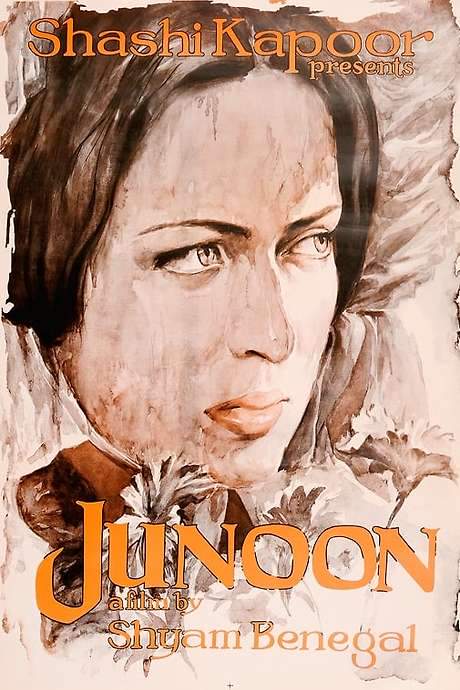


Junoon Plot Summary
Read the complete plot summary and ending explained for Junoon (1978). From turning points to emotional moments, uncover what really happened and why it matters.
Set against the 1857 Indian Rebellion, Javed Khan Shashi Kapoor is a reckless feudal chieftain of Muslim Pathan heritage whose life centers on breeding carrier pigeons. His younger brother-in-law, Sarfaraz Khan Naseeruddin Shah, grows increasingly politically aware and begins openly resisting British rule. When a wave of violence hits the countryside, freedom fighters strike at British administrators during Sunday worship at a church, leaving a trail of devastation that heralds a wider clash between empires and loyalties.
Miriam Labadoor Jennifer Kendal escapes the carnage with her daughter Ruth Labadoor Nafisa Ali and Ruth’s maternal grandmother, a Muslim woman from the royal Nawabi line of Rampur. They seek sanctuary with the wealthy Hindu kin of Lala Ramjimal [Kulbhushan Kharbanda], a man torn between his Indian loyalties and his privileged status under the British. Lala’s household becomes a fragile battleground of culture, expectations, and unspoken longing, especially as his wife Firdaus Shabana Azmi watches with growing jealousy and discomfort. The arrival of Miriam’s daughter and mother unsettles the domestic routine, and Javed Khan forcefully drags Ruth into his own home, upending the precarious balance already in play.
The situation deepens as old loyalties collide with new passions. Javed’s growing attraction to Ruth strains the marriage and social codes that govern the Muslim household, while Ruth herself harbors a quiet yet undeniable connection to him. Miriam, recognizing the danger but also sensing a chance to reshape her daughter’s fate, proposes a stark bargain: Ruth’s hand in marriage to Javed should the British be defeated. At first reluctant, Javed agrees after Miriam challenges him with a stark choice—his fight for independence or continued subjugation under colonial rule. The tension between sincere affection and strategic calculation simmers under the surface, particularly as Firdaus’s suspicions and the family’s precar position threaten to unravel the fragile sanctuary they’ve found.
As the rebellion falters against the better-organized British forces, the story follows a cruel turn of events. Sarfaraz, enraged by the setbacks, destroys Javed’s treasured pigeon coops and frees the birds, a symbolic act illustrating how personal passions collide with political aims. The battlefield humbles all: the Indian forces crumble in Delhi, and Sarfaraz dies in combat, his death underscoring the cost of rebellion and the painful toll exacted by colonial power. The Labadoors, seeking safety, are reluctantly welcomed back into the protection of the British, a choice that weighs heavily on Miriam and Ruth as they navigate a tense, morally complex landscape. Firdaus, driven by a stubborn vision of preserving her marriage, helps shield the Labadoors but remains acutely aware of the consequences.
Javed, drawn by a mixture of duty and longing, races to the church where Ruth and her mother have sought sanctuary. The moment is charged with emotion as Ruth steps out and reveals her feelings for Javed, defying her mother’s wishes. Yet the noble oath that Miriam extracted from Javed weighs on him, and he honors it by stepping away rather than breaking his promise. The scene is a quiet, devastating counterpoint to the storm of the rebellion outside, showing that personal vows can outlast even the fiercest political upheaval.
In the final act, the rebellion’s momentum finally shifts in favor of the British, and Javed is depicted as a martyr fighting for a cause he once embraced with pure intensity. Ruth and her mother depart for England with the Labadoors, their path tracing a long arc that ends many years later. Ruth dies fifty-five years after the events, unwed, a somber coda that emphasizes the enduring costs of conflict, divided loyalties, and the unfulfilled promises threaded through the film’s intricate emotional tapestry. The closing voiceover grounds the saga in a historical memory: the British victory and the sacrifices that helped shape a nation’s uneasy road to independence, seen through the intimate lens of a few families caught between two worlds.
Junoon Timeline
Follow the complete movie timeline of Junoon (1978) with every major event in chronological order. Great for understanding complex plots and story progression.
Javed Khan and his pigeon world
Javed Khan is a reckless feudal chieftain whose life revolves around breeding carrier pigeons. His world reflects the old order, stubborn pride, and a growing collision with British authority. This fascination with birds frames his character as both a guardian of tradition and a potential spark for wider conflict.
Sarfaraz Khan awakens politically
Sarfaraz Khan, Javed's brother-in-law, is politically awakened and begins plotting against the British. He embodies a new generation that questions subjugation and seeks an active role in the rebellion. His outbursts set in motion a broader movement even as personal loyalties are tested.
Massacre at Sunday worship
Freedom fighters strike at the British during Sunday worship, massacring the officials as they pray. The attack galvanizes both sides and triggers retribution and tightening controls. This event marks a pivotal escalation in the rebellion's reach.
Miriam and Ruth seek refuge
Miriam Labadoor escapes with her daughter Ruth and Ruth's grandmother and seeks shelter with Lala Ramjimal, a wealthy Hindu host. The invitation tests old loyalties and introduces cross-cultural dynamics amid crisis. Their shelter provides a fragile sanctuary in the midst of war.
Lala's inner conflict
Lala Ramjimal wrestles with a choice between Indian loyalty and British privilege. He also harbors a quiet, unspoken affection for Miriam, complicating the safety of the guests. The domestic crisis exposes the fault lines of comfort, honor, and survival.
Javed forcibly relocates Ruth
Javed Khan barges into Lala's house and forcibly takes Ruth and her family to his own home. The raid intensifies the strain of hospitality and turns the house into a contested space between old loyalties and the new English guests. Jealousy erupts in Firdaus, and his brother's anger deepens the conflict.
Nanawatai and domestic tension
Nanawatai hospitality enters the narrative as the household accommodates uninvited guests, testing long-standing norms. Firdaus grows jealous of Ruth, while Javed's own feelings blur the line between duty and desire. The clash of customs deepens the strain within the Muslim household.
Love and a political bargain
Javed falls in love with Ruth and wants to marry her, but Ruth's mother Miriam opposes the match. Miriam negotiates with Javed, offering Ruth's hand only if the British are defeated. The romance simmers under Firdaus's watchful, wary eyes.
British defeats and the Delhi setback
The rebellion stalls as British forces push back Indian resistance, culminating in setbacks like the Battle for Delhi. The setback tempers the zeal of the rebels and complicates personal loyalties. The struggle becomes an increasingly costly affair for everyone involved.
Pigeons destroyed as a protest
In a stormy moment, Sarfaraz destroys Javed's pigeon coops and frees the birds after learning of the Delhi defeat. The act signals a break with traditional loyalties and personal protest within the rebellion. It foreshadows the deeper rifts tearing the movement apart.
Sarfaraz dies in battle
Sarfaraz Khan dies fighting the British, a costly sacrifice that underscores the price of awakening and the costs of internal conflict. His death intensifies the moral ambiguity surrounding resistance. Javed's perception of independence begins to shift in the wake of his brother-in-law's loss.
Labadoors seek British protection
The Labadoors seek sanctuary with a re-deployed British contingent. Firdaus helps smuggle the family to safety, aiming to salvage her marriage and escape the turmoil. The episode exposes how personal survival intersects with imperial politics.
Church confrontation and Ruth's confession
Javed learns that the Labadoors sought sanctuary in the church and rushes there for one last meeting with Ruth. Ruth steps out and confesses her love for Javed, defying her mother's wishes. Javed, true to his word, leaves the church without Ruth.
Javed's martyrdom
The story's voiceover confirms that Javed was martyred fighting the British. His sacrifice caps the rebellious arc and seals his loyalty to his ideal of resistance. Ruth and her mother choose exile in England as the rebellion fades.
Ruth's later life and death
Ruth and Miriam return to England after the rebellion. Ruth lives an unwed life for fifty-five years and dies in England, marking a quiet end to a tale of impossible love. The ending lingers on the human costs of war and displacement.
Junoon Characters
Explore all characters from Junoon (1978). Get detailed profiles with their roles, arcs, and key relationships explained.
Javed Khan (Shashi Kapoor)
A reckless feudal chieftain whose life orbits around breeding carrier pigeons. He is drawn to Ruth while navigating his sense of honor and the turbulent politics of the rebellion. His arc moves from domestic indulgence to a costly but martyr-like stand against the British.
Miriam Labadoor (Jennifer Kendal)
Ruth’s mother, a Nawabi-influenced woman who manipulates events to secure a future for her daughter. She escapes with Ruth and Ruth’s grandmother, leveraging diplomacy and grit to negotiate with Javed and others. Her choices hinge on safeguarding her family amid empire-wide upheaval.
Ruth Labadoor (Nafisa Ali)
Daughter of Miriam, Ruth becomes the focal point of competing loyalties and a potential union with Javed. Her feelings complicate a war-torn landscape, and her survival hinges on the shifting alliances around her. The narrative ends with Ruth remaining unwed as the rebellion reorganizes.
Firdaus (Shabana Azmi)
Javed’s wife, whose jealousy grows as Ruth and Miriam challenge the household’s balance. She embodies domestic tension and the strain of hosting strangers while navigating her own place within a patriarchal order. Her reactions reveal the fragility of intimate relationships in wartime.
Sarfaraz Khan (Naseeruddin Shah)
Javed’s politically awakened brother-in-law who becomes a voice for armed resistance. He sabotages Javed’s pigeons as part of the rebellion and meets a fatal fate in battle. His arc embodies the rise and fall of revolutionary fervor within a fractured society.
Lalal Ramjimal (Kulbhushan Kharbanda)
A wealthy Hindu patriarch torn between loyalty to India and his privileged British-backed status. He shelters Ruth’s family at times, highlighting the moral complexity of class and allegiance during the rebellion. His actions reveal the private conflicts behind public duty.
Maternal Grandmother of Ruth Labadoor (Ismat Chughtai)
A matriarch from the Rampur Nawabi milieu who embodies traditional cultural divides. She was married to an Englishman, illustrating the cross-cultural currents shaping Ruth’s lineage. Her presence marks the intergenerational perspective on empire and identity.
Junoon Settings
Learn where and when Junoon (1978) takes place. Explore the film’s settings, era, and how they shape the narrative.
Time period
1857
Set during the Indian Rebellion of 1857, the film captures a pivotal moment when Indian rulers and commoners alike confront British control. The period is marked by shifting loyalties, social rituals in households, and a rising sense of national consciousness. The events center on the rebellion’s early battles, the fall of Delhi, and the personal costs of war.
Location
Rampur, Delhi, India
The story unfolds in northern India against the backdrop of Rampur’s Nawabi society during the 1857 rebellion. It highlights the tension between traditional Muslim courtesies and the encroaching reach of the British Empire. The setting includes lavish households, communal rituals, and a volatile political atmosphere spurred by the rebellion and the Battle for Delhi.
Junoon Themes
Discover the main themes in Junoon (1978). Analyze the deeper meanings, emotional layers, and social commentary behind the film.
⚔️
Conflict & Sacrifice
The rebellion against British rule drives the plot, placing characters in life-or-death choices. Loyalties are tested as feudal tradition clashes with a rising nationalist sentiment. Personal bonds are broken and forged in the furnace of war, culminating in acts of courage and loss.
❤️
Forbidden Love & Duty
Romantic tension exists between Javed and Ruth, complicated by Miriam’s stipulation to defeat the British in exchange for Ruth’s hand. Family expectations and cultural obligations threaten to override personal desire. The couple’s fate reflects how love is constrained by political and social power structures.
🤝
Hospitality & Tension
Nanawatai-like hospitality turns into a contest of loyalties when Ruth and her family seek refuge. The domestic sphere, meant to shelter, becomes a site of cultural misunderstanding and strategic maneuvering. Boundaries blur as kindness intersects with political necessity, shaping the characters’ fates.

Coming soon on iOS and Android
The Plot Explained Mobile App
From blockbusters to hidden gems — dive into movie stories anytime, anywhere. Save your favorites, discover plots faster, and never miss a twist again.
Sign up to be the first to know when we launch. Your email stays private — always.
Explore the mobile appJunoon Spoiler-Free Summary
Discover the spoiler-free summary of Junoon (1978). Get a concise overview without any spoilers.
In the scorching summer of 1857, India trembles under the first sparks of a nationwide uprising. The air is thick with the clang of muskets, the fragrant incense of temples, and the whispered prayers of families huddled behind crumbling walls. Against this turbulent backdrop, the film paints a portrait of a society caught between ancient tradition and the relentless advance of colonial power, where every conversation carries the weight of history and every glance hints at unseen alliances.
Javed Khan is a restless Nawab whose world revolves around the delicate art of breeding carrier pigeons, a hobby that mirrors his yearning for freedom and control. His attention becomes fixated on Ruth Labadoor, a young Anglo‑Indian woman whose mixed heritage places her at the crossroads of two cultures. Ruth’s mother, Miriam Labadoor, is a formidable presence determined to protect her daughter from entanglements that could jeopardize their fragile safety. Their interactions are charged with a mixture of curiosity, restraint, and the unspoken promise of something more, setting the stage for a delicate dance of desire and duty.
Within the sprawling household of Lala Ramjimal, a wealthy Hindu whose loyalties are torn between his native roots and the privileges granted by the British, the tension grows even deeper. Firdaus, Lala’s wife, watches the arrival of Miriam’s family with a blend of hospitality and guarded suspicion, aware that unfamiliar customs can unsettle the fragile equilibrium of her home. Meanwhile, Sarfaraz Khan, Javed’s younger brother‑in‑law, awakens to the political currents swirling around him, his growing awareness adding another layer to the complex web of personal and national loyalties.
The film’s tone is intimate yet expansive, weaving whispered confidences and grand historical reverberations into a tapestry of longing, honor, and cultural collision. As the rebellion swells and the world beyond the household shifts, the characters must navigate love, ambition, and the ever‑present question of where their true allegiance lies, leaving the audience poised on the edge of an unfolding, uncertain destiny.
Movies with Similar Twists and Themes
Uncover films that echo the narrative beats, emotional arcs, or dramatic twists of the one you're exploring. These recommendations are handpicked based on story depth, thematic resonance, and spoiler-worthy moments — perfect for fans who crave more of the same intrigue.






Featured on this page

What's After the Movie?
Not sure whether to stay after the credits? Find out!
Check out our other apps:

SAT Sphere
Build confidence for the Digital SAT.

Mori Atlas
Discover wild places worth protecting.

Luntero
Search smarter for a home in Amsterdam.

Plot Explained
Unravel movie endings and hidden clues.

Pokechamp
Dive into Pokémon data and battle logic.

Driving Theory
Get ready for your European theory test.

Movie Dust
Plan your next cinema trip with ease.

Musemap
Find art and culture as you travel.

Selkobase
Compare credentials before committing.

Local Manual
Turn an unfamiliar country into practical next steps.

Lernavi
Compare school systems before your next move.

GymRoam
Find a workout stop wherever your plans take you.
Explore Our Movie Platform
New Movie Releases (2026)
Famous Movie Actors
Top Film Production Studios
Movie Plot Summaries & Endings
Major Movie Awards & Winners
Best Concert Films & Music Documentaries
Movie Collections and Curated Lists
© 2026 What's After the Movie. All rights reserved.
Privacy Policy