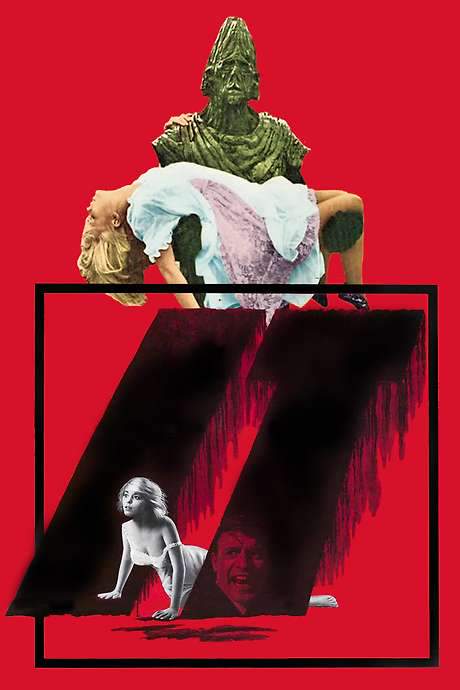
It! 1967

Directed by

Herbert J. Leder
Made by

Gold Star Films Ltd.
It! Plot Summary
Read the complete plot summary and ending explained for It! (1967). From turning points to emotional moments, uncover what really happened and why it matters.
In a quiet London setting, a warehouse fire at a museum sparks a mystery that will coil through art, obsession, and ancient danger. The blaze leaves intact a statue that the museum’s head curator, Ernest Clark, identifies as a relic labeled the “Mid-European Primitive.” The catastrophe is followed by a chilling turn of events when the curator is killed during a late inspection of the artifact, and his assistant, Roddy McDowall as Arthur Pimm, is sent off to fetch a flashlight. What begins as a routine recovery mission quickly spirals into a sequence of unexplained deaths and catastrophic accidents, all strangely tied to the statue.
The object itself is soon revealed to be the legendary Golem of Judah Loew from the sixteenth century, a being forged to defend its community. Arthur Pimm—who carries a disturbing mood and a fixation on his late mother—cossets a macabre home life, keeping his mother’s corpse in his apartment and surreptitiously borrowing jewelry to adorn it. In the process of handling the Golem, he performs a perilous ritual: he places a small scroll containing the Hebrew word emeth (truth) into a hidden compartment at the top of the golem’s right foot. When the scroll is activated, the Golem stirs to life and immediately becomes Pimm’s dangerous ally, bending to his will in ways that betray the creature’s intended role as a protector of its community.
As the Golem grows more active, it is implicated in a spectacular crisis: the supposed destruction of the Hammersmith Bridge. Society’s fear intensifies as the statue’s presence appears to unleash devastation, and Pimm himself becomes embroiled in the murderous aftermath. The film posits a chilling caution about power unleashed and control wrested away from human hands. The inscription on the statue seems to foretell its fate: a warning that it cannot be destroyed by ordinary means. As the threat escalates, the movie leans into a foreboding sense that the Golem will endure where others fail.
for neither by fire, nor water, nor force, nor anything by man created
Meanwhile, a romantic and professional triangle tightens around Ellen Grove, the earlier curator’s daughter, who finds herself drawn to a new admirer from the New York Museum. Jill Haworth portrays Ellen, while Paul Maxwell plays Jim Perkins, a curator from the New York institution who quickly identifies the Golem and senses a strategic opportunity to acquire it for his own museum. Perkins’s presence creates a counterforce to Pimm’s escalating danger, and Ellen’s affections become a focal point in a story that blends love, ambition, and peril.
As the plot advances, Perkins exposes Pimm to the authorities, and the troubled assistant is committed to an insane asylum. Yet the fixation does not end there: Pimm stages a dramatic breakout, kidnapping Ellen with the Golem’s unwelcome complicity. The two retreat to the museum’s annex in a rural area known as the Cloisters, where tension and danger converge. Perkins makes a desperate stand to salvage Ellen and prevent further catastrophe, culminating in a dramatic rescue just as a nuclear blast threatens to annihilate the Cloisters. The explosion vaporizes Pimm and the Cloisters, but intriguingly, the Golem remains, retreating into the sea with an almost inexplicable silence.
The film closes on a note of unresolved mystery, where the Golem’s ultimate fate is left to the sea’s tides. The tale threads together themes of obsession, ethical boundaries in the face of ancient power, and the fragile line between guardian and danger. The cast’s performances ground a narrative that marries Gothic dread with a modern sense of peril, anchored by the chilling possibility that some old legends refuse to stay buried.
- Main cast elements recur through the narrative, with a focus on the intertwined fates of the human characters and the living statue, and the enduring question of whether power can ever be fully controlled once awakened.
It! Timeline
Follow the complete movie timeline of It! (1967) with every major event in chronological order. Great for understanding complex plots and story progression.
Warehouse fire reveals undamaged statue
A London museum's warehouse burns, yet a statue remains unscathed amid the flames. The museum's curator, Mr. Grove, identifies the statue as 'Mid-European Primitive' as investigators scramble to understand its survival. The incident seeds a mystery that centers on the artifact's supposed power.
Curator Grove is murdered during inspection
While inspecting the artifact, Grove is mysteriously killed. His assistant, Arthur Pimm, is sent to fetch a flashlight and becomes drawn into the escalating danger surrounding the statue. The murder marks the first in a series of unexplained calamities linked to the Golem.
Arthur Pimm brings the Golem to life
Pimm, a Norman Bates–like figure who keeps his mother's corpse, uses a small scroll found at the top of the Golem's right foot—bearing the Hebrew word 'emeth'—to awaken the statue. The creature becomes his tool for murder rather than a defender of the community. The Golem's awakening marks the beginning of its deadly partnership with Pimm.
Golem becomes Pimm's deadly accomplice
From this point, the Golem assists in murders and acts of mayhem, transforming from an artifact of protection into a weapon under Pimm's control. The statue's rumored power seems to pull the strings behind the escalating chaos surrounding the artifact. People linked to the statue begin to die in mysterious ways.
Bridge destruction and the inscription's barrier
The Golem is suspected to be behind the catastrophic destruction of Hammersmith Bridge. Pimm attempts to destroy the creature, but the ancient inscription promises immunity: 'neither by fire, nor water, nor force, nor anything by man created.' The line proves a fatal obstacle to their plan.
Jim Perkins arrives and identifies the Golem
Jim Perkins of the New York Museum arrives and identifies the Golem as a living relic from myth. He also shows interest in acquiring the artifact for his own institution, a development that entangles Ellen Grove with the international art trade. Ellen's affections shift toward Perkins as the case deepens.
Pimm is exposed to the police and imprisoned
Perkins exposes Pimm to the authorities, leading to the latter's commitment to an insane asylum. The clash between obsession, crime, and institutional power marks a turning point in the chase over the Golem. The authorities' involvement deepens the web of danger around the statue.
Pimm escapes, abducts Ellen with Golem's help
Pimm breaks out of confinement and kidnaps Ellen, aided by the Golem. He holes up in the museum's country annex known as the Cloisters, where the pursuit and tension escalate toward a final confrontation. Ellen becomes an unwilling pawn in the violent power struggle over the artifact.
Nuclear detonation and rescue
A nuclear warhead detonates in an attempt to stop the Golem, vaporizing Pimm and the Cloisters. Perkins saves Ellen from the explosion, while the Golem, for reasons unexplained, remains unscathed and retreats toward the sea. The catastrophe ends in ambiguous aftermath.
The Golem vanishes into the sea
Despite the destruction, the Golem survives and withdraws into the sea, leaving questions about its fate and the true nature of its threat. The film closes on an ominous note, with the life-sized statue slipping from view. The mystery of what comes next lingers after the catastrophe.
It! Characters
Explore all characters from It! (1967). Get detailed profiles with their roles, arcs, and key relationships explained.
Harold Grove
The museum’s curator who identifies the statue as the Mid-European Primitive. He is killed under mysterious circumstances while inspecting the artifact, triggering the chain of deaths connected to the Golem. He represents the cautious, duty-bound guardian figure at the story’s outset.
Arthur Pimm
A Norman Bates-like figure who keeps his mother’s corpse in his apartment and uses stolen jewelry to adorn it. He awakens the Golem by placing the Hebrew word emeth in its mouth and makes the creature his accomplice in murder. His love for Ellen becomes a driving force behind the mayhem.
Jim Perkins
A representative from the New York Museum who identifies the Golem and seeks to acquire it for his institution. He exposes Pimm to the police and becomes a driving force in pursuing a controlled display of the artifact. He embodies cross-Atlantic competition and ethical scrutiny.
Ellen Grove
Daughter of the first deceased curator, Ellen becomes part of a complex love dynamic, initially drawn to Jim Perkins. She is entangled in the danger surrounding the Golem and Pimm, making her a central figure in the human drama surrounding the artifact.
The Golem
An animated statue identified as the Golem of Judah Loew, which carries a dangerous legacy. It acts under the control of the person who awakens it, yet its supposed defense of the community is subverted by Pimm. The Golem’s resilience is proven when it survives attempts at destruction and ultimately retreats to the sea.
Prof. Weal
A professor involved in the scholarly discussion around the artifact (as per cast list). He represents the academic attempt to understand the Golem’s origins and significance within a museum context.
Miss Swanson
A minor character connected to the museum milieu, contributing to the social web around the central figures.
Insp. White
An inspector who is involved in the investigation surrounding the deaths and paranormal events tied to the Golem.
Curator Trimingham
A curator figure within the museum network, providing institutional perspective on the artifacts and their handling.
The Old Rabbi
A figure tied to the Golem’s legend and Jewish folklore surrounding the creature’s origin.
It! Settings
Learn where and when It! (1967) takes place. Explore the film’s settings, era, and how they shape the narrative.
Time period
1960s
The events unfold in the 1960s London milieu, a period marked by modern institutions and public fascination with ancient myths. The era’s interest in museums and urban culture provides a contemporary stage for occult threats. The climax is anchored by a nuclear warhead detonation, reflecting Cold War anxieties of the time. The time period underscores themes of technological power colliding with age-old legends.
Location
London, Hammersmith, New York, The Cloisters
The story unfolds primarily in London, centering on a museum warehouse fire that reveals the mysterious statue. The urban backdrop—museums, industrial areas, and city bridges—frames a chain of unexplained deaths tied to the artifact. The Cloisters in the countryside and the New York Museum later enter the narrative as the Golem’s influence broadens beyond London.
It! Themes
Discover the main themes in It! (1967). Analyze the deeper meanings, emotional layers, and social commentary behind the film.
🗝️
Obsession
Arthur Pimm’s fixation on his mother’s corpse and the artifact drives his every action. He steals, manipulates, and uses the Golem as a tool for murder, showing how fixation can warp morality. His love for Ellen becomes entangled with his criminal pursuits, turning affection into coercion and danger. The theme examines how obsession can override ethics and unleash violence.
⚗️
Artifact Power
The Golem embodies dangerous power unleashed by a ritual and a cryptic inscription. Its role shifts from guardian to instrument of destruction under Pimm’s manipulation. The story probes the lure and peril of ancient mysteries when placed in modern hands. Power embodied in artifact form resists simple control or eradication.
☢️
Nuclear Threat
The plot escalates with the plan to detonate a small nuclear warhead to stop the menace. The explosion tests the limits of human intervention and the Golem’s resilience. Even as the device detonates, the Golem survives, retreating toward the sea, leaving humanity with an uneasy victory. The theme anchors the tale in Cold War-era fears of annihilation.

Coming soon on iOS and Android
The Plot Explained Mobile App
From blockbusters to hidden gems — dive into movie stories anytime, anywhere. Save your favorites, discover plots faster, and never miss a twist again.
Sign up to be the first to know when we launch. Your email stays private — always.
Explore the mobile appIt! Spoiler-Free Summary
Discover the spoiler-free summary of It! (1967). Get a concise overview without any spoilers.
In the heart of London a grand museum safeguards the past, its vaulted halls echoing with the rustle of history. When a devastating fire engulfs the storage wing, every relic turns to ash—except for a solitary, enigmatic statue that emerges untouched. Its surface bears ancient symbols and an unsettling sense of permanence, hinting at legends of a creation that cannot be undone by flame, water, or any force known to man. The surviving artifact becomes the quiet catalyst for a story that drifts between scholarly intrigue and a lingering, almost palpable dread.
The museum’s senior curator, Grove, is a man whose reverence for the unknown is matched only by his determination to protect his collection. He entrusts the day‑to‑day responsibilities to his assistant, Pimm, a figure whose peculiar habits and obsessive fascination with the statue set him apart in the orderly world of conservation. Their partnership is a study in contrast: Grove’s measured authority meets Pimm’s restless curiosity, each drawn to the statue’s mystery for different reasons. Adding personal complexity, Ellen Grove, the curator’s daughter, navigates the same corridors, her presence weaving familial expectations into the unfolding tension.
Across the Channel, Jim Perkins arrives from a New York museum, his academic poise masking a deep personal interest in antiquities of mythic origin. He recognizes the statue as a possible incarnation of a 16th‑century creation attributed to Rabbi Loew, an artifact said to be forged beyond the reach of ordinary destruction. Perkins’s scholarly perspective introduces a measured, almost scientific counterpoint to the more instinctual drives of Grove and Pimm, setting the stage for a delicate balance between reverence and ambition.
The film’s tone is a blend of gothic atmosphere and quiet psychological suspense, where the cold stone of the statue reflects the hidden impulses of those who surround it. The museum becomes a character in itself—a labyrinth of knowledge where each hallway murmurs with the promise of discovery and the threat of the unknowable. As curiosity deepens, the ordinary world of catalogues and exhibitions gently slides into a realm where ancient myth and modern obsession intersect, inviting the audience to wonder what may awaken when the past refuses to stay buried.
Movies with Similar Twists and Themes
Uncover films that echo the narrative beats, emotional arcs, or dramatic twists of the one you're exploring. These recommendations are handpicked based on story depth, thematic resonance, and spoiler-worthy moments — perfect for fans who crave more of the same intrigue.


Featured on this page

What's After the Movie?
Not sure whether to stay after the credits? Find out!
Check out our other apps:

SAT Sphere
Build confidence for the Digital SAT.

Mori Atlas
Discover wild places worth protecting.

Luntero
Search smarter for a home in Amsterdam.

Plot Explained
Unravel movie endings and hidden clues.

Pokechamp
Dive into Pokémon data and battle logic.

Driving Theory
Get ready for your European theory test.

Movie Dust
Plan your next cinema trip with ease.

Musemap
Find art and culture as you travel.

Selkobase
Compare credentials before committing.

Local Manual
Turn an unfamiliar country into practical next steps.

Lernavi
Compare school systems before your next move.

GymRoam
Find a workout stop wherever your plans take you.
Explore Our Movie Platform
New Movie Releases (2026)
Famous Movie Actors
Top Film Production Studios
Movie Plot Summaries & Endings
Major Movie Awards & Winners
Best Concert Films & Music Documentaries
Movie Collections and Curated Lists
© 2026 What's After the Movie. All rights reserved.
Privacy Policy