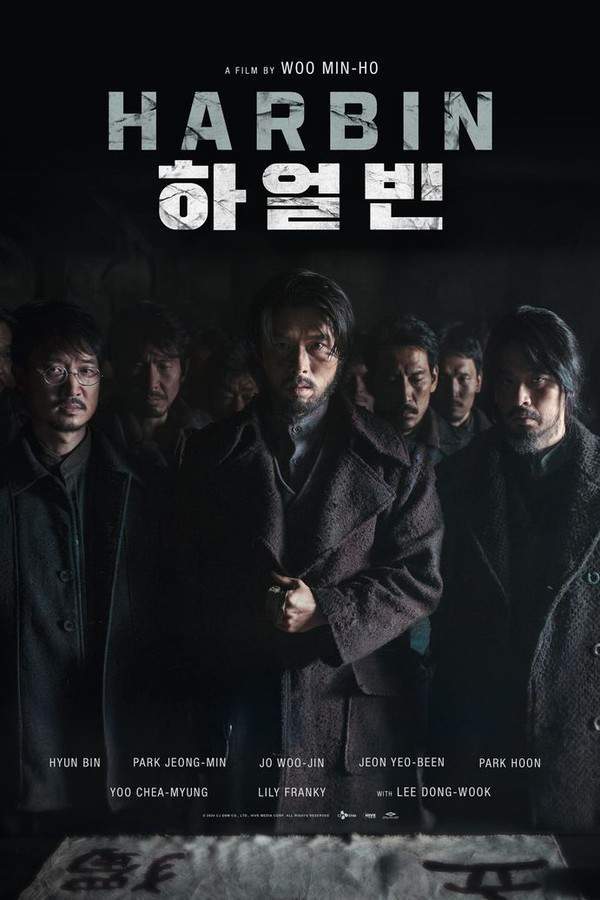
Harbin 2024


Made by

CJ ENM Co.
Where to Watch Harbin
See current US streaming, rental, and purchase options for Harbin (2024) via JustWatch.

Amazon Prime Video
HD
Amazon Prime Video with Ads
HD
Hi-YAH Amazon Channel
HD
Hulu
HD
Fawesome
HD
Hoopla
SD
Kanopy
HD
Amasian TV
HD
Plex
HD
Plex Channel
HD
The Roku Channel
HD
Tubi TV
SD
YouTube Free
HD
Amazon Video
HD
Apple TV Store
4K
Fandango At Home
SD
FlixFling
HD
Google Play Movies
SD
OnDemandKorea
HD
YouTube
SD Streaming availability powered by 
Harbin Plot Summary
Read the complete plot summary and ending explained for Harbin (2024). From turning points to emotional moments, uncover what really happened and why it matters.
In 1909, Ahn Jung-geun, Hyun Bin, a steadfast resistance fighter opposing Korea’s subjugation by Japan, endures the brutal chill of the Tumen River as he presses toward a bold, dangerous plan. The journey is only the beginning of a larger test of loyalty and strategy, because his comrades in the resistance begin to doubt his whereabouts and his intentions. When Ahn finally returns, his authority is questioned; many of the fighters who once followed him have fallen in a recent, audacious strike against Japanese forces, leaving the group raw and uncertain about its leadership.
Ahn’s most principled stance—his refusal to commit war crimes by executing prisoners of war, including the officer Tatsuo Mori, and his decision to free them—haunts the present danger, and Mori relentlessly tracks the group, closing the circle with a brutal, cannon-blasted defeat. This brutal memory of past choices drives Ahn to seek a form of redemption through action that could shift the balance of power: assassinate Itō Hirobumi, the Prime Minister of Japan and a former Resident General of Korea. Itō is moving toward Harbin, traveling by train from China to Russian-controlled Harbin, where he plans to meet with Vladimir Kokovtsov, the Russian Finance Minister, to discuss Korea’s future in a tense regional balance of power. Here, Ahn’s mission intersects with a larger geopolitical chess game.
The mission rises in complexity as a small, determined team forms around him. Ahn leads a group that includes Woo Deok-soon, and Kim Sang-hyun, toward Vladivostok by train, hoping to intercept Itō before he can reach Harbin. A safety check at a first-class carriage becomes a spark for disaster: a brawl erupts after the conductor overhears their Korean conversation, and Kim is knocked out of the train window while Ahn escapes, setting off a chain of regroupings and relay arrivals at a Vladivostok safehouse. There, the team gathers with reinforcements from Korea, only to see a shift in leadership as new voices push forward, with Woo arriving last to join the renewed group.
The search for explosive devices grows urgent, and the team turns to Ms. Gong, a former associate in the independence movement who has become an arms smuggler. Gong, [Jeon Yeo-been], tries to provide the needed explosives, but the clock runs short; when an expedient is found, Gong secures them from her connections in Jilin through her brother-in-law, a former Korean independence fighter-turned bandit. The delay complicates plans, making it unlikely that Itō’s train carriage can be attacked at Changchun as originally hoped, forcing the operation to shift toward a broader theater in China.
The window to act narrows further as Mori and Japanese troops close in, aided by Russian forces, and the team fears a mole among their ranks. On the train toward Harbin, a sting operation is launched with false information to probe whether Itō would be targeted at a railway station where he would switch trains. The operation exposes a betrayal: Kim Sang-hyun is the traitor.
As the altered plan unfolds, Woo and Kim converge at the change station, only to be met by Mori’s troops. A confrontation erupts, and Kim breaks down under the pressure before Woo can act. A flashback reveals Kim’s capture and torture by Mori, including exposure to gas, and Mori’s relentless interrogation about Ahn’s whereabouts. The pursuit continues, and Mori realigns his focus, realizing that Harbin is now the likely focal point of the conspiracy.
At Harbin’s railway station, Ahn receives a briefing from Gong and then stalks the dignitaries as they move through a crowded platform. Mori closes in, yet Gong interrupts the pursuit by knocking him aside, creating an opening for Ahn. In a decisive moment, Ahn shoots Itō repeatedly, shouting a defiant declaration in Russian—Long live Korea!—before being detained by authorities.
The news of Itō’s assassination reverberates through the region, sealing Ahn’s fate as a martyr of the independence cause by March 1910 when he is hanged. In the aftermath, Mori seeks to use Kim to infiltrate Kim Ku’s independence movement, but Kim defeats him, rejoining Gong and a recently released Woo. A pivotal flashback hints that Ahn had urged Woo to give Kim a second chance, underscoring the complexities of trust and redemption in a struggle marked by sacrifice and hard-won courage.
The film closes with Ahn back on the frozen Tumen River, reflecting on the stubborn, unyielding need to keep fighting for Korea’s freedom, even when the outlook seems bleak. The landscape—white and encasing—echoes a life spent in the margins of larger powers, where acts of resistance must endure across time, space, and the ever-present threat of betrayal and loss.
Harbin Timeline
Follow the complete movie timeline of Harbin (2024) with every major event in chronological order. Great for understanding complex plots and story progression.
Ahn crosses the frozen Tumen River
In 1909, Ahn Jung-geun struggles across the frozen Tumen River while his fellow resistance fighters question his allegiance. The brutal conditions test his resolve and his leadership is scrutinized. The tension sets the stage for a deeper internal and external conflict within the movement.
Leadership questioned after the recent attack
Ahn's leadership is challenged because many of the fighters under him perished in a recent attack. He had refused to execute prisoners of war and freed them, including officer Tatsuo Mori, a decision that fuels distrust among some of his squad. The rift foreshadows the difficulties he will face in coordinating future missions.
Mori closes in and annihilates the group
Mori tracks down Ahn's group and slaughters them with cannon fire, decimating many of the resistance fighters. The massacre leaves Ahn and his remaining allies in a precarious position, heightening the sense of looming failure. The losses deepen Ahn's resolve to take decisive action.
Ahn vows to redeem himself by assassinating Itō
Ahn decides redemption lies in the assassination of Itō Hirobumi, the Japanese Prime Minister. Itō is travelling by train from China to Harbin to meet with Kokovtsov to discuss Korea's future, giving Ahn a concrete target and a narrow window of opportunity. The plan moves from aspiration to a clandestine mission.
The Vladivostok mission begins and a brawl erupts
Ahn leads a team by train toward Vladivostok, hoping to secure the means to strike Itō. The conductor overhears Korean voices and alerts Japanese soldiers, triggering a chaotic brawl. Kim is knocked from the train window, and Ahn narrowly escapes, forcing the mission to reset.
Safehouse regroup and leadership disputed
Ahn reaches a safehouse in Vladivostok where reinforcements from Korea arrive. The newcomers question Ahn's leadership, and they usurp his authority as Woo Deok-sun reconnects with the group. The team regroups but remains divided on the path forward.
Itō refuses to cancel the Harbin reception
Itō Hirobumi is briefed about the assassination plot but refuses to cancel the public reception at the Harbin railway station. This decision increases the risk to Itō and raises the stakes for Ahn's operation. The clock ticks as plans tighten around the event.
Gong secures explosives through Jilin
The team seeks explosives from Gong, an arms smuggler. Vladivostok proves too slow, so Gong arranges the materials via her brother-in-law in Jilin, enabling a potential strike. The delays push the mission closer to the critical window for action.
Ambush and warning signs of a mole
With time running out, the team cannot hit Itō in Changchun and moves to China. They are ambushed outside their safe house by Russian and Japanese troops led by Mori, and the explosives are destroyed. The squad begins to suspect a mole within their ranks.
Sting operation reveals Kim's betrayal
On the train to Harbin, the team uses a sting operation to lure Itō into a trap, feigning a strike at a railway station. The ruse exposes Kim as the traitor, fracturing the remaining trust within the group. The traitor's identity accelerates the tension toward a final confrontation.
Change station confrontation and flashback of torture
Woo and Kim reach the change station where Mori's troops await. Woo confronts Kim about his betrayal, and a flashback reveals Kim's capture and Mori's gas torture that brought him to a critical breaking point. Mori realizes the mission's true destination lies in Harbin.
Assassination at Harbin railway station
At Harbin railway station, Ahn stalks the dignitaries through the crowd after a briefing. Mori closes in, but Gong assaults Mori, allowing Ahn to shoot Itō repeatedly while shouting for Korea. Ahn is then detained, marking a dramatic turn in the mission and in his personal sacrifice.
Ahn is hanged for the act
News of Itō's assassination spreads quickly, and Ahn Jung-geun is hanged in March 1910. The execution closes his direct involvement in the plot but cements his legacy as a symbol of resistance. The price paid for independence is loudly proclaimed by his death.
Mori is killed by Kim and the circle closes
Mori meets with Kim to infiltrate Kim Ku's independence movement, but Kim stabs him to death and rejoins Gong and Woo. This act represents a personal victory and a strategic reorganization for the resistance. The group recommits to the struggle under a new dynamic.
Ending reflection on the road ahead
The film returns to the frozen Tumen River where Ahn reflects on the ongoing fight for Korean independence. Ahn's last thoughts affirm the need to persevere despite bleak prospects. The narrative closes with a resolve to continue the resistance.
Harbin Characters
Explore all characters from Harbin (2024). Get detailed profiles with their roles, arcs, and key relationships explained.
Ahn Jung-geun (Hyun Bin)
A fiercely devoted resistance fighter who seeks to liberate Korea from Japanese rule. His earlier choice to spare prisoners haunts him as he grapples with leadership and the cost of war. He remains guided by a strict personal code, even as his mission pushes him toward drastic acts.
Gong Bu-in (Jeon Yeo-been)
A former ally turned arms smuggler who uses her network to assist the resistance. Cunning and resourceful, she navigates danger with pragmatism and a willingness to take risks for the sake of the cause.
Woo Deok-soon (Jeong Min Park)
A loyal resistance fighter who arrives as reinforcements, bringing steady resolve and practical support to the mission. He endures hardship and stands by the team through shifting loyalties and dangerous confrontations.
Kim Sang-hyun
A fellow fighter whose hidden vulnerability becomes a liability under pressure. Tortured by Mori, he betrays the group in a critical moment, revealing the fragility of trust within the resistance.
Vladimir Kokovtsov
A Russian official whose presence ties the Korean independence struggle to broader geopolitical maneuvering. His role and the conversations around Itō Hirobumi underscore the multi-national stakes of Korea’s future.
Harbin Settings
Learn where and when Harbin (2024) takes place. Explore the film’s settings, era, and how they shape the narrative.
Time period
1909-1910
The events unfold during the late 1900s, when Korea remained under Japanese rule and independence fighters operated from exile. The action spans China and Russia, tracing interactions among colonial and imperial powers that shape Korea's fate. The backdrop includes Itō Hirobumi’s political maneuvering and the international diplomacy surrounding Korea’s future.
Location
Harbin, Vladivostok, Changchun, Jilin, Tumen River
Set across Manchuria and the Russian Far East, the film moves through Harbin, Changchun, and Vladivostok, with scenes along the frozen Tumen River. The locations are border towns and railway hubs that frame a clandestine resistance against Japanese occupation. The stark winter landscape amplifies the tension of missions and the dangers of cross-border operations.
Harbin Themes
Discover the main themes in Harbin (2024). Analyze the deeper meanings, emotional layers, and social commentary behind the film.
🗡️
Resistance
The film centers on a small, determined group fighting against a superior power. Ahn Jung-geun’s leadership is tested after a deadly setback, forcing him to balance strategic choices with a strict moral code. The plan to assassinate Itō Hirobumi frames the anti-colonial struggle as a deeply personal vow. Sacrifice and perseverance push the narrative forward, even when the odds seem insurmountable.
🕊️
Redemption
Redemption threads through Ahn’s decisions and their consequences. After choosing mercy over vengeance in the past, he seeks to redeem himself through a high-stakes mission that could alter Korea’s fate. The operation tests loyalties within the group and exacts a heavy personal toll. The ending suggests that redemption may come more from continued resistance than from survival.
🕵️
Betrayal
The story exposes infiltrations and shifting loyalties within the resistance. A mole’s existence and a torture-driven betrayal destabilize the team and threaten their plans. The sting operation reveals Kim Sang-hyun’s betrayal, underscoring how trust is fragile when lives are on the line. The theme shows that betrayal can come from those closest to the cause.

Coming soon on iOS and Android
The Plot Explained Mobile App
From blockbusters to hidden gems — dive into movie stories anytime, anywhere. Save your favorites, discover plots faster, and never miss a twist again.
Sign up to be the first to know when we launch. Your email stays private — always.
Explore the mobile appHarbin Ending Explained
Unravel the ending of Harbin (2024) with our detailed explanation. Understand the final scenes, character fates, and unresolved questions.
During the climactic scene, Ahn Jung-geun successfully assassinates Japanese Prime Minister Ito Hirobumi at Hanbin station, shouting a declaration of his homeland in Russian, “Korya Ula,” in a powerful gesture meant to inspire his fellow Koreans and demonstrate their ongoing resistance. This act becomes a pivotal moment in Korea’s fight for independence, symbolizing the courage and sacrifice of those who fought against Japanese colonial rule. However, Ahn is captured immediately afterward and faces execution a year later, when he is hanged by the Japanese colonial authorities. His death underscores the high cost of his rebellion but also cements his status as a national hero. The assassination’s impact extends beyond immediate repercussions; it ignited a strong wave of patriotism among Koreans, fueling their resolve to resist colonial oppression. Although Japan tightened its grip after Hirobumi’s death, the act inspired many Koreans to continue striving for independence. In the long term, Ahn Jung-geun’s sacrifice became a symbol of resistance, inspiring future generations to fight for their country’s freedom. The movie concludes with the remaining freedom fighters, including Kim Sang-hyun, Ms. Gong, and Woo Duk-soon, continuing the struggle in Ahn’s memory, emphasizing that his act of defiance and patriotism laid the foundation for Korea’s eventual liberation in 1945. The film portrays the assassination not only as a daring act of rebellion but as a catalyst that revitalized the Korean independence movement and kept the flame of resistance alive against the imperial power.
Harbin Spoiler-Free Summary
Discover the spoiler-free summary of Harbin (2024). Get a concise overview without any spoilers.
In the bitter winter of 1909, Korea endures the harsh reality of Japanese colonization, a world where imperial ambition casts a long, chilly shadow over the peninsula. The atmosphere is steeped in quiet desperation, with bustling streets and frozen rivers bearing silent witness to a people whose yearning for freedom is as relentless as the wind. Within this fraught landscape, a covert network of patriots gathers, their whispered plans echoing the urgency of a nation on the brink.
At the heart of the movement is Ahn Jung‑geun, a resolute resistance fighter whose steadfast moral compass sets him apart. Trained by hardship and driven by an unyielding belief in justice, he carries the weight of leadership while wrestling with the responsibility that comes with guiding others. His presence exudes a quiet intensity, a blend of tactical acumen and compassionate restraint that draws both admiration and cautious speculation from his comrades.
Around him, a small but determined circle forms. Woo Deok‑soo brings a fierce loyalty tempered by strategic insight, while Kim Sang‑hyun contributes youthful vigor and a sharp mind for logistics. Ms. Gong, an experienced figure in the underground, supplies the practical know‑how necessary for daring undertakings. Their interactions pulse with a mixture of camaraderie and measured tension, each member aware that any misstep could jeopardize the fragile hope they nurture.
The film’s tone balances stark realism with a brooding, almost lyrical intensity, rendering every frozen landscape and clandestine meeting with a palpable sense of urgency. As the group prepares a bold move to confront the highest echelons of occupying power, the audience is left hovering on the edge of anticipation, feeling the weight of history and the flicker of rebellion that refuses to be extinguished.
Movies with Similar Twists and Themes
Uncover films that echo the narrative beats, emotional arcs, or dramatic twists of the one you're exploring. These recommendations are handpicked based on story depth, thematic resonance, and spoiler-worthy moments — perfect for fans who crave more of the same intrigue.


Featured on this page

What's After the Movie?
Not sure whether to stay after the credits? Find out!
Check out our other apps:

SAT Sphere
Build confidence for the Digital SAT.

Mori Atlas
Discover wild places worth protecting.

Luntero
Search smarter for a home in Amsterdam.

Plot Explained
Unravel movie endings and hidden clues.

Pokechamp
Dive into Pokémon data and battle logic.

Driving Theory
Get ready for your European theory test.

Movie Dust
Plan your next cinema trip with ease.

Musemap
Find art and culture as you travel.

Selkobase
Compare credentials before committing.

Local Manual
Turn an unfamiliar country into practical next steps.

Lernavi
Compare school systems before your next move.

GymRoam
Find a workout stop wherever your plans take you.
Explore Our Movie Platform
New Movie Releases (2026)
Famous Movie Actors
Top Film Production Studios
Movie Plot Summaries & Endings
Major Movie Awards & Winners
Best Concert Films & Music Documentaries
Movie Collections and Curated Lists
© 2026 What's After the Movie. All rights reserved.
Privacy Policy