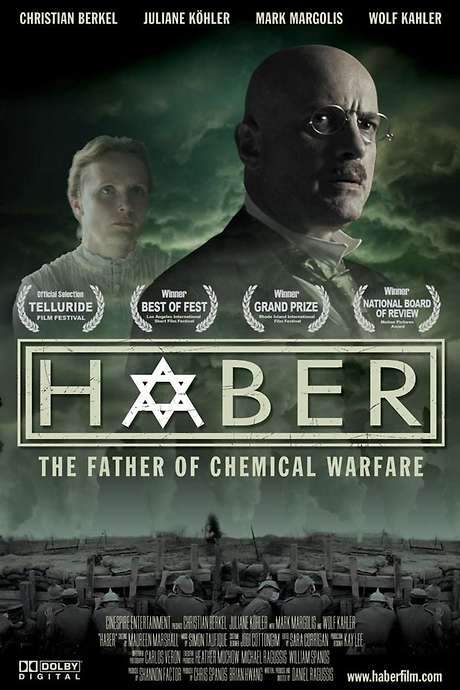



Haber Plot Summary
Read the complete plot summary and ending explained for Haber (2008). From turning points to emotional moments, uncover what really happened and why it matters.
Fritz Shimon Haber Christian Berkel sits at the center of this meticulous biopic, a German-born scientist whose Jewish origins and fierce ambition pull him between belonging and achievement. Born and raised in a world that asks for assimilation, he longs to be seen as a true German even as his scientific fire drives him toward ever-bolder discoveries. To gain acceptance and advance his career, Haber makes a defining choice: he converts to Lutheranism, a decision the film uses to explore the delicate balance between personal identity, loyalty, and the costs of ambition.
In 1918, Haber reaches the pinnacle of scientific recognition when he receives the Nobel Prize for developing an industrial process to fix nitrogen from the atmosphere into ammonia. This breakthrough, known to history as the Haber-Bosch method, turns out to be a double-edged sword. On one hand, it enables synthetic fertilizers that boost agricultural yields and promise food security for a growing world. On the other hand, it foreshadows a future where industry, agriculture, and wealth become tightly intertwined, while concerns about soil depletion, environmental impact, and corporate power begin to loom large. The film does not shy away from these consequences, painting a nuanced picture of a discovery that reshapes society even as it reshapes ethical boundaries.
The quiet moral tension at the heart of the story intensifies when Haber is drafted by the German government to translate his science into weapons. He becomes involved in the development of chlorine gas for use on the battlefield, a disastrous form of chemical warfare that would be banned by the Hague Conventions. The shocks of this decision ripple through Haber’s personal life and political world, forcing him to confront the idea that genius may bear responsibility for harm beyond the laboratory walls. The film juxtaposes the elegance of theoretical breakthroughs with the grim calculus of wartime innovation, inviting viewers to weigh the thrill of discovery against the human cost of its applications.
Clara Haber, Juliane Köhler, Haber’s wife, is depicted as a talented chemist in her own right who sacrifices her career to support him and raise a family. Her perspective grows increasingly pivotal as she witnesses Haber’s ascent and his willingness to weaponize science. She feels the strain of living under a domineering partnership and comes to oppose the path his research travels, a tension that culminates in a devastating personal tragedy. Her suicide marks a turning point that reframes Haber’s world and underscores the film’s relentless examination of duty, love, and consequence. The day after her death, Haber heads to the front to oversee the deployment of chemical warfare, a moment that crystallizes the moral complexity the film anatomizes—how a life devoted to science can simultaneously illuminate and darken the world.
Across its careful, character-driven narrative, the film remains unflinching about the paradox of a man whose contributions revolutionized industry and warfare alike. It does not offer easy answers; instead, it invites reflection on how identity, ambition, and ethical choices intersect in the crucible of history. The result is a thoughtful, multi-faceted portrait that honors the human drama behind a century-defining scientific legacy while insisting on the fragile line between genius and responsibility.
Haber Timeline
Follow the complete movie timeline of Haber (2008) with every major event in chronological order. Great for understanding complex plots and story progression.
Birth in Germany and Jewish origins; the push to belong
Fritz Haber was born in Germany into a Jewish family, and his origin shaped the choices he faced in early life. He longed to be accepted as a true German, a drive that influenced his personal and professional decisions. To fit in, he converted to Lutheranism, a step that would echo through his life and career.
Nobel Prize for the Haber process
In 1918 Haber was awarded the Nobel Prize for the Haber process, a breakthrough in fixing atmospheric nitrogen on an industrial scale. The prize recognized a major advancement with wide-reaching implications for agriculture and war. The ceremony in Stockholm solidified his reputation as a leading scientist.
Industrial impact: fertilizers and explosives
The Haber process enabled synthetic fertilizers and provided the precursors for explosives used in conflict. This dual-use invention massively increased short-term crop yields worldwide, reshaping agriculture. It also bound scientific progress to the devastation of war.
Drafted to develop chlorine gas
Haber was drafted by the German government to develop chlorine gas for warfare, marking a shift from peaceful science to weapons design. The project placed him at the center of an escalating arms race on the Western Front. It reflected the era's moral and strategic pressures on scientists.
Chlorine gas used on the Western Front
Chlorine gas was deployed at Ypres and other fronts, signaling a horrific new form of warfare. The attacks demonstrated the lethal potential of gas and sparked international condemnation and debate. This work would later be scrutinized under evolving conventions on chemical weapons.
Clara Immerwahr: a brilliant chemist in the background
Clara Immerwahr, Haber's wife, was a talented chemist who sacrificed her own career to support him and raise a family. She resented the domineering dynamic of their marriage and disapproved of science being used for war. Her perspective highlights the personal costs behind scientific ambition.
Clara Immerwahr's suicide
Clara Immerwahr committed suicide, an event that exposed the intimate costs of Haber’s path. Her death cast a long shadow over Haber and the meaning of his achievements. The film uses this moment to foreground the human consequences of scientific pursuit.
Immediate aftermath: Haber moves to the front
The day after Clara's death, Haber left to supervise the introduction of chemical warfare to the Eastern Front. This relocation marked a brutal turn in his career and in the war’s history. It underscored the personal costs of his professional choices.
Moral conflict at the heart of the scientist
The film foregrounds Haber’s internal struggle between scientific genius and the human cost of his inventions. He confronts whether knowledge should be pursued without regard to its uses. This tension drives the narrative and ethical questions it raises.
Long-term consequences: fertilizer vs war
Haber’s nitrogen chemistry helped feed growing populations but also strengthened militaries and industry worldwide. Over time, the fertilizer system contributed to corporate agribusiness and soil depletion. The film highlights the environmental and ethical tradeoffs of his work.
Legacy and controversy: a Nobel laureate with a dark side
Haber's life presents a paradox: a Nobel laureate whose work enabled both life-sustaining agriculture and mass destruction. The film frames his achievements against the human costs and historical consequences of chemical warfare. This duality invites reflection on responsibility in science.
Closing thought: science's moral responsibility
The narrative asks what accountability scientists owe society for how discoveries are used. Haber’s story becomes a cautionary tale about ambition, identity, and the ethics of research. It invites ongoing reflection on balancing progress with humanitarian considerations.
Haber Characters
Explore all characters from Haber (2008). Get detailed profiles with their roles, arcs, and key relationships explained.
Fritz Shimon Haber (Christian Berkel)
A brilliant German-born scientist with a dual legacy, Haber is driven by ambition and a longing to be accepted as a true German. He converts to Lutheranism to fit in, and he earns the 1918 Nobel Prize for nitrogen fixation that fuels both agriculture and warfare. The film portrays him wrestling with ethical implications as he leads chemical warfare efforts and grapples with the consequences of his work.
Clara Immerwahr (Juliane Köhler)
A promising chemist who sacrifices her own career to support Haber and raise a family. She disapproves of his use of science to engineer death in war and resents the gendered constraints of her time. Her sense of oppression and her suicide become a central moral counterpoint in the film.
Ludendorff (Wolf Kahler)
A German general who embodies wartime authority and the relentless push for victory. He represents political and military pressure that shapes Haber’s work, including where science should be applied in combat. His presence emphasizes the collision between scientific aspiration and military exigency.
Siegfried Haber (Maury Cooper)
Haber’s son, a figure who embodies the personal stakes and collateral impact of his father’s controversial choices. He stands as a reminder of the human cost behind scientific ambition and wartime decisions.
Haber Settings
Learn where and when Haber (2008) takes place. Explore the film’s settings, era, and how they shape the narrative.
Time period
1910s (World War I era)
The story unfolds during the 1910s, a period defined by total war and rapid scientific advancement. It reaches a turning point in 1918 with Haber's Nobel Prize and the intensification of chemical warfare. The era is marked by international treaties, like the Hague Conventions, that contrast with wartime drive for technological edge.
Location
Germany, Ypres, Eastern Front
The action centers in Germany, home to Haber and his scientific circle, while sequences move to the Western Front at Ypres and to the Eastern Front. The settings show laboratories, government offices, and battlefield scenes, highlighting the pressure to translate scientific breakthroughs into military advantage. These locations frame the ethical stakes of Haber’s work within the broader context of World War I.
Haber Themes
Discover the main themes in Haber (2008). Analyze the deeper meanings, emotional layers, and social commentary behind the film.
🧪
Science and Morality
The film follows Haber’s dual legacy as a groundbreaking chemist and a man entangled in warfare. It questions whether scientific achievement can be separated from its consequences for human life. Haber's ambition clashes with ethical concerns as he faces the choice between progress and harm. The narrative uses his Nobel Prize and his work on nitrogen fixation to explore the costs of genius.
⚖️
Ethics of War
State pressure and national pride push science toward weapons development, exemplified by the chlorine gas project. The film places a spotlight on the dilemmas scientists face when their discoveries are weaponized. It also critiques the personal and political accountability behind decisions made in wartime. The ban on chemical weapons contrasts with the reality of wartime experimentation.
💔
Gender and Sacrifice
Clara Immerwahr’s story highlights the cost of gender expectations in science and marriage. She sacrifices her own career to support Haber and disapproves of his use of science for killing. Her oppression and eventual suicide reveal the personal toll of the era’s hierarchical norms. The film uses her perspective to challenge the idea that scientific progress is value-free.

Coming soon on iOS and Android
The Plot Explained Mobile App
From blockbusters to hidden gems — dive into movie stories anytime, anywhere. Save your favorites, discover plots faster, and never miss a twist again.
Sign up to be the first to know when we launch. Your email stays private — always.
Explore the mobile appHaber Spoiler-Free Summary
Discover the spoiler-free summary of Haber (2008). Get a concise overview without any spoilers.
In the grim crucible of World War I, a nation teeters between scientific brilliance and the brutal demands of total war. The film opens on a Europe where laboratories glow alongside battle‑scarred front lines, and the promise of progress is shadowed by the relentless clang of artillery. Within this charged atmosphere, the pursuit of knowledge becomes a double‑edged sword, offering both the hope of feeding continents and the peril of weaponising the very air people breathe. The mood is austere yet electric, blending the disciplined precision of academia with the frantic urgency of a world on the brink.
At the heart of the story stands Fritz Shimon Haber, a prodigious chemist whose restless ambition has already earned him a Nobel Prize for transforming atmospheric nitrogen into a staple of modern agriculture. Born into a Jewish family yet yearning for full acceptance in a society that judges by bloodlines, he makes a painful conversion to Lutheranism, seeking the respect he feels denied. His brilliance is matched by an inner conflict: a desire to serve his country and a growing awareness of the ethical chasms his work may carve. The film captures his charisma and drive, painting him as both visionary and vulnerable, a man whose genius constantly brushes against the moral limits imposed by his era.
By his side is Clara Immerwahr, herself a gifted chemist whose own aspirations have been set aside to nurture his career and raise a family. Their relationship is a study in love strained by ambition, gender expectations, and divergent worldviews. Clara’s intellect and moral compass provide a quiet counterweight to Fritz’s fervor, and the tension between their ideals underscores the personal cost of scientific ambition in wartime.
The narrative weaves these lives into a broader meditation on the responsibilities of those who unlock nature’s secrets. With a tone that oscillates between measured historical reverence and visceral suspense, the film invites viewers to contemplate how the pursuit of greatness can both illuminate and darken the human condition, leaving the audience poised on the edge of discovery and dread.
Movies with Similar Twists and Themes
Uncover films that echo the narrative beats, emotional arcs, or dramatic twists of the one you're exploring. These recommendations are handpicked based on story depth, thematic resonance, and spoiler-worthy moments — perfect for fans who crave more of the same intrigue.



Featured on this page

What's After the Movie?
Not sure whether to stay after the credits? Find out!
Check out our other apps:

SAT Sphere
Build confidence for the Digital SAT.

Mori Atlas
Discover wild places worth protecting.

Luntero
Search smarter for a home in Amsterdam.

Plot Explained
Unravel movie endings and hidden clues.

Pokechamp
Dive into Pokémon data and battle logic.

Driving Theory
Get ready for your European theory test.

Movie Dust
Plan your next cinema trip with ease.

Musemap
Find art and culture as you travel.

Selkobase
Compare credentials before committing.

Local Manual
Turn an unfamiliar country into practical next steps.

Lernavi
Compare school systems before your next move.

GymRoam
Find a workout stop wherever your plans take you.
Explore Our Movie Platform
New Movie Releases (2026)
Famous Movie Actors
Top Film Production Studios
Movie Plot Summaries & Endings
Major Movie Awards & Winners
Best Concert Films & Music Documentaries
Movie Collections and Curated Lists
© 2026 What's After the Movie. All rights reserved.
Privacy Policy