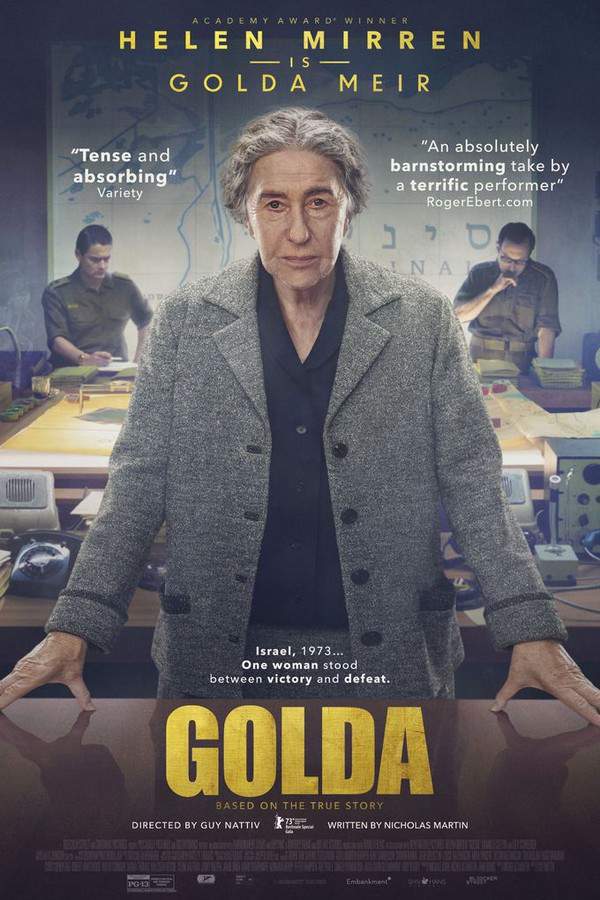
Golda 2023

Directed by

Guy Nattiv
Made by

Bleecker Street Media
Golda Plot Summary
Read the complete plot summary and ending explained for Golda (2023). From turning points to emotional moments, uncover what really happened and why it matters.
In October 1973, Mossad receives intelligence arguing that Egypt and Syria are preparing to launch a military campaign against Israel, and this information is promptly passed to Golda Meir, the Israeli prime minister. She greets the warning with caution, recognizing that she cannot mount a counter-plan without the support of her defense minister, Moshe Dayan, who shares a similar sense of doubt.
On 6 October, Yom Kippur opens with a sudden alert from Golda’s inner circle: Egypt has massed a large force opposite the Suez Canal, and hostilities could begin by sundown. Realizing how late Israel is to respond, she orders a partial mobilization rather than a full pre-emptive strike; the surprise attack still catches Israel off guard and proves more aggressive than expected. Meanwhile, Moshe Dayan—who had been surveying the Golan Heights—discovers that Syria has launched a major offensive against Israeli forces and feels deeply unsettled. He contemplates resignation, but Golda urges him to stay, even as her confidence in him falters.
Between 7–8 October, as Egypt and Syria press their advances, IDF chief of staff Lt. Gen. David Elazar proposes to pull back from exposed Sinai fortifications by deploying the 162nd Division led by Maj. Gen. Avraham Adan. Despite opposition from Zvi Zamir, Mossad’s chief, the plan moves forward, and the Israeli position in the Sinai is nonetheless tested and defeated by Egyptian forces. The following day, with the Syrian offensive easing, Dayan pushes for an air strike on Damascus to pressure Egypt. Yet a shortage of aircraft limits options, and Golda turns to U.S. Secretary of State Henry Kissinger to secure surplus jets, which he reluctantly provides.
As tensions escalate, Maj. Gen. Ariel Sharon proposes a bold plan to cross the canal with the 143rd Division to challenge the Egyptian Second and Third Armies. Zvi Zamir warns that the Egyptian 4th and 21st Divisions would cross within two days, potentially leaving Cairo exposed to an Israeli thrust. The Egyptians respond by advancing across the canal, meeting stiff resistance from Israeli armored forces under Lt. Gen. Haim Bar-Lev, yet they are repelled.
On 15 October, Sharon’s forces cross at an undefended point known as the “Chinese Farm.” They hold their ground despite ambushes, while Elazar prepares to seal off Suez from Cairo to compel Egypt into negotiations. Concurrently, Kissinger privately visits Golda and urges a ceasefire, but Golda presses ahead with a plan that ultimately pushes Egypt toward talks.
By the twentieth day, the two sides agree to continue talks and to exchange POWs, effectively slowing the fighting. However, Zvi Zamir privately reveals that IDF intelligence chief Maj. Gen. Eli Zeira failed to monitor Egyptian signals, allowing Israel to be caught off guard. Appalled, Golda accepts responsibility to shield the IDF from criticism. The war exacts a heavy emotional toll on the aging leader, who is later diagnosed with cancer.
One year later, in 1974, Chairman Agranat Commission proceedings begin as Golda testifies about her conduct during the war. She notes, off the record, that while she initially doubted, she genuinely believed the war was likely. Four years after that, on 8 December 1978, Golda dies bedridden while watching footage of her meeting with Egyptian president Anwar Sadat from the previous year.
The film’s closing monologue states that the commission clears Golda of any wrongdoing and that she lived to witness the Camp David Accords, the first formal steps toward peace between Israel and its Arab neighbors.
Golda Timeline
Follow the complete movie timeline of Golda (2023) with every major event in chronological order. Great for understanding complex plots and story progression.
Mossad warns of imminent war; Golda and Dayan doubt the plan
In October 1973, Mossad intelligence signals Egypt and Syria are preparing a major military campaign against Israel. Golda Meir dismisses the threat and says she cannot act without defense minister Moshe Dayan's backing. Dayan is equally skeptical, leaving her with a shaky sense of preparedness.
October 6: War begins; Golda orders partial mobilization
On Yom Kippur, Golda's inner circle informs her that Egypt has amassed a large force opposite the Suez Canal and that hostilities will begin by sundown. She refuses a full pre-emptive strike but orders a partial mobilization to face the threat. The attack nevertheless breaks out earlier than expected, catching Israel off guard, and Dayan views the situation with alarm.
Dayan's shock at the Golan Heights, contemplates resignation
Dayan travels to the Golan Heights and discovers Syria's forces have launched a thorough attack against ill-prepared Israeli troops. He is dazed and attempts to resign, but Golda talks him out of it. The episode leaves her with a growing loss of confidence in his leadership.
October 7–8: Sinai relief plan and its failures
IDF Chief of Staff David Elazar pushes to relieve Sinai fortifications by deploying the 162nd Division under Avraham Adan. Zvi Zamir, head of Mossad, objects to the plan, but it proceeds anyway. The operation stalls and the Egyptians repel the Israeli force, highlighting the Sinai front's vulnerability.
Damascus air strike plan; US jets promised
With the Syrian offensive pressing, Dayan proposes an air strike on Damascus to pressure Egypt. The plan founders due to a shortage of combat aircraft, and the IAF cannot proceed. Golda appeals to U.S. Secretary of State Henry Kissinger for surplus jets, and he reluctantly agrees to help.
Sharon's crossing plan with the 143rd Division
Maj. Gen. Ariel Sharon proposes an operation to cross the canal with the 143rd Division to challenge the Egyptian Second and Third Armies. Zvi Zamir warns that the Egyptians could cross the canal in two days, leaving Cairo undefended. The plan moves forward amid warnings and strategic calculations.
Egyptians cross the canal; Israeli tanks oppose
The Egyptians cross the canal and meet resistance from Israeli tank forces led by Haim Bar-Lev, who push them back and inflict losses. The Israeli defense holds, halting the Egyptian advance for the moment. The frontline dynamics shift as both sides adapt to the new phase of fighting.
Chinese Farm crossing; ambush; Elazar barricades Third Army
On 15 October, Sharon's forces cross the canal at the undefended 'Chinese Farm' crossing and are ambushed by Egyptian units, yet they maintain their positions. In parallel, Elazar moves to barricade the Third Army by cutting Suez from Cairo, aiming to force Egyptian concessions. Kissinger privately visits Golda and urges a ceasefire.
Kissinger urges ceasefire; diplomatic pressure intensifies
Kissinger's private intervention adds top-level diplomatic pressure as Golda pursues her strategic plan. She continues toward negotiations despite the international push for a ceasefire. The sequence highlights the convergence of military and diplomatic efforts to end the conflict.
Ceasefire talks and POW exchanges begin
By the twentieth day, both sides move toward diplomatic talks and agree to exchange prisoners of war, signaling a de-escalation of hostilities. The negotiations consolidate as the military momentum shifts into a political settlement. The war, while not immediately resolved, trends toward a pause in major fighting.
Zeira's lapse exposed; Golda bears the blame
Zvi Zamir privately informs Golda that IDF intelligence chief Eli Zeira failed to monitor Egyptian signals effectively, allowing Israel to be attacked unawares. Golda chooses to shoulder the blame publicly to shield the IDF from controversy. The moment underscores the personal costs of wartime leadership.
Emotional toll and cancer; leadership burden
Despite a strategic victory, the war exacts an emotional toll on Golda, who is later diagnosed with cancer. The strain of leadership during the conflict compounds her aging and personal burdens. The film portrays a leader bearing heavy scars beyond the battlefield.
Agranat Commission: 1974 testimony and clearance
In 1974, Golda testifies before the Agranat Commission about her conduct during the war. She states, off the record, that she genuinely felt war was certain, and the commission ultimately clears her of wrongdoing. The public narrative emphasizes accountability without liability for the broader war effort.
Golda's death and Camp David; legacy affirmed
On 8 December 1978, Golda Meir dies bedridden while watching footage of her meeting with Anwar Sadat from the previous year. The film notes she lived to see the Camp David Accords, the first formal peace steps between Israel and its Arab neighbors. Her legacy endures in the peace process that followed.
Golda Characters
Explore all characters from Golda (2023). Get detailed profiles with their roles, arcs, and key relationships explained.
Golda Meir (Helen Mirren)
An aging Israeli prime minister whose resolve is tested by the surprise Yom Kippur War. She must balance urgent military needs with the demand for international support, bearing the heavy burden of life-and-death decisions. Her arc blends caution, stubbornness, and a willingness to assume responsibility, even as personal health shadows her leadership.
Moshe Dayan (Rami Heuberger)
A seasoned military leader whose doubts surface as the war unfolds. He contemplates resignation at moments of strategic uncertainty, yet Golda urges him to stay, highlighting the tension between experience and political pressure. His stance reflects the weariness and steadfastness required to navigate a crisis.
Zvi Zamir (Rotem Keinan)
Mossad chief whose intelligence perspective exposes gaps and warnings amid the crisis. He pushes back against risky plans and later reveals critical blind spots in signal monitoring, illustrating the friction between intelligence and political decision-making.
Ariel Sharon
A bold military commander who proposes a daring crossing of the canal to strike at advantage, embodying risk-taking and aggressive strategy. His plan intensifies the war's tempo and tests the balance between audacity and strategic risk.
Chairman Agranat (Henry Goodman)
The chairman whose commission probes the war period and leadership decisions. He embodies the process of accountability, presiding over proceedings that scrutinize actions taken under crisis, shaping the narrative of responsibility.
Henry Kissinger
U.S. Secretary of State who quietly counsels restraint, urging a ceasefire while simultaneously facilitating military support. His diplomacy influences the war's tempo and the path toward negotiations, illustrating the impact of international pressure on national decisions.
Golda Settings
Learn where and when Golda (2023) takes place. Explore the film’s settings, era, and how they shape the narrative.
Time period
1973–1978
The events center on the October 1973 war and its immediate aftermath, followed by the 1974 Agranat Commission proceedings and the ensuing historical arc through 1978. The period is defined by sudden military mobilization, high-stakes diplomacy, and the long shadow of post-war accountability. It captures how leadership responds under crisis and how memory shapes national narrative.
Location
Israel, Sinai Peninsula, Suez Canal, Cairo, Damascus
Primarily set in Israel during the 1973 Yom Kippur War, the story unfolds across the corridors of power and the front lines. Key locations span Tel Aviv decision rooms, the Sinai battlefield, and the Suez Canal, with significant scenes in Cairo and Damascus. The film paints a broad geographic tapestry of a nation at war and the international stage that influences its course.
Golda Themes
Discover the main themes in Golda (2023). Analyze the deeper meanings, emotional layers, and social commentary behind the film.
🧭
Leadership
The narrative centers on Golda Meir's leadership under crisis, balancing urgency with calculated risk. It shows how a head of state must make fast, consequential choices with imperfect information. The emotional toll of power—decisions that save or endanger lives—shapes her arc. The film frames leadership as a heavy, solitary burden carried under intense public scrutiny.
⚖️
War Ethics
The film probes ethical tensions in wartime decisions, including pre-emptive actions, alliances, and accountability. It shows how intelligence gaps, strategic gambles, and political pressures collide with moral responsibility. Public trust and the quest for victory are weighed against the consequences of actions taken under crisis. The portrayal of the Agranat Commission underscores the gray areas of leadership during war.
🕊️
Diplomacy
Diplomacy threads through the crisis as Kissinger's shuttle diplomacy and back-channel talks shape the war's trajectory. The narrative explores how allies and adversaries influence timing for ceasefires and negotiations. It shows the tension between military setbacks and diplomatic breakthroughs, culminating in talks and peace efforts. Diplomacy is depicted as a pivotal force guiding conflict toward resolution.
🕰️
Legacy
The story culminates in Golda's reflection on her legacy amid public scrutiny and personal cost. It traces the arc from crisis leadership to post-war accountability, including the Agranat Commission and her cancer diagnosis. The closing moments affirm her historical role and the peace process that followed. The theme emphasizes how a leader's choices echo into the long arc of history.

Coming soon on iOS and Android
The Plot Explained Mobile App
From blockbusters to hidden gems — dive into movie stories anytime, anywhere. Save your favorites, discover plots faster, and never miss a twist again.
Sign up to be the first to know when we launch. Your email stays private — always.
Explore the mobile appGolda Ending Explained
Unravel the ending of Golda (2023) with our detailed explanation. Understand the final scenes, character fates, and unresolved questions.
Golda’s ending reflects the profound burden carried by Golda Meir, Israel’s only female prime minister, during one of the most tumultuous times in its history. Throughout the film, she faces the harsh realities of decision-making in a tense and dangerous war, heavily influenced by her trust in her military officials and her sense of duty. Her choice to prepare for war despite initial doubts ultimately proves critical, even though it comes at a high cost in terms of lives lost. The imagery of her walking through the morgue and the recurring scene of dead sparrows symbolize her deep guilt and the tragic consequences of her choices. Golda’s health deteriorates amid the stress and grief, culminating in her silent, contemplative death. The film concludes on a note that emphasizes her resilience and moral resolve, showing her influence in shaping peace between Israel and Egypt. Her legacy is one of courage, sacrifice, and determined pursuit of peace, despite the personal and national toll. The final scenes leave viewers with a poignant reminder of the heavy price of leadership and the enduring impact of her decisions.
Golda Spoiler-Free Summary
Discover the spoiler-free summary of Golda (2023). Get a concise overview without any spoilers.
In the early hours of a holy day in 1973, the world holds its breath as a nation confronts a sudden, existential threat. The film places the audience inside the corridors of power in Jerusalem, where the weight of history presses on every decision. At its heart is Golda Meir, Israel’s stalwart prime minister, whose blend of determination and vulnerability becomes the axis around which the drama turns. She must navigate a crisis that could decide the very survival of her people, all while the clock ticks inexorably toward an uncertain dawn.
Around her, a cast of seasoned leaders adds both friction and counsel. Moshe Dayan, the defense minister whose experience is matched only by his doubts, challenges and supports her in equal measure. Across the ocean, Henry Kissinger, the U.S. secretary of state, offers a reluctant partnership that hints at the fragile balance of international politics. Their interactions crackle with tension, revealing how personal convictions clash with the harsh demands of war‑time leadership.
The tone is a tight‑knit political thriller, rendered with a keen eye for the nuance of real‑world stakes. The film’s atmosphere is one of palpable anxiety, interlaced with moments of quiet introspection as leaders weigh the human cost of every strategic move. The cinematography captures the stark contrast between the hushed chambers of decision‑making and the looming, unseen battlefields, underscoring how decisions made in shadow can reverberate across a nation.
Against this backdrop, Golda becomes a study of power under pressure, exploring how a single leader’s resolve can shape the fate of millions. The story invites viewers to feel the weight of responsibility, the pull of conscience, and the relentless march of history, all while leaving the outcome tantalizingly out of reach.
Movies with Similar Twists and Themes
Uncover films that echo the narrative beats, emotional arcs, or dramatic twists of the one you're exploring. These recommendations are handpicked based on story depth, thematic resonance, and spoiler-worthy moments — perfect for fans who crave more of the same intrigue.



Featured on this page

What's After the Movie?
Not sure whether to stay after the credits? Find out!
Check out our other apps:

SAT Sphere
Build confidence for the Digital SAT.

Mori Atlas
Discover wild places worth protecting.

Luntero
Search smarter for a home in Amsterdam.

Plot Explained
Unravel movie endings and hidden clues.

Pokechamp
Dive into Pokémon data and battle logic.

Driving Theory
Get ready for your European theory test.

Movie Dust
Plan your next cinema trip with ease.

Musemap
Find art and culture as you travel.

Selkobase
Compare credentials before committing.

Local Manual
Turn an unfamiliar country into practical next steps.

Lernavi
Compare school systems before your next move.

GymRoam
Find a workout stop wherever your plans take you.
Explore Our Movie Platform
New Movie Releases (2026)
Famous Movie Actors
Top Film Production Studios
Movie Plot Summaries & Endings
Major Movie Awards & Winners
Best Concert Films & Music Documentaries
Movie Collections and Curated Lists
© 2026 What's After the Movie. All rights reserved.
Privacy Policy