
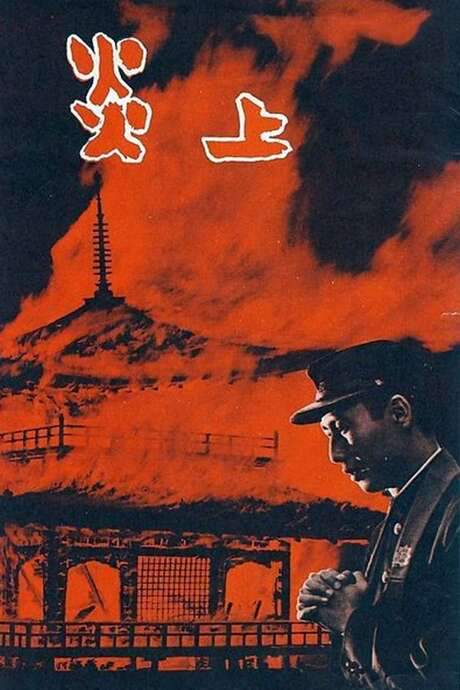
What Is Conflagration About?
The premise of Conflagration in 263 words, with nothing given away. The full story follows below.
In the quiet aftermath of war, a young Buddhist acolyte is thrust into a world of stone halls and whispered prayers far from the turmoil that shattered his family. Goichi arrives at the secluded Temple of the Golden Pavilion, a place revered for its beauty and steeped in ancient ritual, to study in silence while the weight of his lineage presses upon him. The temple’s serene façade masks a delicate balance between devotion and the lingering echoes of personal loss, setting a tone that feels both reverent and unnervingly intimate.
Within the cloistered walls, Goichi encounters a cast of stern mentors and weary relatives whose aspirations for him clash with his own fragile sense of self. His mother, a figure of quiet resolve, hopes he will ascend to become the temple’s future head priest, while the high priest—known for his commanding presence—offers guidance that is at once protective and inscrutable. The subtle power dynamics among monks, the lingering remnants of wartime uncertainty, and the unspoken expectations of tradition converge to create an atmosphere thick with unvoiced tension.
As Goichi grapples with his stutter and the lingering specter of his family’s collapse, the film paints a portrait of a mind teetering on the brink of inner disquiet. The austere visuals of Kyoto’s historic sites, paired with a restrained, almost meditative narrative style, draw the viewer into a contemplation of faith, duty, and the fragile human psyche. The story invites curiosity about how a solitary soul will navigate the contradictions of reverence and desire, leaving the audience poised on the edge of his uncertain journey.
What Happens in Conflagration?
The complete story of Conflagration, from the first scene to the last, in 759 words (about 3 minutes). Spoilers throughout. Names in the text link to 4 cast member pages.
Spoilers ahead
Goichi Mizoguchi, Raizō Ichikikawa? Wait—correction: I’ll use the exact slug from your cast list. Goichi Mizoguchi, Raizō Ichikawa, a young Buddhist acolyte, is interrogated after setting fire to Kyoto’s Shukaku Pavilion during and shortly after World War II. He answers only with silence as investigators press for details, the weight of his actions hanging in the cold air of the station.
A flashback unfolds, showing Goichi arriving at the Soen Temple with a letter of introduction from his deceased father, Jun Hamamura, a monk at the Kan’ei-ji Temple and a trusted friend of the high priest, Tayama Dosen. The elder man’s belief that the Golden Pavilion is the most beautiful thing in the world echoes in Goichi’s memory as he recalls being mocked for his stutter and witnessing his mother’s adultery, memories that haunt him with a growing sense of guilt and confusion.
During a visit, his mother, Tanie Kitabayashi, voices a powerful wish: that he might one day become the head priest of the temple. Yet Goichi doubts such a future, fearing the pull of a draft that could pull him away from his sacred path. The tension between duty, faith, and personal history threads through his thoughts as he moves between reverence for the temples and the harsher realities of the world outside.
One weekend at a popular tourist site, Goichi observes a pregnant woman with a visiting American soldier. The woman tries to enter the pavilion, but in a moment of fear and confusion, he pushes her down the stairs, and she miscarriages. He confesses the deed to Tayama Dosen, who already seems to know of the transgression and has paid off the woman to keep the secret hidden, a detail that unsettles Goichi even more. This admission deepens the rift between Goichi and the temple’s power structures, casting a shadow over his sense of belonging.
Another memory surfaces: Togari, a man with a crippled leg, discusses Goichi’s academic decline at Kotani University and his enduring love for ancient temples. Togari shadows Goichi into monastic life, and Ranko, a geisha, tends to his leg, adding a complicated layer to Goichi’s sense of loyalty and desire. Later, on a different night, Goichi spies Tayama Dosen in the company of a woman, a discovery that strains his trust further and feeds his mounting disillusionment.
During a scripture reading, the kōan of Nanquan and the cat—the tale of east and west halls fighting over a stray kitten—becomes a parable that weighs on Goichi. Nanquan’s extreme resolution—beheading the cat—echoes in the tension around power, discipline, and mercy that permeates the temple. After the reading, Goichi discovers a pin-up photo of a geisha tucked inside Tayama’s study book, a discovery that shakes him further. He confronts the priest, who withdraws his consideration of Goichi’s succession. In response, Goichi asserts that his stutter makes him unsuitable to be a monk, but Tayama counters that he is, in fact, twisted—an accusation that gnaws at him as he grapples with his identity and calling.
Desperation leads Goichi to purchase a knife and sedatives; Togari lends him ¥3,000, though he cannot repay it in time. Tayama partially repays the loan, a small mercy that sits uneasily alongside the larger betrayals Goichi senses. The memories also bring back his father’s funeral and cremation. Back at the pavilion, a police officer suspects Goichi of suicidal intent, and his mother chastises him for such thoughts. In the room, Togari’s voice condemns Goichi’s disillusionment and accuses Tayama of selling access to the pavilion for money, an admission that underscores the corruption Goichi despises. An ikebana teacher—who once had a relationship with Togari—overhears the confession and smashes a vase in anger, a symbolic act that shatters the fragile order the monastery tries to maintain.
Feeling misunderstood and increasingly alienated from the monks’ secular behavior, Goichi ultimately sets fire to the pavilion. In the present, detectives return him to the smoking remains of the temple, a grim echo of the past. During the transfer to prison, Goichi makes one final, fatal choice and throws himself from a moving train, sealing his fate with a dramatic act that mirrors the burning pavilion he set years before.
The film unfolds with quiet, austere detail, balancing memory and present danger as a singular, troubled young man confronts the contradictions of faith, duty, and the world outside the temple walls. The story lingers on the tension between revered tradition and the often messy realities of human desire and guilt, inviting viewers to ponder where responsibility ends and mercy begins in a life shadowed by tragedy.
Conflagration Timeline: Every Key Event in Order
15 key events in the order they happen, from “Interrogation after pavilion fire” to “Burning the pavilion and its aftermath”. 10 events name a place, across 9 locations.
- 1
Interrogation after pavilion fire
Goichi is interrogated by detectives in Kyoto about the destruction of the Shukaku Pavilion. He remains silent throughout the questioning, signaling his emotional numbness and possible guilt. The scene sets the modern arc of the story and hints at a deeper motive behind the fire.
When:Present Where:Kyoto, interrogation room
- 2
Arrival at Soen Temple with father's letter
In a flashback, Goichi travels to the Soen Temple carrying a letter of introduction from his deceased father, a monk at Kan'ei-ji. The letter frames his entry into the temple world and his connections to powerful patrons. The moment foreshadows the weight of lineage in his life.
When:Flashback Where:Soen Temple
- 3
Father's belief about Golden Pavilion
Goichi recalls his father's conviction that the Golden Pavilion is the most beautiful thing in the world. This ideal haunts him as he navigates temple life and the expectations tied to his name. The memory underscores his quest for beauty and meaning in a corrupted world.
When:Flashback
- 4
Stuttering memory during rice prep
While helping with daily chores at the temple, Goichi's stutter becomes obvious and he is ridiculed by others. The moment deepens his sense of isolation within the monastic community. It also foreshadows how speech and power shape his status among the monks.
When:Flashback
- 5
Witnessing mother's adultery
Goichi remembers seeing his mother commit adultery as a child, an event that stains his sense of trust and loyalty. The memory complicates his relationship with family and shapes his view of moral authority. The scene fuels his later distrust of those in power at the temple.
When:Flashback
- 6
Mother's wish he becomes head priest
During a family visit, his mother expresses the hope that he might one day become the temple's head priest. He hesitates, aware of the possibility of war and his own doubts about leadership. The moment adds pressure to his fragile self-image.
When:Flashback
- 7
Pregnant woman and American soldier at a tourist site
On a weekend visit to a tourist site, Goichi encounters a pregnant woman and a visiting American soldier attempting to enter the pavilion. His impulsive act leads to tragedy as he pushes her down the stairs, causing her miscarriage. The incident marks a tipping point in his relationship with his community.
When:World War II era Where:Shukaku Pavilion, Kyoto
- 8
Confession and payoff
Goichi confesses the deed to Tayama Dosen, who already knows about the incident. Tayama has paid off the woman to keep the truth quiet, showing his willingness to use money to shield others and shape who is allowed to rise within the temple system. The revelation compounds Goichi's sense of guilt and betrayal.
When:Flashback Where:Tayama's study
- 9
Togari's critique of Goichi
In another memory, Togari discusses Goichi's academic decline at Kotani University and his lingering love for ancient temples. The exchange highlights how Goichi's talents are at odds with the expectations of modern life and institutional power. It also foreshadows Togari's later role in Goichi's fate.
When:Flashback Where:Kotani University (memory)
- 10
Monastic path and Ranko's aid
Togari reappears as he follows Goichi into the monastic path, where Ranko, a geisha, tends to his injured leg. The unlikely bond hints at the blurred lines between spirituality and worldly desires within the temple. The sequence deepens Goichi's sense of being pulled between duty and personal longing.
When:Flashback Where:Monastic environment
Show the other 5 events of Conflagration Hide the last 5 events
- 11
Spying on Tayama with a companion
Goichi secretly observes Tayama Dosen during a night when the priest is accompanied by a woman. The act reveals the priest's proximity to secular pleasures and power within the temple's inner circle. Goichi's distance from the inner circle grows wider.
When:Flashback Where:Tayama Dosen's quarters
- 12
Nanquan koan, pin-up photo, confrontation
During a scripture reading, the Nanquan and the cat koan is discussed, prompting monks’ petty power struggles. After the reading, Goichi uncovers a pin-up photo of a geisha inside Tayama's study book and confronts the priest. Tayama rebukes him, accusing him of being twisted, and Goichi remarks that his stutter disqualifies him from being a monk.
When:Flashback Where:Temple reading hall and Tayama's study
- 13
Debt, weapons, and forgiveness
Goichi buys a knife and sedatives, while Togari lends him ¥3,000. He cannot repay the loan immediately, and Tayama partially covers the debt. The money matters emphasize the commodification of spiritual life and the power of patronage within the temple.
When:Flashback Where:Temple environs
- 14
Memorial memory: father's funeral
Goichi remembers his father's funeral and the cremation that followed, a moment of quiet grief that anchors his personal history. The memory underlines the absence of a steady paternal guide in his life. The scene adds emotional weight to his later actions.
When:Flashback
- 15
Burning the pavilion and its aftermath
Feeling misunderstood and disillusioned with the monks' secular behavior, Goichi sets fire to the Shukaku Pavilion. The act destroys the temple and triggers the present-day pursuit by the authorities. During the transfer to prison, Goichi throws himself from a moving train, sealing his fate.
When:Present Where:Shukaku Pavilion, Kyoto
Who Are the Main Characters in Conflagration?
6 characters, among them Goichi Mizoguchi (Raizō Ichikawa), Tayama Dosen (Ganjirō Nakamura II) and Aki (Goichi's mother) (Tanie Kitabayashi): who each one is and the part they play in the story. Every profile links to the actor’s page.
- GM
Goichi Mizoguchi (Raizō Ichikawa)
Played by Raizō Ichikawa
A young Buddhist acolyte who is introspective and prone to silence. His stutter and sensitivity create tension with the rigid temple life, and his disillusionment leads him to take drastic action by setting the pavilion on fire. He remains quiet during interrogation, signaling a complex inner struggle between duty, guilt, and personal truth.
- 🧭 Internal conflict
- 🔥 Destructive act
- 🎭 Silent struggle
- TD
Tayama Dosen (Ganjirō Nakamura II)
Played by Ganjirō Nakamura II
A powerful high priest whose influence over the pavilion reveals a world where spiritual authority mingles with money and access. He alternates between mentorship and manipulation, and is implicated in selling access to the pavilion for personal gain. His presence embodies the tension between sacred duty and worldly desire.
- 🏛️ Power
- 💰 Corruption
-

Aki (Goichi's mother) (Tanie Kitabayashi)
Played by Tanie Kitabayashi
Goichi's mother, who harbors hopes for her son to become head priest. Her expectations highlight the pressure of family duty within the temple hierarchy and contribute to Goichi's sense of inadequacy and obligation. Her reactions reflect the personal costs of living within a tradition-bound world.
- 👩👦 Family
- 💔 Secrets
- GF
Goichi's Father (monk at Kan'ei-ji Temple) (Jun Hamamura)
Played by Jun Hamamura
A monk whose funeral and cremation memories haunt Goichi, emphasizing lineage and the weight of familial faith. His remembered words about beauty and the temple's world underscore the conflict between personal longing and institutional duty.
- 🧭 Family legacy
- 🕊️ Tradition
- PD
Police Detective A
Played by Saburo Date
A detective who interrogates Goichi after the pavilion fire, representing law and order during a time of social upheaval. His questioning reveals tensions between personal guilt and public accountability.
- 👮 Justice
- 🗝️ Investigation
- MO
Mistress of the floral art (Michiyo Aratama)
Played by Michiyo Aratama
A figure connected to the ceremonial and aesthetic world of the temple precincts. Her interactions hint at the private networks of influence that operate behind the temple's public face.
- 🌸 Aesthetics
- 🕰️ Elite circles
Where and When Is Conflagration Set?
Conflagration is set in Kyoto, Shukaku Pavilion, Soen Temple, Kan'ei-ji Temple and Golden Pavilion (World War II era and immediate post-war). Here is why the time and place matter to the story.
When
World War II era and immediate post-war
The events occur during the Second World War in Kyoto and extend into the early post-war years. The war creates scarcity, fear, and shifting loyalties that affect how characters behave and how institutions operate. The aftermath exposes moral compromises within religious and social structures as people try to survive and rebuild.
Where
Kyoto, Shukaku Pavilion, Soen Temple, Kan'ei-ji Temple, Golden Pavilion
The story unfolds in Kyoto, centering on the Shukaku Pavilion and nearby temples. Soen Temple and Kan'ei-ji Temple anchor Goichi's path toward monastic life and the temple network's influence. The Golden Pavilion looms as a symbol of beauty and prestige, juxtaposed against the corruption and turmoil surrounding the characters.
- 🏯 Historic Kyoto
- 🧭 War-torn setting
- 🏛️ Sacred temple sites
What Are the Themes of Conflagration?
3 ideas the story keeps returning to, among them Guilt & Consequence, Tradition vs Corruption and Memory & Identity.
-
01
Guilt & Consequence
Goichi's act of setting fire to the pavilion triggers deep personal and institutional repercussions. The film explores how guilt festers when confession is avoided and accountability is deflected. Institutions and mentors respond in ways that reveal hypocrisy and complicity. The narrative suggests that denial intensifies damage and propels a downward spiral.
-
02
Tradition vs Corruption
The temple world, rich in ritual, is shown to be morally compromised by money and desire. Goichi's disillusionment highlights a clash between sacred duties and worldly temptations. The pavilion's power dynamics reveal how tradition can be weaponized to protect influence. The film questions whether spiritual authority can endure scrutiny in a corrupt system.
-
03
Memory & Identity
Flashbacks reveal past traumas—mockery for his stutter and family betrayals—that shape Goichi's sense of self within the temple order. These memories influence his present choices and sense of duty. The past acts as both guide and trap, complicating his path toward or away from monkhood. Memory becomes a lens through which identity is tested and redefined.
What Kind of Film Is Conflagration?
Melancholic in tone, with slow pacing and a complex story, going by the plot summary.
- Tone
- Melancholic
- Pacing
- Slow
- Story
- Complex
- Intensity
- High
- Ending
- Bleak
A slow, melancholic, and psychologically intense drama that immerses the viewer in the oppressive loneliness and mounting disillusionment of a troubled acolyte, culminating in a bleak and tragic act of destruction.
- melancholic
- oppressive
- slow burn
- lonely
- anxious
- somber
- psychological distress
- faith and disillusionment
- beauty and destruction
- trauma
Content notes: suicide, miscarriage, adultery.
Quiz
How well do you remember Conflagration? Test yourself on the story.


