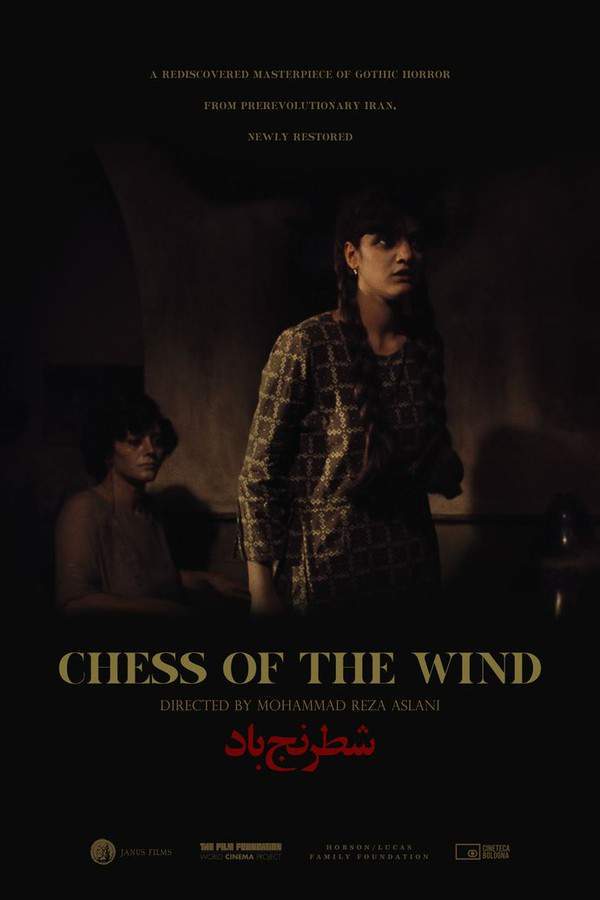
Chess of the Wind (1976) 2021

Directed by

Mohammad Reza Aslani

Chess of the Wind (1976) Plot Summary
Read the complete plot summary and ending explained for Chess of the Wind (1976) (2021). From turning points to emotional moments, uncover what really happened and why it matters.
In a stately aristocratic house, the death of Khanom Bozorg leaves her wheelchair-bound daughter, Aghdas, to mourn within the vast halls of the Moshir ad-Dowleh Mansion. She shares the space with her mother’s widower, Hadji Amoo, and his two nephews, Ramezan and Shaban. The arrangement is uneasy from the start: Ramezan is betrothed to Aghdas, but the marriage promises more wealth than affection, and Aghdas quickly becomes wary of her fiancé’s true intentions. The household is completed by a devoted maid, Kanizak, who looks after Aghdas and quietly forms a bond with Shaban. Intercut scenes of washerwomen gossiping weave a social undercurrent, filling in the history of Aghdas and Hadji Amoo with rumors, memories, and whispered judgments.
As the days unfold, both Aghdas and Hadji Amoo grow certain they are entitled to inherit Khanom Bozorg’s house. A shared sense of grievance fuses into a reckless plan: one evening, Aghdas and Kanizak slip into Hadji Amoo’s private room and burn the house deeds, removing his name from the documents. The act sets off a sequence of confrontations between stepfather and stepdaughter, each clash underscoring a deeper hunger for control and survival. Aghdas, emboldened or desperate, hatches a more drastic scheme: she privately signals to Ramezan her intention to kill Hadji Amoo, masking it as something else and letting him believe he remains in the family’s good graces.
The air grows heavier as Hadji Amoo prays in his chamber, and Aghdas is wheeled in by Kanizak. With a silver flail, she strikes Hadji Amoo, and the household descends into a grim sequence of actions—Kanizak and Ramezan drag the fallen man to the cellar and stash his body in a bottomless jar, a macabre plan to dissolve it later with nitric acid at Aghdas’s command. The home shivers with the potential of discovery, yet the immediate threat seems contained, at least for a moment.
Weeks later, two creditors arrive with a police commissar to press Hadji Amoo for a debt. Aghdas insists she has seen nothing of him for days, but the commissar’s sharper memory tells a different tale: he saw Hadji Amoo on the street only recently. Panic flares as Kanizak and Ramezan escort the men down to the cellar. They search the jars for a body and come up empty-handed, and the pair leave as quietly as they came. The tension intensifies: is Hadji Amoo truly dead, or has he found a way to loom over the house from some shadowed corner?
Aghdas’s paranoia deepens. The rumor mill returns in the form of a traveling musical troupe, who claim to have seen Hadji Amoo in public, and her fear snowballs into illness. Kanizak persuades Aghdas to travel briefly away from the mansion to visit a nearby holy site, hoping distance will ease the danger. Yet the quiet outside cannot silence the murmur inside: at night, laughter echoes from the cellar, and Aghdas, driven by a mixture of resolve and dread, fetches an antique pistol and descends to the basement. There, she discovers Hadji Amoo and Kanizak relaxing together in the bath. In a decisive act, she shoots Hadji Amoo, but the shock proves too much for her, and she collapses from a heart attack.
With Hadji Amoo dead and the plan seemingly undone, Kanizak and Shaban plot to live off the inheritance together. It appears they had staged Hadji Amoo’s death to reap the rewards in concert, their partnership a fragile cooperation built on shared ambition. However, the alliance fractures when Kanizak learns that Shaban does not intend to marry her, and the two argue upstairs. Returning to the cellar, Ramezan discovers the tangled bodies and the betrayal of his cousin. Enraged by Shaban’s treachery, he climbs the stairs and shoots him dead, fracturing the would-be family further.
In the closing moments, Kanizak leaves the mansion behind, carrying only a young boy and Aghdas’s elderly nanny. The camera lingers on the city beyond the walls, a quiet, lingering reminder of lives consumed by greed, fear, and the fragile threads that hold a family together. The film ends on a note of haunting consequence, suggesting that the inheritance, rather than securing a future, has already rewritten the fates of everyone involved.
Chess of the Wind (1976) Timeline
Follow the complete movie timeline of Chess of the Wind (1976) (2021) with every major event in chronological order. Great for understanding complex plots and story progression.
Khanom Bozorg dies and mourning begins
Khanom Bozorg, the matriarch, dies, leaving Aghdas wheelchair-bound and dependent on Hadji Amoo. The vast Moshir ad-Dowleh Mansion becomes a stage for grief, money-driven motives, and the social gossip that threads through the film. Ramezan is engaged to Aghdas, but his interest seems rooted in her fortune.
Deeds burned to claim the house
Aghdas and Kanizak enter Hadji Amoo's room and burn the deeds to the house with his name on them, destroying papers that could prove ownership. The act cements their intent to control the inheritance. The room's ashes mark a turning point in their scheming.
Confrontations escalate; plan to kill
Tensions between Aghdas and Hadji Amoo intensify, with confrontations revealing competing claims to the house. Aghdas openly contemplates murder and signals the plan to Ramezan, setting the stage for a deadly resolution.
Aghdas kills Hadji Amoo
As Hadji Amoo prays in his room, Aghdas is wheeled in by Kanizak and strikes him on the head with a silver flail. He collapses, and Kanizak and Ramezan drag the body toward the cellar to conceal the crime. The act marks a decisive turning point in the scheme for inheritance.
Body stored in cellar
The conspirators transfer Hadji Amoo's body to the cellar and place it in a bottomless jar, planning to dissolve it later with nitric acid. The warehouse-like basement becomes their secret chamber of crime. The scale of the deception grows as more people come to the mansion.
Creditors visit; no body found
A few days later, two creditors and a police commissar arrive to collect a debt Hadji Amoo owed. Aghdas denies knowing him, and Kanizak and Ramezan escort the men to the cellar, where the jars are inspected but the body is nowhere to be found. The inquiry unsettles Aghdas further.
Aghdas grows paranoid; rumours spread
Aghdas becomes increasingly paranoid about whether Hadji Amoo is truly dead. A traveling musical troupe claims to have met him in public, and such whispers drive her into a feverish panic, emphasizing her isolation in the mansion.
Kanizak arranges escape to a holy site
Kanizak persuades Aghdas to leave the house for a brief break, visiting a nearby holy site. Aghdas departs with Kanizak's help for a couple of days, stepping away from the looming possibility of exposure in the mansion.
Aghdas descends to the basement
Alone in her room at night, Aghdas hears laughter from the cellar. She retrieves an antique pistol and drags herself down to the basement, where she confronts the secrecy that's haunted the house.
Aghdas discovers the hidden scene
In the basement, Aghdas finds Hadji Amoo and Kanizak in the bath, exposing their connivance. The shock compounds her fear and rage as the crime circles closer to home.
Aghdas shoots Hadji Amoo; dies
Aghdas shoots Hadji Amoo and immediately collapses from a heart attack. The murder and the death eliminate the central obstacle to her inheritance, but at a terrible personal cost.
Kanizak and Shaban plot to claim the inheritance
With Hadji Amoo dead, Kanizak and Shaban scheme to live off the inheritance. The plan hints at a long-running alliance, though the earlier aid to the deception by Kanizak now collides with Shaban's own intent.
Ramezan kills Shaban
Tensions erupt when Shaban's betrayal is revealed. Ramezan races upstairs and shoots Shaban dead, removing a rival for the inheritance and sealing the fates of those left behind.
Kanizak leaves; final image
Kanizak departs the mansion, leaving only a young boy and Aghdas's elderly nanny. The camera then pans across the city beyond the mansion walls, closing the story on the social labyrinth of wealth and crime.
Chess of the Wind (1976) Characters
Explore all characters from Chess of the Wind (1976) (2021). Get detailed profiles with their roles, arcs, and key relationships explained.
Aghdas
Wheelchair-bound daughter who mourns her mother and fights to secure the family home. She schemes to burn the deeds and manipulate others, showing a calculating, controlling side beneath a vulnerable exterior. Her actions propel the mansion's deadly power struggle and reveal her resolve to secure inheritance.
Hadji Amoo
The aging widower and patriarchal figure who claims a stake in the house. He embodies traditional authority and stubborn ownership, clinging to control even as he becomes a target of others’ schemes. His murder is the fulcrum around which the mansion’s secrets shift.
Ramazan
Aghdas's fiancé who appears courteous but is primarily drawn to the potential wealth of the inheritance. He participates in the house’s power games and stands to gain from its ownership, even as he masks true intentions.
Shaban
Aghdas's other nephew who becomes entangled in the schemes and is implicated in the plan to secure the house. He is betrayed by Kanizak and meets a violent end, illustrating the lethal stakes of the family’s power play.
Kanizak
The maid whose loyalties sway between aiding Aghdas and collaborating with Ramazan and Shaban. Her involvement in burning the deeds and her shifting alliances highlight the fragility of trust in the mansion.
Nanny
The elderly caretaker who has cared for Aghdas, representing a connection to the household’s intimate past. Her presence evokes the fatigue of long-standing service and the quiet resilience of those who keep the household running.
Lady Junior
A figure of aristocratic status who embodies the social world surrounding the family. Her presence underscores the ceremonial aspect of the mansion and the status at stake in the inheritance.
Lady's Maid
An attendant who embodies the servant-class perspective within the house and participates in the drama through subtle actions and observations. Her role highlights the hierarchical layers governing the mansion.
Commissar
The police presence who investigates the family’s debt and the missing Hadji Amoo, representing external authority intruding on private wealth disputes. He embodies the tension between law and private power in the mansion’s world.
Chess of the Wind (1976) Settings
Learn where and when Chess of the Wind (1976) (2021) takes place. Explore the film’s settings, era, and how they shape the narrative.
Time period
The events take place within a historical, aristocratic milieu where wealth, marriage, and property determine social standing. The mansion’s interiors and rigid social hierarchy suggest a world resistant to rapid change, where trust is guarded and debts demand payment. The narrative treats time as a backdrop of tradition and concealed histories rather than modern speed.
Location
Moshir ad-Dowleh Mansion, the city outside the mansion
An opulent, claustrophobic mansion serves as the core setting, where wealth and authority are concentrated within its walls. The Moshir ad-Dowleh Mansion embodies inherited privilege, with rooms that echo gossip and ambition as money becomes a weapon. Its basement and hidden spaces anchor the film’s mood of danger and deceit. The surrounding city outside the walls frames the private power struggle as a public spectacle.
Chess of the Wind (1976) Themes
Discover the main themes in Chess of the Wind (1976) (2021). Analyze the deeper meanings, emotional layers, and social commentary behind the film.
💎
Inheritance
The pursuit and defense of the family house drive the plot as Aghdas and Hadji Amoo clash over the deeds. Wealth is not only money but a tool of power and status within the aristocratic household. The burning of the deeds marks a radical assertion of control and a willingness to erase the past to secure the future. The film uses the mansion and its assets to explore how inherited privilege sustains and corrodes family ties.
🗝️
Secrets
Hidden histories and whispered gossip fill the frame, revealing how rumors shape perception and motive. The cellar jars, the so-called death, and the missing body become anchors for deception and manipulation. Kanizak's alliances with Ramazan and Shaban show how secrets are weaponized to rewrite destiny. The communal gossip contributes to a sense of inevitability and dread.
🔒
Paranoia
The house becomes a pressure cooker where fear and suspicion intensify every interaction. Aghdas's paranoia about Hadji Amoo's fate drives violent acts and reckless decisions. Loyalty fractures as characters pursue self-preservation and wealth, exposing the fragility of trust. The final revelation underscores how private power corrodes moral lines and leaves a hollow victory.

Coming soon on iOS and Android
The Plot Explained Mobile App
From blockbusters to hidden gems — dive into movie stories anytime, anywhere. Save your favorites, discover plots faster, and never miss a twist again.
Sign up to be the first to know when we launch. Your email stays private — always.
Explore the mobile appChess of the Wind (1976) Spoiler-Free Summary
Discover the spoiler-free summary of Chess of the Wind (1976) (2021). Get a concise overview without any spoilers.
In the grand, fading corridors of the Moshir ad‑Dowleh Mansion, the sudden absence of its enigmatic mistress leaves a vacuum that awakens the house’s hidden currents. The sprawling estate, steeped in aristocratic tradition, becomes a pressure cooker where whispers travel through cracked plaster and the weight of legacy presses on every polished surface. Within this claustrophobic world, the promise of a sizeable inheritance turns the familiar rooms into a battlefield of subtle maneuvering, where each glance may conceal a calculation.
At the heart of the tension stands Aghdas, a young woman confined to a wheelchair, whose delicate poise masks a growing awareness of the forces circling her. She shares the mansion with her late mother’s widower, Hadji Amoo, a figure whose presence carries both authority and ambiguity, and his two nephews, Ramezan and Shaban, whose ambitions are as tangled as the family’s history. The household is rounded out by Kanizak, a devoted maid whose quiet loyalty adds another layer to the intricate web of relationships. Their interactions are framed by the ever‑present murmur of servants and neighbors, whose gossip stitches together fragments of past scandals and present desires.
The film’s tone is one of slow‑burning suspense, punctuated by moments of stark, almost theatrical stillness that highlight the characters’ internal games. The mansion itself feels alive, its shadowed hallways echoing the unspoken rivalries and the fragile alliances formed out of necessity. As each relative and confidant circles the inheritance, the atmosphere tightens, suggesting that the true contest lies not merely in wealth but in control over the family’s legacy and the secrets that bind them.
Against this backdrop, the audience is drawn into a world where duty, longing, and the instinct to survive intersect, inviting curiosity about who will finally claim the throne of the estate—and at what cost.
Featured on this page

What's After the Movie?
Not sure whether to stay after the credits? Find out!
Check out our other apps:

SAT Sphere
Build confidence for the Digital SAT.

Mori Atlas
Discover wild places worth protecting.

Luntero
Search smarter for a home in Amsterdam.

Plot Explained
Unravel movie endings and hidden clues.

Pokechamp
Dive into Pokémon data and battle logic.

Driving Theory
Get ready for your European theory test.

Movie Dust
Plan your next cinema trip with ease.

Musemap
Find art and culture as you travel.

Selkobase
Compare credentials before committing.

Local Manual
Turn an unfamiliar country into practical next steps.

Lernavi
Compare school systems before your next move.

GymRoam
Find a workout stop wherever your plans take you.
Explore Our Movie Platform
New Movie Releases (2026)
Famous Movie Actors
Top Film Production Studios
Movie Plot Summaries & Endings
Major Movie Awards & Winners
Best Concert Films & Music Documentaries
Movie Collections and Curated Lists
© 2026 What's After the Movie. All rights reserved.
Privacy Policy