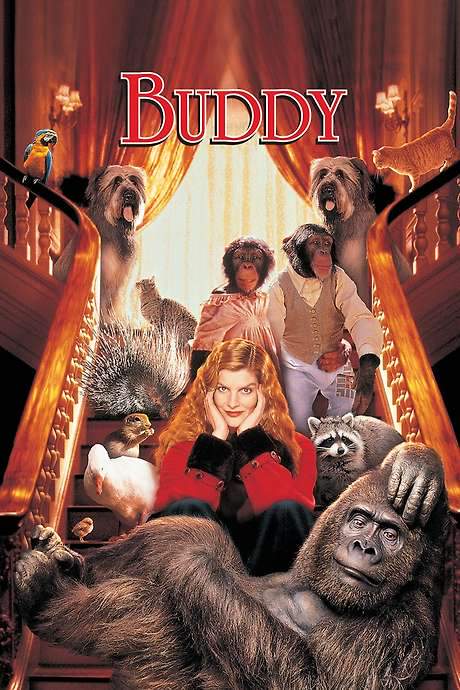
Buddy 1997


Directed by

Caroline Thompson
Made by

Columbia Pictures
Where to Watch Buddy
See current US streaming, rental, and purchase options for Buddy (1997) via JustWatch.









Buddy Plot Summary
Read the complete plot summary and ending explained for Buddy (1997). From turning points to emotional moments, uncover what really happened and why it matters.
Set in the 1930s, Trudy Lintz is an unapologetic animal lover, a wealthy eccentric who fills her grand estate with a ever-changing cast of creatures. She dotes on her two newly arrived chimpanzees, Joe and Maggie, taking them to the movies and turning the household into a lively, chaotic sanctuary that draws stares and wonder from guests and neighbors alike. At home, she welcomes a bustling menagerie that includes kittens, horses, a cheeky talking green parrot, a prize-winning pack of briards, a raccoon, a porcupine, a tortoise, and a flock of geese, all living under one wildly entertaining roof.
Dr. Bill Lintz, Trudy’s amiable husband, receives a phone call that nudges the family into new territory: Trudy is away, and he must oversee the animals until she returns. After the call, she explains to Dick Croner, their animal handler, that he is in charge for the evening as she heads off to Philadelphia, chasing a chance discovery that could reshape their household forever.
In Philadelphia, Trudy finds a sickly baby gorilla and brings him home, naming him Buddy. Bill Lintz determines that Buddy is suffering from severe pneumonia, and life settles into a new rhythm as Buddy begins to drink from a bottle and get settled into the family, while the chimps cause their usual ruckus in the kitchen. To calm the chaos, Trudy uses a rattling toy that startles the chimps and keeps the peace for a moment, but the presence of Buddy shifts the dynamics of the household in subtle, powerful ways.
Seeking guidance on Buddy’s nature and care, Trudy travels to see Professor Spatz, whose Congo experiences offer little true insight into Buddy’s peculiar needs. She returns with a renewed determination to raise Buddy as if he were her own son, treating him with the same affection she lavishes on the chimpanzees, even as the differences between them begin to show.
Life with Buddy proves to be a delicate balance. He finds city life overwhelming in ways the chimps do not—baths bother him, and he resents sharing his mother’s attention, despite Trudy’s best efforts. As Buddy grows stronger, he becomes harder to manage, and Maggie’s cleverness—especially her knack for unlocking cages—keeps the household on edge as mischief becomes a daily affair.
A visiting couple persuades Trudy to showcase her family at the Chicago World’s Fair. Bill warns that Buddy’s temperament could cause problems, but the family heads to the fair with high hopes and a sense of spectacle. The apes are a smash hit, and the crowds adore the show, yet the moment Maggie unlocks Buddy’s cage, the environment—loud noises, crowds, unfamiliar surroundings—proves disorienting for him. The fair’s atmosphere quickly shifts from delighted curiosity to fear, and the spectacle turns tense as Buddy clashes with the surrounding chaos.
Back home, Buddy is haunted by flashbacks of the fair incident, his trauma deepening and coloring every moment with Trudy. As the memories sharpen into fear and aggression, the situation at home spirals. An explosive rampage tears through the estate, leaving damage in its wake and forcing Trudy to confront the limits of her control over Buddy.
In the end, Trudy makes the painful, compassionate choice to place Buddy in an ape sanctuary, where he can live among his own kind in a safer, more natural environment. It’s a bittersweet and earnest goodbye to a family that tried to bridge two very different worlds with love, and it underscores the complicated line between devotion and the reality of needs that can’t be fully met within one home.
Buddy Timeline
Follow the complete movie timeline of Buddy (1997) with every major event in chronological order. Great for understanding complex plots and story progression.
Chimpanzees arrive and settle at Trudy's estate
In the 1930s, Trudy welcomes two new chimpanzees, Joe and Maggie, to her grand estate. The animals draw big stares from visitors and staff, while Trudy lavishes them with attention and affection. The scene establishes her unapologetic love for animals and her larger-than-life approach to pet care.
Bill's phone call and temporary animal care
Dr. Bill Lindz calls to arrange that Dick take charge of the animals for the evening while Trudy is away. She agrees and drives off to Philadelphia, setting the stage for the next development. The phone call reveals the balance between indulgence for animals and practical family responsibilities.
Journey to Philadelphia to fetch Buddy
Trudy drives to Philadelphia after the call to bring home a sickly baby gorilla named Buddy. She insists on treating the infant as part of the family, believing she can raise him as her own son. The trip marks a turning point from domestic pets to a growing primate family.
Buddy diagnosed with pneumonia
In Philadelphia, Buddy is found to have severe pneumonia. Bill assesses the illness as serious and prescribes care, while Trudy dedicates herself to nursing him through bottle-feeding and constant attention. The fragile infant’s condition deepens Trudy’s commitment to him.
Chimps cause mischief, rattling to calm them
The chimpanzees create mischief in the mansion, especially in the kitchen, as their curiosity runs wild. Trudy quiets them by using a rattling device, which scares them into obedience. The moment underscores the contrast between her loving control of animals and the challenges of Buddy’s care.
Trudy seeks Gorilla knowledge from Professor Spatz
Unable to find reliable information about gorillas locally, Trudy travels to see Professor Spatz, who concedes limited knowledge after his Congo experiences. She returns home determined to raise Buddy the same way she raises her chimps, convinced that love and imitation will shape him. The encounter strengthens her resolve to treat Buddy as a son rather than a pet.
Trudy resolves to raise Buddy as her son
After Spatz’s visit, Trudy doubles down on her plan to raise Buddy as her own son rather than a pet. She believes she can replicate the care and affection she gives the chimps, and her confidence grows despite knowledge gaps. The household continues to blend human, canine, and primate family dynamics.
Buddy's adjustment to city life and bath aversion
Buddy struggles with city life and shows a distinct dislike for baths, resisting Trudy’s attempts to bathe him and share attention. He also grows physically stronger, which makes him harder to control alongside the chimps. These challenges complicate Trudy’s dream of a harmonious, blended family.
World's Fair plan and public attraction
A visiting couple convinces Trudy to bring the apes to the Chicago World's Fair, despite Bill’s warning that Buddy should stay at home. The chimpanzees prove to be a hit with crowds and photographers, boosting Trudy’s reputation as a remarkable caretaker. Maggie’s mischief soon leads to trouble when she unlocks Buddy’s cage, causing chaos and fear.
Buddy's traumatic fair experience
The crowds, noises, and unfamiliar surroundings overwhelm Buddy, leaving him disoriented and frightened. The fair’s atmosphere amplifies his anxiety and results in a troubling, lasting impression. He later carries these memories back into the house, shaping his hesitant behavior.
Buddy's flashbacks and aggressive rampage at home
On returning home, Buddy is plagued by flashbacks of the fair, which culminate in an aggressive rampage damaging the house. The family confronts the consequences of keeping a powerful animal in a human environment. This crisis tests Trudy’s commitment to Buddy and the feasibility of their arrangement.
Buddy moves to an ape sanctuary
After the rampage, Trudy finally agrees that Buddy should live among his own kind in an ape sanctuary. The move aims to protect him and restore balance in the household, giving Buddy a safer environment and a chance to thrive with his peers. The sanctuary represents a resolution to the story’s central conflict.
Buddy Characters
Explore all characters from Buddy (1997). Get detailed profiles with their roles, arcs, and key relationships explained.
Trudy Lintz (Rene Russo)
A wealthy, eccentric animal lover whose devotion to her animal family shapes every decision. She treats Buddy as her own child, guiding his early life with warmth and unyielding determination.
Bill Lintz (Robbie Coltrane)
Trudy’s amiable husband who acts as the household’s steadier voice. He recognizes the risks of keeping wild animals and tries to keep the family from tipping into chaos.
Buddy (gorilla) (voiced by Frank Welker)
A sickly baby gorilla whose bond with Trudy becomes the central emotional thread. As he grows, he struggles with illness, environment, and attention, culminating in trauma from public exposure.
Dick Croner (Alan Cumming)
The animal handler who keeps the household’s creatures in line and serves as the domestic link to the outside world. He observes the challenges of managing multiple intelligent animals firsthand.
Professor Spatz (Paul Reubens)
A researcher who offers limited insights into gorilla biology, reflecting the period’s speculative science. His visit underscores Trudy’s ongoing quest for knowledge about Buddy’s nature.
Maggie (chimpanzee)
A clever and mischievous chimpanzee who frequently outsmarts the household’s locks and routines. Maggie’s antics highlight the intelligent but unruly nature of the animal family.
Joe (chimpanzee)
A newly arrived chimpanzee who joins the family dynamic, adding to the chaos and affection within the animal household. His presence intertwines with Buddy’s vulnerability and the chimpanzees’ mischief.
Minister (Philip Baker Hall)
A governmental figure who appears within the story’s social world, providing a sense of formality and authority. His presence anchors the era’s social milieu in the narrative.
Buddy Settings
Learn where and when Buddy (1997) takes place. Explore the film’s settings, era, and how they shape the narrative.
Time period
1930s
Set in the 1930s United States, the era blends opulent private wealth with the era’s broader social currents. Wealth and social status shape how the family treats their animals and navigates public attention. The Chicago World’s Fair moment anchors the story in a real historical context of spectacle.
Location
Philadelphia, Chicago, Lintz estate
The story centers on the Lintz family’s grand estate, a lavish home that houses a growing menagerie. The action shifts to Philadelphia and Chicago, showing the contrast between private life and public spectacle. The mansion’s grounds become a stage for family dynamics, animal care, and ambitious social events.
Buddy Themes
Discover the main themes in Buddy (1997). Analyze the deeper meanings, emotional layers, and social commentary behind the film.
💖
Love & Control
Trudy’s boundless affection for her animals drives her to treat Buddy as her own child. This love blurs boundaries between family life and captivity, creating dependence and tension. As Buddy grows, attempts to manage him reveal the limits of sheltering a wild being.
🎪
Public Spectacle
The household’s life becomes a public attraction as the animals draw crowds and attention. The Chicago World’s Fair moment exposes both wonder and fear, testing the private sanctuary’s resilience under scrutiny. Public admiration clashes with concerns for welfare and safety.
🩹
Trauma & Sanctuary
Buddy’s traumatic experiences, including his disorienting fair visit, trigger flashbacks and fear. The family’s attempts to keep harmony reveal emotional damage and practical challenges of raising a wild creature. The ending shift to an ape sanctuary suggests a path toward healing away from a human-centered home.

Coming soon on iOS and Android
The Plot Explained Mobile App
From blockbusters to hidden gems — dive into movie stories anytime, anywhere. Save your favorites, discover plots faster, and never miss a twist again.
Sign up to be the first to know when we launch. Your email stays private — always.
Explore the mobile appBuddy Spoiler-Free Summary
Discover the spoiler-free summary of Buddy (1997). Get a concise overview without any spoilers.
In the opulent world of a 1930s estate, a sprawling household bursts with an ever‑changing menagerie: playful chimpanzees, a chorus of geese, curious raccoons, a talking green parrot, and a parade of dogs, cats, and even a porcupine. The grounds hum with the lively disorder of creatures sharing a space meant for genteel society, creating a backdrop that feels both vintage and delightfully chaotic. Every room is a stage where animal antics mingle with the genteel rituals of a well‑to‑do social circle, setting a tone that is equal parts whimsical wonder and heartfelt eccentricity.
At the heart of this unusual domestic theater is Trudy Lintz, an unapologetic lover of all things wild who treats her animals with the same devotion she would a child. Beside her stands Bill Lintz, her ever‑supportive husband, whose steady presence offers a calming counterpoint to her boundless enthusiasm. Their household runs with the help of Dick Croner, the seasoned animal handler whose practical know‑how keeps the menagerie humming without tipping into havoc. Together they forge a family bound not by blood alone but by a shared reverence for the untamed.
The arrival of a sickly baby gorilla—named Buddy—adds a new, tender layer to their already intricate dynamic. Trudy’s determination to nurture him as she would her chattering chimps introduces gentle tension, as the massive primate’s needs differ dramatically from the smaller, more mischievous residents. The estate’s bustling rhythm now has to accommodate a creature whose very presence reshapes daily routines, hinting at both the profound love and the inevitable challenges that come with caring for a being so out of place.
Against this backdrop of lavish décor and animal chorus, the film feels like a warm, slightly eccentric portrait of devotion stretched to its limits. The tone balances light‑hearted comedy with an undercurrent of earnestness, inviting the audience to wonder how far an unconventional family will go to protect the ones they cherish—human or otherwise.
Featured on this page

What's After the Movie?
Not sure whether to stay after the credits? Find out!
Check out our other apps:

SAT Sphere
Build confidence for the Digital SAT.

Mori Atlas
Discover wild places worth protecting.

Luntero
Search smarter for a home in Amsterdam.

Plot Explained
Unravel movie endings and hidden clues.

Pokechamp
Dive into Pokémon data and battle logic.

Driving Theory
Get ready for your European theory test.

Movie Dust
Plan your next cinema trip with ease.

Musemap
Find art and culture as you travel.

Selkobase
Compare credentials before committing.

Local Manual
Turn an unfamiliar country into practical next steps.

Lernavi
Compare school systems before your next move.

GymRoam
Find a workout stop wherever your plans take you.
Explore Our Movie Platform
New Movie Releases (2026)
Famous Movie Actors
Top Film Production Studios
Movie Plot Summaries & Endings
Major Movie Awards & Winners
Best Concert Films & Music Documentaries
Movie Collections and Curated Lists
© 2026 What's After the Movie. All rights reserved.
Privacy Policy