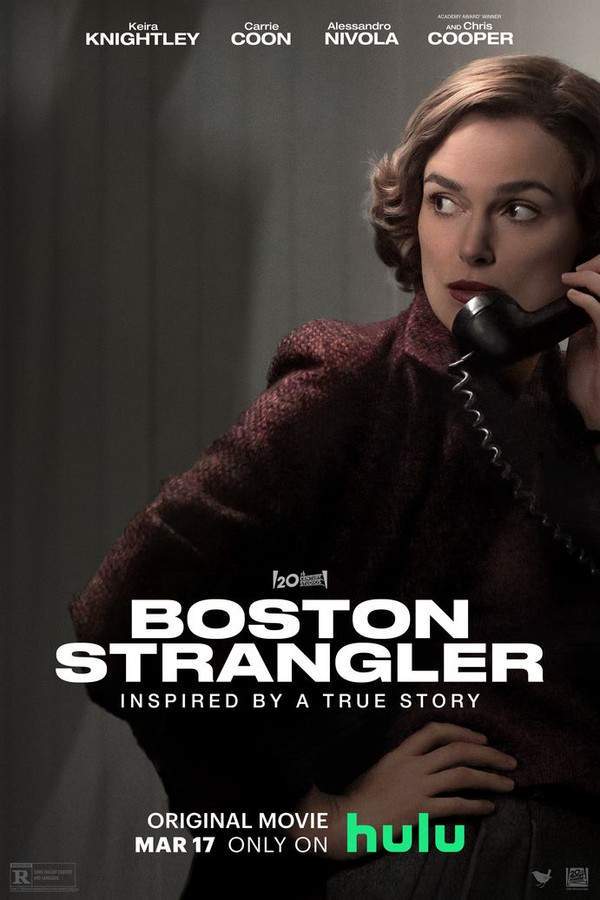
What Is Boston Strangler About?
The premise of Boston Strangler in 315 words, with nothing given away. The full story and the ending follow below.
In the restless streets of early‑1960s Boston, a city still humming with post‑war optimism, a chilling wave of fear begins to ripple through neighborhoods and newsrooms alike. The atmosphere is thick with the clatter of typewriters, the smoke of newsroom coffee, and a palpable tension between a society that clings to traditional roles and a new wave of voices demanding change. Shadows linger in the alleys and in the corridors of power, hinting at secrets that refuse to stay buried.
Enter Loretta McLaughlin, an ambitious reporter whose relentless curiosity drives her to chase a story that many would rather keep suppressed. Her sharp mind and tenacity make her both a beacon and a target in a world that often dismisses women’s instincts. Paired with her equally determined colleague Jean Cole, the duo forms an unlikely partnership that blends wit, courage, and a shared commitment to uncovering the truth, even as they confront the entrenched sexism of a male‑dominated newsroom.
Together they navigate a maze of institutional resistance, personal sacrifice, and mounting pressure, each article they pen edging the city closer to confronting a hidden menace. Their investigatory journey is as much about confronting the opaque walls of bureaucracy as it is about confronting the invisible threat lurking in the night. The tone oscillates between gritty journalism noir and a hopeful, if uneasy, pursuit of justice, underscored by the crackling energy of a city on the brink of transformation.
As the story unfolds, the audience is invited to feel the pulse of Boston’s streets, hear the clamor of newsroom debates, and sense the mounting stakes that push Loretta and Jean deeper into uncharted territory. Their partnership becomes a lens through which the film examines the power of truth, the cost of persistence, and the fragile line between ambition and danger, all set against a backdrop of a city trembling under the weight of its own secrets.
What Happens in Boston Strangler?
The complete story of Boston Strangler, from the first scene to the last, in 673 words (about 3 minutes). Spoilers throughout. Names in the text link to 2 cast member pages.
Spoilers ahead
In 1962, investigative reporter Loretta McLaughlin of the Boston Record American embarks on a harrowing journey after uncovering the chilling cases of three older women who were brutally raped and murdered by strangulation in the Boston area. Each victim bore the same haunting signature—stockings tied around their necks in precise bows—suggesting the potential presence of a serial killer lurking in the shadows. The shocking nature of her findings ruffles feathers among Boston law enforcement and her own superiors, who are determined to suppress the story to safeguard the paper’s reputation.
When a fourth victim emerges, Loretta teams up with fellow journalist Jean Cole, as they face rampant sexism in a male-dominated newsroom and society. The strain on Loretta’s personal life escalates as her long hours take a toll on her marriage, and her family becomes the target of harassment. Amidst these challenges, Loretta coins the infamous moniker “the Boston Strangler” while documenting their findings.
By the following year, tragedy strikes again as a seventh victim, Sophie Clark, is discovered. A neighbor describes a man who could potentially be the murderer, yet this new victim deviates from the established pattern, being considerably younger than the previous ones. As the investigation unfolds, Loretta and Jean realize that the Boston Police Department is mishandling the case, failing to share crucial information with surrounding jurisdictions. They uncover similar murders, including one linked to a man named Paul Dempsey in New York City, that had gone unnoticed.
The plot thickens when Albert DeSalvo, a suspect in this heinous series of murders, is apprehended. A witness is brought in to identify him, but she mistakenly chooses another man, George Nassar. Regardless of this discrepancy, DeSalvo eventually confesses to all 13 murders in 1964. However, due to a lack of physical evidence, he is convicted solely for previous robbery and sexual offenses, receiving a life sentence.
Fast forward to 1965, Loretta discovers through a detective in Ann Arbor, Michigan, that there are six murders there that match the Strangler’s methodology. Traveling to Ann Arbor, she investigates and finds that a prime suspect is Daniel Marsh, an ex-boyfriend of one of the Strangler’s victims. Despite being apprehended, Marsh remains uncooperative. In a twist of fate, DeSalvo reaches out to Loretta in 1973, offering to share his version of the events during visiting hours. Tragically, before their meeting can take place, he is fatally stabbed by another inmate.
With the revelation of an anonymous tip, Loretta connects with Harrison, a former patient at Bridgewater State Hospital, who reveals that DeSalvo, Marsh, and Nassar were all housed in the same ward at one point. He alleges that DeSalvo’s confession was orchestrated by Marsh and Nassar. In a subsequent prison visit, Nassar denies having coached DeSalvo but admits to hoping for the reward money, throwing doubt on the singular narrative of the Strangler and hinting that multiple killers may exist.
As Loretta and Jean dig deeper, they formulate a compelling theory positing that Paul Dempsey was responsible for the initial six murders before relocating to New York, leading to subsequent copycat killings that targeted much younger victims. The media frenzy surrounding DeSalvo’s confessions raised questions about the integrity of the investigative process. Ultimately, Nassar facilitated DeSalvo’s representation by high-profile attorney F. Lee Bailey, manipulating the situation to secure a monetary gain and a supposed lucrative book deal for DeSalvo.
The Record American ultimately publishes Loretta and Jean’s investigative theory, which contributes to a wider discussion about journalism’s role in criminal investigations. In the closing epilogue, Loretta rises to prominence as an award-winning medical reporter at The Boston Globe, while Jean enjoys a flourishing career as a reporter for three decades, maintaining a close friendship with Loretta. In a poignant note, Marsh never faces charges for murder, and Nassar misses out on rewards, remaining incorrectly assumed to linger in prison even as of 2023. The saga reveals that by 2013, DNA evidence linked DeSalvo to the 13th murder, but not to the other twelve, leaving lingering questions about the true identity of the Boston Strangler.
Boston Strangler Timeline: Every Key Event in Order
15 key events in the order they happen, from “Loretta's Investigation Begins” to “Legacy of Unresolved Cases”. 8 events name a place, across 4 locations.
- 1
Loretta's Investigation Begins
In 1962, investigative reporter Loretta McLaughlin becomes deeply involved in a disturbing case after discovering the brutal murders of three older women. Each victim showed a chilling commonality, raising suspicions of a lurking serial killer in the Boston area.
When:1962 Where:Boston, Massachusetts
- 2
Emergence of the Fourth Victim
As the investigation progresses, a fourth victim's body is uncovered, prompting Loretta to collaborate with fellow journalist Jean Cole. Together, they begin to navigate the oppressive male-dominated environment of their newsroom, facing sexism and resistance as they pursue the truth.
When:1962 Where:Boston, Massachusetts
- 3
Sexism and Personal Strain
Loretta's commitment to the story begins to take a toll on her personal life, straining her marriage. Her family suffers harassment as they become entangled in the fierce media attention surrounding the case.
- 4
The Coining of 'The Boston Strangler'
While delving deeper into the cases, Loretta coins the term 'the Boston Strangler' to describe the suspected killer. This moniker becomes infamous, capturing the public's attention and increasing pressure on law enforcement.
- 5
Seventh Victim Discovered
In 1963, a seventh victim named Sophie Clark is found, striking fear into the community as she is younger than previous victims. A neighbor provides a description of a potential suspect, but it becomes clear that the pattern of murders is evolving.
When:1963 Where:Boston, Massachusetts
- 6
Investigating Police Failures
Loretta and Jean realize that the Boston Police Department is not adequately sharing important information that could connect disparate murders. Their investigation uncovers even more similar cases across jurisdictional lines, suggesting systemic failures in the investigative process.
Where:Boston, Massachusetts
- 7
Capture of Albert DeSalvo
Albert DeSalvo becomes a prime suspect after numerous connections to the murders are established. Though a witness mistakenly identifies George Nassar, the pressure mounts as DeSalvo eventually confesses to all thirteen murders.
When:1964 Where:Boston, Massachusetts
- 8
Conviction and Sentencing
Despite his confession, DeSalvo is convicted only for prior robbery and sexual crimes due to the lack of physical evidence linking him to the murders. He receives a life sentence, leaving many details of the case unresolved.
When:1964
- 9
Uncovering More Murders in Ann Arbor
In 1965, Loretta travels to Ann Arbor following a tip regarding six murders that mirror the Strangler's methods. Here, she identifies Daniel Marsh as a prime suspect, although he remains uncooperative with investigators.
When:1965 Where:Ann Arbor, Michigan
- 10
DeSalvo's Fatal Encounter
In a turn of fate, DeSalvo reaches out to Loretta in 1973, wanting to share his story. Tragically, before they can meet, he is fatally stabbed by another inmate in prison, leaving many questions unanswered.
When:1973 Where:Prison
Show the other 5 events of Boston Strangler Hide the last 5 events
- 11
Connecting the Dots
A former patient at Bridgewater State Hospital shares critical information with Loretta, suggesting ties between DeSalvo, Marsh, and Nassar. This revelation hints at a larger conspiracy surrounding the murders.
Where:Bridgewater State Hospital
- 12
Theories of Multiple Killers
As Loretta and Jean investigate further, they formulate a theory that Paul Dempsey may have committed the initial murders. They suggest that copycat killings followed, indicating a pattern of multiple killers targeting younger victims.
- 13
The Role of Media in Investigations
The Record American publishes Loretta and Jean's investigative conclusions, igniting a broader discussion about the media's role in criminal investigations. Their work raises critical questions regarding ethics and responsibility in reporting.
- 14
The Impact on Loretta and Jean
In the epilogue, Loretta emerges as an award-winning medical reporter, while Jean flourishes in her career. Their friendship endures through the years despite the trauma of their harrowing investigation.
When:Post-1973
- 15
Legacy of Unresolved Cases
Years later, advancements in DNA technology reveal that while DeSalvo was linked to the 13th murder, he was not connected to the other twelve. This persistent ambiguity continues to cloud the identity of the Boston Strangler.
When:2013
Who Are the Main Characters in Boston Strangler?
3 characters, among them Loretta McLaughlin (Keira Knightley), Jean Cole (Carrie Coon) and Albert DeSalvo (David Dastmalchian): who each one is and the part they play in the story. Every profile links to the actor’s page.
-

Loretta McLaughlin (Keira Knightley)
Played by Keira Knightley
Loretta is an investigative reporter who demonstrates extraordinary determination and resilience while uncovering the chilling truths behind the Boston Strangler. Her character navigates personal and professional challenges, showcasing her strength and dedication to justice.
- 📰 Journalist
- 💪 Resilient
-

Jean Cole (Carrie Coon)
Played by Carrie Coon
Jean is a fellow journalist and Loretta's ally, providing support as they face the aftermath of uncovering a serial killer. She embodies professionalism while also confronting the prevalent sexism in the newsroom, making her an essential partner in their investigation.
- 📰 Journalist
- 🤝 Supportive
-

Albert DeSalvo (David Dastmalchian)
Played by David Dastmalchian
Albert is the suspected Boston Strangler whose controversial confession raises numerous questions about the truth behind the murders. His character adds layers of complexity to the investigation, revealing the fragility of the justice system.
- ⚖️ Suspect
- 💼 Conflicted
Where and When Is Boston Strangler Set?
Boston Strangler is set in Boston and Ann Arbor (1960s). Here is why the time and place matter to the story.
When
1960s
The events unfold primarily during the early to mid-1960s, a period characterized by heightened social tension and the emergence of investigative journalism. This era saw significant advancements in forensic science and a growing awareness of serial crimes.
Where
Boston, Ann Arbor
The movie takes place primarily in Boston, a historic city known for its rich cultural heritage and as a hub of journalism and academia. Ann Arbor, known for its University of Michigan, is also featured as Loretta investigates a series of murders linked to the Boston Strangler.
- 🏙️ City
- 🏥 Hospital
What Are the Themes of Boston Strangler?
3 ideas the story keeps returning to, among them Journalism, Justice and Feminism.
-
01
Journalism
The film highlights the relentless pursuit of truth in journalism, showcasing the challenges reporters face in male-dominated environments. Loretta and Jean's rigorous investigation into the Boston Strangler case exemplifies the important role of media in uncovering injustices.
-
02
Justice
The theme of justice runs throughout the narrative, exploring the complexities involved in convicting a criminal without concrete evidence. The film raises questions about the integrity and effectiveness of the justice system, particularly in cases involving serial killers.
-
03
Feminism
The story emphasizes the struggles women faced in the workplace during the 1960s, particularly in journalism. Loretta and Jean challenge societal norms, confronting sexism head-on while striving to assert their credibility and achieve professional success.
How Does Boston Strangler End?
The last act of Boston Strangler and what it means, in 287 words. The ending lands as mixed. Big spoilers: read the plot summary first if you have not seen it.
The final act, in full
The film suggests that the true story behind the Boston Strangler might never be fully known. Although Albert DeSalvo confessed to the murders and there was strong evidence linking him to the last victim, the film reveals that his confession was likely fabricated as part of a scheme devised by a fellow inmate, George Nassar. Nassar manipulated DeSalvo into confessing with promises of a lucrative book deal, and it appears that DeSalvo’s murder inside prison shortly after speaking to Loretta was orchestrated by Nassar himself, who wanted to silence him. In the real world, and as shown in the film, there was no definitive proof that DeSalvo was the sole killer, and many believe the crimes were committed by multiple individuals or even a copycat killer. The movie emphasizes how the violence against women in Boston was disturbingly pervasive, with some victims possibly killed by different men exploiting the same methods, creating the illusion of a single, terrifying serial killer. Loretta and Jean, driven by their relentless pursuit of the truth, uncovered the flaws in the police investigation and faced significant personal risks, including threats and danger. In the end, while the case was officially closed with DeSalvo’s confession, the real identity of the Boston Strangler remains uncertain—highlighting the tragic and unresolved nature of this horrifying chapter in history. Loretta went on to have a distinguished career in journalism, and Jean continued her investigative work, both hard-fought women showing remarkable resilience in the face of systemic sexism and personal danger. Ultimately, the film leaves viewers with the understanding that the fear and violence against women highlighted in the case are still very present today, making the case not just about one man but a wider societal issue.
What Kind of Film Is Boston Strangler?
Tense in tone, with steady pacing and a complex story, going by the plot summary.
- Tone
- Tense
- Pacing
- Steady
- Story
- Complex
- Intensity
- High
- Ending
- Mixed
A grim and methodical procedural that builds an oppressive atmosphere of fear as two determined journalists challenge a sexist system while hunting a serial killer, leaving a lasting sense of unsettling ambiguity.
- grim
- anxious
- oppressive
- determined
- suspenseful
- methodical
- true crime investigation
- serial killer
- journalism
- sexism
Content notes: sexual assault, murder, strangulation, harassment.
Quiz
How well do you remember Boston Strangler? Test yourself on the story.
Where to Watch Boston Strangler
Stream it on Hulu. US availability and prices from JustWatch.
Stream 1
 Hulu
Hulu Streaming availability in the US, powered by