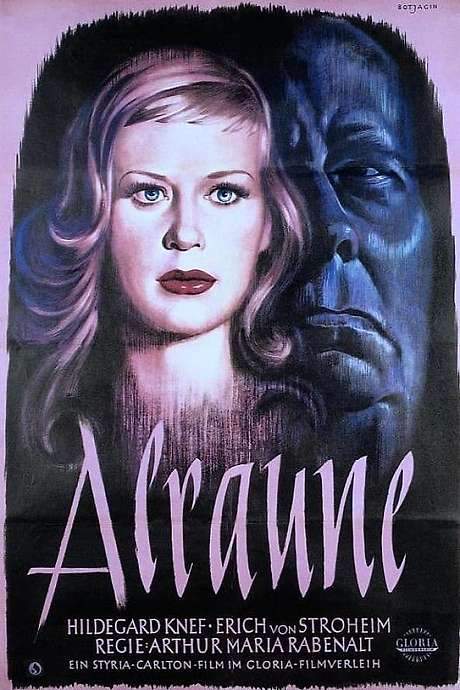
Alraune 1952

Directed by

Arthur Maria Rabenalt
Made by

Deutsche Styria Film GmbH
Alraune Plot Summary
Read the complete plot summary and ending explained for Alraune (1952). From turning points to emotional moments, uncover what really happened and why it matters.
In a moody, early 20th-century Gothic tale, Professor Jacob ten Brinken, Erich von Stroheim, loses his university teaching post because of an obsession with artificial insemination. He secretly uses the sperm of a male murderer condemned to death by hanging to artificially impregnate a female prostitute, and then raises the child as his own. The result is Alraune, a name that evokes both the mandrake root and a troubling lineage, foreshadowing the peculiar blend of beauty and danger she embodies. The film follows her growth from a peculiar, almost mythic presence into a woman who disrupts the lives of everyone around her.
As a medical student, Frank Braun, Karlheinz Böhm, arrives at the ten Brinken estate seeking a loan. He is drawn to Alraune, now a striking and intelligent young woman, and the pair quickly fall in love. Alraune announces she plans to leave her father to join Frank in Paris, but Ten Brinken warns Frank that she can “lure men to their demise.” Frightened and enthralled, Frank travels to Paris without her, leaving her devastated and angry. Her sense of morality slips, and she begins to operate in a world that seems to reward manipulation and desire rather than conscience.
Back at the estate, Alraune’s charm becomes a weapon she wields to test and torment men who cross her path. She goes horseback riding with Gerald, Harry Meyen, during a rainstorm, enjoys a carriage ride with Mathieu, Hans Cossy, and poses for Ralph as he paints her. When a necklace goes missing, she accuses Mlle. Duvaliere, Denise Vernac, a made-up theft that costs her mentor a job—an accusation that is later unmasked as a calculated move by Doctor Mohn, Harry Halm, who stole the piece to push himself into Alraune’s orbit and to attract her attention.
Months pass and Frank returns from his studies, now ready to begin a life with Alraune. Yet he remains wary of her power. Although she loves him, she discovers that love cannot easily reconcile with the destruction she has caused in others’ lives. Feeling betrayed and increasingly isolated, Alraune pleads for Frank’s help and even sheds real tears, prompting Frank to reevaluate the “unnatural being” he was told to fear. He realizes there may be genuine emotion beneath her carefully crafted facade, and he agrees to rekindle their romance and plan an elopement.
Yet Ten Brinken stands in the way, convinced that Alraune’s very presence will ruin both her life and his. Meanwhile, a dwindling sulfur spring on the land becomes a metaphor for dwindling hope; Dr. Mohn threatens to expose Ten Brinken’s illegal experiments if he does not flee with Alraune and the remaining money from the land deal. Alraune grapples with her own sense of worth and destiny, convinced that she is nothing more than “the bringer of destruction” born of a cruel experiment.
Frank, however, speaks to Alraune of a more nuanced truth: good and evil coexist within every person, regardless of their origins. He urges her to believe that her capacity for love can prevail over the darker impulses she has learned to wield. Together, they return to the estate, where Ten Brinken prepares to stop their plan by any means necessary. He shoots Alraune, uttering, Now the toy is broken—the crime against nature that God didn’t want. The act is fatal for Alraune, who dies and dissolves into a mandrake root, the embodiment of her double-edged nature.
In the aftermath, Ten Brinken is arrested for murder and is ultimately hanged for the crime against his own child. The film ends on a haunting note about creation, conscience, and the ambiguous line between science and humanity, leaving the question of whether Alraune’s power was ever truly “evil” or merely a mirror reflecting the fears of those who tried to control her.
Characters and performances color this complex tragedy, with the strong supporting cast shaping the estate’s dynamics and the social tensions that swirl around Alraune’s fate:
- Alraune, the central figure whose beauty and potency provoke desire and danger, Hildegard Knef
- Professor Jacob ten Brinken, her father and the man who created her, Erich von Stroheim
- Frank Braun, the student who loves her but wrestles with what she represents, Karlheinz Böhm
- Mlle. Duvaliere, a teacher acquitted of theft amid the plot’s intrigues, Denise Vernac
- Doctor Mohn, the physician who manipulates events to gain Alraune’s attention, Harry Halm
- Mathieu, the carriage driver whose fate foreshadows the danger surrounding Alraune, Hans Cossy
- Gräfin Wolkonska, a powerful figure at the estate, Trude Hesterberg
- Count Geroldingen, a noble who crosses paths with Alraune, Harry Meyen
- Olga Wolkonska, a member of the household, Julia Koschka
- Lisbeth, a member of the household circle, Gardy Brombacher
This adaptation preserves the original’s psychological intensity and moral questions while presenting them with a more expansive, reader-friendly narrative cadence. The film’s striking imagery, the tension between scientific ambition and ethical restraint, and the ultimate tragedy all cohere to create a meditation on how far love, science, and desire can be pushed before they fracture what remains human.
Alraune Timeline
Follow the complete movie timeline of Alraune (1952) with every major event in chronological order. Great for understanding complex plots and story progression.
Ten Brinken loses his teaching post over unethical insemination studies
Professor Jacob ten Brinken loses his university teaching post due to his abnormal interest in artificial insemination. He conducts an illicit experiment by artificially impregnating a prostitute with the sperm of a male murderer condemned to death. The resulting child is Alraune, whom he raises on his estate.
Alraune is conceived and raised by ten Brinken
From the illicit birth, he raises Alraune on his estate, giving her a life shaped by their unorthodox beginnings. The name Alraune echoes the mandrake root and hints at her uncanny nature.
Frank Braun arrives seeking a loan
Medical student Frank Braun arrives at his uncle's estate to ask for a loan. There he becomes infatuated with the now-beautiful Alraune. They quickly profess their love.
Alraune declares she will move to Paris with Frank
Alraune announces she will leave her father to live with Frank in Paris. Frank is initially intrigued but unsettled by her dangerous charm. The plan foreshadows the couple's departure from the estate.
Ten Brinken warns Frank; Frank departs for Paris without Alraune
Ten Brinken warns Frank about Alraune's ability to lure men to their demise. Horrified, Frank leaves for Paris without Alraune. The revelation strains the relationship between Alraune and her father.
Alraune's true nature starts to emerge through seduction
Now independent of her parents, Alraune uses her sexual appeal to attract men—Gerald, Mathieu, and Ralph—leading to tragedies and social confusion. When a necklace goes missing, she is accused of theft and Duvaliere is fired. It later turns out Doctor Mohn stole the necklace and framed Duvaliere to gain Alraune's attention.
Months later: Frank returns and confronts Alraune's affection
Months later, Frank returns from his studies. Alraune proclaims her love again, but Frank resents her. He gradually realizes that she is capable of genuine emotion, challenging his previous belief that she is soulless.
The couple plans to elope; Ten Brinken refuses to release her
Alraune tells ten Brinken about her plan to elope with Frank. He refuses to let her go, fearing that she will destroy him and herself. The confrontation heightens the tension between them.
Mohn's schemes against ten Brinken: dry sulfur spring and expose
With the sulfur spring dry, Dr. Mohn threatens to expose ten Brinken's illegal experiments. He plans to run away with Alraune to Germany using the land-sale money. Alraune struggles with her own sense of being the bringer of destruction.
Frank's counsel about good and evil; hope for Alraune's redemption
Frank consoles Alraune, arguing that good and evil coexist in every person and that the good in her can prevail. He helps her reclaim hope for a life with him and a chance to choose her own path. This marks a turn toward moral agency.
Climax: Ten Brinken shoots Alraune; she dies and dissolves into mandrake
Frank carries Alraune back to the estate, where ten Brinken confronts the idea of losing her to another man. He shoots Alraune, declaring that the toy has broken and that he cannot tolerate the crime against nature. Alraune dies, dissolving into a mandrake-root form as her true nature is destroyed.
Ten Brinken is hanged for murder of his child
Ten Brinken is arrested and hanged for the murder of Alraune, ending the tale of his cruel experiments. The film closes with the consequences of his actions and the erasure of Alraune's legacy.
Alraune Characters
Explore all characters from Alraune (1952). Get detailed profiles with their roles, arcs, and key relationships explained.
Alraune (Hildegard Knef)
Alraune is the product of Ten Brinken's illicit experiments, a beautiful and perceptive woman whose allure draws men to ruin. She oscillates between longing and moral questioning, revealing genuine emotion despite a creator's accusations of soullessness. Her actions catalyze the moral crisis of the story, culminating in a dramatic confrontation and her eventual death. She embodies the tension between manipulated fate and personal choice.
Jacob ten Brinken (Erich von Stroheim)
A brilliant but morally compromised professor who conducts illicit artificial insemination experiments to create Alraune. He treats Alraune as an object of science and control, driven by hubris and possessiveness. His relentless pursuit of power leads to murder and his downfall, highlighting the dangers of playing God. He is arrested and hanged for the crime of his ‘child.’
Frank Braun (Karlheinz Böhm)
A medical student who falls in love with Alraune and wrestles with the morality of her existence. He experiences a shift from fear and rejection to acceptance of her humanity, influencing the couple to consider elopement. His journey is one of moral awakening, where love challenges the scientist’s demonization of Alraune. He ultimately helps steer her toward self-determination before the tragedy closes in.
Gräfin Wolkonska (Trude Hesterberg)
A noblewoman on the estate who represents the aristocratic social frame surrounding Ten Brinken’s experiments. She embodies the old order and serves as a witness to the ethical and moral consequences of the professor’s actions. Her presence highlights the tension between scholarly ambition and societal norms.
Olga Wolkonska (Julia Koschka)
A member of the aristocratic circle around the Wolkonska family, whose position underscores the societal scrutiny faced by Ten Brinken’s project. She interacts with the main cast within the estate’s social web, reflecting the era’s upper-class concerns about reputation and propriety.
Count Geroldingen (Harry Meyen)
A nobleman entangled in the estate’s social and romantic intrigues. His presence demonstrates how Alraune’s influence extends into the upper echelons of society, complicating loyalties and amplifying the stakes of the love triangle.
Doctor Mohn (Harry Halm)
A physician who manipulates events to gain attention from Alraune, framing others to escalate his own status. He orchestrates misdirections and participates in the scheme that leads to several deaths, underscoring the dangers of vanity and deceit in medical ethics. He becomes a dangerous foil as the truth unfolds.
Mlle. Duvaliere (Denise Vernac)
A schoolteacher who is wrongfully accused of stealing Alraune’s necklace when the truth is later revealed. Her character underscores the theme of false accusation and the fragility of reputation within the social milieu of the estate. She is ultimately vindicated as deception is exposed.
Mathieu (Hans Cossy)
The coachman who becomes entangled in Alraune’s seductive web, meeting a tragic end when his carriage falls off a cliff. His role demonstrates how the chain of desire and manipulation affects ordinary people who cross Alraune’s path.
Wolf Goutram (Rolf Henniger)
A longtime retainer on the estate who navigates the complex social dynamics surrounding Ten Brinken and Alraune. He contributes to the atmosphere of the estate and the unfolding power plays without being central to the romance plot.
Lisbeth (Gardy Brombacher)
A servant on the estate who participates in the daily life and social machinery of Ten Brinken’s world. She provides a ground-level perspective on the drama and serves as part of the estate’s fabric.
Alraune Settings
Learn where and when Alraune (1952) takes place. Explore the film’s settings, era, and how they shape the narrative.
Location
Germany (Ten Brinken's estate), Paris
The story centers on a German estate belonging to Professor Ten Brinken, which doubles as a secret laboratory and social stage for his experiments. Key action moves between the estate and Paris, where Alraune seeks love and autonomy. The plot also touches on the surrounding lands and a sulfur spring tied to the land’s fate, underscoring the clash between science, desire, and nature.
Alraune Themes
Discover the main themes in Alraune (1952). Analyze the deeper meanings, emotional layers, and social commentary behind the film.
⚖️
Moral Duality
Alraune’s existence prompts the film to question whether morality is intrinsic or shaped by circumstance. It suggests that even a created being can feel love and empathy, challenging the notion that she is merely evil. The narrative shows the consequences of scientific meddling when personal desire collides with ethical boundaries. Ultimately, it argues that responsibility accompanies creation.
💘
Desire and Power
Romantic and erotic desire drive much of the plot, with Alraune using her charm to influence men. The relationship with Frank evolves from attraction to moral reckoning, revealing vulnerability beneath a seductive exterior. Desire is portrayed as both intoxicating and dangerous, capable of reshaping lives and destinies. The story probes whether love can redeem or merely complicate the fate of those involved.
🧬
Science and Ethics
Ten Brinken’s experiments showcase scientific hubris and a breach of ethical boundaries. The film questions whether creating life for personal gain justifies harm to others or violates consent. The cascading consequences—betrayal, accusation, and murder—illustrate the social and personal costs of unrestrained inquiry. Ultimately, the ending implies that accountability must follow scientific ambition.

Coming soon on iOS and Android
The Plot Explained Mobile App
From blockbusters to hidden gems — dive into movie stories anytime, anywhere. Save your favorites, discover plots faster, and never miss a twist again.
Sign up to be the first to know when we launch. Your email stays private — always.
Explore the mobile appAlraune Spoiler-Free Summary
Discover the spoiler-free summary of Alraune (1952). Get a concise overview without any spoilers.
In a shadow‑laden landscape that feels simultaneously nineteenth‑century and early‑twentieth, the estate of a reclusive scholar looms over a world where scientific ambition clashes with age‑old superstition. Thick mists roll across the grounds, candlelight flickers in austere corridors, and an undercurrent of moral unease permeates every conversation. The film’s visual language is deliberately gothic, rendering both the natural world and the man‑made laboratory as places of haunting beauty and latent danger.
At the heart of the story is Professor Jacob ten Brinken, a once‑respected academic whose fascination with the limits of biology has driven him into secrecy. Obsessed with the idea of creating life beyond conventional means, he conducts a daring experiment that blurs the line between nature and artifice. His work is whispered about in hushed tones, hinting at profound ethical questions without revealing the full scope of his methods.
From that experiment emerges Alraune, a striking young woman whose very presence seems to echo the mandrake myth that inspired her name. She possesses an enigmatic combination of intellect, allure, and a subtle, unsettling power that draws people toward her like moths to a flame. Those who encounter her sense both attraction and disquiet, sensing that she is a living embodiment of a daring scientific gamble.
Enter Frank Braun, an earnest medical student who arrives at the estate seeking a modest favor but quickly finds himself captivated by Alraune’s mystery. He is torn between the rational teachings of his studies and the intoxicating, inexplicable pull of the woman before him. Their budding romance unfolds against a backdrop of whispered warnings and unseen forces, setting the stage for a tension‑filled exploration of love, creation, and the fragile boundary between humanity and invention.
Movies with Similar Twists and Themes
Uncover films that echo the narrative beats, emotional arcs, or dramatic twists of the one you're exploring. These recommendations are handpicked based on story depth, thematic resonance, and spoiler-worthy moments — perfect for fans who crave more of the same intrigue.

Featured on this page

What's After the Movie?
Not sure whether to stay after the credits? Find out!
Check out our other apps:

SAT Sphere
Build confidence for the Digital SAT.

Mori Atlas
Discover wild places worth protecting.

Luntero
Search smarter for a home in Amsterdam.

Plot Explained
Unravel movie endings and hidden clues.

Pokechamp
Dive into Pokémon data and battle logic.

Driving Theory
Get ready for your European theory test.

Movie Dust
Plan your next cinema trip with ease.

Musemap
Find art and culture as you travel.

Selkobase
Compare credentials before committing.

Local Manual
Turn an unfamiliar country into practical next steps.

Lernavi
Compare school systems before your next move.

GymRoam
Find a workout stop wherever your plans take you.
Explore Our Movie Platform
New Movie Releases (2026)
Famous Movie Actors
Top Film Production Studios
Movie Plot Summaries & Endings
Major Movie Awards & Winners
Best Concert Films & Music Documentaries
Movie Collections and Curated Lists
© 2026 What's After the Movie. All rights reserved.
Privacy Policy