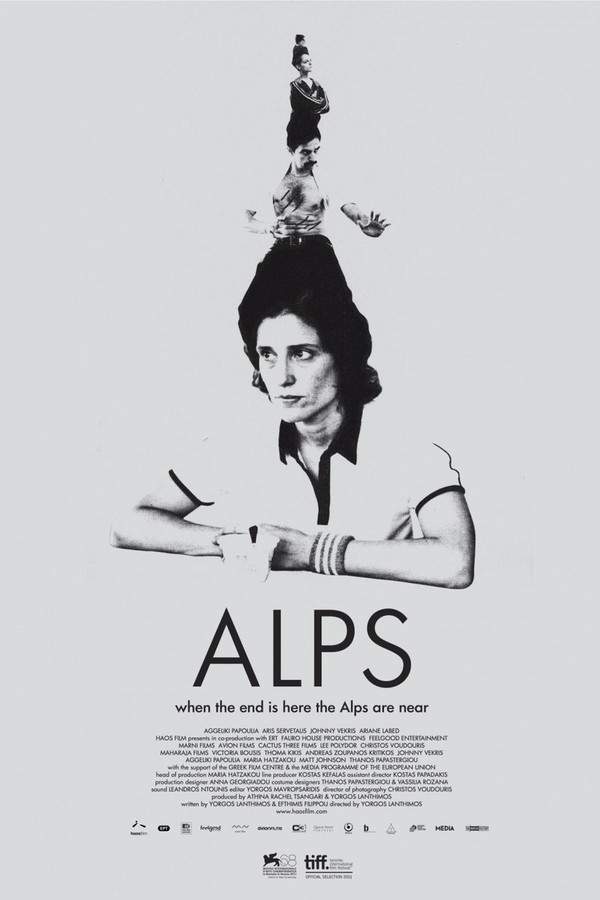
Alps 2012

Directed by

Giorgos Lanthimos
Made by

Kino Lorber
Alps Plot Summary
Read the complete plot summary and ending explained for Alps (2012). From turning points to emotional moments, uncover what really happened and why it matters.
A rhythmic journey into a secretive subculture unfolds as a small gym becomes the stage for an unusual enterprise. A rhythmic gymnast, Ariane Labed, practices a routine to Carl Orff’s Carmina Burana, only to be told by her coach, Johnny Vekris as the man who nicknames himself “Matterhorn,” that she should not drift toward pop and that questioning him could have dire consequences. The pair share a tense dynamic marked by calculated obedience and a chilling undertone of power, and after a moment of quiet apology, the tension lingers in the room.
In Alps, a discreet and secretive organization operates from the gym: the gym itself doubles as a meeting place where the businessman-like staff orchestrate their discreet service. The group comprises four members, each playing a role in a carefully choreographed, emotionless ritual. The gymnast and her coach—the latter adopting the nickname Matterhorn—are joined by a hospital nurse, Aggeliki Papoulia as Monte Rosa, and an EMT, Aris Servetalis as Mont Blanc. For a price, one of Alps’ members acts as a “substitute” for a recently deceased person when clients visit loved ones to help with the grieving process. The set-up is clinical: the substitutions are calculated, the scripts are rehearsed, and the emotional exchanges are meant to feel meaningful while remaining deliberately transactional.
The Mont Blanc-led group undertakes a high-stakes case: a young female tennis player who has survived a serious accident but is not expected to live. Mont Blanc, the leader’s baton-wielding figure, works with Monte Rosa, who is on the tennis player’s hospital care team, to study the teen and gather information that could make a substitute possible after the death. The gymnast tries to stay on Mont Blanc’s good side to position herself as a future substitute, but Monte Rosa becomes emotionally entangled, telling the girl’s family that the teenager will recover. When the tennis player dies, Monte Rosa secretly offers her services to the grieving parents while concealing the truth from the Alps’ circle.
Alps’ client roster reads like a catalog of intimate requests: a man mourning an old friend, a blind woman whose husband has died after years of infidelity, and the lamp shop owner who has lost his diabetic girlfriend. The clients dictate what the members should wear, say, and do, and they help craft scenarios that verge on the intimate while keeping a cold, businesslike detachment. While the rules forbid sexual relations with clients, the dynamics are undeniably charged: Matterhorn regularly kisses the blind woman, and Monte Rosa has sex with the lamp shop owner, underscoring the moral ambiguity that threads through every interaction.
Monte Rosa’s undercover mission grows riskier as she visits the tennis player’s parents multiple times, learning to mimic the girl with unsettling accuracy. The scenes become a study in imitation: Monte Rosa even reenacts a moment with the deceased girl’s boyfriend, then takes that boyfriend home to sleep with him. The other members of Alps grow suspicious when Monte Rosa misses meetings and fabricates explanations. Mont Blanc follows her to the tennis player’s home, confronts her, and, after a brutal moment, ejects her from the group. The gymnast steps in to assume Monte Rosa’s role as the tennis player, stitching up a cheek wound and returning to the family with a new, troubling method of grief work.
Back at home, Monte Rosa confronts personal shocks: she asks her father about her late mother’s favorite actor and singer, and when she pursues him physically, he slaps her. She then crashes a ballroom with her father’s former dance partner and his new girlfriend, forcing a confrontation that ends with the partner on the ground. The final intrusion unfolds when Monte Rosa returns to the tennis player’s house: she breaks a sliding-glass door and slips into the room, only to be confronted by the parents who, in a merciless gesture, seal the scene with a metal shutter as Monte Rosa shuffles on the patio.
The gymnast’s performance closes the film, moving gracefully to “Popcorn” as Matterhorn watches with a quiet pride. She finishes, embraces her coach, and tells him he is the best in the world—an echo of a previous, disturbing moment that lingers in the air. A smile that once seemed bright fades, leaving a stark, unresolved emotion in its wake. The routine ends not with triumph, but with a stark, uneasy quiet that reflects the complicated ethics and blurred boundaries at the heart of Alps.
Alps Timeline
Follow the complete movie timeline of Alps (2012) with every major event in chronological order. Great for understanding complex plots and story progression.
Practice to Carmina Burana
A rhythmic gymnast rehearses a routine set to Carl Orff's Carmina Burana. The rehearsal showcases her precision and the rigid authority of her coach. A tense power dynamic begins to surface as the coach asserts control.
Demand for pop song and coach's threat
After the practice, she tells her coach she would rather use a pop song. He dismisses pop as inappropriate and threatens to break her arms and legs if she questions him again. She apologizes, chastened.
Alps organization introduction
Alps is introduced as an unusual organization that meets in the gym where the gymnast trains. For a fee, a substitute acts as a recently deceased person during visits with loved ones to aid the grieving process. The core members are the gymnast, her coach Matterhorn, the nurse Monte Rosa, and Mont Blanc the EMT.
Mont Blanc's hospital case and Monte Rosa's study
Mont Blanc, the leader, treats a severely injured young tennis player in hospital. Monte Rosa is on the care team and begins studying the patient to collect information for a possible substitution. The nurse's curiosity signals growing interest in Alps' methods.
Tennis player's death and substitution offer
The tennis player dies, leaving the family in mourning. Monte Rosa offers her services to the grieving parents, while telling the others that the girl has recovered.
Alps clients and procedural rules
The Alps' clients include a man mourning an old friend, a blind woman, and the lamp shop owner. The clients dictate what the members should wear, do, and say, and the group constructs scenarios for emotionally intimate, though mostly transactional, interactions.
Affairs within Alps: kiss and sex
Matterhorn regularly kisses the blind woman, showing boundary-crossing affection. Monte Rosa also has sex with the lamp shop owner, illustrating the group's morally ambiguous dynamics.
Monte Rosa prepares to substitute the tennis girl
Monte Rosa visits the tennis player's parents to learn to imitate their daughter. They reenact a scene with the dead boyfriend, and Monte Rosa takes the boyfriend to the home she shares with her father and sleeps with him.
Suspicion and confrontation
The other Alps members grow suspicious when Monte Rosa misses meetings and lies about her whereabouts. Mont Blanc tails her to the tennis player's house and uncovers the truth. He arranges to meet Monte Rosa in the gym, hits her in the face with a training club, and ejects her from the group.
Monte Rosa's family confrontation
Monte Rosa returns home and asks her father about her deceased mother's favorite actor and singer; he slaps her. The moment exposes a volatile, unsettling dynamic between daughter and father.
Ballroom confrontation
She visits a ballroom with her father and aggressively tries to dance with his dance partner and his new girlfriend, not stopping even after the woman has fallen. The behavior underscores her deteriorating sense of boundaries.
Break-in at tennis player's house
Monte Rosa returns to the tennis player's house, breaks through a sliding-glass door, triggering an alarm. She goes to the tennis player's room and gets into bed, but the parents enter and forcibly throw her out, lowering a metal shutter over the door while Monte Rosa shuffles on the patio.
Final performance and coach moment
The gymnast performs elegantly to 'Popcorn' while Matterhorn looks on proudly. After finishing, she runs into his arms and tells him he is the best coach in the world, echoing a bizarre, sadomasochistic moment earlier in the story. Her smile fades, hinting at the emotional cost of the relationship.
Alps Characters
Explore all characters from Alps (2012). Get detailed profiles with their roles, arcs, and key relationships explained.
The Gymnast (Ariane Labed)
A disciplined rhythmic gymnast and core member of Alps. She follows the group’s rules and uses her skill to perform substitutions demanded by Mont Blanc's leadership. Her loyalty shifts between obedience and opportunistic power-sharing, culminating in a tense moment when she takes over the tennis player's role, and a final, fading smile hints at unresolved doubt.
Mont Blanc (Aris Servetalis)
The domineering and detail-oriented leader of Alps who orchestrates the organization’s actions. He controls the substitutions, enforces strict rules, and reacts with force when a member steps out of line. His confrontations and strategic maneuvers drive the group toward a harsh, ultimately restructured dynamic.
Monte Rosa (Aggeliki Papoulia)
A hospital nurse who becomes a calculating participant in the substitutions. She grows attached to the tennis player and begins crossing boundaries, manipulating the truth and personal relationships. Her deception is uncovered, leading to a dramatic fall from the group and a damaging personal unraveling.
Matterhorn (Johnny Vekris)
The gym coach and the nickname-wielding, meticulous commander within Alps. He maintains a strict regime, directs the performances, and serves as a counterbalance to Monte Rosa’s drifting loyalties. His authority is asserted through calculated decisions and controlled interactions.
Tennis Player
A young female athlete who sustains a severe car accident and is not expected to survive. Her case becomes the focal point of Alps' substitution scheme, with the nurse and gymnast preparing to enact a replacement to help the family grieve.
Alps Settings
Learn where and when Alps (2012) takes place. Explore the film’s settings, era, and how they shape the narrative.
Time period
2010s
The events unfold in a contemporary, present-day milieu with modern medical care and urban spaces. The gym, hospital, and personal residences reflect a modern era where technology and routines shape intimate experiences. The story’s pace and aesthetics align with early 2010s cinema, focusing on psychological tension rather than historical context.
Location
Gymnasium (Alps meeting place), Hospital, Tennis Player's House, Ballroom
The Alps conduct their meetings in a stark gym where routines and scripts govern interactions. Key scenes also unfold at a hospital where the tennis player's care is managed, at the tennis player's family home where impersonations are rehearsed, and in a ballroom that becomes a stage for ritualistic confrontations. The setting emphasizes a clinical, controlled environment where grief is manipulated as a service.
Alps Themes
Discover the main themes in Alps (2012). Analyze the deeper meanings, emotional layers, and social commentary behind the film.
🗝️
Control
A world of rigid protocols and paid performances governs every interaction. Alps dictates behavior, appearance, and even moments of intimacy, revealing how power can sanitize grief and emotion. The gymnast, Mont Blanc, and Monte Rosa navigate a hierarchy that rewards compliance and punishes dissent. The tension arises from the thin line between service and manipulation.
💔
Grief
Grief is commodified as a service offered to clients who want closure without genuine mourning. Substituting a deceased person allows families to perform their rituals while bypassing authentic connection. The drama exposes how emotional pain can be monetized and staged. The outcome questions whether genuine healing can occur within such transactional bounds.
🪞
Identity
Identity becomes a flexible role to be assumed or abandoned at will. Monte Rosa impersonates the deceased girl, blurring lines between self and role, while the gymnast steps into another life when the opportunity arises. The boundaries between truth and performance dissolve, leaving characters to confront who they really are under pressure. The film probes how much of a person remains when the mask is worn long enough.

Coming soon on iOS and Android
The Plot Explained Mobile App
From blockbusters to hidden gems — dive into movie stories anytime, anywhere. Save your favorites, discover plots faster, and never miss a twist again.
Sign up to be the first to know when we launch. Your email stays private — always.
Explore the mobile appAlps Spoiler-Free Summary
Discover the spoiler-free summary of Alps (2012). Get a concise overview without any spoilers.
In a quiet suburb a modest gym hides an unsettling subculture: a discreet collective that offers a highly specialized service to those haunted by loss. For a fee, its members step into the lives of the departed, rehearsing scripts and mannerisms to give grieving clients a fleeting, tangible encounter with the people they have lost. The operation is framed as a clinical ritual—precise, emotion‑laden, yet deliberately detached—transforming a space of athletic training into a covert workshop where grief is both commodity and performance.
At the helm of the enterprise is the enigmatic Mont Blanc, a figure whose authority is conveyed through measured gestures and an almost ceremonial presence. Assisting him is the imposing coach known only as Matterhorn, whose relationship with the gym’s rhythmic gymnast is marked by a blend of mentorship and an unspoken power dynamic. Monte Rosa, a poised hospital nurse, brings a clinical exactness to the impersonations, while the young gymnast herself aspires to rise within the ranks, honing her own talent for mimicry. Each member possesses a distinct skill that makes the collective’s service plausible, and together they navigate a delicate balance of professional detachment and personal obsession.
The world of the film is rendered in muted tones, where the hum of treadmills and the echo of practiced routines intertwine with whispered negotiations and carefully crafted facades. The atmosphere oscillates between the austere precision of a medical protocol and the fragile intimacy of a private goodbye, creating a mood that feels both hypnotic and disquieting. As the team prepares its elaborate reenactments, the boundaries between empathy and exploitation blur, inviting the audience to contemplate the ethics of manufactured closure.
Through its restrained visual style and lingering soundtrack, the story immerses viewers in a realm where grief is commodified, talent becomes a conduit for deception, and the characters’ hidden motives ripple beneath the surface of each calculated encounter. The tension between duty and desire, ritual and reality, sustains an unsettling curiosity that drives the narrative forward.
Movies with Similar Twists and Themes
Uncover films that echo the narrative beats, emotional arcs, or dramatic twists of the one you're exploring. These recommendations are handpicked based on story depth, thematic resonance, and spoiler-worthy moments — perfect for fans who crave more of the same intrigue.




Featured on this page

What's After the Movie?
Not sure whether to stay after the credits? Find out!
Check out our other apps:

SAT Sphere
Build confidence for the Digital SAT.

Mori Atlas
Discover wild places worth protecting.

Luntero
Search smarter for a home in Amsterdam.

Plot Explained
Unravel movie endings and hidden clues.

Pokechamp
Dive into Pokémon data and battle logic.

Driving Theory
Get ready for your European theory test.

Movie Dust
Plan your next cinema trip with ease.

Musemap
Find art and culture as you travel.

Selkobase
Compare credentials before committing.

Local Manual
Turn an unfamiliar country into practical next steps.

Lernavi
Compare school systems before your next move.

GymRoam
Find a workout stop wherever your plans take you.
Explore Our Movie Platform
New Movie Releases (2026)
Famous Movie Actors
Top Film Production Studios
Movie Plot Summaries & Endings
Major Movie Awards & Winners
Best Concert Films & Music Documentaries
Movie Collections and Curated Lists
© 2026 What's After the Movie. All rights reserved.
Privacy Policy