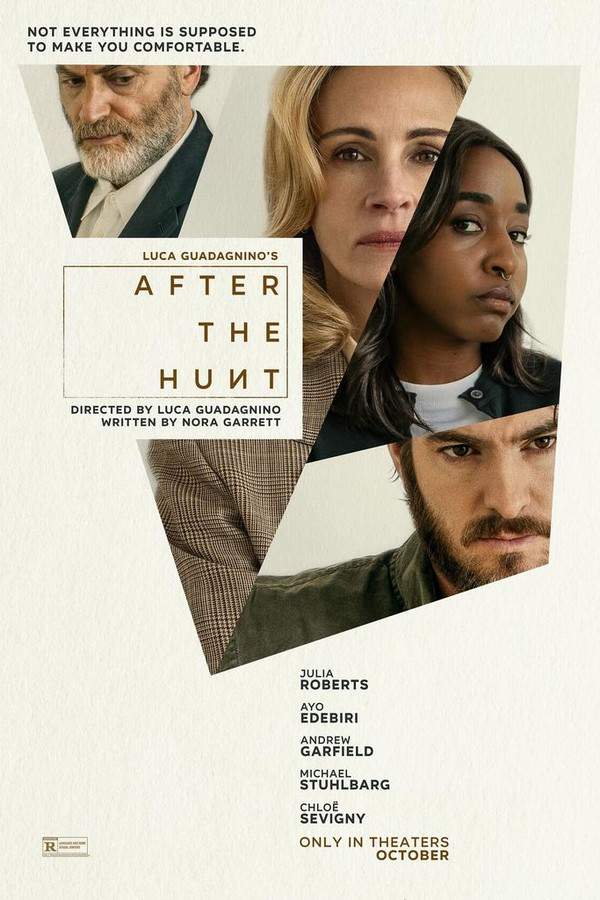
After the Hunt 2025


Directed by
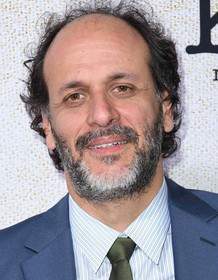
Luca Guadagnino
Made by

Big Indie Pictures
Where to Watch After the Hunt
See current US streaming, rental, and purchase options for After the Hunt (2025) via JustWatch.


Streaming availability powered by 
After the Hunt Plot Summary
Read the complete plot summary and ending explained for After the Hunt (2025). From turning points to emotional moments, uncover what really happened and why it matters.
Alma Imhoff, Julia Roberts, a Yale philosophy professor who has just returned from an extended medical leave, hosts a dinner party at her home in September 2019. Her therapist husband, Frederik Mendelssohn, attends alongside Hank Gibson Andrew Garfield, Alma’s colleague and best friend, and Maggie Resnick Ayo Edebiri, her top PhD student who is openly queer. The gathering is intimate in its warmth but tense with the undercurrents of tenure battles and personal histories. Alma and Hank are both up for tenure, a pressure that frames every careful debate and quiet exchange throughout the evening. The conversation lingers around ambition, mentorship, and the lines scholars navigate to protect their careers, as well as the loyalties that bind colleagues to one another.
During the night, Maggie discovers a mysterious envelope tucked away in the bathroom cupboard. Inside are old mementos and a newspaper clipping written in German, which she pockets for later. Frederik privately remarks to Alma that Hank and Maggie seem to be drawn to her influence—perhaps more for what she represents than for any genuine connection. The next day, Maggie is conspicuously absent from Alma’s class, and that night she confides in Alma that Hank sexually assaulted her in her home after she invited him over for a nightcap. Hank denies the allegation, arguing that Maggie invited him and suggesting she is fabricating the story to undermine his career, pointing to a past disagreement over a plagiarism accusation. The tension between loyalty, consent, and professional duty begins to ripple through the campus like a tremor.
Alma’s decisions grow more complicated as she moves to involve the dean, which Maggie views as a betrayal of trust. Maggie and Hank separately ask Alma for her support, while Alma returns home to find the envelope’s newspaper clipping missing, prompting her to burn much of what remained inside. The following day, Hank is fired and storms into Alma’s classroom, accusing her of not standing up for him to protect her own career. The scene escalates as Maggie walks outside, and Alma follows to comfort her, inviting her to dinner that night. The pair share a fragile moment of reconciliation, but the union remains fragile as Maggie mentions to Alma that a reporter has approached her about going public with the allegations. A faculty colleague, Dr. Kim Sayers, who serves as Yale’s university psychiatrist, urges Maggie to speak out while also voicing skepticism about the way students’ problems are handled in their generation.
When Maggie goes public with her accusation in the Yale Daily News, Alma is forced to confront a painful layer of her own past. Maggie reveals that Alma, as a teenager, accused a trusted family friend of rape but later recanted, a disclosure that casts a troubling light on Alma’s current reactions to Maggie’s testimony. Alma accuses Maggie of violating her privacy, and the moment marks a turning point in their relationship. In the hospital, Alma confronts the truth about her teenage experience, and Frederik helps her lay out the long-hidden details. The truth is wrenching: Alma had a sexual encounter with the man when she was 15, and she had later alleged rape against him—an accusation that contributed to his suicide, though Alma insists she never had sex with him and maintains that it was a case of statutory rape. Frederik reminds her that even if she feels hurt by what happened, the sin of what occurred in the past cannot erase the realities of statutory rape. The admission helps explain Alma’s fragile emotional state and her attempts to reconcile guilt with accountability.
In a pivotal late-night moment, Alma forges a prescription for herself with the help of Kim, triggering consequences that pause her tenure bid. As tensions reach a boiling point, Alma confronts Maggie on campus, leveling a barrage of criticisms: Maggie’s work ethic, her mannerisms, her apparent privilege as the child of wealthy Yale donors, and an insinuation that her relationship with her non-binary partner, Alex, is performative. The confrontation leaves Maggie no choice but to respond physically, slapping Alma in a moment of raw anger and hurt.
Seeking solace, Alma retreats to a wharfside vacation apartment where Hank has secretly returned, using borrowed keys he obtained from Alma’s sister’s past visit. The two of them confront their tangled history. Hank acknowledges flirting with students but denies any sexual or romantic transgressions beyond a past affair with Alma, whom he still harbors feelings for. In a tense and tender exchange, they kiss, but Alma resists his advances and ultimately throws him out, insisting on a boundary she cannot cross.
Back on campus, the fallout widens as Rolling Stone publishes an article in which Maggie’s criticisms of Yale’s handling of the case become a public spectacle. Alma collapses in the hospital from stomach ulcers, a physical manifestation of the mounting stress and guilt she carries. While recovering, she reveals the full truth about her teenage experience to Frederik, who recognizes that the past has shaped rather than excused her actions. He helps her face the ambiguity of consent, responsibility, and memory, acknowledging the nuance that statutory rape can implicate even in the absence of ongoing trauma.
The film moves to a quietly hopeful but complicated epilogue set in January 2025. Alma has rebuilt her career and now serves as a dean, publishing an article about her experiences with statutory rape from her teen years. She meets Maggie at a diner for what amounts to a long, honest conversation about what happened, where their lives have taken them, and whether happiness can be reclaimed after such wounds. Hank has transitioned into a different career as a political consultant, thriving financially, while Alma remains with Frederik, though Maggie remains doubtful about Alma’s happiness and questions whether the article was a genuine act of accountability or a cynical gesture born of ambition and damage. The two women exchange a nuanced glance that suggests both resolve and unfinished business, and as Alma pays and leaves, the director Luca Guadagnino yells “cut!” off screen, a final meta nod to the artifice and control behind the cinematic telling of their story.
After the Hunt Timeline
Follow the complete movie timeline of After the Hunt (2025) with every major event in chronological order. Great for understanding complex plots and story progression.
Dinner party at Yale
Alma Imhoff and Frederik Mendelssohn host a dinner party as Alma returns from medical leave, highlighting the strain of tenure and professional visibility. Hank Gibson and Maggie Resnick attend, each watching how power, mentorship, and ambition shape their actions. The gathering seeds the underlying tensions that drive the story forward.
Envelope in the bathroom cupboard
Maggie discovers a mysterious envelope containing old mementos and a newspaper clipping tucked away in the bathroom cupboard. The find hints at Alma's hidden past and quietly unsettles the party's dynamics. This moment foreshadows later revelations and Maggie's growing unease.
Hank walks Maggie home
Hank accompanies Maggie home after the party, and a tentative line forms between them as trust is tested. The casual escort becomes a focal point for later accusations and misinterpretations. The moment marks the first fracture in the party's carefully curated image.
Maggie tells Alma of the assault
The next day, Maggie is absent from class and later confides that Hank assaulted her in her own home after a nightcap. Alma's response is ambivalent, balancing concern with the pressure to protect her own career. The confession sets the stage for public scrutiny and escalating conflict.
Hank denies and blames Maggie
Alma confronts Hank, who denies the accusation and argues that Maggie invited him for a nightcap. He suggests Maggie is fabricating the assault to damage him and to undermine Alma's career prospects. The exchange intensifies the rift among the three protagonists.
Clipping goes missing and Hank is fired
Alma discovers the clipping is missing from the envelope and burns much of its contents. The next day, Hank is fired and storms into Alma's classroom, accusing her of failing to protect him. Maggie stands outside the room, underscoring the mounting tension.
Dinner invitation and a reporter
Alma invites Maggie to dinner that night, and Maggie mentions a reporter has approached her about the allegations. Professional pressure intersects with personal loyalties as both women navigate risk and visibility. The dinner becomes another charged stage for truth and performance.
Therapist Dr. Kim Sayers weighs in
Dr. Kim Sayers, the university psychiatrist, supports Maggie while criticizing how the younger generation handles problems. Alma weighs the consequences of the scandal on her own career and credibility. The conversation deepens the moral ambiguity surrounding the case.
Maggie goes public and reveals Alma's past
Maggie publicly accuses Hank and Yale of mishandling the case in the Yale Daily News. She translates a German clipping showing that, as a teenager, Alma accused a man of rape but later recanted. The revelation provokes a painful confrontation as Alma confronts Maggie about privacy.
Alma forged prescription; tenure paused
Alma is caught forging a prescription for herself, triggering an indefinite pause on her tenure consideration. The scandal compounds the already fragile credibility surrounding her leadership. Frederik tries to understand, but the situation widens the rift.
Campus confrontation with Maggie
Alma confronts Maggie on campus, lacing her accusation with comments about Maggie's work ethic, privilege, and performance. The confrontation escalates until Maggie slaps Alma, marking a public breakdown of their mentor-mentee relationship.
Wharfside apartment: boundary-crossing kiss
Alma retreats to her wharfside vacation apartment and finds Hank sleeping there, having kept borrowed keys. They discuss their recent pain; Hank acknowledges past boundary-crossing but denies rape. They share a kiss that Alma refuses to escalate, ultimately ejecting him.
Rolling Stone article and campus protest; hospital collapse
The next day, Rolling Stone publishes an article criticizing Yale's handling of Maggie's allegations, and Alex gathers student protesters on campus. Alma collapses as her stomach ulcers perforate and is rushed to the hospital. The crisis takes a physical toll and exposes the mounting pressure on her.
Hospital confession about the past
In the hospital, Alma tells Frederik the truth about her teenage rape accusation, noting that she claimed rape even when the underlying events were complicated. Frederik points out that even if she feels the act was statutory rape, the past cannot simply be erased. Alma clarifies that she never had sex with Wolff.
Epilogue: 2025, Alma as dean; reunion with Maggie
In January 2025, Alma is a dean and publishes an article about her experience with statutory rape. She reunites with Maggie over dinner; they discuss their lives, with Maggie skeptical about Alma's happiness and the authenticity of the article. The scene ends with a meta nod as Luca Guadagnino yells 'cut!' off screen.
After the Hunt Characters
Explore all characters from After the Hunt (2025). Get detailed profiles with their roles, arcs, and key relationships explained.
Alma Imhoff (Julia Roberts)
A Yale philosophy professor who has just returned from medical leave and faces tenure scrutiny. She is intelligent and capable, but emotionally battered by past traumas and present professional pressures. Her pride, vulnerability, and complicated past generate tension with colleagues, students, and herself.
Hank Gibson (Andrew Garfield)
A colleague and best friend of Alma who is up for tenure. Charming and erudite, he also crosses professional boundaries and becomes entangled in the accusations and fallout. His behavior tests loyalties and reveals the fragility of reputations in academia.
Maggie Price (Ayo Edebiri)
An openly queer PhD student who brings a courageous, combative voice to campus debates. Her allegations against Hank catalyze the drama, exposing how power, protection, and privilege intersect with truth. She navigates scrutiny from peers and institutions while seeking accountability.
Dr. Kim Sayers (Chloë Sevigny)
Yale's university psychiatrist who supports Maggie while critiquing how generation gaps affect perceptions of problems. She represents a clinical, institutional perspective in the storms of faculty politics. Her stance reflects the tension between compassion and institutional caution.
Frederik Mendelssohn (Michael Stuhlbarg)
Alma's therapist husband who knows her past and offers acute, sometimes unsettling, insight into truth and guilt. He negotiates boundaries between personal history and professional life while trying to preserve his marriage and integrity.
Dean Thomas (David Leiber)
The dean who oversees tenure considerations and the fallout of allegations. He balances institutional pressures with the demands for fairness, often mediating between faculty, students, and administration.
After the Hunt Settings
Learn where and when After the Hunt (2025) takes place. Explore the film’s settings, era, and how they shape the narrative.
Time period
2019
The events begin in September 2019 at Yale, focusing on tenure discussions, mentorship, and campus politics. The narrative spans a tense sequence of days around a dinner party, a public accusation, and professional fallout. An epilogue set in January 2025 shows how the past shapes present lives.
Location
Yale University
The story unfolds on the Yale University campus, centering on classrooms, offices, and Alma's wharfside vacation apartment. Yale's academic culture, tenure pressures, and donor influence frame the conflict. The setting highlights the interconnection between intellectual life, status, and personal history.
After the Hunt Themes
Discover the main themes in After the Hunt (2025). Analyze the deeper meanings, emotional layers, and social commentary behind the film.
🏛️
Power & Tenure
Tenure expectations drive much of the character dynamics, revealing how ambition, reputation, and institutional protections shape decisions. The film uses academic hierarchy to examine how power can both protect and destroy personal truth. Personal loyalties, professional debts, and donor influence complicate what counts as justice.
🧭
Truth & Memory
Past accusations and later revelations blur lines between memory and record. Characters confront how memories are constructed, recanted, or weaponized in the present. The narrative shows that truth in a hostile environment is often contested and incomplete.
💎
Privilege & Perception
Wealth, donor status, and social visibility color how allegations are received and acted upon. The film scrutinizes privilege and the performative aspects of progress within a prestigious institution. Public narratives clash with private realities, shaping reputations and outcomes.
⚖️
Consent & Boundaries
The film centers on questions of consent, coercion, and professional boundaries in relationships among faculty and students. Denial, defense, and accountability collide as accusations surface and are scrutinized. The narrative treats consent with seriousness while examining the consequences of miscommunication and misinterpretation.

Coming soon on iOS and Android
The Plot Explained Mobile App
From blockbusters to hidden gems — dive into movie stories anytime, anywhere. Save your favorites, discover plots faster, and never miss a twist again.
Sign up to be the first to know when we launch. Your email stays private — always.
Explore the mobile appAfter the Hunt Ending Explained
Unravel the ending of After the Hunt (2025) with our detailed explanation. Understand the final scenes, character fates, and unresolved questions.
The film closes with a quiet reunion five years after the tragedy. Alma, now the dean of Yale, sits across from Maggie, who has moved on and become engaged to an older woman. Their conversation is a careful dance around the past: Maggie admits she still feels pulled between the admiration she once had for Alma and the pain of being used, while Alma, calm and composed, tells Maggie she is “very happy.” In the final exchange Maggie simply says, “You won,” a thinly‑veiled acknowledgement that Alma’s ambition—not any genuine affection—had driven the whole ordeal.
That brief moment crystallises the film’s moral landscape. Throughout the story we learn that Hank’s predatory behaviour toward Maggie was real, and Alma’s own complicity—her silence, her manipulation of the plagiarism accusations, and even her brief, coercive encounter with Hank—was motivated by a desperate hunger for tenure and power. The epilogue shows that Alma finally secured the position she coveted, shedding the guilt that once made her collapse in front of her students. Maggie, meanwhile, has shed the imitation of Alma’s flat‑styled hair and austere demeanor, embracing a life that is unmistakably her own. The ending leaves us with the unsettling truth that none of the three central characters are wholly good; each has sacrificed something—integrity, empathy, or authenticity—to achieve what they wanted, and the last line reminds us that, in the end, the victory belonged to the one who was willing to betray everything else.
After the Hunt Spoiler-Free Summary
Discover the spoiler-free summary of After the Hunt (2025). Get a concise overview without any spoilers.
In the hallowed halls of an Ivy League university, Alma Imhoff returns to her philosophy department after a prolonged medical leave, carrying the weight of both scholarly ambition and lingering physical discomfort. The campus is a world of quiet corridors, old‑world libraries, and the perpetual pulse of intellectual rivalry, where every lecture can feel like a performance and every faculty meeting a subtle power play. Alma’s reputation as a brilliant, if sometimes aloof, thinker has earned her both admirers and critics, setting the stage for a tense season of tenure deliberations.
Around her orbit are the people who have shaped her professional life. Her husband, a therapist, offers a steady, if occasionally distant, personal anchor, while her longtime friend and colleague Hank Gibson stands as both confidant and competitor in the race for permanence. The most outspoken of Alma’s students, Maggie Resnick, a bright and ambitious PhD candidate, has come to rely on Alma’s mentorship, seeing in her professor a model of what a successful academic career could look like. Their relationships are layered with mutual respect, unspoken expectations, and the ever‑present undercurrent of ambition.
When Maggie brings a serious grievance against Hank, Alma is thrust into a maelstrom that forces her to balance loyalty, ethics, and self‑preservation. At the same time, a long‑buried episode from Alma’s own adolescence begins to surface, threatening to unravel the carefully constructed image she has presented to the world. The convergence of a student’s accusation and a personal secret creates a pressure cooker environment where professional reputation, personal integrity, and intimate relationships hang in delicate balance.
The film moves with a measured, intellectual cadence, juxtaposing the polished veneer of academia against the raw, often uncomfortable truths that lie just beneath. Its tone is both contemplative and urgent, inviting viewers to linger over the moral complexities of power, mentorship, and the ways the past can echo loudly in the present.
Movies with Similar Twists and Themes
Uncover films that echo the narrative beats, emotional arcs, or dramatic twists of the one you're exploring. These recommendations are handpicked based on story depth, thematic resonance, and spoiler-worthy moments — perfect for fans who crave more of the same intrigue.

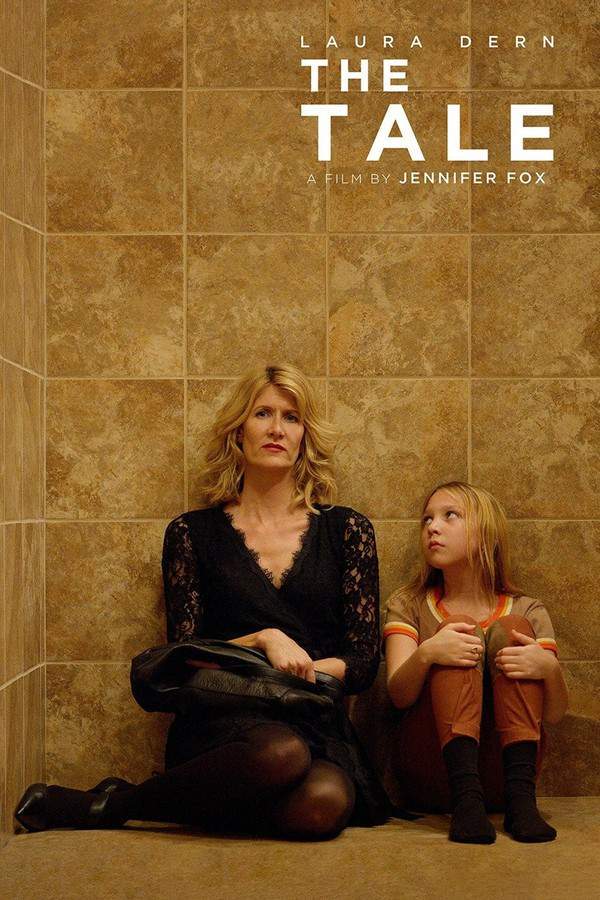
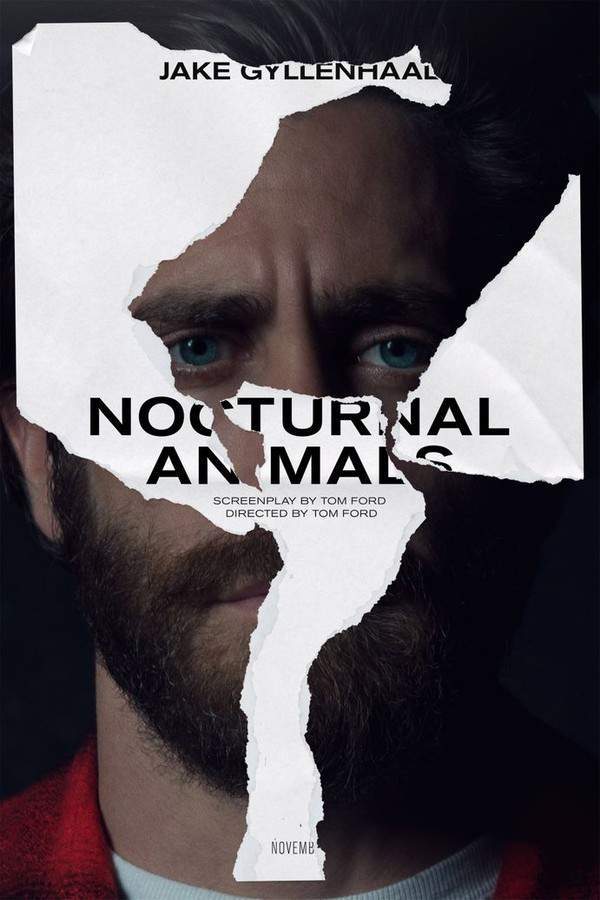


Featured on this page

What's After the Movie?
Not sure whether to stay after the credits? Find out!
Check out our other apps:

SAT Sphere
Build confidence for the Digital SAT.

Mori Atlas
Discover wild places worth protecting.

Luntero
Search smarter for a home in Amsterdam.

Plot Explained
Unravel movie endings and hidden clues.

Pokechamp
Dive into Pokémon data and battle logic.

Driving Theory
Get ready for your European theory test.

Movie Dust
Plan your next cinema trip with ease.

Musemap
Find art and culture as you travel.

Selkobase
Compare credentials before committing.

Local Manual
Turn an unfamiliar country into practical next steps.

Lernavi
Compare school systems before your next move.

GymRoam
Find a workout stop wherever your plans take you.
Explore Our Movie Platform
New Movie Releases (2026)
Famous Movie Actors
Top Film Production Studios
Movie Plot Summaries & Endings
Major Movie Awards & Winners
Best Concert Films & Music Documentaries
Movie Collections and Curated Lists
© 2026 What's After the Movie. All rights reserved.
Privacy Policy