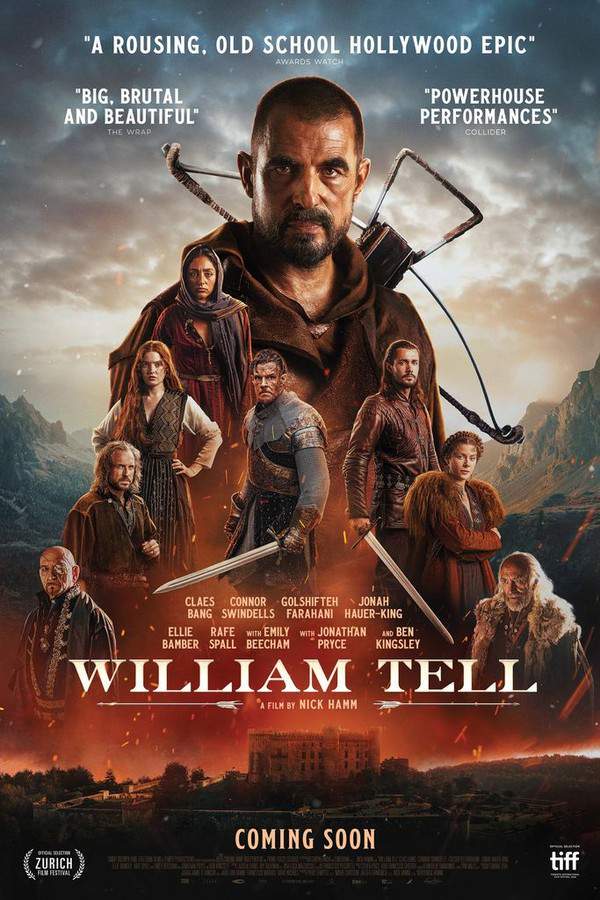
In 14th-century Europe, as the Holy Roman Empire struggles with competing nations and Austria seeks to expand its territory, Switzerland faces increasing pressure. William Tell, once a peaceful hunter, is compelled to act when Austria's ambitions threaten his homeland and family.

Does William Tell have end credit scenes?
No!
William Tell does not have end credit scenes. You can leave when the credits roll.
Explore the complete cast of William Tell, including both lead and supporting actors. Learn who plays each character, discover their past roles and achievements, and find out what makes this ensemble cast stand out in the world of film and television.

Jonah Hauer-King
Rudenz

Golshifteh Farahani
Suna

Ben Kingsley
King Albert

Diarmaid Murtagh
Master Builder

Rafe Spall
Stauffacher

Ellie Bamber
Princess Bertha

Emily Beecham
Gertrude

Jonathan Pryce
Attinghausen

Claes Bang
William Tell

Connor Swindells
Gessler

Paul Bullion
Commander Armgard

Sam Keeley
Baumgarten

Amar Chadha-Patel
Furst

Aron von Andrian
Sergeant Heinrich

Solly McLeod
Melchtal

Tobias Jowett
Walter Tell

Billy Postlethwaite
Tax Collector

Éanna Hardwicke
Young Tell

Jake Dunn
Stussi

Samuel Edward-Cook
Kuoni
Discover where to watch William Tell online, including streaming platforms, rental options, and official sources. Compare reviews, ratings, and in-depth movie information across sites like IMDb, TMDb, Wikipedia or Rotten Tomatoes.

See how William Tell is rated across major platforms like IMDb, Metacritic, and TMDb. Compare audience scores and critic reviews to understand where William Tell stands among top-rated movies in its genre.

William Tell exhibits pronounced strengths in its visual and sensory scope yet is hampered by inconsistent storytelling and uneven character work. Reviews commend its expansive vistas, propulsive battle sequences, and competent direction, while also noting its thin narrative, clichéd arcs, and awkward tonal shifts. The result is a film whose spectacle outshines its substance, leaving a mixed final impression. Overall, the film delivers memorable moments but does not fully cohere into a lasting epic.
The Movie Echo Score Breakdown for William Tell

Art & Craft
In terms of art and craft, William Tell benefits from sweeping cinematography and well-composed production design. Expansive vistas of the Swiss Alps are rendered with clarity, and seasonal color palettes evoke an immersive atmosphere. Occasional lapses in visual coherence and uneven editing undermine the film's stylistic ambitions. Overall, the art direction sustains interest even when narrative momentum falters.

Character & Emotion
When it comes to character and emotion, the film struggles with inconsistent acting styles and superficial development. Performances vary from committed portrayals by the lead actor to moments of stagey delivery and questionable casting. Emotional resonance is sporadic, with few scenes allowing deeper character investment. Consequently, character arcs lack a cohesive progression, limiting audience engagement.

Story & Flow
In its story and flow, William Tell displays uneven pacing and a reliance on familiar tropes. The narrative provides a taut central sequence but is offset by bloated set pieces and abrupt tonal shifts. Critics highlight a sequel-setup conclusion and thin dialogue that undermine plot coherence. As a result, overall engagement is hindered by formulaic storytelling.

Sensory Experience
Regarding the sensory experience, the film excels with rousing battle sequences and a stirring musical score. Elaborate sound design complements the visceral impact of crossbows and swordplay, while the lush visual style underscores the epic scale. Occasional overindulgence in spectacle and uneven mixing moments slightly detract from immersion. Nonetheless, these sequences remain the film's most compelling element.

Rewatch Factor
On the rewatch factor, the film offers mixed appeal. Its memorable battle set pieces and striking landscapes may invite repeat viewings among genre enthusiasts. However, recurring narrative clichés and uneven character work limit lasting attraction. In consequent viewings, lingering questions about pacing and depth emerge, tempering the film's overall replay value.

52
Metascore
5.8
User Score
54%
TOMATOMETER
41%
User Score
5.7 /10
IMDb Rating
62
%
User Score
Read the complete plot summary of William Tell, including all major events, twists, and the full ending explained in detail. Explore key characters, themes, hidden meanings, and everything you need to understand the story from beginning to end.
In 1307, the alpine lands of Switzerland tremble under the iron rule of the Austrian Habsburgs. The people endure heavy taxes, constant convoy of soldiers, and a growing sense that their fate is being decided far from their valleys. In this tense backdrop, a chorus of Swiss figures begins to move toward a common aim: freedom. Among them is Rudenz, a noble tied to the Austrian court through a difficult mix of loyalty, fear, and a buried affection for Bertha, the niece of Albert, Duke of Austria. Bertha herself yearns for a Switzerland that will no longer be forced to bow to foreign will, and she questions the use of her family’s power to keep Rudenz in line.
The spark that lights the rebellion comes from a brutal crime. A sheriff known as “the Wolfshot” descends on Konrad Baumgarten and his household, raping and murdering Baumgarten’s wife in a brutal demonstration of how the occupiers enforce fear. Baumgarten’s desperate act of vengeance—taking the life of the Wolfshot—sparks a manhunt that forces him to flee across a storm-lashed lake. He is aided by Tell, a battle-scarred huntsman and former Crusade veteran who now tends his land with the wary eyes of a man who has seen too much death. The landscape becomes a stage for a rapid series of moral choices, and Tell’s quiet skill with a crossbow hints at the weapon that will become a symbol of resistance.
As the fugitives seek safety with Stauffacher and his wife Gertrude, the Austrians tighten their grip. Gessler, a calculating bailiff installed by King Albert to “keep order,” imposes humiliating decrees that demand the people bow to a helmet perched atop a post in Altdorf. The display is as much psychological as it is political—a daily insult meant to break the Swiss spirit. The search for Baumgarten sweeps through cantons, and the cunning presence of Stussi makes the pursuit merciless. The Stauffacher household becomes a crossroads of fear, loyalty, and the dawning sense that unity is the only shield against conquest.
Tell, initially reluctant to take up arms, slowly shifts from a wary veteran to a catalyst for rebellion. He joins Baumgarten, Fürst, and Walter Fürst in a risky plan to unite the cantons around a shared vision of freedom. Their journey toward Altdorf grows from a series of small rescues—their intervention in a village being pillaged by Austrian soldiers, saving a young farmer named Arnold von Melchtal and his dying father—to a larger strategic effort to link the cantons with a single voice. Along the way they meet and recruit Master Builder and other figures who anchor the rebellion in practical skill and deep-seated memory of Swiss independence.
Back in Altdorf, the oppressive spectacle continues. [Bertha] is drawn closer to [Rudenz], even as she senses his vulnerability to the Austrian cause. She also becomes a target of Gessler’s obsession with control, a tension that deepens the personal stakes for both of them. The story threads through a series of intimate betrayals and public displays: a king’s humiliation, the testing of loyalties, and the gritty, often painful costs of resisting tyranny.
In the mountains and forests, the resistance grows more organized. The five central figures—Tell, Baumgarten, Stauffacher, Fürst, and Melchtal—arrive at a makeshift sanctuary near the hidden cave by the Rhone uplands, where the leaders of Unterwalden, Schwyz, and Uri crystallize their plan. It is here that the spark of unity becomes a flame: if the cantons do not stand together, their people will be crushed under the weight of the Habsburg boot. The decision to unify is not merely political; it is existential, a choice about whether a people will survive with dignity.
Across the lake, Tell returns to his home with his wife and son, only to face the cruel test Gessler has prepared. When Tell refuses to bow before the post, the bailiff pushes a dramatic contest into the foreground: he orders Tell to shoot an apple off his own son’s head. The crowd gasps, Rudenz protests, and Baumgarten, loyal to their shared cause, offers himself as a victim to buy Tell’s freedom. Tell’s single, precise shot succeeds in saving his son, but the moment crystallizes the moral cost of resistance. The prisoner’s fate is sealed when Gessler locks Tell away, while Bertha is seized and placed under guard as the authorities tighten their grip.
The conflict deepens as the resistance learns of the broader political maneuvering in the Austrian court. Albert’s pursuit of ongoing domination pushes Gessler into more aggressive acts, including a plan to move heavy reinforcements into Sarnen and Küssnacht. Bertha’s courage surfaces again as she confronts her uncle and fights to break the chains of tyranny, though she is arrested and later freed by a cousin who remains loyal to Switzerland. The resistance responds with a bold tactic—a carefully planned assault that uses a secret tunnel to gain entry to Altdorf, enabling a sunrise breakout that blinds Gessler’s forces and opens the gates for the Swiss fighters.
The battle within Altdorf is merciless and symbolic. Gessler’s grip on the town weakens as the Swiss gain the upper hand, and in a wrenching turn, Rudenz and Werner Stauffacher lose their lives. Tell’s son Walter is captured, turning the tide toward a final, desperate confrontation. Albert’s army watches from the hills, only to retreat when they learn of their king’s death at the hands of the Switzers’ allies, a blow that retests the will of a people who may now carve their own destiny.
In the aftermath, Tell refuses to deliver a final, brutal vengeance on Gessler and instead chooses a path of restraint, spurred by Walter’s insistence. The act of mercy hints at a broader cost: the struggle for freedom is not a single victory but a continual test of courage in the face of ongoing threats. Bertha returns to Tell, revealing that Albert’s daughter Agnes vows vengeance against the Swiss, signaling that the fight for autonomy will endure beyond this generation.
The tale closes on a note of hard-won hope rather than easy triumph. Switzerland has claimed the right to shape its future, but the power of this freedom remains fragile, haunted by the memory of oppression and the knowledge that more struggles lie ahead. The alliance forged at Rütli—the vow of unity among Unterwalden, Schwyz, and Uri—becomes both a historical seed and a warning: the price of liberty is paid in endurance, sacrifice, and a willingness to confront tyranny again and again.

Coming soon on iOS and Android
From blockbusters to hidden gems — dive into movie stories anytime, anywhere. Save your favorites, discover plots faster, and never miss a twist again.
Sign up to be the first to know when we launch. Your email stays private — always.
Explore the mobile appWatch official trailers, exclusive clips, cast interviews, and behind-the-scenes footage from William Tell. Dive deeper into the making of the film, its standout moments, and key production insights.
Discover the central themes, ideas, and keywords that define the movie’s story, tone, and message. Analyze the film’s deeper meanings, genre influences, and recurring concepts.
Explore the various alternative titles, translations, and other names used for William Tell across different regions and languages. Understand how the film is marketed and recognized worldwide.
Browse a curated list of movies similar in genre, tone, characters, or story structure. Discover new titles like the one you're watching, perfect for fans of related plots, vibes, or cinematic styles.
What's After the Movie?
Not sure whether to stay after the credits? Find out!

Check out our other apps:
SAT Sphere
Build confidence for the Digital SAT.
Mori Atlas
Discover wild places worth protecting.
Luntero
Search smarter for a home in Amsterdam.
Plot Explained
Unravel movie endings and hidden clues.
Pokechamp
Dive into Pokémon data and battle logic.
Driving Theory
Get ready for your European theory test.
Movie Dust
Plan your next cinema trip with ease.
Musemap
Find art and culture as you travel.
Selkobase
Compare credentials before committing.
Local Manual
Turn an unfamiliar country into practical next steps.
Lernavi
Compare school systems before your next move.
GymRoam
Find a workout stop wherever your plans take you.
Explore Our Movie Platform
New Movie Releases (2026)
Famous Movie Actors
Top Film Production Studios
Movie Plot Summaries & Endings
Major Movie Awards & Winners
Best Concert Films & Music Documentaries
Movie Collections and Curated Lists
© 2026 What's After the Movie. All rights reserved.
Privacy Policy