Thunderstorm 1934

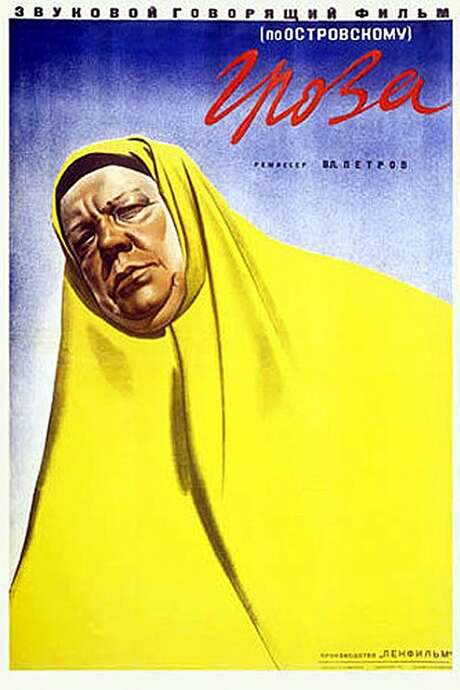
Adapted from Aleksandr Ostrovsky’s play “The Storm”, the film follows Katerina in a Volga town. She marries the violent drunk Tikhon and enters the world of merchants known as the “dark kingdom”. Dominated by her mother‑in‑law Kabanikha, she is tormented until, in Tikhon’s absence, she meets Boris, a man who offers the freedom she longs for.

Does Thunderstorm have end credit scenes?
No!
Thunderstorm does not have end credit scenes. You can leave when the credits roll.
Meet the Full Cast and Actors of Thunderstorm
Explore the complete cast of Thunderstorm, including both lead and supporting actors. Learn who plays each character, discover their past roles and achievements, and find out what makes this ensemble cast stand out in the world of film and television.

Mikhail Zharov
Koudryash
Vladimir Petrov
Mikhail Tsaryov
Boris Grigoriyevich, her lover
Mikhail Tarkhanov
Saveli Prokofiyevich Dikoy
Varvara Massalitinova
Marfa Ignatovna Kabanova, her mother-in-law
Irina Zarubina
Barbara Kabanova, her sister-in-law
Alla Tarasova
Katerina Petrovna Kabanova
Ivan Chuvelyov
Tikhon Kabanov, her husband
Ekaterina Korchagina-Aleksandrovskaya
The Old Seer
External Links and Streaming Options
Discover where to watch Thunderstorm online, including streaming platforms, rental options, and official sources. Compare reviews, ratings, and in-depth movie information across sites like IMDb, TMDb, Wikipedia or Letterboxd.




Take the Ultimate Thunderstorm Movie Quiz
Challenge your knowledge of Thunderstorm with this fun and interactive movie quiz. Test yourself on key plot points, iconic characters, hidden details, and memorable moments to see how well you really know the film.
Thunderstorm (1934) Quiz: Test your knowledge of the characters, plot twists, and themes in the 1934 film Thunderstorm.
Who is the powerful businessman patriarch of the Zhou family?
Full Plot Summary and Ending Explained for Thunderstorm
Read the complete plot summary of Thunderstorm, including all major events, twists, and the full ending explained in detail. Explore key characters, themes, hidden meanings, and everything you need to understand the story from beginning to end.
Thunderstorm examines how rigid traditionalism and hollow morality corrode a wealthy, modern family and lay bare the wounds of secrecy, desire, and power. Set against the backdrop of a prestige-filled household, the drama centers on Zhou Puyuan, a powerful businessman whose authority and sense of propriety mask a pattern of domination, hypocrisy, and hidden appetites. The full-text version begins with a prologue that shifts the scene to a former Zhou mansion turned hospital run by Catholic nuns. There, an old man visits two distressed women—one silent and morose, the other violently unsettled—while nurses reveal through their conversation that a tragedy struck the house a decade earlier, leaving the place rumored to be haunted. The old woman at the window finally falls, signaling the weight of the past pressing into the present.
In Act I, the action moves to the summer of 1925, when the Zhou family house becomes a pressure chamber for desire, class, and loyalty. Lu Gui, a servant, confides in his daughter Sifeng about a forbidden affair between Fanyi, the master’s refined but brittle wife, and her stepson Zhou Ping. Sifeng herself harbors a delicate romance with Ping, and the revelation unsettles her as she finds herself entangled in a web of social boundaries. Fanyi’s fragility is matched by a steely core; she is both drawn to Ping and haunted by the family’s expectations. Zhou Puyuan returns from the mine with a stern, commanding presence, correcting Ping’s indulgences and scolding him for habits that signal a deeper contempt for convention. To control the household’s narrative, Puyuan enlists Fanyi’s complicity in a medical ritual, forcing her to drink a traditional remedy to address a supposed “mental imbalance.” When she refuses, he weaponizes authority to bend her to his will, a display that foreshadows the coercive climate at the heart of the family. Puyuan’s conversations with Lu Gui and his wife Mrs. Lu hint at a buried history; a photograph of a woman named Shiping—tied to Ping’s origin—appears as a thread that will later pull tight. The act ends with a disturbing sense of impending reckoning, as Puyuan’s disapproval widens the rift between the generations and classes.
Act II intensifies the already volatile dynamics. Zhou Ping contemplates leaving the family business to seek a life in the countryside, a move that would upend the household’s carefully constructed order. Sifeng pleads with him to stay, while Fanyi confronts Ping with memories of abuse and a torrent of resentment. Ping’s insistence on a future with Sifeng collides with Fanyi’s demand for loyalty and stability, and a bitter argument erupts. The moment crystallizes the social fissures beneath the surface: Ping’s longing for a life free from his father’s control collides with Fanyi’s desire for security and vindication. Into this tense mix enters Mrs. Lu, a figure who begins to recognize herself in Shiping’s photograph—Shiping being Ping’s birth mother and Puyuan’s former lover. Mrs. Lu’s recognition does not yet resolve the moral maze; it rather deepens the mystery surrounding Ping’s parentage and the power that Puyuan exerts over family fate. Puyuan soon learns that Shiping’s grave lies somewhere nearby, and a new layer of parental history reveals itself: Shiping’s own life had been a series of betrayals and survival, a narrative that now interlocks with the Zhou family’s current crisis. When Lu Dahai, Ping’s half-brother in the eyes of the law but not yet in the minds of the family, arrives to confront Puyuan about workers’ exploitation at the mine, his confrontation exposes the cost of the mine’s prosperity on the workers who fuel it. The act closes with a sudden consolidation of the act’s themes: the family’s hypocrisy, the allure of upward mobility, and the fear of a hidden truth that could upend social standing.
Act III shifts the focus to Sifeng’s home, where the consequences of the Zhou household’s actions begin to ripple outward. Lu Gui accuses Dahai of destabilizing Sifeng’s life, sparking a quarrel that highlights the precarious position of those in the serving class who are pulled into the family’s dramas. Ping visits Sifeng in the evening, and an uneasy attempt at reconciliation sits alongside a growing sense that the social order is breaking apart. Dahai interprets Ping’s presence as a temptation to desecrate Sifeng, and he threatens to act on his own grievances, while Mrs. Lu continues to misread the loyalties at play. The night deepens as Zhou Ping climbs through Sifeng’s window to be with her, a secret romance that is both tender and dangerous. Fanyi—still haunted by the fear of losing control—appears briefly at the window, a ghostly reminder of the household’s surveillance and the price of desire. The lovers’ moment is abruptly disrupted by Dahai’s intrusion, and the family’s pursuit of truth and protection becomes a race against the rain that darkens the night.
Act IV intensifies the crisis as the truth about lineage and desire erupts in the Zhou living room. Puyuan pursues a fragile, uneasy effort to mend relations with his son Chong, only to be met with a cold resistance that underlines the growing estrangement between generations. As Ping and Fanyi confront their own feelings, Fanyi’s isolation deepens; she begins to confront the possibility that Ping’s attachment might threaten the entire family’s stability. Dahai returns, determined to safeguard his sister Sifeng’s future, and the tension culminates as Ping reveals his love for Sifeng and promises to return to marry her. Dahai relents when faced with the warning from his mother and hands Ping a pistol to defend himself in a precarious moment. Sifeng discovers she is pregnant with Ping’s child, and Mrs. Lu takes on the role of gatekeeper, insisting that the couple flee as far as possible to avert disaster. Yet the revelation that Ping and Sifeng are half-siblings, a truth kept hidden until now, shatters the family’s sense of order and devastates all involved. Fanyi, driven by jealousy and a thirst for revenge, disrupts the fragile accord by exposing the affair to Chong, only to be confronted with the sudden, devastating consequences of her own choices. The room becomes a chamber of recognition when Puyuan, unaware of the lovers’ exact relationship, confirms that Mrs. Lu is Ping’s mother and Sifeng’s and Ping’s shared bloodline makes their love incestuous. A deadly silence fills the space, and the tragedy escalates in a final, unforeseeable turn: Sifeng and Chong both perish after stepping onto a broken, electrified wire, and a gunshot rings out as Zhou Ping takes his own life. The play’s cruelty is not in a single act of violence but in the cascading revelations that leave the family’s ideals and pretenses irreparably shattered.
The Epilogue returns us to the hospital, ten years later, where the old Zhou remains a watcher of the past. He asks a nun about the old woman and the connection to Shiping’s son, Lu Dahai, in a search that reveals how the past continues to haunt the living. He longs for resolution that never comes, a reminder that the consequences of a family’s moral laxity extend far beyond the immediate circle of power and privilege.
Thunderstorm unfolds as a slow-burning critique of a society that prizes appearances over honest accountability. Its characters navigate a maze of love, class tension, and the heavy burden of legacy, where even acts of affection can unleash a chain of events that exposes the hollowness of wealth and the fragility of family bonds. The play’s most powerful moment may be the quiet, inexorable realization that the truth—no matter how long suppressed—will reshape every relationship it touches, leaving behind a cost that no wealth or social standing can ever erase.

Coming soon on iOS and Android
The Plot Explained Mobile App
From blockbusters to hidden gems — dive into movie stories anytime, anywhere. Save your favorites, discover plots faster, and never miss a twist again.
Sign up to be the first to know when we launch. Your email stays private — always.
Explore the mobile appDiscover Film Music Concerts Near You – Live Orchestras Performing Iconic Movie Soundtracks
Immerse yourself in the magic of cinema with live orchestral performances of your favorite film scores. From sweeping Hollywood blockbusters and animated classics to epic fantasy soundtracks, our curated listings connect you to upcoming film music events worldwide.
Explore concert film screenings paired with full orchestra concerts, read detailed event information, and secure your tickets for unforgettable evenings celebrating legendary composers like John Williams, Hans Zimmer, and more.


Thunderstorm Themes and Keywords
Discover the central themes, ideas, and keywords that define the movie’s story, tone, and message. Analyze the film’s deeper meanings, genre influences, and recurring concepts.
Thunderstorm Other Names and Titles
Explore the various alternative titles, translations, and other names used for Thunderstorm across different regions and languages. Understand how the film is marketed and recognized worldwide.
Similar Movies To Thunderstorm You Should Know About
Browse a curated list of movies similar in genre, tone, characters, or story structure. Discover new titles like the one you're watching, perfect for fans of related plots, vibes, or cinematic styles.













Quick Links: Summary, Cast, Ratings, More

What's After the Movie?
Not sure whether to stay after the credits? Find out!
Check out our other apps:

SAT Sphere
Build confidence for the Digital SAT.

Mori Atlas
Discover wild places worth protecting.

Luntero
Search smarter for a home in Amsterdam.

Plot Explained
Unravel movie endings and hidden clues.

Pokechamp
Dive into Pokémon data and battle logic.

Driving Theory
Get ready for your European theory test.

Movie Dust
Plan your next cinema trip with ease.

Musemap
Find art and culture as you travel.

Selkobase
Compare credentials before committing.

Local Manual
Turn an unfamiliar country into practical next steps.

Lernavi
Compare school systems before your next move.

GymRoam
Find a workout stop wherever your plans take you.
Explore Our Movie Platform
New Movie Releases (2026)
Famous Movie Actors
Top Film Production Studios
Movie Plot Summaries & Endings
Major Movie Awards & Winners
Best Concert Films & Music Documentaries
Movie Collections and Curated Lists
© 2026 What's After the Movie. All rights reserved.
Privacy Policy