The Chronology of Water 2025

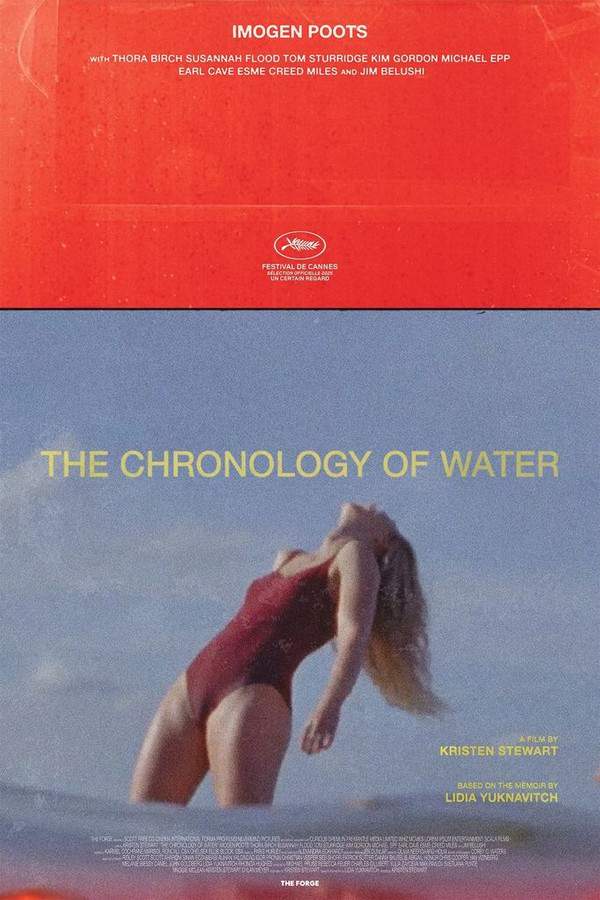
Raised in a home shattered by violence and alcoholism, Lidia Yuknavitch seemed headed toward self‑destruction until literature offered an unexpected escape. Adapted from her bestselling memoir, the film traces her relentless quest to claim a voice, confronting trauma, sexuality, love, and loss while discovering the transformative power of storytelling.

Does The Chronology of Water have end credit scenes?
No!
The Chronology of Water does not have end credit scenes. You can leave when the credits roll.
Where to Watch The Chronology of Water
See current US streaming, rental, and purchase options for The Chronology of Water (2025) via JustWatch.






Meet the Full Cast and Actors of The Chronology of Water
Explore the complete cast of The Chronology of Water, including both lead and supporting actors. Learn who plays each character, discover their past roles and achievements, and find out what makes this ensemble cast stand out in the world of film and television.

Imogen Poots
Lidia

Thora Birch
Claudia

Kristen Stewart

Kim Gordon

Tom Sturridge
Devin

Earl Cave

Michael Epp

Charlie Carrick

Peter Rundle
Randy Reese
Jim Belushi
Ken Kesey
Esme Allen
Hannah
Jeremy Ang Jones
Chad
Anna Wittowsky
Young Lidia
Susannah Flood
Hal Weaver
Pastor
Anton Lytvynov
Swimming competition spectator
Alexander Johnson
Assistant Coach
Dominik Gabriel Roseti
Student
Alina Lytvynova
Swimming competition spectator
Marlena Sniega
Claudia Preteen, Claudia Teen
Tetiana Lytvynova
Swimming competition spectator
External Links and Streaming Options
Discover where to watch The Chronology of Water online, including streaming platforms, rental options, and official sources. Compare reviews, ratings, and in-depth movie information across sites like IMDb, TMDb, Wikipedia or Rotten Tomatoes.








Ratings and Reviews for The Chronology of Water
See how The Chronology of Water is rated across major platforms like IMDb, Metacritic, and TMDb. Compare audience scores and critic reviews to understand where The Chronology of Water stands among top-rated movies in its genre.

The Movie Echo Score
The Chronology of Water presents a bold debut that divides opinion, with strengths in performance and visual ambition offset by uneven narrative cohesion and experimental excess. Critics commend the director’s confidence and the lead’s emotional depth, while several viewers cite overused voice‑over and disjointed editing. Sensory elements receive praise for their immersive quality, yet the story’s pacing and clarity suffer. Consequently, the film offers moments of striking artistry but struggles to sustain engagement throughout.
The Movie Echo Score Breakdown for The Chronology of Water

Art & Craft
In terms of direction and craft, Stewart demonstrates a confident visual sensibility, employing dreamlike haze and bold compositions that many critics highlighted as accomplished. However, several viewers criticized the frequent voice‑over, rapid cuts, and purposeless shots as messy and overbearing. The cinematography receives praise for its beauty, yet editing choices divide opinion, leading to an overall mixed assessment of the film’s art and craft.

Character & Emotion
When evaluating character and emotional depth, Imogen Poots’s performance is repeatedly described as profoundly moving and authentic, compensating for narrative unevenness. Critics note her primal agony and resilience, while users generally consider the acting strong despite a detached story. The emotional resonance achieved through focused close‑ups is a central strength, though some viewers feel the characters remain distant due to stylistic distractions.

Story & Flow
Regarding story and flow, the film’s fragmented structure and heavy reliance on voice‑over generate mixed reactions. Critics acknowledge an ambitious, albeit occasionally clichéd, narrative ambition, whereas users frequently describe the plot as lacking coherence, slow, and overly experimental. The pacing and absence of a clear central storyline undermine engagement, leading to a perception of the story as one of the weaker elements.

Sensory Experience
In terms of sensory experience, the film’s sound design and visual style receive praise for creating an immersive, avant‑garde atmosphere. Critics and some users highlight the effective use of zooms, flashbacks, and bold audio choices that convey trauma. Conversely, several viewers find the constant stylistic flourishes, such as overused voice‑over and trippy visuals, to be distracting and detracting from narrative clarity.

Rewatch Factor
Assessing rewatch value, the film’s distinctive aesthetic and emotionally charged performances suggest potential appeal for viewers attuned to experimental cinema. Some critics and users note its boldness may reward repeat viewings, uncovering new layers. However, the prevailing sense of narrative fatigue, overstretched experimental techniques, and divided audience response reduce its likelihood of being revisited frequently.

78
Metascore
6.3
User Score


%
TOMATOMETER

0%
User Score

6.4 /10
IMDb Rating

68
%
User Score
Full Plot Summary and Ending Explained for The Chronology of Water
Read the complete plot summary of The Chronology of Water, including all major events, twists, and the full ending explained in detail. Explore key characters, themes, hidden meanings, and everything you need to understand the story from beginning to end.
Lidia, portrayed by Imogen Poots, develops a lifelong passion for writing and swimming as a refuge from a turbulent home life. Her father, Mike, subjects her and her sister Claudia to physical abuse, while their alcoholic mother Dorothy largely ignores the pain, shaping a childhood where water and words become the only safe spaces. Mike tries to keep Lidia from going to college as a means of control, but she fights back and leaves for Texas to study, swim, and explore her sexuality. Yet the memories of those years cling to her, and her later choices—excessive partying, drinking, and drug use—threaten both her academic path and her progress in the pool.
On campus, Lidia meets Philip, and their quick romance deepens into a marriage that is deeply tethered to unresolved trauma. She, still haunted by her father’s dominance, initially views Philip’s sensitive and gentle nature as weakness, and the relationship becomes a stage for both verbal and physical aggression. When a pregnancy follows, she leaves him to live with Claudia and Dorothy, hoping to raise the child together. The baby is stillborn, a devastating blow that reshapes her life: she reconciles with Philip, they scatter the baby’s ashes at sea, and they ultimately divorce. The memories of their marriage and the loss of their daughter haunt her for years, casting long shadows over every future relationship.
Struggling to find a new path, Lidia loses her scholarship and drifts without direction until a friend persuades her to enroll at the University of Oregon. There, she studies under the enigmatic writer Ken Kesey (portrayed by Jim Belushi), joining a collaborative novel project with other students that helps her process grief and channel her voice. Kesey, who has endured his own sorrow—especially the loss of a son—sees something of his own endurance in Lidia, and a powerful bond forms between mentor and student. Her time in that program becomes a turning point, a place where creativity begins to heal the rifts left by years of trauma. To support her healing, she also works with a BDSM therapist, a choice that signals her willingness to confront pain in unconventional ways and to reclaim control over her body and her narrative.
As her literary star begins to rise, Lidia enters a marriage with Devin, a relationship marked by intense passion but also volatility. She searches for the sense of completeness she believed she found with Philip, yet the partnership quickly strains under the weight of unmet needs and lingering ghosts from her past. After a pivotal live reading of her work, she receives an offer from a publishing house, a moment that should illuminate her professional ascent; instead, it arrives alongside the continuing push of alcohol and self-destructive patterns that threaten to derail everything she has rebuilt. A drunk driving incident lands her in trouble with the law, leading to a community service sentence that becomes another crucible in her ongoing process of self-examination and growth.
Teaching becomes a new horizon in her life when she begins guiding young writers at Eastern Oregon University. There, she meets Andy—another admirer who has followed her career—and the two eventually marry, hoping to construct a life that balances art, healing, and family. Andy urges her to consider expanding her family, and she ultimately gives birth to their son, Miles. The film closes on a quiet, intimate note: a young family swimming together at a lake, with Lidia reflecting on the water’s power to heal, to cleanse the past, and to offer a future where creativity and motherhood can coexist with resilience and hope.
The story unfolds as a patient, sometimes painful meditation on how trauma can shape a person’s ambitions and relationships, and how perseverance—through writing, sport, therapy, and family—can guide someone toward renewal. Throughout, Lidia’s life is framed by water: its currents echo the pull of memory and the effort to move forward, while its capacious surface suggests a space where pain can be weighed, spoken, and ultimately transformed into something capable of healing both the self and the ones she loves.

Coming soon on iOS and Android
The Plot Explained Mobile App
From blockbusters to hidden gems — dive into movie stories anytime, anywhere. Save your favorites, discover plots faster, and never miss a twist again.
Sign up to be the first to know when we launch. Your email stays private — always.
Explore the mobile appWatch Trailers, Clips & Behind-the-Scenes for The Chronology of Water
Watch official trailers, exclusive clips, cast interviews, and behind-the-scenes footage from The Chronology of Water. Dive deeper into the making of the film, its standout moments, and key production insights.
The Chronology of Water Themes and Keywords
Discover the central themes, ideas, and keywords that define the movie’s story, tone, and message. Analyze the film’s deeper meanings, genre influences, and recurring concepts.
The Chronology of Water Other Names and Titles
Explore the various alternative titles, translations, and other names used for The Chronology of Water across different regions and languages. Understand how the film is marketed and recognized worldwide.
Similar Movies To The Chronology of Water You Should Know About
Browse a curated list of movies similar in genre, tone, characters, or story structure. Discover new titles like the one you're watching, perfect for fans of related plots, vibes, or cinematic styles.







Quick Links: Summary, Cast, Ratings, More

What's After the Movie?
Not sure whether to stay after the credits? Find out!
Check out our other apps:

SAT Sphere
Build confidence for the Digital SAT.

Mori Atlas
Discover wild places worth protecting.

Luntero
Search smarter for a home in Amsterdam.

Plot Explained
Unravel movie endings and hidden clues.

Pokechamp
Dive into Pokémon data and battle logic.

Driving Theory
Get ready for your European theory test.

Movie Dust
Plan your next cinema trip with ease.

Musemap
Find art and culture as you travel.

Selkobase
Compare credentials before committing.

Local Manual
Turn an unfamiliar country into practical next steps.

Lernavi
Compare school systems before your next move.

GymRoam
Find a workout stop wherever your plans take you.
Explore Our Movie Platform
New Movie Releases (2026)
Famous Movie Actors
Top Film Production Studios
Movie Plot Summaries & Endings
Major Movie Awards & Winners
Best Concert Films & Music Documentaries
Movie Collections and Curated Lists
© 2026 What's After the Movie. All rights reserved.
Privacy Policy