Resistance 2020


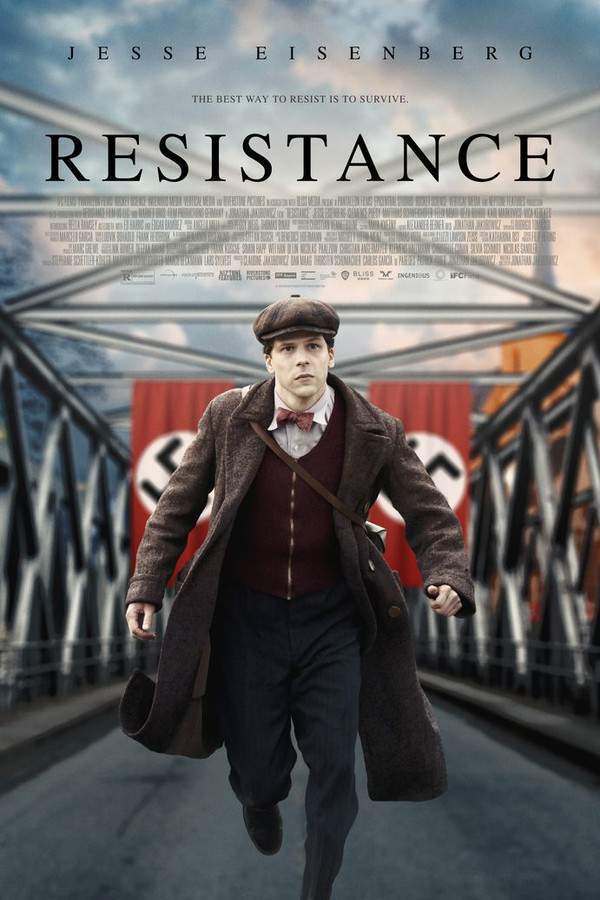
During the Nazi occupation of Europe, Marcel Mangel's life takes a dramatic turn from carefree youth to perilous involvement with the Resistance. The aspiring actor and artist, Marcel, portrayed by Jesse Eisenberg, abandons his burlesque performances to undertake dangerous missions. He uses his talents to instruct orphaned Jewish children, equipping them with essential survival skills as they navigate the devastating realities of the Holocaust.


Does Resistance have end credit scenes?
No!
Resistance does not have end credit scenes. You can leave when the credits roll.
Where to Watch Resistance
See current US streaming, rental, and purchase options for Resistance (2020) via JustWatch.

AMC+ Amazon Channel
HD
AMC+ Roku Premium Channel
HD
Philo
HD
Sundance Now
HD
Kanopy
HD
Apple TV Store
4K
Fandango At Home
HD
Amazon Video
HD
Google Play Movies
SD
YouTube
SD Streaming availability powered by 
Meet the Full Cast and Actors of Resistance
Explore the complete cast of Resistance, including both lead and supporting actors. Learn who plays each character, discover their past roles and achievements, and find out what makes this ensemble cast stand out in the world of film and television.









External Links and Streaming Options
Discover where to watch Resistance online, including streaming platforms, rental options, and official sources. Compare reviews, ratings, and in-depth movie information across sites like IMDb, TMDb, Wikipedia or Rotten Tomatoes.










Ratings and Reviews for Resistance
See how Resistance is rated across major platforms like IMDb, Metacritic, and TMDb. Compare audience scores and critic reviews to understand where Resistance stands among top-rated movies in its genre.

The Movie Echo Score
Resistance delivers a moderately engaging historical thriller that struggles to fully realize its narrative potential. Reviewers highlight the earnest central performances but note uneven pacing and an at-times generic approach to visual storytelling. The film’s direction and sound design provide intermittent tension, yet occasional disjointed editing and dated transitions detract from coherence. While character portrayals are emotionally grounded and the score occasionally heightens key moments, the inconsistent flow limits repeated viewings. The net result is a film with commendable intentions that remains watchable but rarely transcends familiar World War II conventions.
The Movie Echo Score Breakdown for Resistance

Art & Craft
In terms of art and craft, the film offers reliable direction and moments of visual strength amid uneven execution. Some critics praise its tense framing and measured editing for sustaining suspense, while others find the production design and thematic juxtapositions underdeveloped. The cinematography occasionally captures the period detail but shifts in style contribute to a dated feel. On balance, the film’s craft maintains basic competence but rarely achieves distinctive artistry.

Character & Emotion
When it comes to character and emotion, the central performances provide a sincere anchor for the story. Many applaud Jesse Eisenberg’s nuanced portrayal of Marceau, and supporting roles deliver credible sincerity, particularly in tense moments. Critics note moments of subdued restraint, yet the lead’s emotional investment consistently registers. While depth varies across secondary figures, the film’s ensemble conveys authentic vulnerability. Overall, the characters offer a relatable core that sustains viewer engagement.

Story & Flow
In terms of story and flow, Resistance presents an historically significant narrative but often struggles with pacing and coherence. Early sequences are slower to develop, leading to critiques of disjointed editing and generic plotting. However, the central premise of rescue and resistance retains emotional weight, and key action set-pieces provide intermittent engagement. Despite familiar tropes, the film’s earnest intent and occasional suspenseful sequences deliver enough momentum to carry the central arc.

Sensory Experience
Regarding sensory experience, the film features a serviceable score and occasional visual flourishes that heighten tension. Some viewers commend the soundtrack’s measured crescendos during key sequences, while the period production design lends occasional authenticity. Yet inconsistencies in sound mixing and a subdued color palette contribute to moments of flatness. Overall, the audio-visual elements support the narrative adequately, though they seldom reach truly immersive or memorable heights.

Rewatch Factor
When evaluating rewatch factor, Resistance offers a historically rooted drama that may appeal on a single viewing but lacks lasting novelty. The earnest performances and thematic resonance encourage reflection, yet recurring plot beats and predictable structure reduce its subsequent appeal. Viewers may revisit key scenes of heroism, but the uneven pacing and conventional storytelling limit broader repeat engagement. Consequently, the film can be revisited selectively, but it rarely sustains full rewatch enthusiasm.

53
Metascore
6.4
User Score


57%
TOMATOMETER

78%
User Score

6.5 /10
IMDb Rating

70
%
User Score

3.2
From 14 fan ratings

5.00/5
From 3 fan ratings
Full Plot Summary and Ending Explained for Resistance
Read the complete plot summary of Resistance, including all major events, twists, and the full ending explained in detail. Explore key characters, themes, hidden meanings, and everything you need to understand the story from beginning to end.
In 1938 Munich, under the grim shadow of Nazi rule, a young Jewish girl named Elsbeth Bella Ramsey suffers a brutal intrusion when Nazi Brown Shirts invade her home and murder her parents, leaving a fragile safety net fraying around her.
In Strasbourg, 1939, a restless, aspiring artist named Marcel Marceau Jesse Eisenberg toils in his father’s butcher shop, feeling the pull of the arts far more keenly than any family approval he might crave. He longs for a life of mime and painting, and he performs impressions of Charlie Chaplin at a local cabaret, a pastime that earns disapproval from his father yet fuels Marcel’s quiet defiance. Across this growing backdrop of fear, he notices a local girl, Emma Clémence Poésy, whose presence becomes a lifeline he hopes to weave into his future.
Marcel’s cousin Georges Géza Röhrig operates within the Jewish arm of the French Resistance, threading together danger and hope. Together with Emma, Georges brings a troop of 123 Jewish orphans to Strasbourg, taking up residence in a castle that becomes a makeshift sanctuary. The first tremors of terror tremble through the castle walls, but Marcel’s gift—his quiet, transforming mime—helps the children find moments of relief and daring in a cauldron of fear. He and Emma grow closer, their bond deepening as they navigate a world where every small act of courage could be a lifeline.
As Germany’s invasion of Poland redraws the map of Europe, the couple’s commitment to the Resistance intensifies. The orphans are dispersed into smaller groups, hidden in churches and among Jewish families, their safety carefully engineered by those who refuse to yield to despair. Marcel and Emma continue to stay in contact with Elsbeth, a reminder of what they are fighting to protect, even as each day becomes more perilous.
The story then threads into the brutal reality of Klaus Barbie, who arrives in Lyon in 1942 amid the Nazi occupation of southern France. Barbie—“The Butcher of Lyon”—administers brutal justice with bribery, manipulation, and brutal executions in Gestapo headquarters’ empty swimming pool, a chilling display of cruelty that foreshadows a ruthless man’s reign over the city. Barbie Matthias Schweighöfer becomes a menacing force straddling both fear and power, his presence casting a long shadow over every plan to resist.
Marcel and Emma relocate to Lyon to continue their work with the Resistance, joined by Marcel’s brother Alain Félix Moati and Emma’s sister Mila Vica Kerekes. Alain narrowly escapes a Nazi sweep at Lyon’s train station, and Marcel helps him slip away by a near-savage act of burning a German soldier as a cover. But Emma and Mila are not as fortunate. In a brutal round of Gestapo raids, Mila is captured and tortured to death by Barbie, who also pressures Emma for information about the Resistance. Emma survives the brutality by yielding to collaboration in a moment that leaves her devastated, and yet she survives with a resolve that becomes crystalline. Marceau refuses to abandon her, and the two vow to shield Jewish children from further harm, even as the cost climbs perilously high.
Driven by a renewed, unyielding resolve, Marcel and Emma set in motion a daring plan to shepherd children to safety. Disguised as a Scouts’ hiking trip, the small caravan—now including Elsbeth—is shepherded toward the French Alps by SNCF trains. Barbie and his SS units close in on the last checkpoint before the Franco-Swiss border, forcing Emma into hiding as the search intensifies. Marcel, posing as a collaborator, does his best to misdirect Barbie’s suspicions, and the pursuers miss the exact moment the children slip toward the border. Relief washes over the group as the Alpine air approaches, the border promising protection.
Yet Barbie’s vigilance is unyielding. He mobilizes his troops to chase the group through the icy forests that guard the Swiss frontier, and the distance between safety and catastrophe narrows with every heartbeat. A critical moment arrives when Barbie nearly unravels the ruse and confronts Marcel, but the escape endures. Emma is fatally wounded at the edge of the border, a blow that devastates Marcel but does not end their mission; the children, guided by his steady hand, cross into Switzerland, where a fragile new chapter can begin.
The film returns to the broader arc in 1945 at Nuremberg, where Marceau has become a Liaison Officer with the United States Army. It is here that his extraordinary courage is acknowledged by General George S. Patton Ed Harris, who helps illuminate the full scope of his wartime acts. The narrative closes with a final, quiet triumph: Marceau’s enduring gift as an entertainer—his signature mime—reaches a podium of remembrance as he performs before troops and civilians, a poignant reminder of the countless children saved through a combination of courage, creativity, and compassion. In the end, the screen lingers on Marceau in his iconic white-face costume, a vivid image of resilience and humanity amid the ashes of war.
This is a story of art meeting resistance, of a community’s refusal to surrender to cruelty, and of a man who used performance to heal and to protect the innocent. It paints a vivid panorama of fear and hope, of near-impossible choices, and of the quiet, stubborn bravery that can emerge when the world seems most dark. It invites viewers to reflect on the power of creativity to outlast tyranny and to imagine a future where, against all odds, children find pathways to safety and a life beyond survival.

Coming soon on iOS and Android
The Plot Explained Mobile App
From blockbusters to hidden gems — dive into movie stories anytime, anywhere. Save your favorites, discover plots faster, and never miss a twist again.
Sign up to be the first to know when we launch. Your email stays private — always.
Explore the mobile appWatch Trailers, Clips & Behind-the-Scenes for Resistance
Watch official trailers, exclusive clips, cast interviews, and behind-the-scenes footage from Resistance. Dive deeper into the making of the film, its standout moments, and key production insights.
Resistance Themes and Keywords
Discover the central themes, ideas, and keywords that define the movie’s story, tone, and message. Analyze the film’s deeper meanings, genre influences, and recurring concepts.
Resistance Other Names and Titles
Explore the various alternative titles, translations, and other names used for Resistance across different regions and languages. Understand how the film is marketed and recognized worldwide.
Similar Movies To Resistance You Should Know About
Browse a curated list of movies similar in genre, tone, characters, or story structure. Discover new titles like the one you're watching, perfect for fans of related plots, vibes, or cinematic styles.





Quick Links: Summary, Cast, Ratings, More

What's After the Movie?
Not sure whether to stay after the credits? Find out!
Check out our other apps:

SAT Sphere
Build confidence for the Digital SAT.

Mori Atlas
Discover wild places worth protecting.

Luntero
Search smarter for a home in Amsterdam.

Plot Explained
Unravel movie endings and hidden clues.

Pokechamp
Dive into Pokémon data and battle logic.

Driving Theory
Get ready for your European theory test.

Movie Dust
Plan your next cinema trip with ease.

Musemap
Find art and culture as you travel.

Selkobase
Compare credentials before committing.

Local Manual
Turn an unfamiliar country into practical next steps.

Lernavi
Compare school systems before your next move.

GymRoam
Find a workout stop wherever your plans take you.
Explore Our Movie Platform
New Movie Releases (2026)
Famous Movie Actors
Top Film Production Studios
Movie Plot Summaries & Endings
Major Movie Awards & Winners
Best Concert Films & Music Documentaries
Movie Collections and Curated Lists
© 2026 What's After the Movie. All rights reserved.
Privacy Policy