Ghulami 1985

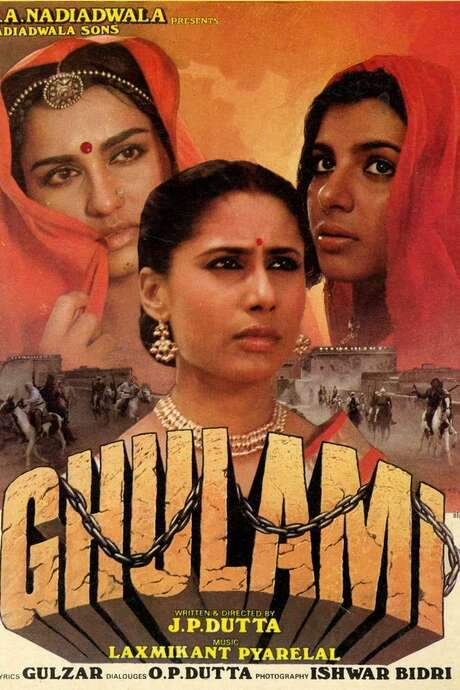
Set in the border town of Fatehpur on the India‑Pakistan frontier, the story follows Ranjit Singh Choudhary, a young man branded a rebel by his schoolmaster and by his father’s employer, Bade Thakur. Unwilling to accept the exploitation of his father’s generation, who have become economic slaves to the upper‑caste Thakurs that lend them money, Ranjit confronts the systemic injustice and fights for his fellow farmers.


Does Ghulami have end credit scenes?
No!
Ghulami does not have end credit scenes. You can leave when the credits roll.
Meet the Full Cast and Actors of Ghulami
Explore the complete cast of Ghulami, including both lead and supporting actors. Learn who plays each character, discover their past roles and achievements, and find out what makes this ensemble cast stand out in the world of film and television.

Naseeruddin Shah
SP Sultan Singh

Amitabh Bachchan
Narrator

Raza Murad
Fatehpur's Thanedar
Mithun Chakraborty
Jabhar
Kulbhushan Kharbanda
Havaldar Gopi Dada
Dharmendra
Ranjit Singh Choudhary
Avtar Gill
Shamu
Aanjjan Srivastav
Munim
Reena Roy
Moran
Rammohan Sharma
Masterji
Bharat Kapoor
Thakur Shakti Singh
Om Shivpuri
Bade Thakur
Smita Patil
Sumitra Sultan Singh
Sulochana Latkar
Makhan's Wife
Anita Raj
Tulsi
Rajan Haksar
Makhan
External Links and Streaming Options
Discover where to watch Ghulami online, including streaming platforms, rental options, and official sources. Compare reviews, ratings, and in-depth movie information across sites like IMDb, TMDb, Wikipedia or Letterboxd.




Take the Ultimate Ghulami Movie Quiz
Challenge your knowledge of Ghulami with this fun and interactive movie quiz. Test yourself on key plot points, iconic characters, hidden details, and memorable moments to see how well you really know the film.
Ghulami (1985) Quiz: Test your knowledge of the 1985 Hindi film Ghulami, its characters, plot points, and themes.
Who plays the role of Ranjit Singh Chaudhary in Ghulami?
Full Plot Summary and Ending Explained for Ghulami
Read the complete plot summary of Ghulami, including all major events, twists, and the full ending explained in detail. Explore key characters, themes, hidden meanings, and everything you need to understand the story from beginning to end.
Ranjit Singh Chaudhary, portrayed by [Dharmendra], grows up in a Rajasthan village where a powerful zamindar family and a rigid caste order shape every facet of life. The peasants toil hard on the land, while the landlord’s clan commands authority over land, education, and justice, perpetuating a cycle of exploitation. In school, Ranjit’s rebellious spirit clashes with deep-rooted caste prejudices, earning him trouble as the landlord’s two sons, who are roughly his own age, bully him. Two sympathetic girls—the daughter of the school-master and the sister of the bully—offer him a glimmer of hope, hinting at connections beyond the village’s rigid rules. Frustrated by the injustice around him, Ranjit ultimately runs away to the city, seeking a path that might break the cycle of oppression.
Years pass. Ranjit’s father dies, and a telegram summons him back to the village to perform the last rites. He returns to a landscape that has changed little, only to learn that his father had borrowed money from the landlord to pay for medicines and healthcare. Now the landlord demands repayment, threatening to seize Ranjit’s lands and home—the collateral for the loan. Ranjit voices a stark, unflinching logic: the peasants till the land for generations while the landowners do little work, so if the landlord lent money to a peasant, the loan should not automatically be repaid; this belief is laid bare in a long, emotional monologue that lays bare the fault lines of class and power.
This realization catalyzes a burgeoning class conflict. Ranjit storms into the landlord’s living room, denouncing him and his ancestors as blood-suckers and challenging the legitimacy of their accumulated wealth. The landlord’s daughter, listening behind a door, is deeply moved by the confrontation and the raw honesty of Ranjit’s stance. Ranjit returns home to bury his father and forges a bond with Moran, a fellow local who becomes an ally in the struggle that is about to intensify. The stage is set for a love triangle and a broader revolutionary vendetta, as personal passions intersect with political outrage.
The romantic tension is resolved swiftly in a sequence of brutal events: the landlord’s sons attempt to rape Moran, but Ranjit intervenes, saving her and marrying Moran, who has clearly needed a protector. Sumitra Sultan Singh, who has cherished an unrequited love for Ranjit, is eventually pressed into an arranged marriage with a police officer chosen by her father. This husband—Fatehpur’s Thanedar, a man tasked with maintaining order—discovers Sumitra’s past affections and, inflamed by jealousy, aligns with his two brothers-in-law in a bid to eliminate Ranjit. What follows is a violent arc of confrontations and retaliations, with Ranjit becoming a fugitive, chased by the law and by those who would preserve the old order.
Throughout the conflict, Ranjit is supported by Jabhar, a villager who has returned from military service, and by Havaldar Gopi Dada, the village police officer whose own son was murdered by the landlord’s henchmen on his wedding day, a personal wound that fuels his complicity in the revolt. Mithun Chakraborty brings Jabhar to life, while Kulbhushan Kharbanda embodies Havaldar Gopi Dada, lending grit and resolve to the insurgent effort. The plot darkens into a cascade of bloodletting, as both sides suffer losses.
The film’s climax is stark and uncompromising: most of the principal players fall in the violence that erupts when old hierarchies refuse to yield. Yet the final note is clear—the brutal cycle of oppression persists even as rebels die for their cause. Told with a steady, even-handed tone, the narrative underscores a harsh reality: changing a centuries-old system is brutal, costly, and rarely fully victorious, even as individual courage and solidarity shine through.
The storytelling is carried by a guiding voice, with Amitabh Bachchan serving as the narrator, lending a calm, authoritative cadence that anchors the emotional and political stakes of the tale. The film’s themes—the clash of caste, the ethics of land and labor, and the human cost of rebellion—unfold through a grounded, human lens, balancing intimate relationships with sweeping social critique.

Coming soon on iOS and Android
The Plot Explained Mobile App
From blockbusters to hidden gems — dive into movie stories anytime, anywhere. Save your favorites, discover plots faster, and never miss a twist again.
Sign up to be the first to know when we launch. Your email stays private — always.
Explore the mobile appWatch Trailers, Clips & Behind-the-Scenes for Ghulami
Watch official trailers, exclusive clips, cast interviews, and behind-the-scenes footage from Ghulami. Dive deeper into the making of the film, its standout moments, and key production insights.
Ghulami Themes and Keywords
Discover the central themes, ideas, and keywords that define the movie’s story, tone, and message. Analyze the film’s deeper meanings, genre influences, and recurring concepts.
Ghulami Other Names and Titles
Explore the various alternative titles, translations, and other names used for Ghulami across different regions and languages. Understand how the film is marketed and recognized worldwide.
Similar Movies To Ghulami You Should Know About
Browse a curated list of movies similar in genre, tone, characters, or story structure. Discover new titles like the one you're watching, perfect for fans of related plots, vibes, or cinematic styles.









Quick Links: Summary, Cast, Ratings, More

What's After the Movie?
Not sure whether to stay after the credits? Find out!
Check out our other apps:

SAT Sphere
Build confidence for the Digital SAT.

Mori Atlas
Discover wild places worth protecting.

Luntero
Search smarter for a home in Amsterdam.

Plot Explained
Unravel movie endings and hidden clues.

Pokechamp
Dive into Pokémon data and battle logic.

Driving Theory
Get ready for your European theory test.

Movie Dust
Plan your next cinema trip with ease.

Musemap
Find art and culture as you travel.

Selkobase
Compare credentials before committing.

Local Manual
Turn an unfamiliar country into practical next steps.

Lernavi
Compare school systems before your next move.

GymRoam
Find a workout stop wherever your plans take you.
Explore Our Movie Platform
New Movie Releases (2026)
Famous Movie Actors
Top Film Production Studios
Movie Plot Summaries & Endings
Major Movie Awards & Winners
Best Concert Films & Music Documentaries
Movie Collections and Curated Lists
© 2026 What's After the Movie. All rights reserved.
Privacy Policy