Concrete Utopia 2023


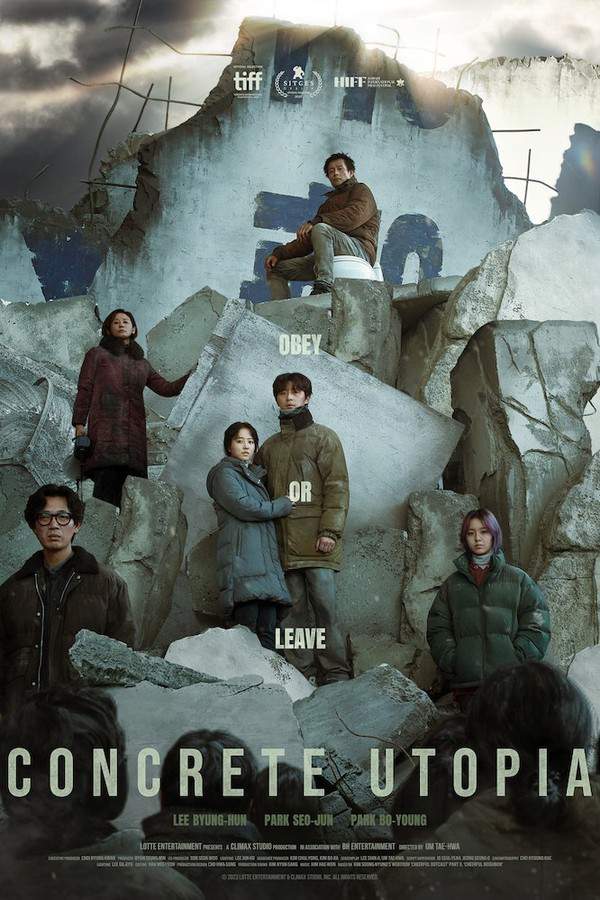
Following a cataclysmic event that destroys Seoul, a single apartment building, Hwang Gung Apartments, miraculously remains standing. Strangers are drawn to this refuge, seeking safety and shelter from the ravaged landscape. As they struggle to survive, they must forge a precarious community while confronting the challenges of a shattered world and the growing desperation among them.


Does Concrete Utopia have end credit scenes?
No!
Concrete Utopia does not have end credit scenes. You can leave when the credits roll.
Where to Watch Concrete Utopia
See current US streaming, rental, and purchase options for Concrete Utopia (2023) via JustWatch.

Streaming availability powered by 
Meet the Full Cast and Actors of Concrete Utopia
Explore the complete cast of Concrete Utopia, including both lead and supporting actors. Learn who plays each character, discover their past roles and achievements, and find out what makes this ensemble cast stand out in the world of film and television.


External Links and Streaming Options
Discover where to watch Concrete Utopia online, including streaming platforms, rental options, and official sources. Compare reviews, ratings, and in-depth movie information across sites like IMDb, TMDb, Wikipedia or Rotten Tomatoes.










Ratings and Reviews for Concrete Utopia
See how Concrete Utopia is rated across major platforms like IMDb, Metacritic, and TMDb. Compare audience scores and critic reviews to understand where Concrete Utopia stands among top-rated movies in its genre.

The Movie Echo Score
Overall, Concrete Utopia delivers a visually compelling and thematically resonant thriller that balances technical proficiency with social commentary. The film’s polished presentation and sustained suspense engage viewers through its tense depiction of survival amid chaos, even as familiar genre tropes and episodic structure limit its originality. Performances ground the unfolding crisis with emotional weight, though occasional tonal shifts and broad caricatures temper its impact. Ultimately, the movie offers a gripping albeit somewhat conventional disaster drama.
The Movie Echo Score Breakdown for Concrete Utopia

Art & Craft
The film’s art and craft stand out in a polished production design and striking visuals. In terms of direction and cinematography, the shattered concrete landscapes are captured with precise framing and dynamic camera movement. Editing maintains tension through measured pacing, while special effects and set design convincingly depict urban destruction. Overall, the visual craftsmanship is consistently impressive.

Character & Emotion
Character and emotion exhibit moments of depth, particularly in the lead performance’s raw intensity. When it comes to acting, Lee’s portrayal anchors the film’s emotional stakes despite occasional broad caricatures among secondary figures. The interpersonal dynamics convey moral tension and group conflict, yielding enough resonance to sustain viewer investment. On balance, the character work is engaging but uneven.

Story & Flow
The story and flow provide a tense and thought-provoking progression through a society in collapse. In terms of plot coherence, the narrative sustains suspense with measured pacing and a clear escalation toward crisis, though episodic structure and familiar genre tropes undercut some originality. Character motivations drive key turning points, maintaining engagement despite predictable elements. Overall, the plot is engaging but moderately derivative.

Sensory Experience
The sensory experience is anchored by a cohesive visual style and immersive sound design. In terms of visual style, the film employs an understated color palette and stark lighting to accentuate the ruined urban setting. The soundtrack and ambient sound work reinforce tension, while momentary silences heighten dramatic beats. Overall, the sensory presentation is consistently effective and immersive.

Rewatch Factor
The rewatch factor is moderate, offering thoughtful themes but limited novelty on repeat viewings. In terms of replay value, the film’s social commentary and suspenseful sequences retain interest, though familiar narrative beats and genre conventions reduce the incentive for multiple viewings. Characters’ moral dilemmas may invite further reflection, but the overall familiarity of the plot tempers its lasting appeal.

73
Metascore
6.3
User Score


100%
TOMATOMETER

75%
User Score

69
%
User Score

/5
Full Plot Summary and Ending Explained for Concrete Utopia
Read the complete plot summary of Concrete Utopia, including all major events, twists, and the full ending explained in detail. Explore key characters, themes, hidden meanings, and everything you need to understand the story from beginning to end.
In a version of 1970s Seoul where apartment blocks rise like landmarks of progress, the city’s story takes a harsh turn from progress to catastrophe. The skyline has already shifted to concrete towers and skyrocketing prices, but by December 2023 an unprecedented cold wave and a massive earthquake flatten most of it. Out of the wreckage, one building survives: the Hwang Gung (Imperial Palace) Apartments, a place that becomes both sanctuary and prison for its inhabitants.
Within this lone refuge, the lives of a few survivors begin to converge. Min-sung wakes up to a gray world where power and water are gone, and contact with the outside is severed. His wife, Myung-hwa, shares the burden of adaptation as they tentatively reestablish routines in the ruined rooms. When a mother and child from a neighboring collapsed unit come seeking shelter, a test of mercy arises. Though uncertainty gnaws at him, Min-sung is swayed by Myung-hwa’s compassion, and they open their doors to strangers, attempting to preserve some semblance of humanity amid the collapse.
As days pass, the fragile calm gives way to a harsher truth: survival appears to demand a new, brutal morality. The community begins to barter for scarce resources, and the fear of outsiders mutates into open hostility. Tensions escalate, and a deadly clash erupts at the gates as outsiders press for access to food and safety. A fire breaks out, and a figure of quiet courage steps forward: Yeong-tak, a man who risks his life to extinguish the flames and earns the admiration—and the political capital—of the residents, eventually becoming their leader.
Under Yeong-tak’s uneasy leadership, the residents vote to expel outsiders, framing the measure as a necessary act of survival. The outsiders push back, and a brutal confrontation at the apartment gates reveals how quickly order can fracture into control, fear, and violence. What begins as a siege evolves into a reshaping of the complex into a seemingly utopian enclave: strict rules, labor-based food distribution, and patrols that claim to protect the community. Yet the veneer of order masks a growing cruelty. The patrols plunder nearby shops and beat survivors, and the city’s inhabitants begin using a dehumanizing term for the outsiders: “cockroaches.”
Hidden tensions simmer just beneath the surface. Myung-hwa learns that some residents, including Do-kyun, are quietly sheltering refugees inside the building’s walls, a dangerous act that could shatter the fragile peace. The arrival of a former resident, a woman named Hye-won, unsettles Yeong-tak and stirs memory and resentment within the group. Her presence challenges the delicate balance of power and tests the legitimacy of the new order.
As the community settles into its manufactured stability, the truth about Yeong-tak begins to emerge. In reality, he is not the man everyone believes him to be: a taxi driver who had been scammed while trying to buy an apartment in Hwang Gung. On the day of the earthquake, he confronted the real Yeong-tak and killed him, then assumed the dead man’s identity to survive. The impostor’s secret festers beneath the surface as Myung-hwa and Hye-won uncover the corpse of the real Yeong-tak hidden in his old unit, exposing the ruse and shattering the illusion of control.
chaos erupts as the façade collapses. Yeong-tak reacts with fury, killing Hye-won in a burst of rage, and the building is soon besieged by organized outsiders. A violent battle rips through the complex, explosions tear through walls, and many residents fall, including Yeong-tak himself. Min-sung and Myung-hwa manage to escape the collapsing structure, their world reduced to rain, rubble, and a smeared memory of order that could not endure.
Wandering the devastated landscape, the two survivors find shelter in a ruined church. There, a quiet moment of humanity lingers: Min-sung gives Myung-hwa a hairpin—an emblem from their scavenging days—and, injured though he is, dies from wounds sustained during the night’s chaos. Myung-hwa buries him with the help of other survivors, who invite her to join their community in another collapsed apartment building, a fragile offer of belonging amid a fractured city and a shattered dream of safety.
This is a story of how quickly systems that promise safety can become mechanisms of fear, how compassion can bend under pressure, and how, in the wake of catastrophe, people cling to fragments of hope while the world around them burns. It’s a stark meditation on resilience, identity, and the thin line between order and cruelty in a city that has already seen too much.

Coming soon on iOS and Android
The Plot Explained Mobile App
From blockbusters to hidden gems — dive into movie stories anytime, anywhere. Save your favorites, discover plots faster, and never miss a twist again.
Sign up to be the first to know when we launch. Your email stays private — always.
Explore the mobile appWatch Trailers, Clips & Behind-the-Scenes for Concrete Utopia
Watch official trailers, exclusive clips, cast interviews, and behind-the-scenes footage from Concrete Utopia. Dive deeper into the making of the film, its standout moments, and key production insights.
Concrete Utopia Other Names and Titles
Explore the various alternative titles, translations, and other names used for Concrete Utopia across different regions and languages. Understand how the film is marketed and recognized worldwide.
Quick Links: Summary, Cast, Ratings, More

What's After the Movie?
Not sure whether to stay after the credits? Find out!
Check out our other apps:

SAT Sphere
Build confidence for the Digital SAT.

Mori Atlas
Discover wild places worth protecting.

Luntero
Search smarter for a home in Amsterdam.

Plot Explained
Unravel movie endings and hidden clues.

Pokechamp
Dive into Pokémon data and battle logic.

Driving Theory
Get ready for your European theory test.

Movie Dust
Plan your next cinema trip with ease.

Musemap
Find art and culture as you travel.

Selkobase
Compare credentials before committing.

Local Manual
Turn an unfamiliar country into practical next steps.

Lernavi
Compare school systems before your next move.

GymRoam
Find a workout stop wherever your plans take you.
Explore Our Movie Platform
New Movie Releases (2026)
Famous Movie Actors
Top Film Production Studios
Movie Plot Summaries & Endings
Major Movie Awards & Winners
Best Concert Films & Music Documentaries
Movie Collections and Curated Lists
© 2026 What's After the Movie. All rights reserved.
Privacy Policy