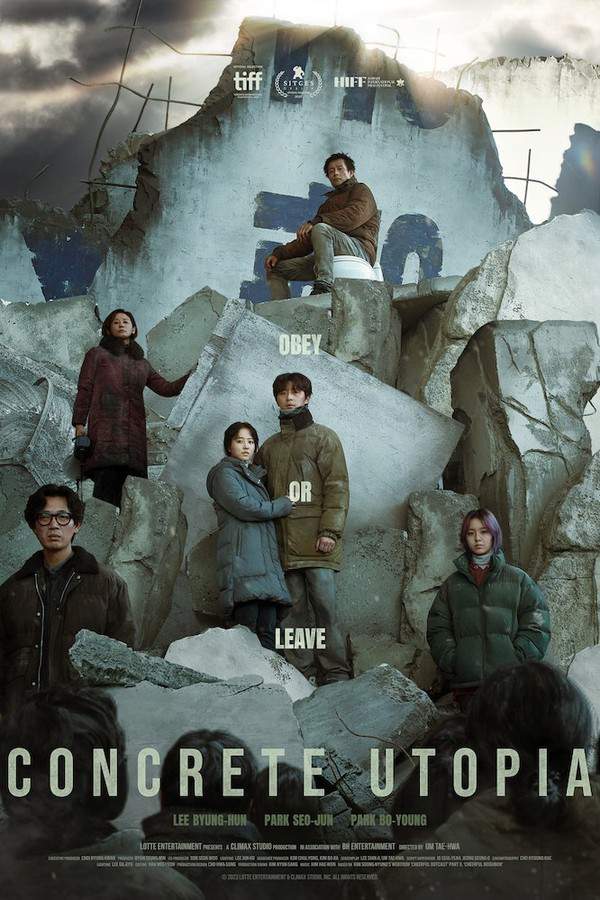
Concrete Utopia 2023


Directed by

Tae-hwa Eom
Made by

Climax Studio
Where to Watch Concrete Utopia
See current US streaming, rental, and purchase options for Concrete Utopia (2023) via JustWatch.

Streaming availability powered by 
Concrete Utopia Plot Summary
Read the complete plot summary and ending explained for Concrete Utopia (2023). From turning points to emotional moments, uncover what really happened and why it matters.
In a version of 1970s Seoul where apartment blocks rise like landmarks of progress, the city’s story takes a harsh turn from progress to catastrophe. The skyline has already shifted to concrete towers and skyrocketing prices, but by December 2023 an unprecedented cold wave and a massive earthquake flatten most of it. Out of the wreckage, one building survives: the Hwang Gung (Imperial Palace) Apartments, a place that becomes both sanctuary and prison for its inhabitants.
Within this lone refuge, the lives of a few survivors begin to converge. Min-sung wakes up to a gray world where power and water are gone, and contact with the outside is severed. His wife, Myung-hwa, shares the burden of adaptation as they tentatively reestablish routines in the ruined rooms. When a mother and child from a neighboring collapsed unit come seeking shelter, a test of mercy arises. Though uncertainty gnaws at him, Min-sung is swayed by Myung-hwa’s compassion, and they open their doors to strangers, attempting to preserve some semblance of humanity amid the collapse.
As days pass, the fragile calm gives way to a harsher truth: survival appears to demand a new, brutal morality. The community begins to barter for scarce resources, and the fear of outsiders mutates into open hostility. Tensions escalate, and a deadly clash erupts at the gates as outsiders press for access to food and safety. A fire breaks out, and a figure of quiet courage steps forward: Yeong-tak, a man who risks his life to extinguish the flames and earns the admiration—and the political capital—of the residents, eventually becoming their leader.
Under Yeong-tak’s uneasy leadership, the residents vote to expel outsiders, framing the measure as a necessary act of survival. The outsiders push back, and a brutal confrontation at the apartment gates reveals how quickly order can fracture into control, fear, and violence. What begins as a siege evolves into a reshaping of the complex into a seemingly utopian enclave: strict rules, labor-based food distribution, and patrols that claim to protect the community. Yet the veneer of order masks a growing cruelty. The patrols plunder nearby shops and beat survivors, and the city’s inhabitants begin using a dehumanizing term for the outsiders: “cockroaches.”
Hidden tensions simmer just beneath the surface. Myung-hwa learns that some residents, including Do-kyun, are quietly sheltering refugees inside the building’s walls, a dangerous act that could shatter the fragile peace. The arrival of a former resident, a woman named Hye-won, unsettles Yeong-tak and stirs memory and resentment within the group. Her presence challenges the delicate balance of power and tests the legitimacy of the new order.
As the community settles into its manufactured stability, the truth about Yeong-tak begins to emerge. In reality, he is not the man everyone believes him to be: a taxi driver who had been scammed while trying to buy an apartment in Hwang Gung. On the day of the earthquake, he confronted the real Yeong-tak and killed him, then assumed the dead man’s identity to survive. The impostor’s secret festers beneath the surface as Myung-hwa and Hye-won uncover the corpse of the real Yeong-tak hidden in his old unit, exposing the ruse and shattering the illusion of control.
chaos erupts as the façade collapses. Yeong-tak reacts with fury, killing Hye-won in a burst of rage, and the building is soon besieged by organized outsiders. A violent battle rips through the complex, explosions tear through walls, and many residents fall, including Yeong-tak himself. Min-sung and Myung-hwa manage to escape the collapsing structure, their world reduced to rain, rubble, and a smeared memory of order that could not endure.
Wandering the devastated landscape, the two survivors find shelter in a ruined church. There, a quiet moment of humanity lingers: Min-sung gives Myung-hwa a hairpin—an emblem from their scavenging days—and, injured though he is, dies from wounds sustained during the night’s chaos. Myung-hwa buries him with the help of other survivors, who invite her to join their community in another collapsed apartment building, a fragile offer of belonging amid a fractured city and a shattered dream of safety.
This is a story of how quickly systems that promise safety can become mechanisms of fear, how compassion can bend under pressure, and how, in the wake of catastrophe, people cling to fragments of hope while the world around them burns. It’s a stark meditation on resilience, identity, and the thin line between order and cruelty in a city that has already seen too much.
Concrete Utopia Timeline
Follow the complete movie timeline of Concrete Utopia (2023) with every major event in chronological order. Great for understanding complex plots and story progression.
City reduced to rubble and awakening in Hwang Gung
The 1970s Seoul boom ends abruptly as a massive disaster collapses the city into gray dust. Min-sung wakes inside the surviving Hwang Gung Apartments to a world with no power, water, or communication. The once thriving metropolis lies in ruins around the lone, partially standing complex.
Survival begins: life in a powerless shelter
Residents scramble to adapt to a reality without basic services and with limited resources. Fear and confusion spread as people search for safety and order within the crumbling interiors. Min-sung and Myung-hwa attempt to maintain some sense of routine amid the chaos.
A begging family is given shelter
A mother and child from a neighboring collapsed apartment arrive seeking refuge. Min-sung hesitates, but Myung-hwa's compassion overrides caution, and they take the pair in. Their arrival unsettles the fragile balance within the surviving community.
Barter and rising tensions
Scarcity drives people to barter for food and water, corroding trust and cooperation. Outsiders push for aid, and a violent incident claims the life of a resident. The shelter's fragile order begins to crack under the strain.
Fire and the birth of leadership
A fire breaks out and Young-tak courageously extinguishes it, earning the admiration of the survivors. His competence and presence propel him into a position of influence. The episode marks a turning point in the building's power dynamics.
Consolidation of power and expulsion of outsiders
Under Young-tak's command, residents vote to expel all outsiders, arguing it is necessary for survival. The outsiders resist, and a brutal clash at the apartment gates ensues. Through forceful defense, Young-tak solidifies his grip on leadership.
A veneer of utopia and regimented living
The apartment reforms into a seemingly utopian community with strict rules and labor-based food distribution, all under vigilant security patrols. The order appears stable, but a growing cruelty and fear undercuts genuine solidarity. Residents police each other as loyalty becomes a currency.
Cruelty hides behind unity; refugees concealed
Patrols plunder nearby shops for supplies and mete out brutal punishments to survivors. Outsiders are increasingly dehumanized, branded as 'cockroaches.' Inside the building, Do-kyun secretly shelters refugees, hinting at quiet resistance to the regime.
Hye-won returns; unsettling presence
Hye-won, a former resident who survived outside, reappears within the confines of the complex, unsettling Young-tak's fragile authority. Her presence threatens the carefully engineered order and hints at hidden loyalties among survivors. Tensions rise as new dynamics challenge the leadership.
The impostor's secret begins to surface
The truth about Young-tak starts to emerge: he is revealed to be a taxi driver who staged as the real Young-tak after killing him during the disaster. The community's faith in the leader slowly crumbles as doubt spreads. The faulty foundation of their so-called order begins to crack.
Corpse discovery and the fall of the illusion
Myung-hwa and Hye-won locate the real Young-tak's corpse hidden in his old unit, exposing the impostor to everyone. The revelation shatters the illusion of unity and triggers chaos and fear among the residents. The social fabric of the community unravels in an instant.
Outsiders strike; the building falls
Organized outsiders assault the complex, tearing through defenses with brutal force. Explosions erupt, and many residents lose their lives in the onslaught. Young-tak dies during the assault, clutching a family photo as he crawls back to his unit.
Escape into the shattered city
Min-sung and Myung-hwa manage to crawl out of the collapsing structure as rain begins to fall over the ruined city. They wander through the devastated landscape in search of safety and a new foothold in a world turned to rubble. The immediate danger behind them, a desolate future looms ahead.
A quiet death and a farewell in a ruined church
The two survivors find refuge in a ruined church, where Min-sung quietly dies from wounds sustained during the night. He gives Myung-hwa a hairpin, a tangible memory of their life together. She buries him with the help of other survivors and faces the uncertain road ahead.
A glimmer of humanity among the ruins
The remaining survivors invite Myung-hwa to join a new community in a collapsed apartment building, offering a chance at belonging amid the wreckage. She stands at a crossroads, choosing whether to seek safety with others or continue wandering alone through the desolate landscape.
Concrete Utopia Characters
Explore all characters from Concrete Utopia (2023). Get detailed profiles with their roles, arcs, and key relationships explained.
Min-sung (Park Seo-joon)
Min-sung is a practical, compassionate husband who hesitates to shelter strangers yet grows to protect the mother and child. He struggles to balance survival with morality as resources dwindle and fear takes hold, revealing a steady, humane core under stress.
Myung-hwa (Park Bo-young)
Myung-hwa is Min-sung’s wife, whose empathy drives the decision to shelter outsiders. She champions human solidarity amid scarcity, and her actions catalyze the moral conflict that drives the couple’s choices and the building’s fate.
Young-tak (Lee Byung-hun)
Young-tak is the impostor-turned-leader who capitalizes on fear to impose order. He orchestrates expulsions, commands patrols, and cultivates an illusion of utopia, only to reveal a ruthless hunger for control.
Hye-won (Park Ji-hu)
Hye-won is a former resident who survived outside and returns to challenge the new regime. Her presence unsettles Young-tak as the truth about the impostor begins to surface, triggering a deadly confrontation.
Do-kyun (Do-yoon Kim)
Do-kyun is a resident who secretly hides refugees inside the building, revealing a quiet, risk-taking moral ambiguity. His actions complicate the community’s sense of safety and loyalty as tensions rise.
Concrete Utopia Settings
Learn where and when Concrete Utopia (2023) takes place. Explore the film’s settings, era, and how they shape the narrative.
Time period
1970s and 2023
The film threads through 1970s Seoul, a period of rapid apartment construction and economic growth. By December 2023, a massive earthquake and cold wave devastate the city, leaving only one building standing. The story contrasts these eras to explore how people respond when civilization collapses.
Location
Hwang Gung (Imperial Palace) Apartments, Seoul
In December 2023, the only surviving structure in a ruined Seoul is the Hwang Gung Apartments, a once-grand high-rise now reduced to gray dust and rubble. The surrounding city lies in silence without power, water, or communications, as residents hoard dwindling supplies. The complex becomes a microcosm of society, where fear and scarcity shape loyalties and life-or-death decisions.
Concrete Utopia Themes
Discover the main themes in Concrete Utopia (2023). Analyze the deeper meanings, emotional layers, and social commentary behind the film.
🧭
Survival
With no power, water, or communications, residents improvise to secure basic needs. Scarcity drives tough choices, barter, and violence, testing loyalties between neighbors. The survival instinct gradually overrides empathy, revealing the darker side of human resilience.
👑
Power
A leader rises from the wreckage, imposing strict rules, labor-based food distribution, and security patrols. The veneer of order masks coercion and the potential tyranny of those who claim to protect the community. External expulsions and vigilantism reveal how easily power corrupts in crisis.
🪪
Identity
An impostor, a taxi driver, steals another man’s life to survive, undermining the social order from within. The revelation shatters the illusion of stability and exposes how identity can be weaponized in a desperate environment. Trust becomes precarious as secrets unravel.
🏚️
Outsiders
Outsiders are labeled as 'cockroaches' and targeted for exclusion. Some residents secretly shelter refugees, hinting at a more humane impulse beneath the harsh rhetoric. When organized outsiders attack, the fragile social order collapses into chaos and violence.

Coming soon on iOS and Android
The Plot Explained Mobile App
From blockbusters to hidden gems — dive into movie stories anytime, anywhere. Save your favorites, discover plots faster, and never miss a twist again.
Sign up to be the first to know when we launch. Your email stays private — always.
Explore the mobile appConcrete Utopia Ending Explained
Unravel the ending of Concrete Utopia (2023) with our detailed explanation. Understand the final scenes, character fates, and unresolved questions.
The ending of Concrete Utopia portrays a grim yet thought-provoking conclusion. After defending the building against outside attackers, Se-beom, who reveals his true identity as Kim Young-Tak, is severely wounded but manages to stay alive long enough to return to his beloved apartment. However, the attack is relentless, and ultimately, Se-beom’s injuries prove fatal. Though he is left severely injured, he does not die immediately, hinting that he could succumb to his wounds later, leaving the apartment and its symbolic meaning behind. His death signifies the collapse of his fragile facade and the loss of his humanity, especially after the revelation of his true identity and his brutal actions against outsiders and fellow residents alike.
Meanwhile, Myeong-hwa and Min-sung attempt to escape the chaos, but their attempt ends tragically. Min-sung is fatally wounded and dies in his sleep after a brief and desperate struggle for survival. Myeong-hwa, who witnesses this, is left completely alone in a devastated world. Her question about whether she can join the outsiders reflects a critical lesson from the film: in a world reduced to rubble, human connection and empathy matter most. Her curiosity about living among the outsiders shows her understanding that survival isn’t just about shelter or strength but about compassion and community.
The film intimately illustrates how greed, fear, and a lack of compassion can escalate conflict and destruction. Se-beom’s transformation from a brave survivor into a ruthless leader underscores how fear of losing power can strip away one’s humanity. The ending leaves viewers contemplating whether redemption is possible or if humanity is doomed to repeat its mistakes, giving a bleak but poignant reflection on the importance of empathy and the true meaning of survival. Ultimately, the story underscores that in a broken world, human connection remains the only hope for salvation.
Concrete Utopia Spoiler-Free Summary
Discover the spoiler-free summary of Concrete Utopia (2023). Get a concise overview without any spoilers.
The story opens on a Seoul that has been ripped apart by an unprecedented cold snap and a massive earthquake, leaving the city’s skyline reduced to rubble. Amid the devastation, a single high‑rise—Hwang Gung Apartments—miraculously stands untouched. This lone tower becomes an unintended sanctuary, drawing strangers who have lost everything and compelling them to confront the stark reality of survival in a world where basic utilities have vanished and the outside is a hostile wasteland. The film sets a bleak, tense atmosphere, where the concrete walls both promise safety and hint at claustrophobic confinement.
Inside the building, Min-sung awakens to a silent, gray world, his ordinary life abruptly replaced by the need to ration water, share heat, and rebuild routine. Beside him, his wife Myung‑hwa works to keep a thread of humanity alive, extending compassion to those who knock on their door. Their small, intimate bond provides a quiet counterpoint to the growing collective unease as more people flock to the apartment, each bringing their own hopes and fears. The interactions among the newcomers spark the formation of fragile alliances, subtle power shifts, and an unspoken question: how far will a community go to protect its own?
As the residents adjust to their new reality, a figure known as Yeong‑tak steps forward, offering a steadying presence that begins to shape the group’s emerging social order. His calm demeanor and willingness to act in crises earn him a pivotal role, hinting at the delicate balance between cooperation and control that will define life within the walls. The building’s corridors become a micro‑cosm of a shattered city, where the tension between survival instincts and moral compromise lingers in every hallway.
The film’s tone remains unflinching and atmospheric, pairing the stark visual decay of a post‑cataclysmic Seoul with intimate moments of tenderness and conflict. It invites viewers to contemplate how ordinary people respond when civilization collapses, and whether the thin veneer of order can survive the pressure of desperation.
Featured on this page

What's After the Movie?
Not sure whether to stay after the credits? Find out!
Check out our other apps:

SAT Sphere
Build confidence for the Digital SAT.

Mori Atlas
Discover wild places worth protecting.

Luntero
Search smarter for a home in Amsterdam.

Plot Explained
Unravel movie endings and hidden clues.

Pokechamp
Dive into Pokémon data and battle logic.

Driving Theory
Get ready for your European theory test.

Movie Dust
Plan your next cinema trip with ease.

Musemap
Find art and culture as you travel.

Selkobase
Compare credentials before committing.

Local Manual
Turn an unfamiliar country into practical next steps.

Lernavi
Compare school systems before your next move.

GymRoam
Find a workout stop wherever your plans take you.
Explore Our Movie Platform
New Movie Releases (2026)
Famous Movie Actors
Top Film Production Studios
Movie Plot Summaries & Endings
Major Movie Awards & Winners
Best Concert Films & Music Documentaries
Movie Collections and Curated Lists
© 2026 What's After the Movie. All rights reserved.
Privacy Policy