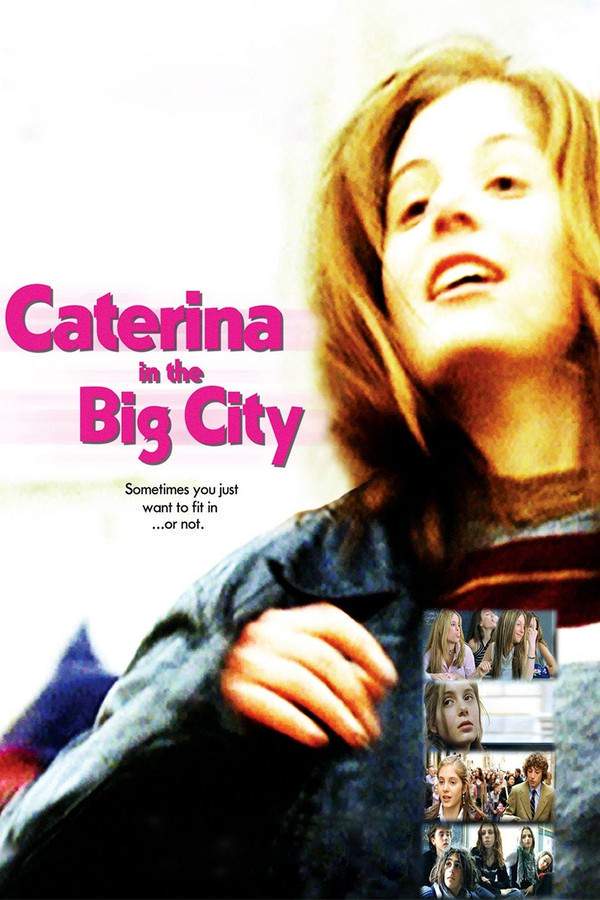
Caterina in the Big City 2003


Caterina, a twelve‑year‑old, follows her ambitious father from a small northern town to his native Rome, where she is placed in his former school. She quickly discovers a rigid hierarchy where pupils group themselves by social status and their families’ political leanings, leaving her feeling adrift and questioning where she belongs.


Does Caterina in the Big City have end credit scenes?
No!
Caterina in the Big City does not have end credit scenes. You can leave when the credits roll.
Meet the Full Cast and Actors of Caterina in the Big City
Explore the complete cast of Caterina in the Big City, including both lead and supporting actors. Learn who plays each character, discover their past roles and achievements, and find out what makes this ensemble cast stand out in the world of film and television.

Sergio Castellitto
Giancarlo Iacovoni

Roberto Benigni
Self

Marit Nissen
Germanos' governess

Flavio Bucci
Lorenzo Rossi Chaillet
Michele Placido
Self
Luisella Boni
Andreina, Gianfilippo's mother
Pasquale Anselmo
Riccardo
Margherita Buy
Agata Iacovoni
Bruno Pavoncello
Armando
Raffaella Lebboroni
Livia's friend
Paola Tiziana Cruciani
Aunt Marisa
Raffaele Vannoli
Marcello, the chaffeur
Dario Ceruti
PE teacher
Bob Messini
Professor
Franco Pinelli
Headmaster
Claudio Amendola
Manlio Germano
Corrado Fortuna
SS Lazio player
Giulia Elettra Gorietti
Giada
Maurizio Costanzo
Self
Galatea Ranzi
Livia, Margherita's mother
Paola Rota
Lucilla
Silvio Vannucci
Fabietto Cruciani
Alison Cameron Adam
Edward's mother
Margherita Mazzola
Martina
Federica Sbrenna
Daniela Germano
Alice Teghil
Caterina Iacovoni
Carolina Iaquaniello
Margherita Rossi Chaillet
Martina Tasquetta
Alessia
Alessandra Celi
Mrs. Germano
Simonetta Martone
Self
Renata Orso Ambrosoli
Aunt Adelina
Luigi Grilli
Uncle Alfredo
Zach Wallen
Edward
Emanuele Ajello
Mirko
Giuditta Avossa
Other Parioli student
Ottavia Virzì
Red-headed leftist student
Milly Corinaldi
Grandma Cesira
Maria Grazia Nazzari
Interviewer at the club
Martino Reviglio
Gianfilippo
Paolo Proietti
Palazzo Chigi's usher
Roberta Lena
School secretary
External Links and Streaming Options
Discover where to watch Caterina in the Big City online, including streaming platforms, rental options, and official sources. Compare reviews, ratings, and in-depth movie information across sites like IMDb, TMDb, Wikipedia or Rotten Tomatoes.






Take the Ultimate Caterina in the Big City Movie Quiz
Challenge your knowledge of Caterina in the Big City with this fun and interactive movie quiz. Test yourself on key plot points, iconic characters, hidden details, and memorable moments to see how well you really know the film.
Caterina in the Big City Quiz: Test your knowledge of the 2003 Italian film *Caterina in the Big City* with a mix of easy, medium, and challenging questions.
What is the name of the 13‑year‑old protagonist?
Full Plot Summary and Ending Explained for Caterina in the Big City
Read the complete plot summary of Caterina in the Big City, including all major events, twists, and the full ending explained in detail. Explore key characters, themes, hidden meanings, and everything you need to understand the story from beginning to end.
Caterina Iacovoni Giulia Elettra Gorietti is a 13-year-old girl who stands at the center of a family and a city beginning to fracture. Her father, Giancarlo Iacovoni Sergio Castellitto, is an aspiring novelist and an accounting teacher whose sharp, often corrosive view of modern society masks deeper frustrations. He lives with Caterina and his wife, Agata Iacovoni Margherita Buy, in a home that has grown tense under the weight of unspoken disappointments and broken promises. The family relocates from their hillbilly country north of Rome to Giancarlo’s birthplace, a move meant to secure him a long-sought teaching position but one that only amplifies his sense of displacement and resentment.
Once in Rome, Caterina enrolls in a fast-track high school where she is quickly pulled between two powerful student cliques. The left-leaning, bohemian group is led by Margherita Rossi-Chaillet Carolina Iaquaniello, a world-wanderer with an air of intellectual authority and a personal code that Cabot-like intensity; the right-leaning faction is fronted by Daniela Germano Federica Sbrenna, the daughter of a prominent, hardline conservative figure. Margherita embraces Caterina as a new best friend, and the two roam through rallies, graves of poets, and the echoing sounds of Nick Cave, cultivating a bond that feels both intimate and fraught with possibility. The relationship soon carries a complicated nuance, as a kiss between Margherita and Caterina hints at either emerging sexuality or a pact of loyalty—an ambiguity that lingers as the girl’s loyalties begin to tilt.
As Caterina’s social world expands, a rift forms. After a drunken incident and a recent tattoo acquired with Margherita’s help, Caterina clashes with her mentor-turned-peer, drawing a wedge between the two friends and pushing Caterina toward Daniela’s circle. Daniela’s world is fenced by wealth and power, with her father, a figure implied to be closely tied to fascist-era politics, watching from the wings. The wedding Caterina attends with Daniela becomes a stark tableau: neo-fascists pay homage to Daniela’s father, underscoring a climate where ideology and privilege intertwine with social performance. There is also a subtle suggestion of a private, uneasy dynamic between Daniela and her father’s bodyguard, adding another layer of complexity to Caterina’s social education.
Amid the personal maneuverings, Giancarlo tries to leverage Caterina’s social bridges for his own stalled ambitions. He secretly passes Margherita a copy of his manuscript to slip to her mother, a maneuver designed to leverage influence through an editor, even as he clings to the idea that Caterina’s friendships might rescue his career. After a public misstep on a talk show and a disciplinary firing for striking a student, he seeks influence at Daniela Germano’s father’s office but finds no easy harbor there either. The more Caterina learns about the world around her, the more she discovers that the world she hoped to inhabit—one built on sincerity—may be built on fragile, performative walls.
The realization that Daniela and her circle “do not like” Caterina lands hard. A failed romance with a wealthy boy from Daniela’s clique seals the feeling of betrayal, and Caterina’s sense of home and belonging begins to cave in. A pivotal moment arrives when she lashes out, and in the aftermath, she finds solace with a neighboring Australian boy who has been quietly watching over the family—a watcher who calls their life a soap opera and whose presence feels curiously comforting to Caterina. She returns home to a house still mired in misery, with her mother, Agata, and her father each wrestling their own unhappiness.
The tension within the family peaks when a conversation between Agata and Fabietto (a close neighbor) reveals the longing for a life apart—Agata confesses her wish to leave Giancarlo, but fears she cannot bear to leave him to face life alone. Unbeknownst to them, Giancarlo overhears enough to frighten himself into action, and he rides away on his motorcycle. The film cuts to him as a person who simply disappears from the frame, with the family choosing to reinterpret his absence as a form of happiness elsewhere: “he doesn’t bother our family more, we like to think he’s in a place that’s making him happy.”
As Caterina moves through the summer, she is urged by Margherita to consider the conservatory of music, a path that eventually becomes her future. Before a holiday break, her Australian friend explains he will return to his homeland as his parents repair their own bond, and Caterina quietly confesses a wish that, should they meet again, she would like to be his girlfriend. The summer folds into quiet moments—playing with a second cousin on the beach, spending time with her mother and Fabietto—and ends with Caterina giving a solo performance at the conservatory, her voice rising in a finale that embodies a tentative, hopeful maturity amid the chaos she has endured.
Throughout, the film embeds a portrait of social divisions, personal disillusionments, and the stubborn persistence of a young girl who learns to navigate an urban landscape where family, friendship, desire, and ideology collide. The final image of Caterina’s ascent—singing in a conservatory performance—functions as a quiet testament to resilience, growth, and the enduring question of where one’s true place in the world might finally be found.

Coming soon on iOS and Android
The Plot Explained Mobile App
From blockbusters to hidden gems — dive into movie stories anytime, anywhere. Save your favorites, discover plots faster, and never miss a twist again.
Sign up to be the first to know when we launch. Your email stays private — always.
Explore the mobile appDiscover Film Music Concerts Near You – Live Orchestras Performing Iconic Movie Soundtracks
Immerse yourself in the magic of cinema with live orchestral performances of your favorite film scores. From sweeping Hollywood blockbusters and animated classics to epic fantasy soundtracks, our curated listings connect you to upcoming film music events worldwide.
Explore concert film screenings paired with full orchestra concerts, read detailed event information, and secure your tickets for unforgettable evenings celebrating legendary composers like John Williams, Hans Zimmer, and more.


Caterina in the Big City Themes and Keywords
Discover the central themes, ideas, and keywords that define the movie’s story, tone, and message. Analyze the film’s deeper meanings, genre influences, and recurring concepts.
Caterina in the Big City Other Names and Titles
Explore the various alternative titles, translations, and other names used for Caterina in the Big City across different regions and languages. Understand how the film is marketed and recognized worldwide.
Similar Movies To Caterina in the Big City You Should Know About
Browse a curated list of movies similar in genre, tone, characters, or story structure. Discover new titles like the one you're watching, perfect for fans of related plots, vibes, or cinematic styles.












Quick Links: Summary, Cast, Ratings, More

What's After the Movie?
Not sure whether to stay after the credits? Find out!
Check out our other apps:

SAT Sphere
Build confidence for the Digital SAT.

Mori Atlas
Discover wild places worth protecting.

Luntero
Search smarter for a home in Amsterdam.

Plot Explained
Unravel movie endings and hidden clues.

Pokechamp
Dive into Pokémon data and battle logic.

Driving Theory
Get ready for your European theory test.

Movie Dust
Plan your next cinema trip with ease.

Musemap
Find art and culture as you travel.

Selkobase
Compare credentials before committing.

Local Manual
Turn an unfamiliar country into practical next steps.

Lernavi
Compare school systems before your next move.

GymRoam
Find a workout stop wherever your plans take you.
Explore Our Movie Platform
New Movie Releases (2026)
Famous Movie Actors
Top Film Production Studios
Movie Plot Summaries & Endings
Major Movie Awards & Winners
Best Concert Films & Music Documentaries
Movie Collections and Curated Lists
© 2026 What's After the Movie. All rights reserved.
Privacy Policy