
The Pout-Pout Fish (2026) Reviews: Critical Reception, Audience Reactions & Is It Worth Watching?
When DreamWorks Animation brought Deborah Diesen’s beloved picture book to the big screen on March 20, 2026, expectations swirled around whether The Pout-Pout Fish could translate its simple, rhyming narrative into a feature-length theatrical experience. Parents familiar with the source material—a board book staple in toddler libraries—wondered if the adaptation would capture the gentle moral about emotional resilience, while critics questioned whether stretching a minimalist bedtime story into a 90-minute animated film would result in meaningful cinema or merely padding. As audiences began searching for The Pout-Pout Fish review insights and spoiler-free guidance on whether to purchase tickets for their preschoolers, the reception landscape quickly revealed a fascinating divide: what entertains a three-year-old versus what satisfies their parents (and professional critics) turned out to be two entirely different currents. This comprehensive analysis examines the real critic reviews and authentic user reactions to determine whether this children’s book adaptation sinks or swims, providing you with the detailed film reception context you need before heading to theaters.
Critical Consensus: How Critics Received The Pout-Pout Fish (2026) Adaptation
Professional film critics approached The Pout-Pout Fish with measured expectations, and the resulting critical consensus reflects a movie that accomplishes its modest goals without aspiring to animated classic status. Peter Travers of The Travers Take delivered a characteristically wry assessment, noting that “this animated tale of a grumpy fish is as bland as blueberries,” while simultaneously dismissing concerns about the material’s psychological impact by confirming that “positive messaging swims will all these fishes.” This dual observation captures the essential tension in the critical reception: the film may lack sophisticated storytelling or visual inventiveness for adult viewers, yet it successfully avoids undermining its source material’s uplifting themes about emotional growth and community support.
Collider’s official critic review reinforces this perception of competent adequacy, stating definitively that “The Pout-Pout Fish is not bad by any means, but don’t go in expecting a new animated classic.” This sentiment resonates across the critical spectrum, suggesting that the film occupies a specific niche in the animation landscape—neither a Toy Story-level triumph nor a direct-to-streaming disaster. The review emphasizes that “little kids will probably enjoy it for the innocent, lesson-filled, mild fun it is,” particularly if they’ve been exposed to Diesen’s book beforehand. This conditional approval—“there’s nothing wrong with that”—encapsulates the professional verdict: the film achieves exactly what it aims for, no more and no less.
However, the critical reception raises important questions about adaptation strategy and genre expectations for modern children’s cinema. Where adaptations like The Gruffalo or Room on the Broom expanded their source material with cinematic economy, critics suggest The Pout-Pout Fish struggles with pacing and storytelling quality issues inherent to stretching minimal text across feature length. The “bland as blueberries” critique suggests a visual and narrative conservatism that may disappoint animation enthusiasts seeking the boundary-pushing artistry of Pixar or Laika productions. Yet, unlike harsher film analysis of truly failed adaptations, the critical consensus acknowledges the film’s successful targeting of its demographic—an increasingly rare virtue in an era where “four-quadrant” family films often sacrifice toddler accessibility for adult-oriented pop culture references.
Audience Reactions and Viewer Sentiment: Real User Reviews Analysis
While critics debated cinematic merit, audience reactions reveal a stark polarization between adult chaperones and their preschool charges, creating a complex viewer sentiment landscape that potential ticket-buyers must navigate carefully. User “Davetheman” offered rare unqualified enthusiasm among adult respondents, praising the production with “good animation” and calling it “the incredible movie I seen,” suggesting that technical execution of underwater visuals satisfied at least some family moviegoers seeking visual spectacle.
However, the dominant fan opinions thread among parents reveals significant frustration with the film’s engagement levels. “billie F” reported that “my 3 year old found it a bit boring,” while “j H” delivered a devastating verdict: “This wa a very dull and mostly unimaginative movie. If the writers had stayed more close to the original story, this would have been more engaging. Kids were bored and disappointed. So were the parents.” This dual disappointment—failing both generations simultaneously—represents the worst-case scenario for family entertainment. Similarly, “batsell S” argued that “some books should just be books,” criticizing the adaptation as “flat attempts at jokes” that were “stretched out about 45 minutes too long.”
Yet the viewer reactions aren’t uniformly negative. “Sherry M” offered a contrarian perspective, finding it “much better than expected. Funny and sweet,” while “Eileen” appreciated that “it was cute with a nice moral.” Perhaps most revealing is the demographic specificity in positive responses. “Molly” provided crucial parental guidance context: “Maggie liked the fish, the baby fish, chaos. I (the parent) thought it was a really cute movie esp for toddlers. Easy to follow along and while predictable, it was very entertaining for my 3 year old.” This distinction between toddler (ages 2-4) and slightly older preschooler engagement proves essential for is The Pout-Pout Fish worth watching determinations.
The most concerning audience reactions come from “Dizzyscribbles,” who reported that “My 4 year old asked us to walkout 30 minutes before the end. The characters are unlikable and the entire thing is poorly written. It is derivative, annoying and too loud. I thought it was just me but my daughter said it was scary.” This account of tonal inconsistency—too dark or intense for the target demographic—contradicts the “innocent, mild fun” described by critics, suggesting that film reception varies significantly based on individual children’s sensitivity levels and prior familiarity with the source material.
Tone, Pacing, and Storytelling Quality: Where The Pout-Pout Fish Sinks or Swims
The most persistent criticism across both critical reviews and user opinions centers on fundamental storytelling quality issues, particularly regarding how the minimalist source material expanded to feature length. Multiple reviewers identified pacing problems as the film’s fatal flaw. The observation by “batsell S” that the narrative feels “stretched out about 45 minutes too long” aligns with broader film analysis suggesting that The Pout-Pout Fish (2026) suffers from the common adaptation pitfall of confusing “longer” with “more substantial.”
The narrative structure appears to have generated specific complaints about writing quality. “Dizzyscribbles” noted that “The themes are almost non existent, jokes weak,” while “j H” lamented that the script deviated from the book’s elegant simplicity. This creates a fascinating tension in reception analysis: where the book derives its power from repetitive, soothing rhyme schemes suitable for bedtime reading, the cinematic adaptation seemingly struggled to translate this literary device into visual storytelling without becoming, as Travers noted, “bland.”
The tone of the film generated particularly contradictory viewer reactions. While Collider described the experience as “innocent, lesson-filled, mild fun,” Dizzyscribbles’ child found it “scary,” suggesting that the animation style or narrative stakes may have inadvertently created tension inappropriate for the youngest viewers. This tonal confusion—simultaneously too boring for adults yet potentially too intense for sensitive preschoolers—represents a significant reception challenge for the marketing campaign, which positioned the film as gentle, toddler-friendly content.
Interestingly, “Gabe H” identified a specific screenwriting bright spot, noting that “at the very end there was a joke that made laugh out loud. and most movies can not even make laugh.” This suggests that while the bulk of the pacing and storytelling may drag, the conclusion provides satisfactory payoff—a crucial detail for parents wondering if their endurance through the middle act will be rewarded. The adaptation strategy clearly prioritized expansion over distillation, a choice that satisfied some book fans like “Patti,” who appreciated “depicting the anxiety around loneliness,” while alienating others who preferred the original’s brevity.
Visuals and Animation: Technical Reception and Production Values
Despite narrative criticism, the technical reception of The Pout-Pout Fish (2026) generated more uniformly positive audience reactions, particularly regarding animation quality. User “Davetheman” specifically highlighted “good animation” as the redeeming quality that elevated the film to “incredible” status in his view, suggesting that DreamWorks’ visual department successfully rendered the underwater world with sufficient color and movement to captivate young viewers.
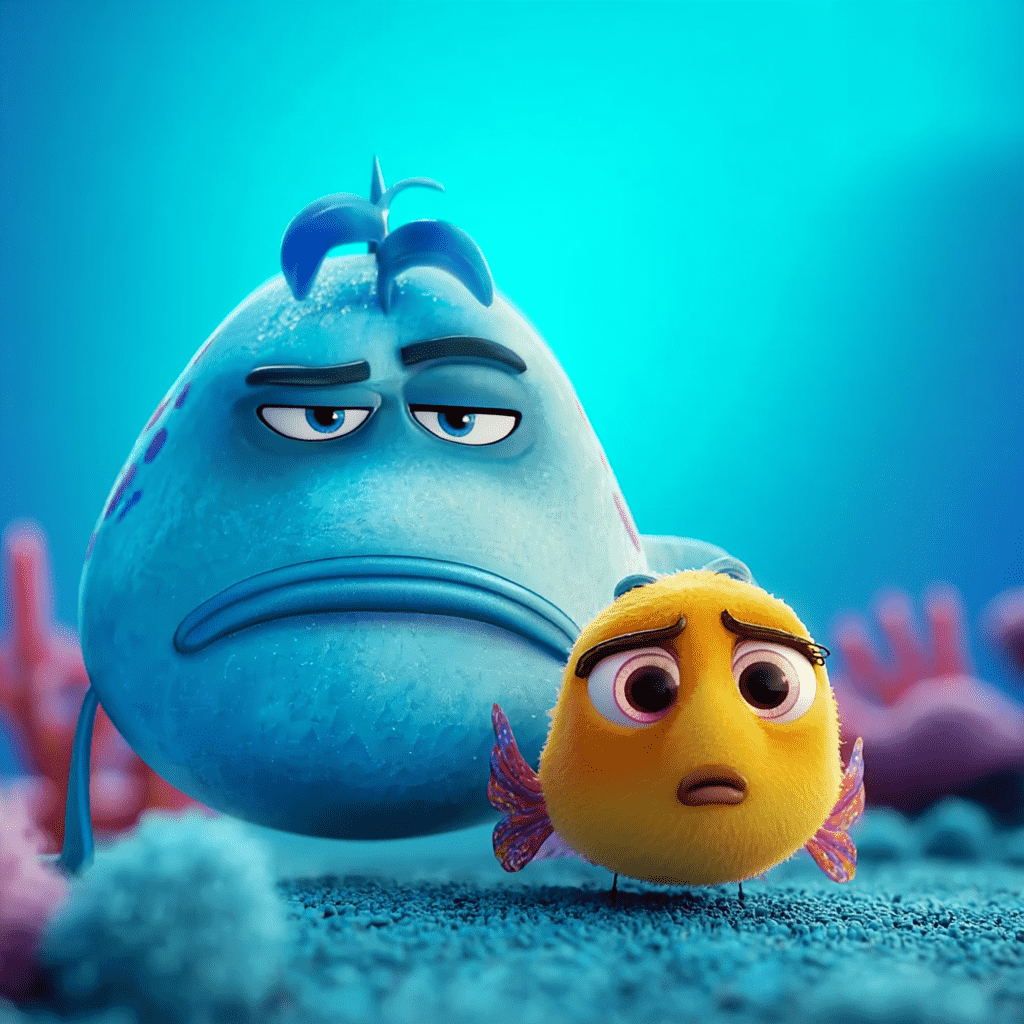
The visual storytelling appears to have successfully translated the board book’s distinctive character designs into three-dimensional CGI, maintaining the recognizability of Mr. Fish and his aquatic companions while expanding the environment to feature-film scale. Parents like “Molly” noted that their children responded specifically to “the fish, the baby fish, chaos,” indicating that the character animation and action sequences provided sufficient visual stimulation for toddlers with limited attention spans.
However, critical reception of the visuals trended toward the “bland” assessment offered by Travers, suggesting that while technically competent, the art direction may lack the distinctive visual identity of contemporary animated classics. This creates an interesting comparison point to other aquatic animated films like Finding Nemo or Shark Tale—where those films pushed color palettes and character design into memorable, iconic territory, The Pout-Pout Fish seemingly opted for a safer, more literally illustrative approach that satisfied literal book adaptation expectations without transcending them.
The production values debate ties directly to parental guidance concerns about volume and intensity. “Dizzyscribbles” complained that the film was “too loud,” suggesting that sound design choices may have prioritized theatrical impact over the gentle atmosphere that would better suit the demographic. This technical decision—part of the broader film analysis of the movie’s tone—represents a disconnect between the animation studio’s commercial instincts and the source material’s quiet, bedtime-story essence.
Target Audience Analysis: Is The Pout-Pout Fish (2026) Right for Your Family?
Determining whether The Pout-Pout Fish is worth watching requires precise demographic targeting. The reception data suggests a narrow sweet spot: children ages 2-3 appear most likely to engage positively, while older preschoolers and adults frequently report disappointment. “BETTY R” confirmed that “younger kids will really enjoy this,” while “billie F” noted that even a three-year-old could find it boring, indicating that child development stage matters significantly more than chronological age.
For parents deciding whether to purchase tickets, the spoiler-free review consensus suggests tempering expectations. If you’re seeking a cinematic experience that will entertain the whole family equally—offering layered humor for adults while captivating children—this adaptation appears to fall short of Shrek or Paddington standards. However, if you need 90 minutes of toddler distraction with positive messaging about emotional resilience and community, the film reception suggests acceptable utility.
The viewer reactions emphasize source material familiarity as a crucial variable. Collider specifically recommended the film for children “introduced to what inspired it first,” while “j H” criticized deviations from the original story. Parents should consider reading the book with children before attending, potentially increasing engagement with the cinematic adaptation.
Finally, sensitivity considerations matter: children prone to movie theater anxiety or those sensitive to loud noises may find the “too loud” and allegedly “scary” elements problematic, despite the G-rating suggesting universal appropriateness.
Conclusion: Final Verdict on The Pout-Pout Fish Reception and Legacy
The critical consensus and audience reactions to The Pout-Pout Fish (2026) paint a portrait of a film that successfully fulfills its commercial mandate while failing to achieve artistic distinction. This children’s book adaptation delivers exactly what Travers and Collider suggested: mild, inoffensive entertainment for the diaper-and-sippy-cup set that offers little to those outside its narrow demographic. For parents of toddlers seeking spoilage-free cinema options, the film analysis suggests manageable—if not magical—experiences, provided expectations remain calibrated toward babysitting rather than bonding.
The long-term reception of The Pout-Pout Fish will likely depend on home viewing endurance, where the “too long” criticism becomes less burdensome when viewed in segments. Unlike animated classics that reward repeat viewings, the user reviews suggest this adaptation may test parental patience while satisfying the limited narrative demands of its target audience. Ultimately, the reception trends indicate a film that knows its audience and serves them adequately—a humble achievement that, while far from cinematic excellence, fulfills the promise of bringing a beloved bedtime story to slightly larger screens.
For more movie reviews, box office analysis, and reception updates, visit What’s After the Movie.
| Site | Link |
|---|---|
| The Pout-Pout Fish IMDB | IMDB |
| The Pout-Pout Fish TMDB | TMDB |
| The Pout-Pout Fish Wikipedia | Wikipedia |
| The Pout-Pout Fish Rotten Tomatoes | Rotten Tomatoes |
| The Pout-Pout Fish Metacritic | Metacritic |
| The Pout-Pout Fish JustWatch | JustWatch |
| The Pout-Pout Fish Box Office Mojo | Box Office Mojo |