What's After the Blog?
analysis • feature
How Scientifically Accurate Is Ryan Gosling's Project Hail Mary?
Project Hail Mary balances rigorous scientific concepts with creative liberties in its adaptation of Andy Weir's novel. We examine which elements of Ryan Gosling's interstellar journey reflect actual physics and biology, and where the film bends reality for narrative purposes.
March 22, 2026
How Scientifically Accurate Is Ryan Gosling’s Project Hail Mary?
When Project Hail Mary rocketed into theaters under the direction of Phil Lord and Christopher Miller, it brought Andy Weir’s brand of hard science fiction to mainstream audiences. The adaptation, penned by screenwriter Drew Goddard, follows Ryan Gosling’s Ryland Grace as he undertakes a desperate mission to the Tau Ceti star system roughly twelve light-years from Earth. Unlike typical space operas that prioritize spectacle over substance, this production grapples with genuine orbital mechanics, relativistic physics, and speculative biology—though it occasionally takes creative license when the narrative demands.
The film arrives at a moment when audiences increasingly scrutinize scientific authenticity in blockbuster entertainment. Christopher Nolan’s Interstellar previously set a high watermark by accurately visualizing black holes before scientific confirmation, raising expectations for cosmic accuracy. Project Hail Mary attempts a similar tightrope walk, grounding its most fantastical elements—sentient aliens and star-consuming microorganisms—in theoretical frameworks that pass casual inspection while delivering cinematic thrills.
Andy Weir’s Credentials in Hard Science Fiction
The scientific rigor behind Project Hail Mary begins with its source material. Author Andy Weir cultivated an unusual background for a novelist, raised by a physicist and an electrical engineer before pursuing his own career in software programming. This technical foundation first manifested in his 2011 debut The Martian, which meticulously detailed orbital mechanics, interplanetary communication, and the botany of potato cultivation in hostile environments.
Weir approaches Project Hail Mary with similar methodological precision. He treats the narrative’s biological and physical challenges as engineering problems requiring logical solutions rather than magical technology. This philosophy attracted directors Lord and Miller, known for balancing irreverent humor with structural coherence, and screenwriter Goddard, who previously adapted The Martian for Ridley Scott. Their collaboration attempts to preserve Weir’s technical specificity while translating complex astrophysics into accessible drama.
The Mechanics of Interstellar Travel
The film’s central journey—transporting Ryland Grace to the Tau Ceti system—presents the first major scientific hurdle. Covering approximately twelve light-years requires either centuries of travel or speeds approaching light itself. The screenplay addresses this through medically-induced comas and intravenous feeding, a notably more grounded approach than the cryogenic freezing typical of science fiction.
This choice reflects actual conversations within space agencies about long-duration missions. Rather than suspending biological functions entirely, the film’s astronauts remain alive but metabolically suppressed, receiving nutrients through IV lines. When Grace awakens, he hasn’t aged significantly despite the voyage’s duration because of time dilation—the relativistic effect where objects moving near light speed experience time more slowly than stationary observers.
The spacecraft itself, dubbed the Hail Mary, must solve additional engineering challenges:
- Radiation shielding: Deep space exposes travelers to dangerous cosmic rays that standard spacecraft cannot block effectively
- Fuel constraints: Conventional rocket propellant lacks the energy density for interstellar distances
- Life support: Sustaining human biology for years without resupply requires closed-loop systems
The narrative introduces “astrophage,” fictional microscopic organisms that consume stellar energy, to solve these limitations. In the film’s logic, these creatures provide both radiation protection and serve as a mass-conversion fuel source—storing enormous energy in minimal mass. While no such organism exists, the concept draws from theoretical physics regarding matter-energy conversion and biological radiation resistance found in extremophiles on Earth.
Astrophage and Theoretical Biology
The astrophage organisms represent the story’s most significant departure from established science, functioning as a narrative Swiss Army knife for propulsion, protection, and plot. These microscopic entities feed on solar energy, hastening stellar death while providing the means to travel between stars. In reality, stars like our sun operate on timescales of billions of years; Sol currently sits at roughly 4.5 billion years old with approximately 5 billion years of hydrogen fuel remaining.
Weir compresses this timeline dramatically, positing a mold-like infection that consumes stars at catastrophic rates. While loosely inspired by spores and algae, the astrophage concept remains purely speculative with no observational basis in astronomy. The film uses these creatures to create immediate existential stakes—Earth faces rapid cooling as the sun dims—while providing the technological means to reach Tau Ceti, the only nearby system showing immunity to the infection.
Scientifically, the film suggests that if interstellar travel were possible, mass-conversion fuel would provide the necessary energy density. The astrophage essentially function as biological batteries, converting stellar radiation into storable chemical energy far more efficiently than human technology currently allows. This reflects real-world research into biological energy storage and radiation-resistant organisms, even if the specific application remains firmly in the realm of fiction.
Alien Biology and the Eridians
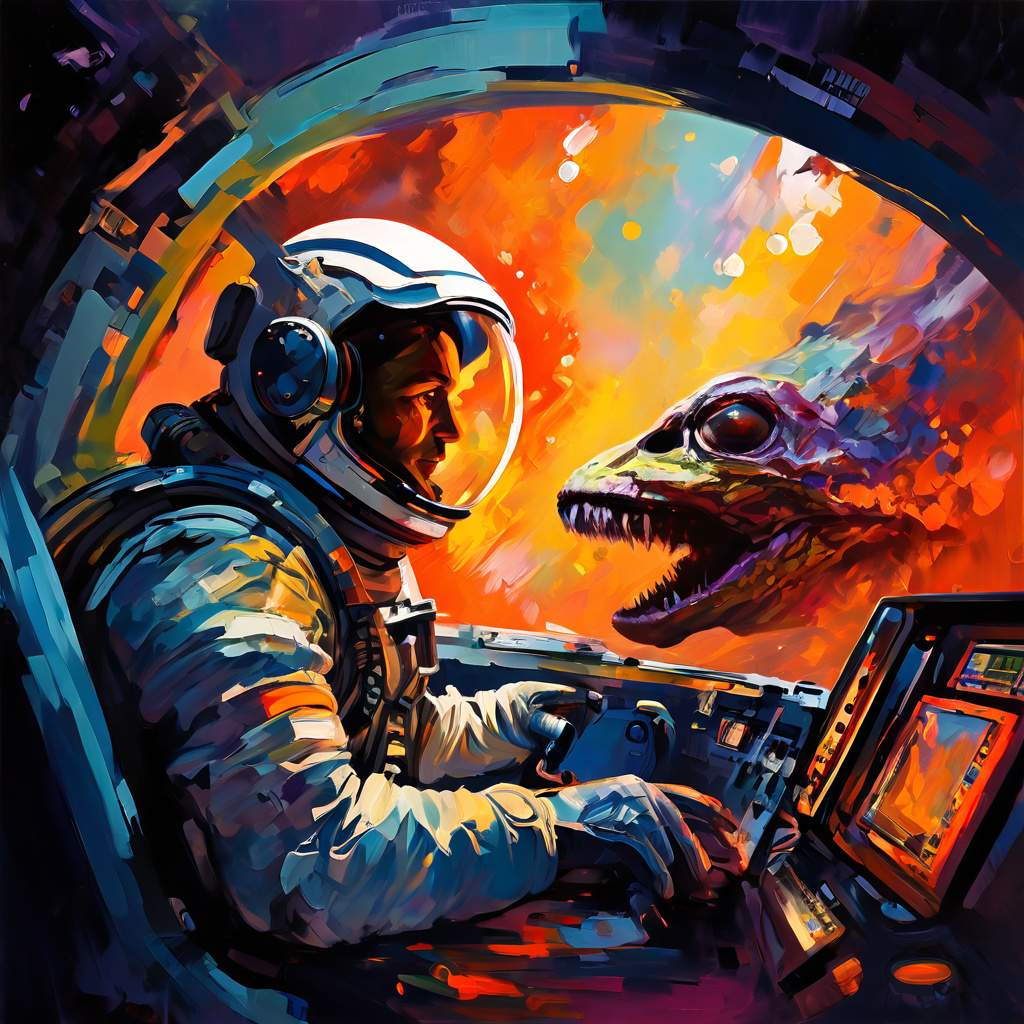
The film’s most charming scientific extrapolation comes in the form of Rocky, the Eridian astronaut voiced by James Ortiz. Unlike the humanoid aliens common in cinema, Rocky resembles a spider made of rock, breathing ammonia in an atmosphere toxic to humans, and navigating without eyes using audio echolocation. This design stems from Weir’s approach to speculative evolution: removing restrictions based on Earth biology.
In recent interviews, Weir explained that he imposed no earthly limitations when developing Rocky. The result is a creature with zero biological overlap with humans—no carbon-based similarity, no water dependence, no visual processing. Rocky possesses a rocky exterior, survives in extreme pressure environments, and represents a genuinely alien biochemistry.
This portrayal aligns with astrobiological theories suggesting that extraterrestrial life would likely diverge radically from terrestrial templates. Scientists searching for life elsewhere in the universe typically look for water and carbon, primarily because those are the conditions we know support life. However, Project Hail Mary argues—correctly, according to many researchers—that life might exploit completely different chemistry, such as ammonia or methane solvents rather than water.
The film also addresses the Fermi Paradox—the question of why we haven’t encountered other civilizations despite the statistical probability of their existence. By establishing that multiple intelligent species evolved simultaneously in nearby stellar neighborhoods (Earth, Eridani, and others), and that all face the same astrophage threat, the narrative provides a logical reason for why Grace and Rocky might encounter each other despite astronomical improbabilities. Both species independently identified Tau Ceti as the sole uninfected system in the region, converging there as the only viable destination for survival.
The Sun’s Lifecycle: Fact vs. Fiction
Regarding the central threat—our dying sun—the film takes significant liberties with stellar physics. While Sol will indeed exhaust its nuclear fuel and expand into a red giant approximately 5 billion years from now, the rapid dimming depicted in the story requires fictional biological intervention. No known organism could consume stellar energy at rates that would noticeably affect a star’s output within human timescales.
However, the film accurately portrays the sun as a relatively youthful star in cosmic terms. At 4.5 billion years, Sol has completed less than half its projected main-sequence lifetime. The astrophage infection serves as a plot accelerator, creating an artificial deadline that forces immediate action rather than waiting for geological ages. This device allows the film to explore genuine stellar mechanics—how stars generate light through fusion, how they eventually transition to white dwarfs, and what happens to planetary environments when solar input decreases—while maintaining dramatic urgency.
What’s After the Movie?
If you’re fascinated by the science behind Project Hail Mary and want to explore more films that blend entertainment with scientific authenticity, What’s After the Movie offers comprehensive coverage of hard science fiction cinema. From detailed explanations of complex plot points to spoiler-free summaries and ending breakdowns, our platform helps you understand the physics, biology, and astronomy behind your favorite space adventures.
Visit What’s After the Movie for complete movie information, or check out our science fiction film collection to discover similar titles. For the latest industry news and scientific accuracy breakdowns of upcoming releases, explore our entertainment blog.
Continue reading




What's After the Movie?
Not sure whether to stay after the credits? Find out!
Check out our other apps:

SAT Sphere
Build confidence for the Digital SAT.

Mori Atlas
Discover wild places worth protecting.

Luntero
Search smarter for a home in Amsterdam.

Plot Explained
Unravel movie endings and hidden clues.

Pokechamp
Dive into Pokémon data and battle logic.

Driving Theory
Get ready for your European theory test.

Movie Dust
Plan your next cinema trip with ease.

Musemap
Find art and culture as you travel.

Selkobase
Compare credentials before committing.

Local Manual
Turn an unfamiliar country into practical next steps.

Lernavi
Compare school systems before your next move.

GymRoam
Find a workout stop wherever your plans take you.
Explore Our Movie Platform
New Movie Releases (2026)
Famous Movie Actors
Top Film Production Studios
Movie Plot Summaries & Endings
Major Movie Awards & Winners
Best Concert Films & Music Documentaries
Movie Collections and Curated Lists
© 2026 What's After the Movie. All rights reserved.
Privacy Policy