What Is Zerograd About?
The premise of Zerograd in 267 words, with nothing given away. The full story follows below.
In a remote Soviet town that feels both familiar and ill‑timed, everyday routines take on an oddly amplified hue. The streets, the factories, and the quiet cafés echo the patterns of a city anyone might recognize, yet each gesture seems to carry an undercurrent of absurdity. The air hums with a faint surrealism, as if the town itself is a mirror tilted just enough to reveal the hidden eccentricities that lie beneath the surface of ordinary existence.
Alexei Varakin, an engineer from Moscow, arrives on what should be a straightforward business trip. Accustomed to the orderly logic of his profession, he finds his expectations unsettled by a place where normal procedures appear both present and strangely detached. The locals— from a poised secretary named Elena to a museum caretaker called Evgeniy— greet him with a calm that masks an inexplicable depth. Their interactions hint at a collective consciousness that quietly questions the very habits they perform.
The town’s mood is a slow‑burn blend of tension and curiosity, where the mundane is rendered uncanny. A local electrician, Aleksandr, offers a glimpse into family life that feels simultaneously intimate and oddly prophetic, while a driver named Anna becomes a conduit through the winding outskirts that seem to resist the notion of departure. Around them, the landscape is littered with relics of history and whispered folklore, each element reinforcing the sense that this place, though rooted in the real, operates on a subtly altered set of rules. The result is an immersive, almost dream‑like tableau that invites Alexei—and the audience—to contemplate how ordinary lives can conceal an unexpected, surreal rhythm.
What Happens in Zerograd?
The complete story of Zerograd, from the first scene to the last, in 603 words (about 3 minutes). Spoilers throughout. Names in the text link to 8 cast member pages.
Spoilers ahead
Alexei Varakin, Leonid Filatov, an engineer from Moscow, travels to a nameless town in the Soviet Union for a routine business trip. On arrival at the factory, his pass is missing, creating immediate friction with the local routine. Inside, the manager’s secretary, Elena Arzhanik, is working naked, yet no one seems surprised by the odd scene. The manager remains unaware of the chief engineer’s death, a detail that will quietly haunt the day’s events.
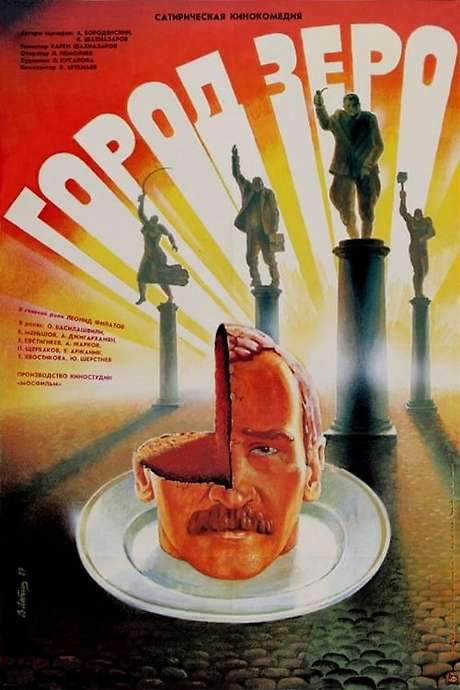
During lunch at an empty restaurant, Alexei is offered a cake shaped like his head—a harmless joke that he refuses. The cook who prepared the cake, however, is deeply upset by the moment and ultimately takes his own life, casting a pall over the town and signaling that not everything here is as it seems.
After giving his statement to the authorities, Alexei tries to depart, but all train tickets are sold out. His growing desperation to return to Moscow is met with indifference, and his pleas go unanswered. A taxi driver redirects him to a remote spot housing an underground local history museum, where the museum’s caretaker, Evgeniy Evstigneev, presents Alexei with a diverse exhibition spanning eras from the Trojans to Romans to Soviet leaders, a surreal survey of human culture that foreshadows the town’s strange currents.
That night, Alexei finds shelter at the home of a local electrician, Aleksandr Bespalyy, whose son Misha confidently proclaims that he will never leave the town, even offering intimate details about Alexei’s life and future plans that feel strikingly prescient. Later, a local driver named Anna, Tatyana Khvostikova, offers to drive him to Perebrodino station for trains bound for Moscow. A black police Volga intercepts them, and the town’s investigator, Aleksei Zharkov, informs Varakin that his biological father was a deceased cook named Nikolayev and reveals that his own name is Mahmud, a startling lineage that unsettles him further.
The town’s prosecutor, Vladimir Menshov, who secretly harbors a desire to commit a crime, confronts Varakin with the truth: what was believed to be a suicide was in fact a premeditated murder. They head to the summer house of poet Vasily Chugunov, Oleg Basilashvili, where he and others come to terms with the past. There, they learn that the cook Nikolayev in town used to be a famous rock ’n’ roll dancer, a detail that reshapes the town’s memory and adds a chilling edge to the narrative. The opening of the Nikolayev Rock ’n’ Roll Fans Club becomes a backdrop for broader political and personal tensions, as prominent locals mingle in the glow of a fragile democracy.
As the night deepens, the prosecutor’s disquiet grows; he attempts to shoot himself with his service weapon, but the gun misfires several times, a moment that blurs the line between intention and failure. A group from the dance party, led by Alexei, heads to the legendary 1,000-year-old oak tree that locals believe grants power to those who dare to cut its branches. The tree itself is dying, yet the crowd still gathers to claim a piece of its legacy, gathering branches as mementos. In a troubling turn, the prosecutor offers Alexei a chance to escape; after fleeing through a forest, he discovers an abandoned boat without oars and decides to ride the current, letting the river carry him toward an uncertain future.
This tale weaves a slow-burn mood of tension and curiosity, anchored by a cast of complex figures who drift between loyalty and self-interest, their fates intertwined through a town that feels both timeless and uneasy. The interplay of memory, ambition, and mortality lingers long after Alexei’s final, improvisational decision at the river’s edge.
Zerograd Timeline: Every Key Event in Order
13 key events in the order they happen, from “Arrival and missing pass at the factory” to “Escape attempt and final drift”. 13 events name a place, across 12 locations.
- 1
Arrival and missing pass at the factory
Alexei Varakin arrives in the nameless Soviet town on a business trip from Moscow to inspect a factory. He discovers the pass he requested is missing, complicating his entry. Inside the factory, the manager's secretary is strikingly naked, and nobody seems to react. The manager himself remains unaware of the chief engineer's death.
When:Day 1 – morning Where:Factory, nameless town
- 2
Lunch, cake offer, and suicide
During a meager lunch at an empty restaurant, a cake shaped like Alexei's head is offered to him, which he declines. The gesture unsettles the cook who made the cake, and her disappointment spirals into an impulsive act. She commits suicide soon after, leaving behind a town that does not question such oddities.
When:Day 1 – afternoon Where:Empty restaurant, nameless town
- 3
Statement to authorities and ticket shortage
After giving his statement to the authorities, Alexei tries to leave town but all train tickets are sold out. Desperation grows as his pleas fall on deaf ears, and the town's officials appear indifferent.
When:Day 1 – late afternoon Where:Police station area, nameless town
- 4
Visit to underground local history museum
A taxi driver takes him to a remote place housing an underground local history museum. The caretaker guides Alexei through a diverse exhibit spanning Trojans, Romans, and Soviet leaders, hinting at a town that clings to grand narratives. The encounter sets a cryptic, thematic tone for Varakin's stay.
When:Day 1 – evening Where:Remote site with local history museum
- 5
Overnight at the electrician's home
Alexei stops overnight at the home of a local electrician. The electrician's son, Misha, confidently predicts that Alexei will never leave the town and speaks with unsettling precision about his life and future plans.
When:Night Where:Local electrician's home
- 6
Escape attempt collides with police interception
Anna, a local driver, offers to drive him to Perebrodino station for Moscow trains. A black police Volga intercepts them, signaling that escape may be blocked. The sense of surveillance deepens as Varakin's options shrink.
When:Late night Where:Road near town
- 7
Revelation of Varakin's lineage
The town's investigator informs Varakin that his biological father was Nikolayev, a deceased cook, and reveals his real name is Mahmud. This revelation binds his identity to hidden town histories and power dynamics.
When:Day 2 – morning Where:Investigator's office
- 8
Prosecutor uncovers a premeditated murder
The town's prosecutor, who secretly harbors a desire to commit a crime, reveals that the supposed suicide was actually a premeditated murder. The finding reframes Varakin's understanding of the town's ethics and raises the stakes for everyone involved.
When:Day 2 – afternoon Where:Prosecutor's office
- 9
Visit to Chugunov's summer house and rock'n'roll past
Alexei and Anna visit the summer house of poet Vasily Chugunov, where they learn Nikolayev used to be a famous rock'n'roll dancer in town. The revelation connects the cook's hidden past to the town's cultural memory, hinting at deeper secrets.
When:Evening Where:Vasily Chugunov's summer house
- 10
Nikolayev Rock'n'Roll Fans Club opening
That evening they attend the opening of the Nikolayev Rock'n'Roll Fans Club, where prominent townspeople are present. Chugunov proclaims the event a triumph for democracy, masking underlying town tensions and political theater.
When:Evening Where:Nikolayev Rock'n'Roll Fans Club venue
Show the other 3 events of Zerograd Hide the last 3 events
- 11
The prosecutor's self-inflicted misfire
During the night, the prosecutor whom Varakin had previously spoken to attempts to shoot himself with his service gun, but the weapon misfires several times. The failed act exposes the volatility and hidden motives within the town's power structures.
When:Night Where:Nikolayev Rock'n'Roll Fans Club venue
- 12
Visit to the ancient oak and souvenir gathering
As night grows, a group from the dance party led by Alexei visits the legendary 1,000-year-old oak tree believed to grant power to those who dare to cut its branches. The tree is dying, but they still collect its branches as souvenirs, pondering power, fate, and memory.
When:Night Where:1,000-year-old oak tree
- 13
Escape attempt and final drift
The prosecutor offers Alexei a chance to escape; after running through a forest, he finds an abandoned boat without oars and climbs in, letting the river's current carry him away. The last act leaves his fate open to the town's currents and secrets.
When:Night to dawn Where:Forest and river
Who Are the Main Characters in Zerograd?
8 characters, among them Николай Иванович Смородинов, прокурор города (Vladimir Menshov), Степан Филиппович Иванов, председатель горисполкома (Pyotr Shcherbakov) and Пал Палыч, директор завода (Armen Dzhigarkhanyan): who each one is and the part they play in the story. 7 of them link to the actor’s page.
- НИ
Николай Иванович Смородинов, прокурор города (Vladimir Menshov)
Played by Vladimir Menshov
A city prosecutor who projects control while nurturing a secret desire to commit a crime. He pieces together the events around the murder, revealing the moral ambiguities at the heart of civic power.
- 🧠 Calculated
- 🗳️ Authority
- 🕵️♂️ Investigative
- СФ
Степан Филиппович Иванов, председатель горисполкома (Pyotr Shcherbakov)
Played by Pyotr Shcherbakov
A powerful local official whose outward democratic rhetoric masks scheming and self-interest. He embodies the town’s political theater and the fragility of public virtue.
- 🎭 Power
- 🕰️ Authority
- ПП
Пал Палыч, директор завода (Armen Dzhigarkhanyan)
Played by Armen Dzhigarkhanyan
Factory director who embodies practical pragmatism and a firm grip on the town’s economy. He influences events through control of work and social networks.
- 🏭 Industrial
- 🧠 Cunning
- ВН
Василий Николаевич Чугунов, председатель писательской организации (Oleg Basilashvili)
Played by Oleg Basilashvili
Poet and organizer with a magnetic presence who navigates the town’s cultural life while hinting at hidden agendas. His words reveal the gap between idealism and reality.
- 🎭 Culture
- 🔍 Insight
- АМ
Алексей Михайлович Варaкин, инженер (Alexei Varakin)
Engineer from Moscow visiting the town on a business trip. He is rational, curious, and increasingly unsettled by his surroundings, driving the plot forward as a reluctant observer.
- 🧭 Traveler
- 🧠 Rational
- АВ
Анна, водитель (Tatiana Khvostikova)
Played by Tatyana Khvostikova
Local driver who offers Alexei a ride; she appears as a practical helper but also a window into the town’s hidden currents and loyalties.
- 🚗 Driver
- 🗺️ Connector
- НС
Нина, секретарша Пал Палыча (Elena Arzhanik)
Played by Elena Arzhanik
Secretary to Pal Palych who embodies the intimate links between the town’s administration and personal lives. She observes the power dynamics from close proximity.
- 🗂️ Clerk
- 👀 Observer
- Л(
Лиза (Olga Konovalova)
Played by Olga Konovalova
A figure with limited screen time who represents the town’s ordinary citizens caught in extraordinary events.
- 👥 Citizen
- 🧊 Witness
Where and When Is Zerograd Set?
Zerograd is set in Nameless Soviet town (Late 1980s, Soviet Union). Here is why the time and place matter to the story.
When
Late 1980s, Soviet Union
Set in the late Soviet era, a period of stagnation and creeping change. Bureaucratic rituals, opaque investigations, and surveillance shape everyday life. The atmosphere breeds paranoia and a sense that truth can be manipulated.
Where
Nameless Soviet town
A nameless industrial town in the Soviet Union centers on a factory, a restaurant, and a hidden history museum. The place feels claustrophobic and performative, where official life masks deeper ambitions and violence. Its streets connect a cast of officials, workers, and dreamers through intrigue and mystery.
- 🏭 Industrial town
- 🗂️ Bureaucratic
- 🎭 Cultural decay
What Are the Themes of Zerograd?
5 ideas the story keeps returning to, among them Bureaucracy, Identity and Culture.
-
01
Bureaucracy
The missing pass, sold-out trains, and opaque investigations illustrate how the system constrains individuals. Characters improvise around rules, exposing how paperwork and procedure can mask power dynamics. The town's inertia becomes a character in itself, driving fear and fatalism.
-
02
Identity
Varakin learns his true origins, including a revelation about his father and name, highlighting the fragility of self-definition. The town's figures perform roles that blur personal and public identities. The search for who he really is collides with a landscape that offers few solid anchors.
-
03
Culture
A diverse cultural stage unfolds: rock'n'roll clubs, a local museum, and artifacts spanning civilizations. These rituals offer a sense of freedom and community, even as they are entangled with power and politics. The contrasts between art, heritage, and state control reveal the tension at the heart of the town.
-
04
Escape
Varakin's attempted departure, sold trains, and the option to take a river journey underscore the universal urge to escape stagnation. The search for a way out is fraught with obstacles and indifference. The possibility of escape acts as a lingering lure throughout the narrative.
-
05
Mortality
Death threads through the story: a cook's suicide and a later revealed murder expose a darker underbelly beneath everyday civility. The town's violence suggests that fate is as present as choice, often tied to places like the dying oak.
What Kind of Film Is Zerograd?
Dark in tone, with slow pacing and a complex story, going by the plot summary.
- Tone
- Dark
- Pacing
- Slow
- Story
- Complex
- Intensity
- Medium
- Ending
- Ambiguous
A slow-burning surrealist journey that immerses the viewer in a world of oppressive bureaucratic absurdity, creating a deeply unsettling and melancholic atmosphere through constant, bizarre encounters.
- bizarre
- oppressive
- dreamlike
- melancholic
- unsettling
- surreal
- surreal bureaucracy
- absurdism
- identity crisis
- political satire
Content notes: suicide, apparent suicide, fake suicide.
Quiz
How well do you remember Zerograd? Test yourself on the story.