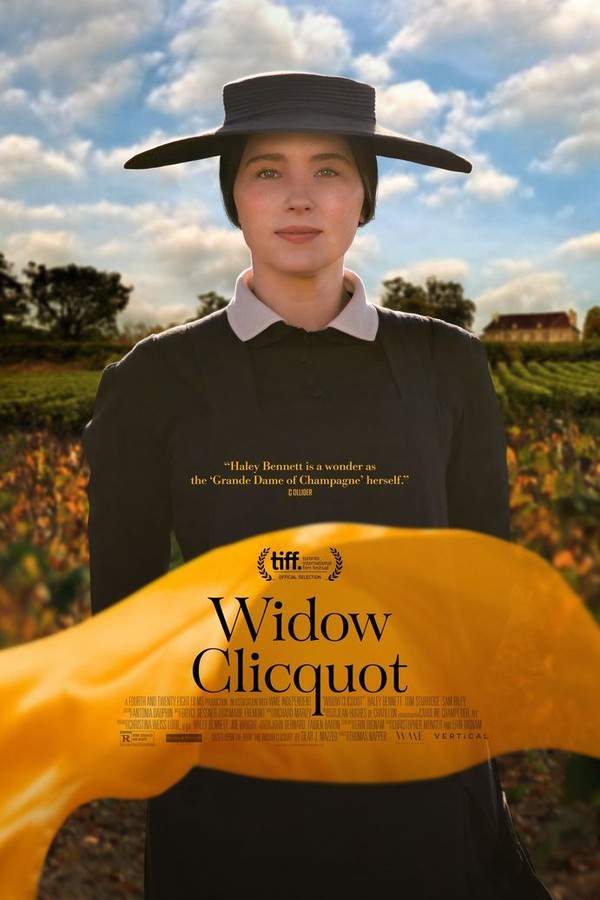
Widow Clicquot 2024


Directed by

Thomas Napper
Made by

Fourth & Twenty Eight Films
Where to Watch Widow Clicquot
See current US streaming, rental, and purchase options for Widow Clicquot (2024) via JustWatch.

Amazon Prime Video
HD
Amazon Prime Video with Ads
HD
The Roku Channel
HD
YouTube Free
HD
Amazon Video
SD
Apple TV Store
4K
Fandango At Home
SD
Google Play Movies
SD
Spectrum On Demand
HD
YouTube
SD Streaming availability powered by 
Widow Clicquot Plot Summary
Read the complete plot summary and ending explained for Widow Clicquot (2024). From turning points to emotional moments, uncover what really happened and why it matters.
In Napoleonic France, Barbe-Nicole Ponsardin Clicquot, Haley Bennett, is widowed by the early death of her husband François, an unsuccessful winemaker. Instead of selling off the vineyards, she resolves to use her own money to revive the flailing winery, determined to honor his memory and keep the lineage intact. She confronts a world that underestimates a woman’s claim to a thriving business, and she refuses to walk away from the land that defined their family.
Her bold vision leads her to adopt unconventional planting techniques, a move that invites skepticism from workers and from her father-in-law Philippe, who doubts whether radical methods can ever yield reliable results. Yet Barbe-Nicole remains steadfast, blending practical grit with a steady flair for experimentation, slowly reshaping the winery’s fate even as the pressures of war and embargoes tighten around them. She envisions a sparkling product that could rewrite their fortunes, and the idea of a pink champagne starts to crystallize in her plans.
The breakthrough comes when the wine gains the attention of the Clicquots’ friend, wine merchant Louis Bohne, Sam Riley. Together, they dream of reaching markets that have long resisted Napoleon’s strict embargoes. Their collaboration becomes a daring partnership, as they work to smuggle the new creation to Amsterdam, hoping to spark demand in a city hungry for novelty and luxury despite the political strain. The venture embodies a defiant optimism, a belief that quality can outpace restrictions.
But the voyage from bottle to market is perilous. The Amsterdam shipment is lost, a devastating setback that tests Barbe-Nicole’s resolve. To keep the winery afloat, she begins selling off personal possessions and shrinking the household to conserve every resource. Yet resilience is a deeply rooted habit by now, and soon Louis finds a path for a portion of the product to reach Russia, where the wine’s sweetness and charm win admirers in a climate far from home. This new frontier proves pivotal, especially as it unfolds in the lead-up to the Great Comet of 1811, a celestial omen that seems to echo the turning tides of the era.
With Napoleon finally exiled, the political chaos loosens its grip on trade and new opportunities emerge. Barbe-Nicole and Louis press their advantage, expanding sales in Russia more earnestly and with greater ambition than before. The wine’s reputation grows, and what began as a stubborn attempt to preserve a family legacy blossoms into a burgeoning business that spans continents and seasons of uncertainty.
Yet success draws scrutiny. Barbe-Nicole’s ascent unsettles many of her male peers, who challenge her authority in a system that has long constrained women from owning or steering a business of such scale. She faces a courtroom trial grounded in a law designed to prevent women from owning enterprises. Her accusers argue that her unwillingness to marry Louis—viewed as the social norm of the time—allows her to continue controlling the business as a widow. In response, Barbe-Nicole delivers a pointed rebuke, defending her autonomy and the merit of her work with a clarity that resonates beyond the courtroom.
Louis publicly declares his devotion, proposing marriage as a personal and professional alliance, but Barbe-Nicole remains resolute in her choice to chart her own path. She rejects the proposal, asserting that her commitment to the winery must stand on its own terms, free from pressure or expectation. The confrontation becomes a defining moment, crystallizing her as a figure who navigates tradition and autonomy with quiet, unwavering authority.
As the narrative moves toward its close, epistolary and card-based epilogues reveal the lasting arc of her decision. Barbe-Nicole never remarries, and the winery endures as a testament to a founder who steered it through crisis and skepticism alike. The story closes with the foreshadowing of a dynasty: the Veuve Clicquot champagne house rises from these early trials to become a lasting emblem of resilience, ingenuity, and a woman’s enduring influence on an industry long shaped by men.
Widow Clicquot Timeline
Follow the complete movie timeline of Widow Clicquot (2024) with every major event in chronological order. Great for understanding complex plots and story progression.
Widowed and refuses to sell vineyards
Barbe-Nicole's husband François dies, leaving her as a widow. She refuses to sell the family vineyards, choosing instead to use her own money to keep the winery from collapsing. Her determination sets the course for the future of Veuve Clicquot.
Funding the winery with her own money
She uses her savings to invest in the flailing business, determined to prove a widow can manage a winery. Workers and her father-in-law Phillipe resist her leadership, challenging her authority. She remains steadfast, treating the venture as her personal mission.
Unconventional planting techniques
She introduces novel planting methods to boost production and quality, pushing through resistance from workers. These changes stabilize the vineyard and set the foundation for future success. Her willingness to experiment marks a turning point for the operation.
Pink champagne and collaboration
She develops a pink champagne that impresses Louis Bohne, a wine merchant. The innovation prompts a collaboration aimed at expanding markets beyond France.
Smuggling to Amsterdam against the embargo
Barbe-Nicole and Bohne attempt to smuggle champagne to Amsterdam in defiance of Napoleon's embargoes. The venture is risky but vital for keeping sales alive. The operation tests her nerve and resolve as a businesswoman.
Lost shipment and financial strain
The shipment to Amsterdam is lost, delivering a devastating blow to Barbe-Nicole. She begins selling off her possessions to keep the winery afloat. The setback underscores the fragility of her enterprise during wartime restrictions.
Russian markets prove the wine’s appeal
Louis manages to get a few bottles to Russia, where the sweet wine proves popular before the Great Comet of 1811. The unexpected demand provides a critical lifeline for the business. Moscow and St. Petersburg become growing hubs for her wine.
Expansion in Russia after Napoleon's exile
After Napoleon's exile, Barbe-Nicole and Bohne seize the opportunity to sell in Russia in earnest. They capitalize on the chaos of the era to broaden distribution. The Russian market becomes central to the winery’s expansion.
Trial for owning a business as a woman
Her rising success unsettles male peers, and she is brought to trial for a law that forbids women from owning businesses. The case tests her authority and threatens the future of the winery. She stands firm in defense of her capabilities.
Accusers claim she must marry to keep ownership
Accusers argue that she refuses to marry Louis Bohne to maintain widow status and keep control of the winery. Barbe-Nicole responds with a forceful defense of her independence and competence. The confrontation highlights gendered expectations of the era.
Louis's proposal and her rejection
Louis publicly proposes to Barbe-Nicole, seeking a formal partnership through marriage. She declines, choosing ongoing autonomy over a traditional union. The moment reinforces her commitment to leading the business on her own terms.
Epilogue and the Veuve Clicquot dynasty
Epilogue cards reveal that Barbe-Nicole never remarried and that the winery eventually evolves into the Veuve Clicquot champagne dynasty. Her legacy endures through the brand she built with grit and vision. The story closes with the enduring success of her modern champagne house.
Widow Clicquot Characters
Explore all characters from Widow Clicquot (2024). Get detailed profiles with their roles, arcs, and key relationships explained.
Barbe-Nicole Ponsardin Clicquot (Haley Bennett)
Widowed after François's untimely death, Barbe-Nicole refuses to sell the vineyards. She invests her own money to revive the winery and leads with unconventional planting techniques. She confronts social and economic resistance, driving the winery toward international fame and innovation.
Louis Bohne (Sam Riley)
A wine merchant and ally who recognizes Barbe-Nicole's talent. He helps develop the pink champagne and partners with her to explore new markets, even as their relationship faces social and professional strain. He is both a business guide and a catalyst for bold moves like cross-border shipments.
François (Tom Sturridge)
Barbe-Nicole's husband, an unsuccessful winemaker whose early death thrusts her into leadership. His absence underscores the transition from traditional family business to Barbe-Nicole's pioneering role. His legacy frames Barbe-Nicole's determination to prove the winery's viability.
Philippe (Ben Miles)
Barbe-Nicole's father-in-law, a traditional figure who resists radical changes. He represents the older generation's skepticism toward a woman leading the business and the family’s social status within the wine trade. His stance highlights the social obstacles Barbe-Nicole must overcome.
Jeanne-Marie Ponsardin (Cara Seymour)
A member of the Ponsardin circle, connected to the family and its business. She embodies the social networks that influence the winery's fortunes and represents the broader household dynamics surrounding Barbe-Nicole.
Nicolas Ponsardin (Christopher Villiers)
A member of the Ponsardin family who appears within the winery's extended network. His role underscores how family ties intersect with business ambitions during the era. He contributes to the decision-making climate around ownership and strategy.
Edouard (Anson Boon)
A younger figure within the circle, possibly a relative or junior operator in the winery. He represents the next generation navigating tradition and modernization. His presence reflects the shifting dynamics of succession in the early 1800s wine trade.
Marie-Catherine Clicquot (Phoebe Nicholls)
A figure within the Clicquot family who interacts with Barbe-Nicole as the winery evolves. She embodies the family's longstanding involvement in the business and the tension between tradition and innovation. Her perspective helps frame the social expectations around female leadership.
Georges (Leo Suter)
A character in the winery's orbit, likely a colleague or worker connected to production and distribution. He participates in the day-to-day operations that sustain the business. His role highlights the collaboration needed to implement new techniques.
Clementine (Cecily Cleeve)
Another member of the social and professional circle around the winery. She contributes to the network of relationships that influence Barbe-Nicole's decisions and the winery's reputation. Clementine's presence adds depth to the domestic and social strands of the story.
Anne (Natasha O'Keeffe)
A figure within the broader community linked to the wine trade and Barbe-Nicole's world. She represents the local voices, patrons, or opponents who intersect with the legal and commercial battles of the era.
Muller (Chris Larkin)
A cast member within the winery's network, contributing to the production or distribution chain. Muller's role underscores the practical expertise required to translate Barbe-Nicole's vision into marketable champagne.
Paquet (Ian Conningham)
A figure within the legal or administrative side of the wine business, possibly a clerk or official connected to trials and regulations. His presence hints at the institutional pressures the winery faces.
The Priest (Joseph Rapp)
A religious figure encountered during trials or social events. The Priest's presence emphasizes the moral and legal scrutiny Barbe-Nicole endures as she navigates ownership and legitimacy of the business.
Magistrate #1 (Mark Tandy)
A magistrate presiding over the trial that challenges Barbe-Nicole's right to own a business as a widow. His conduct frames the legal barriers and gender-based scrutiny she faces.
Magistrate #2 (Antoine Blanquefort)
Another judicial figure involved in the case against Barbe-Nicole. His role reinforces the institutional challenge to female entrepreneurship in the period.
Widow Clicquot Settings
Learn where and when Widow Clicquot (2024) takes place. Explore the film’s settings, era, and how they shape the narrative.
Time period
Early 19th century (Napoleonic era, ca. 1800–1812)
Set during the Napoleonic era, the film captures a time of wartime restriction and shifting markets. It places Barbe-Nicole in a male-dominated society that constrains women's ownership of business, while war and embargo drive risky trade. The timeline touches key moments like the Great Comet of 1811 and the ensuing disorder that opens opportunities for the winery.
Location
Napoleonic France, Amsterdam, Russia
The story unfolds in the Champagne region of northeastern France during the Napoleonic era. It follows the daily life on a winery and the social world that keeps it running, including the rural countryside and the courtship of powerful trade networks. The plot expands to Amsterdam and Russia, reflecting cross-border commerce and smuggling amid embargoes.
Widow Clicquot Themes
Discover the main themes in Widow Clicquot (2024). Analyze the deeper meanings, emotional layers, and social commentary behind the film.
💪
Empowerment
Barbe-Nicole transforms personal loss into a driving force for business. She refuses to surrender the family vineyards and pushes innovative planting methods. Her leadership challenges gender norms and demonstrates resilience in a hostile market.
🚢
Trade & Defiance
The embargo creates a dangerous but lucrative network for smuggling champagne to Amsterdam and later Russia. Barbe-Nicole and Louis navigate legal risks and political pressure to reach new markets. The plot highlights the fragility of war-time commerce and clever logistics.
🏆
Legacy
Barbe-Nicole's success unsettles her male peers and cements a multi-generational wine dynasty. The film emphasizes her choice to remain a widow rather than remarry, preserving control of the business. Epilogue notes the eventual rise of Veuve Clicquot as a lasting champagne empire.

Coming soon on iOS and Android
The Plot Explained Mobile App
From blockbusters to hidden gems — dive into movie stories anytime, anywhere. Save your favorites, discover plots faster, and never miss a twist again.
Sign up to be the first to know when we launch. Your email stays private — always.
Explore the mobile appWidow Clicquot Ending Explained
Unravel the ending of Widow Clicquot (2024) with our detailed explanation. Understand the final scenes, character fates, and unresolved questions.
In the ending of Widow Clicquot, Barbe Nicole stands firm in her identity and her dreams, refusing to bow to societal expectations or the silencing laws of her time. Throughout the story, her journey is one of resilience, where she fights against prejudice and patriarchal controls to keep her late husband’s vineyard alive. When faced with Louis Bohne’s marriage proposal in court, she chooses her independence over societal approval or personal security. Her refusal is not just about rejecting marriage; it’s a declaration of her commitment to her craft, her legacy, and her own sense of self. By saying no, she affirms that her passion and her visions are more valuable than conforming to the expectations of a society that seeks to diminish her. The film ends with her remaining true to her principles, carrying forward her late husband’s dream with pride and integrity, demonstrating that her success was rooted in her authenticity and unwavering dedication. Her story is a powerful testament to the strength and resilience of a woman who refused to be defined by others, and who chose her path despite all the barriers placed before her.
Widow Clicquot Spoiler-Free Summary
Discover the spoiler-free summary of Widow Clicquot (2024). Get a concise overview without any spoilers.
In the twilight of the 18th century, amid the tumult of Napoleonic France, a quiet determination begins to stir in the vineyards of Champagne. The loss of her beloved husband thrusts Barbe‑Nicole Ponsardin into a world where the clink of crystal glasses masks rigid expectations, and the rolling hills echo with the whispers of an industry dominated by men. The film opens with the estate’s fragrant rows of grapes, the soft hum of laborers, and a society poised on the brink of both political and cultural upheaval, setting a stage that feels both grand and intimate.
Confronted with the sudden responsibility of a faltering winery, Barbe‑Nicole refuses to surrender the legacy she inherited. Her fierce resolve is matched only by a daring willingness to experiment—reimagining planting methods, challenging tradition, and envisioning a future where her family’s name could flow from bottle to banquet. The narrative paints her as a figure both of her time and ahead of it, navigating the delicate balance between honor, grief, and an unyielding entrepreneurial spirit.
Along her journey, she encounters allies who recognize the sparkle of her vision. Among them is a savvy wine merchant, Louis Bohne, whose friendship hints at a partnership forged in shared ambition rather than convenience. Their interactions are laced with wit and subtle mutual respect, offering glimpses of how collaboration can become a catalyst for innovation when society’s doors remain stubbornly closed.
The tone remains a graceful blend of historical richness and quiet rebellion, inviting viewers to feel the effervescent tension between constraint and creativity. As the curtains rise on Barbe‑Nicole’s world, the audience is left with a lingering curiosity about how far a single, resilient widow will press against the barriers of her era, and what legacy she might pour into the glass of history.
Movies with Similar Twists and Themes
Uncover films that echo the narrative beats, emotional arcs, or dramatic twists of the one you're exploring. These recommendations are handpicked based on story depth, thematic resonance, and spoiler-worthy moments — perfect for fans who crave more of the same intrigue.

Featured on this page

What's After the Movie?
Not sure whether to stay after the credits? Find out!
Check out our other apps:

SAT Sphere
Build confidence for the Digital SAT.

Mori Atlas
Discover wild places worth protecting.

Luntero
Search smarter for a home in Amsterdam.

Plot Explained
Unravel movie endings and hidden clues.

Pokechamp
Dive into Pokémon data and battle logic.

Driving Theory
Get ready for your European theory test.

Movie Dust
Plan your next cinema trip with ease.

Musemap
Find art and culture as you travel.

Selkobase
Compare credentials before committing.

Local Manual
Turn an unfamiliar country into practical next steps.

Lernavi
Compare school systems before your next move.

GymRoam
Find a workout stop wherever your plans take you.
Explore Our Movie Platform
New Movie Releases (2026)
Famous Movie Actors
Top Film Production Studios
Movie Plot Summaries & Endings
Major Movie Awards & Winners
Best Concert Films & Music Documentaries
Movie Collections and Curated Lists
© 2026 What's After the Movie. All rights reserved.
Privacy Policy