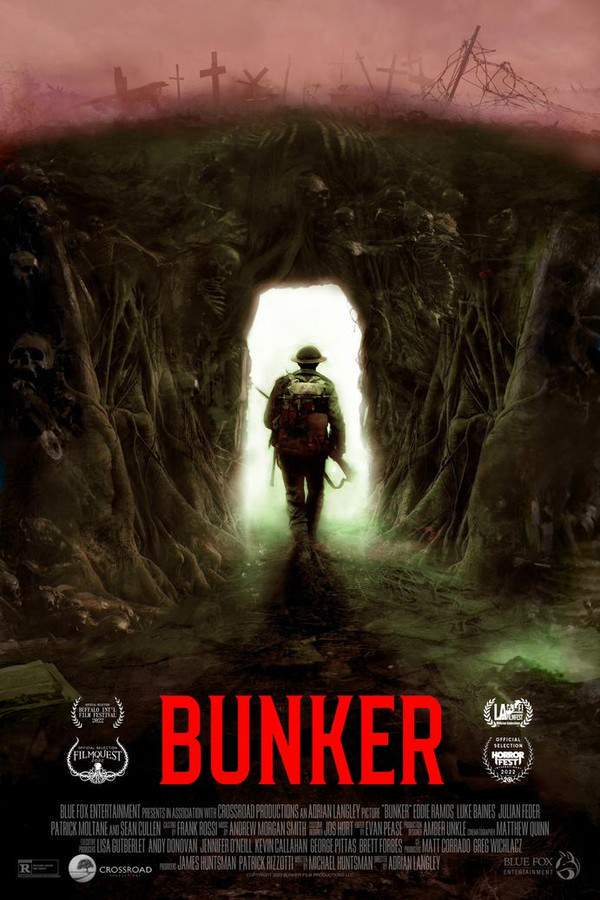
What Is The Bunker About?
The premise of The Bunker in 351 words, with nothing given away. The full story follows below.
In the bleak winter of 1944, a detachment of German soldiers finds itself holed up on the desolate Belgian‑German frontier. After a fierce clash with advancing American forces, the men retreat to an abandoned concrete stronghold, a bunker that promises temporary safety but quickly reveals its own claustrophobic mysteries. The thin line between enemy fire and the unforgiving cold is punctuated by the faint echo of distant artillery, while the surrounding landscape—scarred fields, ruined villages, and a lingering memory of centuries‑old plague—infuses the setting with a lingering sense of dread.
The core of the story revolves around a small, weary cohort forced to confront both the external threat of war and the internal pressure of survival. Sergeant Theobald Heydrich, the seasoned non‑commissioned officer, carries the weight of command and the expectations of his men. Lieutenant Krupp represents the uneasy bridge between orders and practicality, while Corporal Otto Schenke pushes the group toward uneasy curiosity. Among the enlisted, Private Heinrich Mirus offers a quiet, almost obsessive knowledge of the bunker’s history, and Private Michael Neumann provides a steadier, more measured perspective. Their interactions are a study in hierarchy, duty, and the thin veneer of camaraderie that holds them together as supplies dwindle.
Beneath the bunker, a maze of forgotten tunnels stretches into darkness, hinting at forgotten wars and buried secrets. The mere presence of these passages fuels a growing unease, as faint sounds and shifting shadows suggest that the environment may be as hostile as any opponent. The film’s tone balances stark wartime realism with a creeping, almost supernatural tension, allowing the soldiers’ fear and desperation to echo through the stone corridors. The interplay of relentless artillery, dwindling ammunition, and the oppressive underground world creates a pressure cooker atmosphere that tests each man’s resolve and sanity.
Against this stark backdrop, the narrative sets the stage for an examination of what happens when the line between external combat and inner terror blurs. The characters are poised on the edge of a profound psychological ordeal, their fates intertwined with the unforgiving landscape and the mysterious depths that lie just beyond the bunker’s iron doors.
What Happens in The Bunker?
The complete story of The Bunker, from the first scene to the last, in 686 words (about 3 minutes). Spoilers throughout. Names in the text link to 3 cast member pages.
Spoilers ahead
In late 1944, the remnants of a Panzergrenadiers platoon are caught in an ambush by American troops. As they retreat, Private Hugo Engels Nicholas Hamnett is killed, and the platoon discovers a bunker occupied by Privates Heinrich Mirus John Carlisle and Michael Neumann Andrew Lee Potts who have orders to defend it. Corporal Otto Schenke [Andrew Tiernan] confronts Sergeant Theobald Heydrich [Christopher Fairbank] about not counter-attacking. Mirus relates the history of the area, where victims of the Black Plague were massacred on the orders of a stranger who influenced the townspeople to turn against one another.
During the night, tunnels are discovered beneath the bunker. Corporal Schenke [Andrew Tiernan] wants to explore them but Lieutenant Krupp [Simon Kunz] refuses. Mirus sneaks into the tunnels and a curious Private First Class Wolfgang Kreuzmann [Eddie Marsan] follows him. When they are discovered missing, Krupp believes they’ve deserted and orders a pursuit. Neumann is caught and reveals that Mirus had been using the tunnels as private property for several weeks while concealing his specific activities in them. Corporal Bruno Baumann [Jason Flemyng] discovers plans for the complex while Corporal Tobias Ebert [Jack Davenport] finds a warning sign. Ebert also discovers a mine shaft where he is attacked from behind by a silhouetted figure resembling Kreuzmann.
Baumann concludes there are Americans in the tunnels, and uses a generator to turn lights on in the complex. Krupp asks Mirus to explain the mysterious activities but is interrupted by machine gun fire in the bunker. Rejoining the platoon, they discover they had been firing at nothing. Cut phone lines convince them Americans are in the tunnels. The platoon splits up and searches the complex. Mirus reveals his belief that his dead son is talking to him about the tunnels. Schenke and Krupp’s search discovers Ebert’s body. Another group discovers a mass grave and Kreuzmann is found catatonic and incoherent. Kreuzmann breaks away from the group and runs into Krupp and Schenke as they continue their exploration. Startled, Schenke and Krupp shoot him dead, in the process creating a collapse that kills Krupp.
The gunfire alerts Neumann who enters the tunnel and, running from a shadowy figure, joins Schenke. Mirus attempts to run away and becomes tangled in barbed wire. When Heydrich, Baumann and Helmut Franke try to blow the bunker door with a stick grenade, Schenke and Neumann mistake the noise for an American assault. They set the fuse to a demolition charge to blow the ammunition up and keep it from the Americans.
Heydrich, Baumann and Franke’s attempt to open the door fails. While searching for another exit they meet Schenke and Neumann who open fire thinking the trio are Americans. The three are driven back after running out of ammunition. Neumann fires at the trio while Schenke kills Franke and then threatens Neumann. The ammunition detonates and Heydrich, Baumann and Neumann flee with Schenke firing at them. The trio find the main exit blocked, try to escape through the mine shaft, and fire at an approaching figure. When Heydrich shoots Schenke with his flare pistol, he bursts into flames. Neumann manages to break through the wall of the mass grave with his entrenching tool and into open air. Heydrich is stabbed by Schenke who survived the fire, and Baumann assaults Schenke with bare hands. Heydrich is killed during the altercation and Baumann escapes with Neumann, throwing a grenade into the grave with Schenke where it explodes.
Corporal Baumann gives Neumann permission to surrender to the Americans and he sets off, finding Mirus’ body in the barbed wire. When he sees American soldiers, he waves a handkerchief to surrender.
The film cuts to a flashback in which Baumann’s squad is marching through a field on a sunny day, coming upon a group of deserters about to be executed. Baumann is asked to participate in the firing party. Baumann shoots at a man who is praying, and misses before hitting him twice. An officer delivers the coup de grace and the firing party pose for photographs with the executed man.
Baumann’s flashback ends and he staggers off to surrender to the Americans.
The Bunker Timeline: Every Key Event in Order
15 key events in the order they happen, from “Ambush and bunker discovery” to “Surrender and discovery of Mirus' body”. 15 events name a place, across 13 locations.
- 1
Ambush and bunker discovery
Late 1944: The remnants of a Panzergrenadier platoon are ambushed by American troops as they retreat toward cover. Private Hugo Engels is killed in the assault. They reach a bunker where they discover Privates Heinrich Mirus and Michael Neumann prepared to defend it.
When:Late 1944 Where:Battlefield exterior / bunker entrance
- 2
Night tunnels found and pursuit ordered
Night falls as tunnels are found beneath the bunker. Corporal Schenke wants to explore, but Krupp refuses. Mirus slips into the tunnels, followed by Kreuzmann, and when they are discovered missing, Krupp orders the platoon to pursue them.
When:Night, late 1944 Where:Bunker tunnel access
- 3
Neumann captured; Mirus's tunnel activity exposed
Neumann is caught in the tunnels and reveals that Mirus had been using the tunnel network as private property for weeks, concealing his activities. The revelation unsettles the command and casts doubt on the true purpose of the tunnel complex. Tension rises as the platoon realizes the intrusion may be deeper than simple incursions.
When:Night, late 1944 Where:Tunnels beneath the bunker
- 4
Plans and warning signs found
Corporal Bruno Baumann discovers plans for the tunnel complex, while Corporal Tobias Ebert finds a warning sign. The documents hint at a broadly organized network and possible American presence. The men grow more anxious as the scale of the installation becomes clear.
When:Night, late 1944 Where:Bunker / tunnel entrance
- 5
Ebert attacked in the mine shaft
Inside a mine shaft, Ebert is attacked from behind by a silhouette resembling Kreuzmann. He is gravely wounded, heightening paranoia about who else might be lurking in the tunnels. Krupp orders more cautious exploration.
When:Night, late 1944 Where:Mine shaft
- 6
Lights reveal Americans in the tunnels
Baumann concludes there are Americans in the tunnels and uses a generator to turn the lights on in the complex. The illumination reveals more of the labyrinth and confirms intruders may be close. The men brace for further conflict.
When:Night, late 1944 Where:Tunnel network
- 7
Bunker tensions and cut communications
Krupp asks Mirus to explain the mysterious activities but is interrupted by machine gun fire in the bunker. Rejoining the platoon, they discover they had been firing at nothing. Cut phone lines convince them Americans are in the tunnels.
When:Night, late 1944 Where:Bunker and tunnel access
- 8
Platoon splits to search the complex
The platoon splits up to search the complex, spreading through the tunnel network. The tension mounts as every corridor could hide an enemy. Leadership struggles to maintain control while the men press deeper.
When:Night, late 1944 Where:Tunnel network
- 9
Mirus's haunting belief about his son
Mirus reveals his belief that his dead son is talking to him about the tunnels. The confession deepens the eerie atmosphere and adds a personal dimension to the danger below. His fixation raises questions about reliability amid the stress.
When:Night, late 1944 Where:Tunnels
- 10
Ebert's body found in the tunnels
Schenke and Krupp’s search discovers Ebert's body, confirming that there have been casualties inside the tunnels. The grim discovery heightens the urgency of the mission and the stakes for everyone involved. The group steels themselves for further confrontations.
When:Night, late 1944 Where:Tunnel network
Show the other 5 events of The Bunker Hide the last 5 events
- 11
Mass grave and Kreuzmann’s condition
Another search group discovers a mass grave, and Kreuzmann is found catatonic and incoherent. The macabre discovery hints at past atrocities in the area and worsens the claustrophobic tension. The soldiers brace for the unknown threats still lurking.
When:Night, late 1944 Where:Mass grave site, tunnels
- 12
Kreuzmann dies and Krupp is killed by collapse
Kreuzmann breaks away and encounters Krupp and Schenke; Schenke shoots Kreuzmann dead, and a collapse follows from the gunfire, killing Krupp. The tunnel instability compounds the danger as the unit fights to maintain a path to the surface. The loss tightens the noose around the remaining soldiers.
When:Night, late 1944 Where:Tunnel intersection / collapse zone
- 13
Grenade attempt to breach the bunker
Heydrich, Baumann, and Franke attempt to blow the bunker door with a stick grenade. Schenke and Neumann mistake the noise for an American attack and prepare to defend the position. They set a demolition charge to ruin the ammunition stockpile and prevent a breach.
When:Night, late 1944 Where:Bunker door area
- 14
Final confrontation in the mass grave area
In the final confrontation, Heydrich fires a flare pistol at Schenke, who survives the blaze and stabs Heydrich in the ensuing struggle. Baumann and Neumann escape with a violent exchange against Schenke, and a grenade is thrown into the grave, resulting in Schenke’s demise.
When:Night, late 1944 Where:Mass grave / bunker interior
- 15
Surrender and discovery of Mirus' body
Baumann gives Neumann permission to surrender to the Americans; Neumann sets off and discovers Mirus's body entangled in barbed wire. He waves a handkerchief to surrender when he encounters the American soldiers. The encounter marks the end of the tunnel ordeal for the survivors.
When:Late 1944 Where:Barbed wire perimeter / surface
Who Are the Main Characters in The Bunker?
10 characters, among them Pfc Wolfgang Kreuzmann (Eddie Marsan), Cpl Bruno Baumann (Jason Flemyng) and Sgt Theobald Heydrich (Christopher Fairbank): who each one is and the part they play in the story. Every profile links to the actor’s page.
-

Pfc Wolfgang Kreuzmann (Eddie Marsan)
Played by Eddie Marsan
A curious Private First Class who follows Mirus into the tunnels, his presence heightening tension as the group questions intruder motives. His restlessness under pressure exposes the fragility of discipline in confinement. In the claustrophobic tunnels, his behavior amplifies fear and accelerates the conflict. He embodies the survival instinct pushing characters toward risky choices.
- 🪖 Soldier
- 🕵️ Suspicion
-

Cpl Bruno Baumann (Jason Flemyng)
Played by Jason Flemyng
A pragmatic, authoritative corporal who leads under pressure and uncovers plans for the bunker. His practical mindset clashes with fear-driven impulses, highlighting the tension between duty and humanity. Baumann’s violent past revealed in a flashback underscores the moral costs of obedience. He ultimately escapes with Neumann, illustrating the harsh calculus of war survival.
- 🪖 Soldier
- ⚖️ Morality
-

Sgt Theobald Heydrich (Christopher Fairbank)
Played by Christopher Fairbank
An experienced sergeant attempting to maintain order and strategy as chaos erupts. His attempts to coordinate and lead reveal a brittle trust under siege, with decisive actions carrying deadly consequences. He becomes a casualty of the bunker’s escalating danger, illustrating how leadership is tested and broken by war.
- 🪖 Soldier
- 🧭 Leadership
- LT
LCpl Tobias Ebert (Jack Davenport)
Played by Jack Davenport
A keen-eyed corporal who detects warning signs and uncovers the mine shaft, contributing to the investigation of the bunker’s hidden history. His discoveries heighten the tension and push the group toward a deadly confrontation. Ebert embodies the vigilant, by-the-book soldier whose findings reveal the depth of danger within.
- 🪖 Soldier
- 🧭 Investigation
-

Lt. Krupp (Simon Kunz)
Played by Simon Kunz
A cautious officer who resists unnecessary counter-attacks and questions perilous orders. His measured restraint contrasts with others’ impulsiveness, highlighting the clash between strategic caution and panic.
- 🪖 Officer
- 🧠 Discipline
- CS
Cpl Schenke (Andrew Tiernan)
Played by Andrew Tiernan
An aggressive corporal who pushes into the tunnels, triggering violent confrontations. His brutality toward Franke and Neumann escalates the siege, and his survival through the early chaos leads to a final escalation and violent demise in the explosion.
- 🪖 Soldier
- ⚔️ Aggression
- PM
Pvt Michael Neumann (Andrew-Lee Potts)
Played by Andrew Lee Potts
A private caught between orders and fear, finding himself in a morally fraught struggle to survive. He participates in dangerous choices and ultimately seeks a fragile escape, reflecting the personal cost of wartime survival.
- 🪖 Soldier
- 🧭 Survival
- PM
Pvt Mirus (John Carlisle)
Played by John Carlisle
An elder private whose memories bleed into the present, recounting a history of massacre tied to the area. His insistence on listening to the past grounds the bunker in its haunted history and colors the group’s actions with a sense of doom.
- 🪖 Soldier
- 🧠 Memory
- PE
Pvt Engels (Nicholas Hamnett)
Played by Nicholas Hamnett
A private observer within the tense bunker dynamics, bearing witness to escalating violence and shifting loyalties. His presence marks the slow erosion of trust under siege.
- 🪖 Soldier
- 🕵️ Observation
- C(
Corporal (Unnamed) (Peter McNeil-O'Connor)
Played by Peter McNeil O'Connor
A corporal representing the chain of command during the siege; his actions reflect how leadership endures and falters under wartime pressure. His role underscores the strain on authority when fear and conflict erupt.
- 🪖 Soldier
- 🔀 Authority
Where and When Is The Bunker Set?
The Bunker is set in Bunker complex and tunnels, German-occupied Europe (Late 1944). Here is why the time and place matter to the story.
When
Late 1944
Set in the waning months of World War II, German Panzergrenadiers are attempting a withdrawal while American forces press the pursuit. The bunker and its tunnels become the focal point of a high-stakes standoff, reflecting the fatigue and desperation of late-war Europe. The tense chronology highlights the urgency and dwindling options that define this period.
Where
Bunker complex and tunnels, German-occupied Europe
The action unfolds inside a cramped German bunker and its network of tunnels beneath a field. The concrete structure, shuttered entrances, and hidden passages create a claustrophobic battlefield beyond the surface. As the group discovers a mine shaft and a mass grave, the environment becomes a living part of the danger and mystery surrounding the siege.
- 🔒 Underground
- 🕳️ Tunnels
- 🪖 War Zone
What Are the Themes of The Bunker?
4 ideas the story keeps returning to, among them War and Guilt, Haunted Past and Paranoia and Illusion.
-
01
War and Guilt
The narrative probes how soldiers commit violence under orders and bear the moral weight afterward. An execution memory from Baumann’s past reveals the dehumanizing rituals of war and the lingering burden of those actions. As the characters confront what they’ve done, the bunker becomes a stage for moral reckoning under pressure.
-
02
Haunted Past
The area's dark history—massacre, plague-era violence, and manipulated loyalties—haunts the present as characters move through the tunnels. A dead son and eerie memories blur the line between memory and madness, showing how history can follow the living. Past crimes shape present choices and fears, intensifying the danger.
-
03
Paranoia and Illusion
Fear distorts perception inside the confined bunker, turning noises and shadows into threats. The discovery of tunnels and hidden signs fuels mistrust, making friends seem foes and foes seem inevitable. In such a claustrophobic setting, reality becomes fragile and danger feels omnipresent.
-
04
Survival and Moral Choice
Desperation pushes characters toward brutal, quick decisions as they fight for control and escape. The tension between duty, loyalty, and self-preservation drives the actions that define who survives. Surrender, evasion, or confrontation each carries a heavy moral price, underscoring the cost of war.
What Kind of Film Is The Bunker?
Dark in tone, with steady pacing and a moderate story, going by the plot summary.
- Tone
- Dark
- Pacing
- Steady
- Story
- Moderate
- Intensity
- High
- Ending
- Bleak
A relentlessly grim and claustrophobic descent into madness, where the psychological terror of an unseen threat proves more deadly than the war raging above ground, culminating in a bleak and fatalistic conclusion.
- claustrophobic
- paranoid
- oppressive
- grim
- desperate
- unsettling
- war survival
- psychological horror
- sanity unraveling
- brotherhood strained
Content notes: war violence, graphic death, mass graves, psychological trauma, execution, claustrophobic settings.
Quiz
How well do you remember The Bunker? Test yourself on the story.