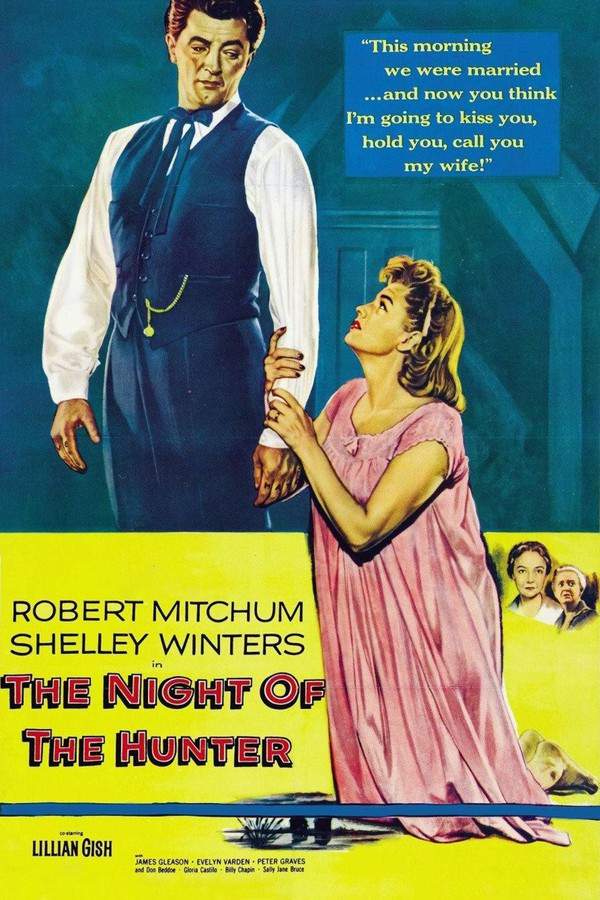
The Night of the Hunter 1955


Directed by

Terry Sanders
Made by

United Artists
Where to Watch The Night of the Hunter
See current US streaming, rental, and purchase options for The Night of the Hunter (1955) via JustWatch.

Criterion Channel
HD
fuboTV
HD
MGM Plus
HD
MGM Plus Roku Premium Channel
HD
MGM+ Amazon Channel
HD
Philo
HD
Fawesome
HD
Kanopy
HD
Tubi TV
SD
YouTube Free
HD
Apple TV Store
HD
Fandango At Home
HD
Google Play Movies
SD
Spectrum On Demand
HD
YouTube
SD Streaming availability powered by 
The Night of the Hunter Plot Summary
Read the complete plot summary and ending explained for The Night of the Hunter (1955). From turning points to emotional moments, uncover what really happened and why it matters.
Night of the Hunter begins with a cosmic panorama, where Rachel Cooper (Lillian Gish) narrates an intricate Southern Gothic tale to a group of children, imparting essential life lessons about the fleeting joys of childhood and the lurking menaces of “wolves in sheep’s clothing.” As we plunge into the story, John (Billy Chapin) and his younger sister Pearl (Sally Jane Bruce) engage in a game of hide and seek around their homestead. A playful hunt leads them to the secrets hidden in their surroundings, including a chilling encounter with the sinister Reverend Harry Powell (Robert Mitchum), who is driving a stolen Model-T while fervently conversing with the Lord about his mission to rid the world of its wickedness—particularly targeting “vain women” who ensnare men with their allure.
As the Reverend observes the women in a local peep show, revealing the tattoos that spell “LOVE” and “HATE” across his knuckles, we are drawn into his twisted psyche. His violent tendencies emerge as he faces the law for car theft, merely delaying his sinister pursuits with a thirty-day sentence at Moundsville Penitentiary.
Simultaneously, Ben Harper (Peter Graves), the father of John and Pearl, is embroiled in his own harrowing predicaments. In a desperate bid for survival, he returns home clutching a fortune of stolen money, hastily concealed before the police arrive to arrest him. As he implores John to watch over Pearl and safeguard their father’s secret, tension is palpable in the air. Ben’s fate is sealed as he is tried and condemned to death for murder, ultimately imprisoned with Powell, who learns of Ben’s hidden treasure.
As the situation unfolds, children in the town cruelly chant a hangman’s song, tormenting John and Pearl further. Despite the threatening atmosphere surrounding them, John displays a courageous resolve to protect his sister’s innocence, even as temptations beckon. The harrowing experience intensifies when Willa (Shelley Winters), their mother, becomes an unwitting pawn in Powell’s malicious scheme, unaware of the true nature of her new husband’s intentions.
Under the veil of night, Powell infiltrates their lives, showcasing a façade of charm and religion while gradually revealing his monstrous nature. He seeks to control the children, using psychological manipulation and physical threats. Desperation mounts as Willa’s trust in her new husband begins to fray, leading to a nightmarish confrontation that culminates in a shocking act of violence.
As the film progresses, the children navigate an increasingly hostile world, attempting to evade the sinister Reverend Powell while seeking refuge on Uncle Birdie’s boat. The tension comes to a head as Powell relentlessly pursues them, with Rachel Cooper, a guardian of lost souls, emerging as a beacon of hope. Rachel has taken in numerous abandoned children, including Ruby, who grapples with her infatuation with the dangerous preacher, unknowingly drawing parallels between her tumultuous emotions and the children’s plight.
This heart-pounding chase leads to a final confrontation as Rachel, armed and protective, stands up against Reverend Powell’s manipulative facade. The climactic scenes are painted with raw emotional depth, showcasing John’s struggle against the echoes of his childhood amidst the threat posed by evil cloaked in piety. The standoff, a poignant duel of wills, illustrates the characters’ harrowing journeys towards safety and redemption.
Ultimately, as Icey leads a vengeful mob against Powell, John’s internal conflict solidifies, revealing the scars left by fear and trauma. The film presents a haunting exploration of innocence lost, the corrosive effects of manipulation, and the profound resilience of children, leaving viewers to grapple with the lingering specter of dread that accompanies the battle between light and darkness in a world rife with deception.
The Night of the Hunter Timeline
Follow the complete movie timeline of The Night of the Hunter (1955) with every major event in chronological order. Great for understanding complex plots and story progression.
Introduction of Rachel Cooper
The film opens in the stars with Rachel Cooper narrating a Southern Gothic parable to the audience. She emphasizes the importance of childhood and warns of the dangers posed by deceptive individuals, commonly referred to as 'wolves in sheep's clothing.' This sets the tone for the impending threats the children will face.
Children Playing Hide and Seek
Several children play hide and seek near a farmhouse, enjoying the simplicity of childhood. One child discovers a hidden cellar, but as he opens the door, he is met with a sinister sight—a young woman's twisted legs at the top of the stairs, foreshadowing darker events to come.
Reverend Powell's Arrival
Reverend Harry Powell drives a stolen Model-T and believes he is on a divine mission to punish wicked individuals. His disturbing nature is revealed as he sneers in disdain at a peep show and is soon arrested for car robbery, leading to a thirty-day sentence in Moundsville Penitentiary.
Ben Harper's Desperation
In a frantic moment, Ben Harper, the father of John and Pearl, returns home clutching stolen money amounting to $10,000. He implores young John to protect his sister Pearl and never reveal the money's location as the police close in on their home, leading to his ultimate arrest.
Ben Harper's Trial
Ben Harper is tried for murder and sentenced to be hanged. While incarcerated, he meets Reverend Powell, who learns about Ben's hidden fortune. Powell begins to plot how to marry Ben's widow and seize the money for himself, which he perceives as his opportunity from the Lord.
Children's Fear and Resilience
John and Pearl are taunted by other children at school, who sing a dark hangman's song. John tries to shield Pearl from the grim reality, showing maturity beyond his years as he resists the temptation to spend the money they have.
Reverend Powell's Manipulation
During a town picnic, Reverend Powell deceives Willa, John's mother, claiming he knows the whereabouts of the stolen money. John becomes increasingly wary of Powell, suspicious of his intentions and how he manipulates the adults around him.
Willa's Descent into Madness
Powell's sinister influence over Willa becomes apparent as she fervently leads a revival meeting, convinced of Powell's righteousness. However, she is simultaneously manipulated into a state of delusion regarding the safety of her family.
Tragic Turn of Events
As tensions escalate, Willa overhears Powell's threatening tactics toward John and Pearl regarding the hidden money. Unfortunately, her hopes of a happy family life shatter when Powell brutally murders her, leading to a profound moment of loss for the children.
Uncovering the Truth
The morning after Willa's death, Reverend Powell feigns innocence, claiming she has run away. However, the reality is revealed as Uncle Birdie discovers Willa's body submerged in a car, highlighting Powell's true nature and the danger he poses.
Children's Escape
After hiding from Powell, John and Pearl attempt to escape by boat down the river. As they navigate under the crescent moon and evade Powell's relentless pursuit, they find a fleeting moment of peace in their resilience against their threats.
Rachel Cooper's Intervention
John and Pearl encounter Rachel Cooper, a woman dedicated to caring for abandoned children. Rachel becomes their protector, confronting Powell when he attempts to reclaim the children. Her strong stance provides a sense of security in the face of danger.
Confrontation with the Law
As Reverend Powell faces arrest following Rachel's confrontation, John struggles with conflicting emotions about the justice system. His refusal to point out Powell as Willa's murderer reveals his deep-seated sense of fear and loyalty to his family.
Final Showdown
In a tense culmination, Reverend Powell attempts to intimidate Rachel and the children, but she stands firm, illustrating the battle between good and evil. As he is finally apprehended, the children's escape from his grasp signals a new beginning for their lives.
The Aftermath
In the closing moments, John and Pearl are shown as safe and free from Powell’s menace. They signify hope for the future, suggesting that the trauma they've endured will not define them, as they slowly begin to heal and move on from their tragic past.
The Night of the Hunter Characters
Explore all characters from The Night of the Hunter (1955). Get detailed profiles with their roles, arcs, and key relationships explained.
Reverend Harry Powell (Robert Mitchum)
Reverend Harry Powell is a manipulative and sinister figure who embodies the film's theme of good versus evil. With his charismatic yet menacing demeanor, he exudes a false sense of righteousness while pursuing selfish and violent motives. His obsession with control and dominance reveals the depths of his depravity, making him a formidable and unforgettable antagonist.
Rachel Cooper (Lillian Gish)
Rachel Cooper is a compassionate and protective figure, embodying maternal instincts in the face of danger. She represents hope and resilience, providing a refuge for John and Pearl amidst the chaos arising from Powell's malevolence. Her strength and determination highlight the contrasting themes of innocence and the need for safeguarding vulnerable children.
John Harper (Billy Chapin)
John Harper is a brave and resourceful boy, thrust into a precarious situation as his family is targeted by evil. He embodies the theme of childhood innocence, often caught between wanting to protect his sister and confronting the terrifying Reverend Powell. His struggles reflect the loss of innocence and the harsh realities children may face when adults fail to safeguard them.
Willa Harper (Shelley Winters)
Willa Harper is a complex character, reflecting desperation and vulnerability as she seeks love and approval. Caught in Powell's web of manipulation, her struggle symbolizes the dangers of misplaced affections. Her tragic fate reveals the consequences of naivety in the face of evil, serving as a cautionary tale for both children and adults.
The Night of the Hunter Settings
Learn where and when The Night of the Hunter (1955) takes place. Explore the film’s settings, era, and how they shape the narrative.
Time period
Depression Era
The events of the movie are set during the Great Depression, a time marked by economic hardship and social struggles in America. Families often faced dire circumstances, leading to desperate measures. The stark realities of life during this period underscore the themes of survival and moral conflict depicted in the film.
Location
Southern town, farmhouse, river, Uncle Birdie's houseboat, Cooper's ranch
The movie takes place in a Southern town characterized by its rural landscape and a central farmhouse where much of the drama unfolds. The river serves as a critical setting for both escape and confrontation. Uncle Birdie's houseboat represents a refuge from the dangers posed by Reverend Powell, while Cooper's ranch signifies a hope for safety and community.
The Night of the Hunter Themes
Discover the main themes in The Night of the Hunter (1955). Analyze the deeper meanings, emotional layers, and social commentary behind the film.
🖤
Good vs. Evil
The battle between good and evil is central to the story, embodied in the character of Reverend Powell, who presents a façade of righteousness while harboring malevolent intentions. The children, particularly John, represent innocence and the fight to protect their family against dark influences. The juxtaposition of Powell's tattoos 'LOVE' and 'HATE' further emphasizes this moral struggle.
👶
Childhood Innocence
The film places a strong emphasis on the fragility of childhood innocence, showcasing how young characters navigate threats from adult malevolence. Through the bond between John and Pearl, the film highlights the need for protection and the inherent dangers posed by a corrupt society. This theme is represented through their imaginative games and moments of joyful play, sharply contrasted against their dire circumstances.
🔪
Manipulation
Reverend Powell's character is a textbook representation of manipulation, as he exploits the trust of those around him to achieve his sinister goals. The film portrays the impact of his deceit on Willa and the children, delving into themes of vulnerability and the consequences of misplaced trust. This manipulation leads to tragic outcomes, forcing the children into a fight for their survival.

Coming soon on iOS and Android
The Plot Explained Mobile App
From blockbusters to hidden gems — dive into movie stories anytime, anywhere. Save your favorites, discover plots faster, and never miss a twist again.
Sign up to be the first to know when we launch. Your email stays private — always.
Explore the mobile appThe Night of the Hunter Spoiler-Free Summary
Discover the spoiler-free summary of The Night of the Hunter (1955). Get a concise overview without any spoilers.
In a sun‑bleached Southern town where the cotton fields stretch into the horizon and church bells echo over quiet backroads, the world feels both intimate and unsettling. The film swaths its story in a hushed, lyrical atmosphere that mixes the warmth of small‑town life with the looming shadows of hidden sins. Light filters through lace curtains, yet a constant sense of watchful eyes hints that innocence can be fragile in a place where appearances often conceal deeper darkness.
The central figure is a charismatic yet unsettling man of the cloth, introduced as Reverend Harry Powell. Recently freed from prison, his veneer of piety masks a compulsive drive to uncover a stash of cash tied to a recent execution. He presents himself as a beacon of righteousness, skillfully weaving sermons and smiles together, while an undercurrent of calculation guides his every step. His presence introduces a tension between faith and manipulation, setting the tone for a story that probes how evil can masquerade as virtue.
At the heart of the narrative are a grieving widow, Willa, and her two young children, John and Pearl. Willa carries the quiet strength of a mother trying to rebuild a shattered life, while her children embody the raw, unguarded wonder of childhood—always playing, always listening, always trusting. Their modest home becomes a fragile sanctuary, a place where love and fear coexist, and where the arrival of an enigmatic outsider begins to unsettle the fragile peace they have carved out.
The film lingers on the uneasy dance between light and shadow, exploring how ordinary people navigate threats that wear holy robes. It hints at a looming confrontation without spelling it out, inviting the audience to wonder whether the gentle rhythm of family life can withstand the invasive curiosity of a man who sees salvation in control. As the story unfolds, the mood remains taut, the visuals striking, and the question of who truly holds the moral high ground lingers long after the last hymn fades.
Movies with Similar Twists and Themes
Uncover films that echo the narrative beats, emotional arcs, or dramatic twists of the one you're exploring. These recommendations are handpicked based on story depth, thematic resonance, and spoiler-worthy moments — perfect for fans who crave more of the same intrigue.




Featured on this page

What's After the Movie?
Not sure whether to stay after the credits? Find out!
Check out our other apps:

SAT Sphere
Build confidence for the Digital SAT.

Mori Atlas
Discover wild places worth protecting.

Luntero
Search smarter for a home in Amsterdam.

Plot Explained
Unravel movie endings and hidden clues.

Pokechamp
Dive into Pokémon data and battle logic.

Driving Theory
Get ready for your European theory test.

Movie Dust
Plan your next cinema trip with ease.

Musemap
Find art and culture as you travel.

Selkobase
Compare credentials before committing.

Local Manual
Turn an unfamiliar country into practical next steps.

Lernavi
Compare school systems before your next move.

GymRoam
Find a workout stop wherever your plans take you.
Explore Our Movie Platform
New Movie Releases (2026)
Famous Movie Actors
Top Film Production Studios
Movie Plot Summaries & Endings
Major Movie Awards & Winners
Best Concert Films & Music Documentaries
Movie Collections and Curated Lists
© 2026 What's After the Movie. All rights reserved.
Privacy Policy