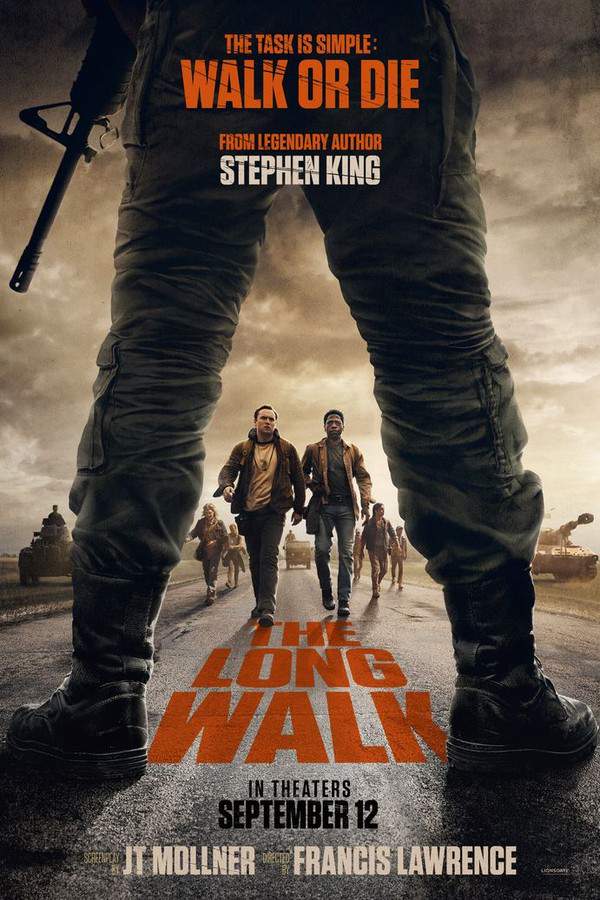
The Long Walk 2025


Directed by

Francis Lawrence
Made by

Lionsgate
Where to Watch The Long Walk
See current US streaming, rental, and purchase options for The Long Walk (2025) via JustWatch.

HBO Max
HD
HBO Max Amazon Channel
HD
Starz Apple TV channel
HD
Amazon Video
4K
Apple TV Store
4K
Fandango At Home
4K
FlixFling
HD
Google Play Movies
SD
Plex
HD
YouTube
SD Streaming availability powered by 
The Long Walk Plot Summary
Read the complete plot summary and ending explained for The Long Walk (2025). From turning points to emotional moments, uncover what really happened and why it matters.
The film, expanded into a feature, reimagines Montgomery, Alabama in 1955 at the heart of the Montgomery bus boycott. It follows Odessa Cotter, a Black woman who works as a maid for Miriam Thompson, and together with her family, they navigate the harsh realities of poverty, racism, segregation, and the threat of violence that marked the era. The bus boycott reshapes daily life, and the Black community increasingly relies on long walks and stubborn endurance as they challenge a system designed to keep them in their place.
Miriam Thompson, moved by Odessa’s struggle, offers to give her a ride two days a week, hoping to make Odessa’s commute more reliable and less exhausting. Around the city, informal carpools begin to form and new support networks emerge, yet most residents still must walk to work, confronting fatigue and curiosity from a society watching every move. The act of sharing a ride becomes more than convenience; it signals a collective resilience growing beneath the surface.
As the boycott drags on, tensions mount in Montgomery. The bus system, heavily used by Black riders, faces financial strain as the community holds firm to its stand. Miriam’s decision to help Odessa becomes a flashpoint within her own household and among white neighbors and influential figures who want the boycott to end. She confronts a difficult choice between immediate social and personal comfort and the larger moral imperative she senses in the struggle for equal rights.
After a heated confrontation, Miriam chooses to follow her conscience and broaden her commitment. She joins a carpool network intended to assist other Black workers, turning a personal gesture into a broader act of solidarity. In the film’s closing moments, Miriam and her daughter Mary Catherine join Odessa and the other protesters in a public demonstration, a powerful image of unity against oppression.
The narrative underscores how ordinary acts—sharing rides, forming carpools, and standing together—can ripple through a community and contribute to a larger movement for dignity and equality. It emphasizes memory, intergenerational perspectives, and the courage of everyday people who push against a segregated status quo, painting a nuanced, human portrait of a pivotal moment in civil rights history.
The Long Walk Timeline
Follow the complete movie timeline of The Long Walk (2025) with every major event in chronological order. Great for understanding complex plots and story progression.
Odessa's daily walk amid the boycott
In Montgomery, Alabama, 1955, Odessa Cotter begins her day as a maid, navigating long walks to work as the city-wide bus boycott disrupts the usual commute. The boycott forces Black residents to forgo convenient transit and endure extended travel times. This routine exposes her to fatigue and the risks of walking in a segregated South.
Miriam offers Odessa rides twice a week
Miriam Thompson offers to give Odessa a ride two days a week to ensure she gets to work on time and to reduce the fatigue of the long walk. The small act of kindness bridges the gap between employer and employee within a segregated society. This gesture sets off a chain reaction as more residents notice and discuss rides.
Informal carpools begin forming
Around Montgomery, informal carpools and other passenger networks begin to form to keep Black workers moving. The community takes initiative to offset the loss of the city buses during the boycott. These informal arrangements become a lifeline for many families.
Bus system finances strained by boycott
With Black riders now the majority on the city-owned buses, the bus system suffers financially, signaling the boycott's economic pressure against segregation. Public debate intensifies as leaders and residents react to the system's strain. Odessa and her neighbors witness how collective action translates into real consequences.
Pressure to end the boycott rises
Norman Thompson, Miriam's husband, and other prominent white residents push to end the boycott, arguing that it harms the community and destabilizes life in Montgomery. Tensions rise as Miriam grapples with pressure from home and from friends who favor a quick return to the old order. The conflict places Miriam at a crossroads between right action and social expectations.
Daily dangers and perseverance
The film shows daily dangers faced by Black residents—poverty, racism, segregation, and occasional violence—amid the ongoing protest. The boycott becomes personal, shaping every interaction on the street and in the workplace. Odessa remains determined to persevere for the cause.
Confrontation with Norman
An argument between Miriam and Norman reveals the gulf between her family's private comfort and the public protest she has begun to support. She weighs the cost of sticking with Odessa against the fear of backlash. The confrontation marks a turning point in her stance.
Miriam chooses to stand with Odessa
Miriam decides to follow her heart and stand by Odessa, choosing to support the carpool idea and the broader effort. She accepts the risk of opposition from her husband and his allies in order to do what she believes is right. This personal commitment signals the shift from passive sympathy to active involvement.
Organizing a carpool group
Miriam becomes deeply involved in organizing a carpool group to help other Black workers like Odessa. The effort expands beyond a single ride to a community-wide transportation solution. This civic action demonstrates how ordinary citizens mobilize to challenge segregation.
Carpool networks sustain the boycott
As the carpool network grows, Black residents sustain transportation amid resistance, reinforcing solidarity and resilience. The collaboration keeps workers moving and reinforces the boycott's shared purpose. The movement continues to press for dignity and equality in Montgomery.
Final scene: unity against oppression
In the film's final scene, Miriam and her daughter Mary Catherine join Odessa and the other protesters, standing together against oppression. Mary Catherine, the story's narrator, frames the events in flashback to reveal how far they've come. The image of unity underscores the lasting message of courage and collective action.
Ending message: resilience and hope
The film closes with a sense of ongoing struggle and hope, showing that ordinary acts of resistance can challenge systemic injustice. It emphasizes dignity, community, and the belief that change is possible through sustained solidarity.
The Long Walk Characters
Explore all characters from The Long Walk (2025). Get detailed profiles with their roles, arcs, and key relationships explained.
Odessa Cotter (Whoopi Goldberg)
A Black maid and mother who endures long walks to her job as the bus boycott disrupts daily life. She experiences racism and poverty firsthand, and her quiet resilience anchors the community's struggle for dignity.
Miriam Thompson (Sissy Spacek)
A white woman who offers Odessa a ride two days a week and later joins a carpool to aid Black workers. She faces social pressure from her husband and the white community and must choose between tradition and justice.
Norman Thompson (Dwight Schultz)
Miriam's husband who wants the boycott to end and resists the growing protest. He embodies the pressure from white society to preserve the status quo.
Mary Catherine (Lexi Randall)
Narrator of the story in flashbacks; her perspective frames the events and the movement. Her narration offers a generational lens on the struggle for equality.
The Long Walk Settings
Learn where and when The Long Walk (2025) takes place. Explore the film’s settings, era, and how they shape the narrative.
Time period
1955
The film is set in 1955 Montgomery, a focal point of the civil rights movement. Segregation under Jim Crow laws frames everyday life as Black residents organize a nonviolent bus boycott. The period is marked by courage, fear, and a shared sense of purpose as ordinary people challenge an unjust system.
Location
Montgomery, Alabama, United States
Montgomery, Alabama, during the 1955 bus boycott, is a city shaped by segregation and the daily struggle of Black residents. The city-owned buses symbolize oppression as the boycott unfolds. To cope with the disruption, many Black workers must walk long distances or rely on informal carpools as the community fights for dignity.
The Long Walk Themes
Discover the main themes in The Long Walk (2025). Analyze the deeper meanings, emotional layers, and social commentary behind the film.
✊
Civil Rights
The movie centers on a nonviolent protest against segregation, showing how ordinary people organize, endure intimidation, and demand dignity. It explores moral choices under pressure and the power of collective action to challenge unjust laws. Odessa and Miriam's actions illustrate how individual courage contributes to a broader movement.
🤝
Solidarity
Communities cross racial lines to support workers who rely on the buses. Carpooling and mutual aid grow from necessity into political solidarity against oppression. The film shows relationships becoming engines of social change when people choose to help each other.
💸
Economic Pressure
The boycott strains the city's finances as Black riders stop using the buses. White leaders face pressure from business and society to end segregation. The financial consequences reveal how economic leverage can drive political reform.
🗽
Courage
Characters confront fear and risk their jobs, safety, and reputations to do what is right. The narrative emphasizes personal bravery and a steadfast resolve against oppression. Small acts of resistance accumulate into a broader movement.

Coming soon on iOS and Android
The Plot Explained Mobile App
From blockbusters to hidden gems — dive into movie stories anytime, anywhere. Save your favorites, discover plots faster, and never miss a twist again.
Sign up to be the first to know when we launch. Your email stays private — always.
Explore the mobile appThe Long Walk Ending Explained
Unravel the ending of The Long Walk (2025) with our detailed explanation. Understand the final scenes, character fates, and unresolved questions.
When the endless march finally narrows to two, Peter McVries and Ray Garraty become each other’s only lifeline. McVries, who has repeatedly pulled Garraty back from collapse, finally decides to give up, dropping to the ground and letting the soldiers fire. Instead of letting his friend die, Garraty drags McVries to his feet and, in a heartbreaking reversal, chooses to end his own walk. At that moment the gunfire stops and only McVries remains standing.
With the last step taken, McVries inherits the prize that the competition promises—a single wish from the authoritarian Major. The loss of Garraty shatters the fragile moral compass that had guided McVries throughout the ordeal, and in a flash of rage he uses the wish not to escape but to exact vengeance, demanding a weapon and killing the Major who embodies the ruthless regime.
The film’s conclusion diverges sharply from Stephen King’s original novel, where Garraty survives, driven onward by a mysterious dark figure, and the story ends on a more existential, if still bleak, note. The cinematic version replaces that ambiguous triumph with a stark, revenge‑filled finale, placing the “winner” in a far darker place than the writer intended.
Ultimately, the ending underscores the story’s core question: can a person retain their humanity after being forced to watch friends fall one by one? McVries’s survival comes not with redemption but with a broken spirit and a thirst for retribution, suggesting that the true cost of the walk is the loss of the self‑same kindness that kept the contestants moving at all.
The Long Walk Spoiler-Free Summary
Discover the spoiler-free summary of The Long Walk (2025). Get a concise overview without any spoilers.
In Montgomery, Alabama, 1955, the city pulses with quiet tension as the Black community stages a historic boycott against the segregated bus system. The streets are alive with countless feet shuffling between homes and workplaces, each step a quiet act of resistance against entrenched racism. The film captures this era with a blend of stark realism and an almost cinematic reverence for the everyday endurance required to survive under such oppression, inviting the audience to feel the weight of each measured footfall.
Odessa Cotter is a resilient African‑American woman who supports her family by working as a maid and nanny for a white household. Her days are defined by the long walks she must take to and from work, a routine that becomes both a physical trial and a symbolic march through a society that forces her to navigate invisible barriers. Her quiet strength is reflected in the rhythm of her steps, hinting at an inner resolve that fuels her persistence despite the daily grind of poverty, segregation, and the ever‑present threat of violence.
Miriam Thompson belongs to the white family for whom Odessa works, living comfortably yet increasingly aware of the injustice surrounding her. When she offers Odessa a ride a few times a week, the gesture becomes a subtle yet potent challenge to the status quo, placing her at the crossroads of personal conscience and the expectations of her husband, Norman Thompson, and their social circle. The tension in her home mirrors the city’s growing unrest, suggesting that even small acts of kindness can ripple outward, questioning long‑held beliefs.
The story is narrated through the eyes of Mary Catherine, the young daughter who observes these quiet acts of courage and conflict. Her perspective adds an intimate, almost nostalgic layer to the narrative, turning the collective struggle into a personal memory. The film’s tone remains intensely immersive, urging viewers to contemplate how far anyone might go when survival itself hinges on the simple act of continuing to walk.
Movies with Similar Twists and Themes
Uncover films that echo the narrative beats, emotional arcs, or dramatic twists of the one you're exploring. These recommendations are handpicked based on story depth, thematic resonance, and spoiler-worthy moments — perfect for fans who crave more of the same intrigue.






Featured on this page

What's After the Movie?
Not sure whether to stay after the credits? Find out!
Check out our other apps:

SAT Sphere
Build confidence for the Digital SAT.

Mori Atlas
Discover wild places worth protecting.

Luntero
Search smarter for a home in Amsterdam.

Plot Explained
Unravel movie endings and hidden clues.

Pokechamp
Dive into Pokémon data and battle logic.

Driving Theory
Get ready for your European theory test.

Movie Dust
Plan your next cinema trip with ease.

Musemap
Find art and culture as you travel.

Selkobase
Compare credentials before committing.

Local Manual
Turn an unfamiliar country into practical next steps.

Lernavi
Compare school systems before your next move.

GymRoam
Find a workout stop wherever your plans take you.
Explore Our Movie Platform
New Movie Releases (2026)
Famous Movie Actors
Top Film Production Studios
Movie Plot Summaries & Endings
Major Movie Awards & Winners
Best Concert Films & Music Documentaries
Movie Collections and Curated Lists
© 2026 What's After the Movie. All rights reserved.
Privacy Policy