What Is The B-Side: Elsa Dorfman's Portrait Photography About?
The premise of The B-Side: Elsa Dorfman's Portrait Photography in 332 words, with nothing given away. The full story follows below.
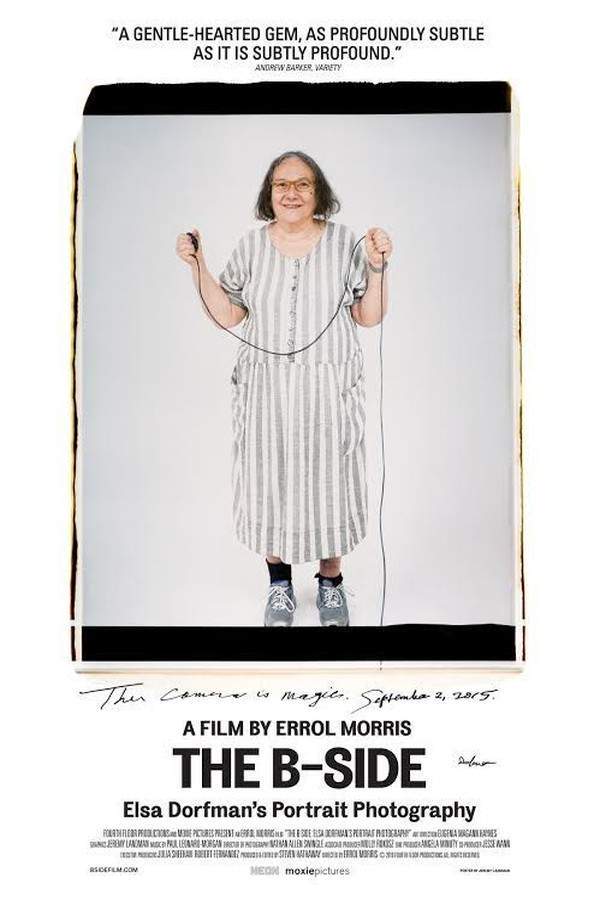
This documentary offers an intimate window into the life and craft of Elsa Dorfman, a portrait photographer whose career spans half a century. Now on the cusp of retirement, she lovingly sorts through decades of work, inviting viewers into the world she built — one luminous, oversized photograph at a time. The film captures the quiet rhythms of a woman reflecting on an extraordinary artistic journey, surrounded by the tangible evidence of countless encounters preserved on film.
At the heart of Dorfman’s story is her singular relationship with the Polaroid Land 20x24 camera, a rare and unwieldy instrument that became her signature medium. She was one of only a handful of photographers ever to use it, and the film traces how this remarkable technology shaped her artistic vision. Her subjects range widely — Cambridge locals, celebrated musicians, Harvard students, and fellow artists — each photographed with a warmth and presence that feels distinctly her own. The large-format Polaroid demands a slower, more deliberate pace of collaboration, lending its portraits an unusual intimacy and immediacy that smaller cameras cannot replicate.
The documentary draws viewers into the warm, lived-in space of Dorfman’s home studio, where stacks of photographs and shelves of memories coexist. Her narration carries the unhurried cadence of someone who has learned to see people deeply over decades, weaving together reflections on art, identity, and the fleeting nature of the relationships that shaped her. She speaks with affection about the creative circles she moved through, the literary and cultural figures who became friends, and the simple joys of family life that grounded her practice.
A thoughtful and affectionate portrait, the film lingers on the textures of a working artist’s home and the irreplaceable quality of analog photography in a digital age. More than a chronicle of technique or biography, it becomes a meditation on what it means to witness and preserve other people’s lives — and on the quiet grace of someone finally pausing to consider the full scope of her own.
What Happens in The B-Side: Elsa Dorfman's Portrait Photography?
The complete story of The B-Side: Elsa Dorfman's Portrait Photography, from the first scene to the last, in 385 words (about 2 minutes). Spoilers throughout. Names in the text link to 1 cast member page.
Spoilers ahead
Following her transition into retirement, the renowned photographer Elsa Dorfman provides an intimate and loving showcase of her extensive body of work, spanning a distinguished fifty-year career. Throughout the film, she reflects on her artistic journey, sharing a blend of personal anecdotes and professional milestones while detailing the core motivations that drove her creative vision.
The narrative unfolds in a loose chronological sequence, beginning with Elsa Dorfman presenting her earliest explorations in black and white photography. She recalls the formative period of her life when she moved to New York City to secure a position at Grove Press. It was during this vibrant era that she first became acquainted with the influential Beat writers, most notably Allen Ginsberg. Following this period, she describes her move back to Massachusetts to pursue a career in elementary education. It was here, through an introduction by a photographer assigned to work with her, that she discovered her true passion for the art of photography.
As her career progressed into the 1970s, her portfolio grew to include portraits of legendary figures and intellectuals, such as:
- Andrew Wylie and Victor Bockris
- Anaïs Nin and W. H. Auden
- Andrea Dworkin, Ed Sanders, and Gail Mazur
- Audre Lorde and Anne Sexton
A significant turning point in her work occurred in 1980 with the release of the 20x24 Large Format Polaroid. The film captures her genuine excitement regarding this technology, featuring footage of her utilizing one of only five such cameras available for rent. She proudly reveals the very first image she captured with this massive format: a striking portrait of Allen Ginsberg accompanied by an amaryllis.
As she navigates through other photographs taken with the 20x24 Polaroid, she delves into the deeply personal memories tied to each frame. This includes poignant imagery of her parents, her husband, and her son, as well as her lifelong bond with Ginsberg. She reflects with solemnity on the passing of her parents and Ginsberg, while contrasting those losses with more lighthearted recollections of her past birthdays.
The film concludes with her discussing the eventual decline and closure of the Polaroid company, examining how the loss of her preferred medium affected her work. Through these reflections, the film successfully conveys her profound artistic motivations and her deep technical understanding of the photographic mediums that defined her life’s work.
The B-Side: Elsa Dorfman's Portrait Photography Timeline: Every Key Event in Order
15 key events in the order they happen, from “Early Black and White Work” to “Retirement and Retrospective”. 4 events name a place, across 2 locations.
- 1
Early Black and White Work
Elsa Dorfman begins her retrospective by presenting her earliest black and white photographs, offering a look at the beginnings of her craft. These early images lay the foundation for what would become a fifty-year career in photography.
- 2
Moving to New York City
Dorfman recalls relocating to New York City to work for Grove Press, the influential publishing house. The job placed her at the center of the city's vibrant literary scene during a formative period of her life.
Where:New York City
- 3
Meeting the Beat Writers
While working at Grove Press, Dorfman became acquainted with the Beat writers, most notably Allen Ginsberg. These encounters proved pivotal, as Ginsberg would later become one of her most enduring subjects and a lifelong friend.
Where:New York City
- 4
Returning to Massachusetts
Dorfman moved back to Massachusetts, where she took a job teaching elementary school. The new chapter gave her a steady profession while she remained connected to the literary circles she had met in New York.
Where:Massachusetts
- 5
Introduction to Photography
During her time teaching, a photographer assigned to work with her introduced Dorfman to photography. This encounter sparked the passion that would come to define the rest of her life and career.
Where:Massachusetts
- 6
Photographing Literary Icons
By the 1970s, Dorfman had built an impressive roster of subjects, photographing figures such as Anaïs Nin, W. H. Auden, Andrea Dworkin, Ed Sanders, Gail Mazur, Audre Lorde, and Anne Sexton. Her portfolio also included Andrew Wylie and Victor Bockris. This period established her place within the artistic and literary circles she had long been part of.
When:1970s
- 7
The 20x24 Polaroid Arrives
In 1980, the 20x24 Large Format Polaroid was released, and Dorfman describes her overwhelming excitement about the new medium. The enormous prints offered her a scale and detail she had never been able to achieve before.
When:1980
- 8
Renting the Rare Camera
Dorfman was eventually able to rent a 20x24 Polaroid camera, one of only five in existence. Access to the massive machine became central to her photographic practice from that point onward.
- 9
The First 20x24 Photograph
Dorfman shows the first photo she ever took on the 20x24 Polaroid: a portrait of Allen Ginsberg with an amaryllis. The image marks the beginning of her deep creative relationship with the large-format medium.
- 10
Family Portraits on the 20x24
Over the years, Dorfman used the 20x24 camera to photograph her parents, her husband, and her son. These large-format portraits capture the people closest to her with striking intimacy and remain among her most personal works.
Show the other 5 events of The B-Side: Elsa Dorfman's Portrait Photography Hide the last 5 events
- 11
Remembering Past Birthdays
Dorfman fondly recalls lighthearted memories of her past birthdays, many of which were captured on film. These joyful recollections bring warmth and humor to her reflection on a life lived behind and in front of the camera.
- 12
The Loss of Her Parents
Dorfman reflects on the deaths of her parents, one of the most profound losses of her life. Her photographs of them take on even greater meaning as cherished memories preserved on film.
- 13
The Death of Allen Ginsberg
Dorfman mourns the death of Allen Ginsberg, her longtime subject and dear friend. His passing marked the end of a decades-long personal and creative bond that had shaped so much of her work.
- 14
Polaroid Goes Out of Business
Dorfman describes the impact of Polaroid going out of business, which threatened access to the medium at the heart of her art. The collapse of the company fundamentally changed her ability to continue her beloved large-format work.
- 15
Retirement and Retrospective
Following her retirement, Dorfman lovingly showcases her photographic works spanning her fifty-year career. Through personal and professional anecdotes, she shares her artistic motivations and her lasting understanding of her photographic mediums.
Who Are the Main Characters in The B-Side: Elsa Dorfman's Portrait Photography?
2 characters, among them Elsa Dorfman and Allen Ginsberg: who each one is and the part they play in the story. 1 of them link to the actor’s page.
- ED
Elsa Dorfman
Played by Elsa Dorfman
Elsa Dorfman is a passionate and reflective photographer whose career spans several decades. Known for her emotional depth and intimate portraits, she conveys her artistic vision through personal stories and pivotal moments in her life. As she transitions to retirement, Elsa provides insights into her motivations and the legacy of her craft.
- 📷 Photographer
- 👩🎨 Artist
- AG
Allen Ginsberg
Allen Ginsberg was a prominent Beat writer and a significant influence on Elsa's work. Their deep bond is reflected in her portraits, which capture not only his likeness but also the essence of their shared experiences. Ginsberg's literary contributions and artistic collaboration with Elsa are pivotal to the narrative of her photography journey.
- ✍️ Poet
- 🖋️ Influencer
Where and When Is The B-Side: Elsa Dorfman's Portrait Photography Set?
The B-Side: Elsa Dorfman's Portrait Photography is set in New York City and Massachusetts (1950s - 1980s). Here is why the time and place matter to the story.
When
1950s - 1980s
The film spans the latter half of the 20th century, a dynamic period marked by significant cultural shifts and artistic movements. This era saw the rise of influential literary figures and the evolution of photography technology, such as the introduction of the 20x24 Polaroid camera, which transformed Elsa's approach to capturing portraits.
Where
New York City, Massachusetts
New York City is a vibrant hub of culture and creativity, known for its influence on art and literature. Here, Elsa Dorfman first encountered iconic Beat writers, which significantly shaped her artistic journey. Massachusetts, where she returned to pursue education, became a nurturing ground for her photography passion.
- 🌆 City
- 🏡 Home
What Are the Themes of The B-Side: Elsa Dorfman's Portrait Photography?
3 ideas the story keeps returning to, among them Artistic Journey, Memory and Loss and Technological Change.
-
01
Artistic Journey
The theme of artistic journey runs throughout the film, as Elsa reflects on her evolution from novice to renowned photographer. Her experiences capture the triumphs and tribulations of pursuing one's passion, showcasing how personal and professional milestones intertwine. Ultimately, it highlights the impact of creative exploration on individual identity.
-
02
Memory and Loss
Memory and loss are deeply woven into Elsa's narrative, as she shares personal anecdotes tied to her family and friends. Through her photographs, she immortalizes her relationships, evoking a poignant sense of nostalgia. This theme underscores the emotional weight that art carries, serving both as a tribute to those lost and a celebration of cherished moments.
-
03
Technological Change
Technological change is a significant theme, as the film charts the transition from traditional photography to the innovative use of large-format Polaroid. Elsa's excitement about new technology reflects the broader shifts in the art world, showing how tools can transform creative expression. The eventual decline of Polaroid serves as a reminder of the transient nature of artistic mediums.
What Kind of Film Is The B-Side: Elsa Dorfman's Portrait Photography?
Bittersweet in tone, with slow pacing and a straightforward story, going by the plot summary.
- Tone
- Bittersweet
- Pacing
- Slow
- Story
- Straightforward
- Intensity
- Low
- Ending
- Bittersweet
A gentle, reflective documentary that lingers across half a century of Polaroid portraits, weaving warmth and quiet loss as an artist reviews her life's work and a fading era.
- nostalgic
- reflective
- gentle
- wistful
- contemplative
- intimate
- photography
- memory and nostalgia
- retirement
- artistic legacy
Content notes: death of family members.
Quiz
How well do you remember The B-Side: Elsa Dorfman's Portrait Photography? Test yourself on the story.