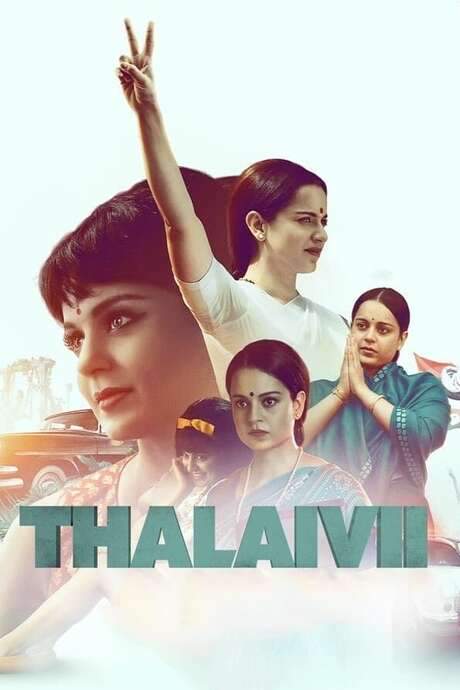
Thalaivii 2021


Directed by

A. L. Vijay
Made by

Karma Media and Entertainment
Where to Watch Thalaivii
See current US streaming, rental, and purchase options for Thalaivii (2021) via JustWatch.







Thalaivii Plot Summary
Read the complete plot summary and ending explained for Thalaivii (2021). From turning points to emotional moments, uncover what really happened and why it matters.
This biographical drama traces the life of Jaya, a determined public figure who rises from the shadows of cinema to lead Tamil Nadu’s political landscape. The narrative unfolds through two interwoven arcs that span decades, offering a nuanced portrait of ambition, public service, personal sacrifice, and the weight of public perception. On one hand, the film revisits the late-1960s and early-1980s cinema world where a star’s image can shape a nation; on the other, it follows the gritty, high-stakes arena of state politics, where every move invites scrutiny, praise, or backlash. At the center is a woman who navigates pressure from her family, her admirers, and rival parties, all while trying to stay true to her ideals and her people.
The 1965 arc begins in a moment when [Jaya] is still a young entrant in a film industry buzzing with larger-than-life personalities. Her mother, [Sandhya], an actress of the older generation, pushes her toward acting, and she steps into the spotlight by replacing another performer. The experience exposes her to the complexities of fame, public scrutiny, and the ethical lines that surround on-set relationships. The industry’s leading figure, [MGR], looms large as both a mentor and a political symbol—the public’s beloved “god” whose choices influence the tides of cinema and politics alike. In this tension between stardom and responsibility, [Saroja] emerges—a character who will become a touchstone in Jaya’s evolving view of loyalty, influence, and the roles women play in shaping public life. When Veerappan, a powerful adversary, tries to challenge Jaya, she uses wit and resilience to push back, signaling the beginning of a public figure who negotiates danger with poise. The film also shows Veerappan’s attempts to control the narrative by casting a rival talisman in a key project and offering settlements to reel her away from her on-screen partnership with MGR, a move that tests Jaya’s resolve and the loyalty she garners from her collaborators.
As the story moves forward, the personal and political spheres collide in her relationship with the cinema icon [MGR], who transitions from a film powerhouse to a political heavyweight. The plot delves into the moment when MGR shifts his focus from the screen to the campaign trail, a decision that dramatically reshapes Jaya’s own ambitions. The couple’s bond is tested by professional pressures, public speculation, and the heartbreak of personal loss—most notably the death of MGR’s wife, [Janaki Ramachandran], a tragedy that reverberates through the party and alters the balance of power within AIADMK. The film portrays how Jaya’s affection and respect for MGR evolve into a deeper sense of responsibility toward the people he sought to serve, while also highlighting the emotional toll of living in a world where every gesture is interpreted through a political lens.
The arc also sheds light on the broader cultural and social work that surrounds Jaya’s rise. A pivotal moment occurs when she embraces educational reform, transforming the Midday Meal program into a tangible lifeline for children and families. The program becomes a symbol of her commitment to public welfare and an emblem of the partnership she sustains with MGR as they work to improve the state’s schools and infrastructure. Jaya’s outreach extends beyond the capitol as she connects with communities in rural and urban areas, spreading a message of empowerment and opportunity. The public comes to see her as a champion of education, a voice for the underrepresented, and a symbol of resilience under pressure.
The political landscape shifts as elections approach. A crucial challenge arises when the opposition attacks her leadership and paints the party as unstable under her influence. In a rousing response, Jaya demonstrates political acumen and rhetorical skill, gaining sympathy and admiration from many who see in her a new kind of leadership. Her ascent is marked by a series of strategic moves—serving as a Member of Parliament, engaging with national leaders, and pushing for policy reforms that touch on education, healthcare, and social welfare. A landmark moment occurs when she speaks in important sessions of the Rajya Sabha, articulating South India’s concerns and highlighting the need for balanced development in national plans. Her presence earns respect from peers and opponents alike, even as she navigates the delicate balance between loyalty to MGR’s legacy and her own independent political path.
The narrative then shifts to the tumultuous period following MGR’s tenure, when the AIADMK party faces internal divisions after his passing. A factional split emerges, and former allies must decide which path to follow—one that honors MGR’s vision through a continued coalition or one that tests the party’s unity under new leadership. Across this upheaval, Jaya’s capacity to maintain focus on education and social programs becomes a unifying thread for her supporters, even as the party grapples with factional rivalries and the long shadow of national politics. The story also touches on the broader national context, including the assassination of Rajiv Gandhi, which disrupts the political climate and reshapes campaign strategies across the country. Through it all, Jaya remains a central figure whose decisions are interpreted as a barometer of public sentiment and a testament to the power of grassroots outreach.
The film culminates in a return to the heart of Jaya’s mission: governance grounded in service. In the wake of adversity, she emerges as a leader who steadies her party and uses the levers of power to advance education, welfare, and women’s participation in public life. The narrative emphasizes her perseverance in the face of personal trials, political setbacks, and the relentless gaze of the public—an examination of how courage and compassion can inform political strategy and social change. By the end, Jaya’s leadership is portrayed as less about personal glory and more about the enduring goal of uplifting communities, uplifting lives, and sustaining momentum for a state that often sits at the center of national attention. The film closes on a note of resolve: the people she serves remain the measure of her work, and the movement she helps sustain continues to influence Tamil Nadu’s political and social landscape.
This portrait blends intimate moments—family, mentorship, and the pressures of fame—with sweeping scenes of political maneuvering, public policy, and mass mobilization. It offers a respectful, human-facing look at a figure whose fame grew into a formidable public office, while acknowledging the complexities and costs that accompany a life spent in the limelight and in service to others.
Thalaivii Timeline
Follow the complete movie timeline of Thalaivii (2021) with every major event in chronological order. Great for understanding complex plots and story progression.
Jaya's film debut and mentorship in 1965
1965 marks Jaya's entry into the Tamil cinema, stepping into the spotlight after her mother Sandhya pushes her to replace another performer. She confronts public scrutiny, fame's temptations, and the ethical lines of on-set relationships. MGR emerges as both a mentor and a symbolic figure, while Saroja becomes a touchstone in her early loyalties.
Veerappan's interference and Jaya resists
Veerappan attempts to shape Jaya's career by casting a rival talisman and offering settlements to pull her away from her on-screen partnership with MGR. Jaya counters with wit and resolve, resisting manipulation and maintaining her partnership with MGR. The episode underscores the vulnerable intersection of cinema, politics, and power.
MGR shifts from cinema to politics
The relationship with MGR deepens as he transitions from film icon to political powerhouse, reshaping Jaya's own ambitions. The couple navigates professional pressure, public speculation, and personal limits, learning the weight of a life beyond the screen. Jaya's rising public role begins to anchor her future in public service.
Janaki Ramachandran's death and party tremors
The death of MGR's wife, Janaki Ramachandran, sends shockwaves through the party and shifts internal power dynamics. Jaya offers quiet strength and loyalty as she supports MGR through tragedy, while observers watch how personal loss translates into political resolve. The episode marks a turning point in the party's trajectory.
Midday Meal reform and education emphasis
Jaya champions educational reform, turning the Midday Meal program into a tangible lifeline for children and families. The initiative becomes a symbol of her welfare agenda and a cornerstone of AIADMK's social outreach alongside MGR. Her work reshapes schooling across the state and deepens public faith in governance through service.
Outreach to rural and urban communities
Her outreach extends beyond the capital, connecting with communities in rural and urban areas to spread empowerment and opportunity. Public perception shifts as she is seen as a champion of education, welfare, and resilience under constant scrutiny. The groundwork solidifies her image as a leader who serves the people first.
Rajya Sabha role and national dialogue
As elections approach, Jaya enters national politics, serving as a Member of Parliament and engaging with national leaders. She speaks in Rajya Sabha sessions, articulating South India's concerns and advocating for balanced development in national plans. Her presence signals a broader recognition of her experience beyond state lines.
Opposition scrutiny and political acumen
Jaya faces sharp opposition attacks that paint the party as unstable, yet she responds with political acumen and steady resolve. Her rhetoric and strategy win sympathy and admiration from many voters, reinforcing her evolving leadership style. The public begins to see her as a steady, reform-minded force.
AIADMK divisions after MGR
Following MGR's tenure, AIADMK faces internal factional splits that test the party's unity and future direction. Throughout the upheaval, Jaya keeps education and welfare as a unifying thread for supporters, demonstrating resilience amid competing visions. The drama reveals how legacy and leadership shape party strategy.
Rajiv Gandhi assassination and campaign recalibration
The assassination of Rajiv Gandhi reverberates across India's political climate, forcing parties to recalibrate campaign strategies. Jaya's team adapts by leaning on grassroots networks and policy-focused messaging to stay relevant. The moment reframes national discourse and the way states engage with national politics.
Governance by service and women's participation
In the wake of adversity, Jaya returns to governance with a focus on education, welfare, and increasing women's participation in public life. She steadies her party and uses state power to advance tangible social outcomes. The narrative emphasizes a leadership style rooted in service rather than personal glory.
Enduring mission and collective movement
The film closes by underscoring that the people she serves remain the measure of her work. The movement she helps sustain continues to influence Tamil Nadu's political and social landscape, even as leadership evolves. It leaves a note of resolve about continuing public service and community resilience.
Thalaivii Characters
Explore all characters from Thalaivii (2021). Get detailed profiles with their roles, arcs, and key relationships explained.
J. Jayalalithaa (Kangana Ranaut)
Jaya begins as a young actress pushed by family into cinema, navigating power structures with wit and ambition. She transforms into a determined leader who uses public welfare acts to win trust and expand her influence. Her journey blends personal resilience with a growing political calling, earning the Amma title and shaping Tamil Nadu’s future.
M. G. Ramachandran (Arvind Swamy)
MGR is depicted as a magnetic film icon who ascends to political power and mentors Jaya. He fosters social reforms, including education and welfare schemes, while navigating the pressures of public life. His influence anchors the political movement around AIADMK and frames the early crossovers between cinema and governance.
R. N. Veerappan (Samuthirakani)
Veerappan stands as the antagonist who challenges Jaya and the political establishment through intimidation and manipulation. His actions reflect the darker side of power and the personal risks faced by public figures. Despite clashes, he later appears as an aide, illustrating the shifting loyalties within a volatile power landscape.
Saroja Devi (Regina Cassandra)
Saroja Devi is a veteran actress whose career is affected by Veerappan’s interference, highlighting the fragility of cinema careers under political pressure. Her presence illustrates the intersection of film legacy with evolving political currents. The arc underscores how cinema history intersects with the era’s power struggles.
Sandhya (Bhagyashree)
Sandhya is Jaya’s mother, a former actress who pushes her daughter into films to secure a brighter future. Her influence shapes Jaya’s values and determination, and her eventual passing deepens Jaya’s resolve amid political trials. The mother-daughter dynamic adds emotional weight to the ascent into leadership.
Indira Gandhi (Flora Jacob)
Indira Gandhi appears in political exchanges that connect Tamil Nadu’s state politics with national leadership. Her interactions with Jaya and other actors emphasize the broader context of Indian politics during the era. The portrayal marks the film’s scope beyond regional boundaries.
Thalaivii Settings
Learn where and when Thalaivii (2021) takes place. Explore the film’s settings, era, and how they shape the narrative.
Time period
1965–1990s
The story spans from the mid-1960s, when Jaya enters cinema, through MGR's peak and transition into politics, to the late 1980s and early 1990s when she rises to leadership. It situates the characters against era-defining national events, including Indira Gandhi and Rajiv Gandhi's prominence. The period is marked by shifting alliances, media attention, and the personal costs of public life as cinema power translates into political influence.
Location
Tamil Nadu, India, New Delhi, India, Madurai, India, Thanjavur, India, Kalpakkam, India
The narrative unfolds primarily in Tamil Nadu, a state known for its vibrant cinema and strong political movements, with key scenes in Madurai and Thanjavur that anchor cultural roots. It also depicts political reach to New Delhi, where national leaders influence regional dynamics. The setting contrasts glittering film industry landscapes with the grit of grassroots politics, highlighting how cinema and governance mingle in Tamil Nadu. Locations like Kalpakkam reflect industrial development as backdrop to political decisions.
Thalaivii Themes
Discover the main themes in Thalaivii (2021). Analyze the deeper meanings, emotional layers, and social commentary behind the film.
👑
Leadership
A central thread traces Jaya’s evolution from a film star to a governing figure revered by supporters and scrutinized by rivals. Her leadership is tested by male-dominated politics, media scrutiny, and personal challenges, yet she forges a path that reshapes Tamil Nadu’s public sphere. The narrative emphasizes resilience, strategic thinking, and the symbolic weight of the Amma persona.
📰
Media & Public Perception
The film shows how media coverage, public sympathy, and image management shape political fortunes. Jaya’s public narrative is crafted through press attention, campaigns, and performative acts that solidify her iconic status. The media becomes both a battleground and a tool for building popular legitimacy.
🗳️
Politics & Strategy
The plot centers on political maneuvering, party dynamics, and strategic alliances. It portrays how confidence, loyalty, and calculated decisions influence the AIADMK's evolution and Jaya’s rise to leadership. The narrative also explores the tension between personal relationships and political advantage within a volatile power landscape.

Coming soon on iOS and Android
The Plot Explained Mobile App
From blockbusters to hidden gems — dive into movie stories anytime, anywhere. Save your favorites, discover plots faster, and never miss a twist again.
Sign up to be the first to know when we launch. Your email stays private — always.
Explore the mobile appThalaivii Spoiler-Free Summary
Discover the spoiler-free summary of Thalaivii (2021). Get a concise overview without any spoilers.
In a vibrant portrait of mid‑twentieth‑century Tamil Nadu, the film follows the extraordinary ascent of a young actress whose on‑screen charisma soon finds a new stage in the corridors of power. The world it conjures is one where cinema and politics intertwine, where the adulation of a film audience can ripple into the ambitions of a burgeoning political movement. Against a backdrop of colorful studios, bustling streets, and the fervent energy of public rallies, the story balances the glitter of stardom with the gravitas of governance.
The narrative centers on Jayalalithaa, a talented and determined woman whose early years are shaped by a mother eager to see her succeed in the film industry. Her talent quickly draws the attention of a legendary star, whose own larger‑than‑life presence becomes both a mentor and a catalyst for her ambitions. As she moves from being a celebrated screen heroine to a public figure of increasing influence, Jayalalithaa discovers that the discipline and poise required for performance can serve her in the arena of public service.
The film’s tone is both reverent and grounded, weaving lyrical moments of nostalgia with the stark realities of political life. It captures the delicate dance between personal conviction and the expectations of a populace that looks to its icons for both entertainment and leadership. Through careful character dynamics, the story hints at the complexities of loyalty, the weight of public perception, and the inner resolve needed to navigate a male‑dominated arena.
At its heart, the picture is a study of ambition tempered by responsibility, portraying how a woman who once captivated audiences from the silver screen learns to wield that same magnetism to inspire and govern, leaving an indelible imprint on the cultural and political landscape of her state.
Movies with Similar Twists and Themes
Uncover films that echo the narrative beats, emotional arcs, or dramatic twists of the one you're exploring. These recommendations are handpicked based on story depth, thematic resonance, and spoiler-worthy moments — perfect for fans who crave more of the same intrigue.






Featured on this page

What's After the Movie?
Not sure whether to stay after the credits? Find out!
Check out our other apps:

SAT Sphere
Build confidence for the Digital SAT.

Mori Atlas
Discover wild places worth protecting.

Luntero
Search smarter for a home in Amsterdam.

Plot Explained
Unravel movie endings and hidden clues.

Pokechamp
Dive into Pokémon data and battle logic.

Driving Theory
Get ready for your European theory test.

Movie Dust
Plan your next cinema trip with ease.

Musemap
Find art and culture as you travel.

Selkobase
Compare credentials before committing.

Local Manual
Turn an unfamiliar country into practical next steps.

Lernavi
Compare school systems before your next move.

GymRoam
Find a workout stop wherever your plans take you.
Explore Our Movie Platform
New Movie Releases (2026)
Famous Movie Actors
Top Film Production Studios
Movie Plot Summaries & Endings
Major Movie Awards & Winners
Best Concert Films & Music Documentaries
Movie Collections and Curated Lists
© 2026 What's After the Movie. All rights reserved.
Privacy Policy