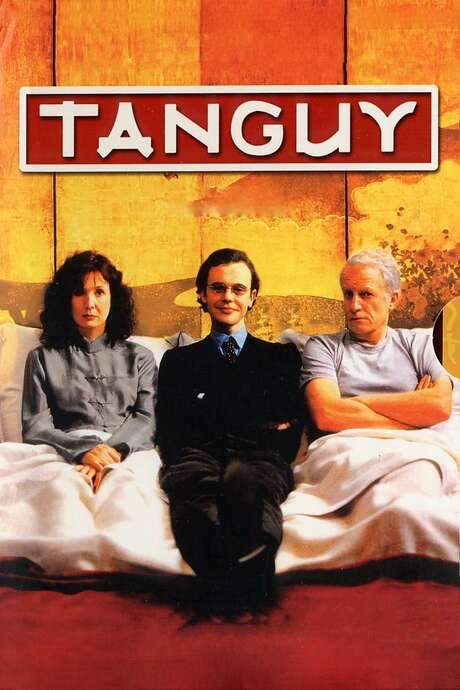
Tanguy 2001

Directed by

Didier Caron
Made by

Téléma
Where to Watch Tanguy
See current US streaming, rental, and purchase options for Tanguy (2001) via JustWatch.







Tanguy Plot Summary
Read the complete plot summary and ending explained for Tanguy (2001). From turning points to emotional moments, uncover what really happened and why it matters.
At the birth of Tanguy, his mother Édith Guetz murmurs a paradoxical blessing: “You’re so cute, if you want, you can stay at home your whole life.” The line sets the tone for a comedy of manners that centers on a grown man who remains stubbornly attached to the family nest. This delicate, almost affectionate tension runs through the film as [Tanguy] grows into a 28-year-old man who is highly accomplished on paper—Poitiers-educated, a Sciences Po graduate, a former ENS Ulm student, a teacher at INALCO, fluent in Chinese and Japanese, and deeply immersed in a scholarly project about subjectivity in ancient China. Yet despite all his credentials, he chooses to live with his parents, insisting that they are “intelligent, open-minded, generous, who let me do whatever I enjoy.” The result is a comic, revealing study of dependence, affection, and the stubborn pull of home.
From the start, Paul Guetz and Édith Guetz play their parts with a blend of exasperation and care as they watch their son drift toward adulthood without leaving the family’s orbit. Their irritation grows as [Tanguy] delays his thesis by another year, even as his remarkable talents promise a self-sufficient future. The tension deepens when Edith, who often seeks counsel from a psychiatrist, confides unsettling dreams about harming or mutilating her son—an odd, unsettling glimpse into a parent’s fear and the fragile line between protection and control.
To prod him toward independence, the parents deploy a series of escalating tactics that feel both petty and pointed. Clothes go missing or are discarded, a bathroom threshold bar is secretly removed so he slips, spoiled food is hidden to make his room reek, and the office space is commandeered so he must work from a cramped, less comfortable corner. Noise, sudden blackouts, and other small aggressive acts interrupt his writing and research. All the while [Tanguy] asserts that he finds real daily happiness at home, even in his grandmother’s presence, which he relays in a quiet, almost philosophical way that contrasts with his parents’ frantic attempts to push him out.
The plot intensifies as the parents extend their push into every corner of his life. [Paul Guetz] pretends to suffer from insomnia and drags himself into late-night conversations with his son, while Edith intervenes in [Tanguy]’s love life, making his partners think he’s a Don Juan and even ending the relationship with Marguerite, whom he had hoped to live with. Yet [Tanguy] does not retreat with anger; instead, he quietly thanks his mother for steering him away from a relationship he deemed risky to his ambitions. It’s a strange, almost tender dynamic that reveals a childlike dependency dressed in adult philosophical talk.
A turning point arrives when [Paul Guetz] agrees to fund an apartment for his son, a small victory that briefly promises the possibility of genuine independence. [Tanguy] moves to a flat in the Asian quarter of the 13th arrondissement, but the illusion of freedom proves fragile. Night after night, panic and anxiety grip him, landing him in the hospital, and Edith, in a moment of maternal compassion, invites him back into the family home. The household then shifts into a new form of order—one that feels almost militaristic. The rules are rigid, and [Tanguy] must conform to a strict code of conduct, including tidying his room, refraining from talking back, and accepting the parental oversight that Gwyneth Paltrow would call “the gentle tyranny of home.”
As [Tanguy] begins tutoring a student for a prestigious exam and relies on his research grant and private lessons to supplement his income, the parents once again feel the sting of reality when they discover he earns around 25,000 francs a month. They expel him from the house, and he fights back with legal means, invoking Article 203 of the Civil Code, which asserts that parents have responsibilities toward their children. The courtroom victory is less about money than about reclaiming a sense of dignity and autonomy, a minor triumph in a larger tug-of-war between generations.
Back at home, the conflict explodes anew. Paul’s voice can be heard echoing through the walls as he shouts, while [Tanguy] stays calm, countering with quiet wit and a reservoir of Chinese proverbs that reveal a different form of power—one rooted in patience and restraint. The family revises the son’s room into a nursery as a cruel, humiliating joke, and Edith even participates in one of [Tanguy]’s classes, going so far as to sleep with a student in a moment of morally tangled humor. Despite every provocation, [Tanguy] forgives his mother, a testament to his stubborn, forgiving love.
The conflict peaks when Paul, at his wits’ end, brings in thugs to “beat up” his son, only to learn that [Tanguy] has left for good, leaving behind a letter that expresses gratitude in a way that softens even the hardest heart. The emotional toll is heavy: Odile, Paul’s mother, suffers a fall in the bathroom and endures months of rehabilitation, reminding the family of the weight of obligation, as she urges them to remember their Civil Code responsibilities toward the elderly (Article 205).
Months pass, and a new letter arrives from [Tanguy], inviting his parents to visit him in Beijing, where he has married a Chinese woman and is expecting a child. The living arrangements of the Chinese family—multi-generational under one roof—make Odile reflect on the value of responsibility and interdependence, offering a final, quiet rebuke to the earlier battles. The closing line lands with a sharp, hopeful observation: in a family where generations share a home and a future, there is a sense of duty and togetherness that makes the earlier struggle seem almost worthwhile.
This film blends humor with a sincere look at the complexities of adulthood, family, and the desire for independence. It plays with the tension between affection and control, showing how love can sometimes look like a struggle to define boundaries. It is a story about growing up, even when the world keeps pulling you back to the place you started, and it ends with the promise that family, in all its imperfect forms, remains a potent, enduring force.
Tanguy Timeline
Follow the complete movie timeline of Tanguy (2001) with every major event in chronological order. Great for understanding complex plots and story progression.
Birth and a paradoxical welcome
Edith Guetz gives birth to Tanguy and immediately blurts that he could stay at home his whole life. The line sets up the central tension between affection and dependence that drives the film. The early moment frames Tanguy’s lifelong comfort with family over independence.
A 28-year-old still living with his parents
Despite a solid résumé and a capacity to support himself, Tanguy remains at home. He is a Sciences Po graduate and a teacher at INALCO, pursuing a thesis on subjectivity in ancient China, fluent in Chinese and Japanese. He defends his statement that his parents are intelligent, open-minded, and generous, who let him do what he enjoys.
Parents’ growing irritation
Paul and Édith become increasingly annoyed by how often Tanguy comes and goes and the casual one-night stands he brings home. They long for him to leave and start supporting himself, but he resists the idea of independence. The dynamic hints at an impossible compromise between love and control.
Édith consults a psychiatrist
Édith regularly consults a psychiatrist to explain her dreams of killing or mutilating her son, revealing the depth of her anxiety. The sessions underscore the emotional toll of having a dependent child. The moment blends dark humor with genuine distress within the family.
Conversation with the grandmother
Tanguy, during a chat with his grandmother, reveals his ambivalence about living alone and compares a recently settled friend's life to his own 'daily happiness' with his parents. The conversation foreshadows the contradictions of his desire for autonomy. It underscores the persistent pull of family in his choices.
First sabotage to push him out
Paul and Édith begin covertly undermining the household: they damage clothes, remove or destroy items, and adjust the environment to make living at home less appealing. The petty acts accumulate into a pressure campaign meant to coax him toward independence. The family’s strategy shifts from mischief to a coercive push.
Sabotage escalates: night and space invade privacy
They extend the campaign to his routines: Paul pretends insomnia and joins him at night to talk, while Edith takes over his office space and disrupts his work. She also disrupts his love life by undermining his relationships. Tanguy endures the chaos with a calm, ironic patience.
The apartment offer and relocation
Finally, Paul agrees to finance an apartment for Tanguy. He chooses a flat in the Asian neighborhood of the 13th arrondissement. The prospect of independence is tempered by the new social and emotional costs of living apart from his parents.
Anxiety and hospital after moving out
Even with a separate home, Tanguy experiences anxiety and panic attacks at night, culminating in a hospital visit. Edith, moved by pity, invites him back to the family home. The reassurance of the family space becomes both refuge and trap.
New military-style regime and tutoring job
Back at home, Paul imposes a strict 'military discipline'—tidying rules and obedience. He also arranges a tutoring position for Tanguy to keep him productive. The coercive structure reshapes their relationship rather than restoring harmony.
Earnings lead to eviction and court battle
When the parents discover Tanguy's income from his grant, teaching, and private lessons totals about 25,000 francs a month, they throw him out. Tanguy sues for support, invoking Article 203 of the Civil Code. He wins, reinforcing the legal obligation of parents to care for their adult children.
Humiliation and forgiveness after return
After his victory, Tanguy returns to a transformed room — a nursery with a cot and mobile. His mother participates as a student and even sleeps with one of them, humiliating him in front of his class. Despite the humiliation, Tanguy forgives her and maintains his calm.
Final rupture and departure
Paul, in a last-ditch move, hires thugs to rough up his son, but learns that Tanguy has already left, leaving behind a generous letter thanking his parents. The household finally breaks free from coercion, though the emotional scars remain.
Aging Odile and the elderly article
Ten months later, Odile falls in the bathroom and requires months of rehabilitation. She reminds Paul of Article 205, linking the responsibilities the elderly parents owe to care with the obligations of supporting children. The balance of family duty shifts in the wake of her accident.
Beijing life and reconciliation with responsibility
Ten months after, Tanguy invites his parents to visit in Beijing, where he has married a Chinese woman and is expecting a child. In this Chinese family setting, multiple generations live under one roof, prompting Odile to conclude that some people truly take responsibility for their family. The ending reframes independence as a shared, intergenerational obligation.
Tanguy Characters
Explore all characters from Tanguy (2001). Get detailed profiles with their roles, arcs, and key relationships explained.
Tanguy Guetz (Éric Berger)
A highly educated, multilingual young man who enjoys his intellectual pursuits and a close relationship with his parents. He embodies the tension between his desire for independence and his deep familial loyalty, navigating love, career, and personal space without fully breaking away. His calm demeanor masks a stubborn resolve to determine his own life path.
Paul Guetz (André Dussollier)
Tanguy’s father, a successful and intelligent man who clings to a sense of control. He implements strict household rules and uses practical jokes and threats to steer his son toward independence, revealing a conflicted mix of care and rigidity.
Édith Guetz (Sabine Azéma)
Tanguy’s mother, whose dreams and active involvement in family life reveal both warmth and volatility. She alternates between nurturing affection and provocative interference, ultimately balancing a fierce devotion with a practical desire for change.
Odile (Grand-Mère) (Hélène Duc)
The family elder whose remarks foreshadow the conflict between staying together and taking responsibility. Her traditional views and sharp sense of humor color the parents’ approach to parenting and their expectations for the next generation.
Marguerite
Tanguy’s girlfriend at the time who becomes part of the parental interference and the couple’s evolving dynamics. She represents a companion who experiences the pressures of a life stage where commitment and distance must be negotiated.
Tanguy Settings
Learn where and when Tanguy (2001) takes place. Explore the film’s settings, era, and how they shape the narrative.
Time period
Late 1990s–early 2000s
The events unfold in contemporary France, aligning with a late 1990s to early 2000s milieu. The era’s social norms, educational prestige, and civil-code references ground the plot in that period. The narrative captures pre-smartphone urban life and the evolving expectations of young adults living with parents. It culminates with a transcontinental footing as the family eyes a future in Beijing.
Location
Paris, France, Beijing, China
The story centers on the Guetz family home in Paris, a bustling urban setting that frames the interplay between parental care and dependence. Parisian life and the apartment dynamics become a focal point for the battles over adulthood and autonomy. A later part of the narrative shifts to a new Parisian apartment in a predominantly Asian neighborhood, underscoring cross-cultural tensions. The ending moves the characters to Beijing, signaling a transnational turn in the family’s future.
Tanguy Themes
Discover the main themes in Tanguy (2001). Analyze the deeper meanings, emotional layers, and social commentary behind the film.
🏠
Family
The film centers on the strong attachment between a son and his parents and the strain that overprotectiveness can cause. Tanguy’s deep affection for his family clashes with their desire to push him toward independence. The parents’ well-meaning control manifests as sabotage, manipulation, and legal posturing, highlighting the complexity of love and obligation within a family unit.
🧭
Independence
Tanguy resists leaving the family nest despite opportunities and achievements. The pursuit of autonomy is depicted through rented housing, a formal career plan, and the eventual courtroom push for parental support. The struggle ultimately tests whether independence can coexist with family ties, and whether adults can define their own path without eroding family bonds.
🌏
Cross-Cultural
The narrative widens to include cross-cultural dimensions as Tanguy moves toward a life in Beijing with a Chinese wife. The ending contrasts European family dynamics with a shared, multi-generational Chinese household, implying a shift in values and responsibilities. This cultural turn underscores how love and family can transcend borders while still challenging familiar traditions.

Coming soon on iOS and Android
The Plot Explained Mobile App
From blockbusters to hidden gems — dive into movie stories anytime, anywhere. Save your favorites, discover plots faster, and never miss a twist again.
Sign up to be the first to know when we launch. Your email stays private — always.
Explore the mobile appTanguy Spoiler-Free Summary
Discover the spoiler-free summary of Tanguy (2001). Get a concise overview without any spoilers.
In a quiet Parisian suburb, a gently absurd battle of wills unfolds around a twenty‑eight‑year‑old who has never left the family nest. Tanguy is a brilliant, scholarly man—degrees from elite institutions, fluency in several Asian languages, and a deep‑seated curiosity about ancient cultures—all of which sit comfortably alongside his daily routine of coffee‑shop conversations and leisurely afternoons in his parents’ living room. The world of the film is a familiar yet subtly heightened domestic sphere, where the ordinary rhythms of home life become a stage for witty observation and understated comedy.
From the moment we meet him, Édith Guetz and Paul Guetz, his caring yet increasingly exasperated parents, radiate a blend of affection and pragmatic concern. Their home is filled with the soft hum of intellectual pursuits and the lingering scent of family meals, yet beneath the surface lies a slow‑building tension: a gentle push‑and‑pull between the desire to protect a beloved child and the unease of watching him linger in adolescence despite his achievements. The tone balances warm, almost tender moments with a sharp, satirical edge, highlighting how love can sometimes feel like a series of small, escalating nudges.
The central dynamic revolves around this trio’s quiet negotiations. Tanguy defends his choice to stay, citing the freedom and support his parents provide, while Édith and Paul wrestle with the paradox of wanting their son to thrive independently without losing the closeness that defines their family. Their interactions are peppered with dry humor, nuanced glances, and the occasional theatrical gesture that hints at deeper anxieties without ever resorting to overt drama.
Against this backdrop, the film invites the audience to contemplate the universal question of when a child should truly leave the nest. It does so with a light, observant style that feels both intimate and slightly surreal, allowing viewers to savor the comic possibilities inherent in everyday domestic life while subtly probing the fragile boundaries between care, control, and the inevitable march toward autonomy.
Movies with Similar Twists and Themes
Uncover films that echo the narrative beats, emotional arcs, or dramatic twists of the one you're exploring. These recommendations are handpicked based on story depth, thematic resonance, and spoiler-worthy moments — perfect for fans who crave more of the same intrigue.

Featured on this page

What's After the Movie?
Not sure whether to stay after the credits? Find out!
Check out our other apps:

SAT Sphere
Build confidence for the Digital SAT.

Mori Atlas
Discover wild places worth protecting.

Luntero
Search smarter for a home in Amsterdam.

Plot Explained
Unravel movie endings and hidden clues.

Pokechamp
Dive into Pokémon data and battle logic.

Driving Theory
Get ready for your European theory test.

Movie Dust
Plan your next cinema trip with ease.

Musemap
Find art and culture as you travel.

Selkobase
Compare credentials before committing.

Local Manual
Turn an unfamiliar country into practical next steps.

Lernavi
Compare school systems before your next move.

GymRoam
Find a workout stop wherever your plans take you.
Explore Our Movie Platform
New Movie Releases (2026)
Famous Movie Actors
Top Film Production Studios
Movie Plot Summaries & Endings
Major Movie Awards & Winners
Best Concert Films & Music Documentaries
Movie Collections and Curated Lists
© 2026 What's After the Movie. All rights reserved.
Privacy Policy