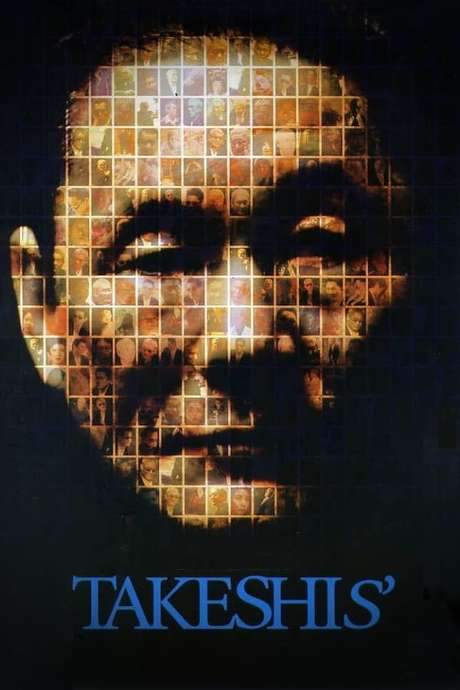
Takeshis’ 2005

Made by

dentsu Music and Entertainment
Takeshis’ Plot Summary
Read the complete plot summary and ending explained for Takeshis’ (2005). From turning points to emotional moments, uncover what really happened and why it matters.
Two intertwined stories unfold around two versions of the same man: Beat Takeshi and his look‑alike, Mr. Kitano, both brought to life by Takeshi Kitano. The film follows these two figures as they drift through a shared, paranoid cinema of dreams and reality, where the lines between actor and persona, dream and deed, become increasingly blurred.
In the world of film and television, Beat Takeshi stands as a towering showbiz figure, surrounded by a recurring troupe who inhabit his life in double roles. His girlfriend Kotomi Kyōno appears beside him, his manager Ren Osugi keeps the wheels turning, and his former stand‑up partner lingers in memory and performance, a constant echo of who he used to be. The film also briefly revisits the tense, bromantic bond with Susumu Terajima, grounding the meta‑narrative in real faces that feed the dreamlike sequence.
Kitano’s other half enters the frame in a clown’s garb among the TV crew, a plain man who longs for the aura and charisma of the movie star. This version of Kitano longs for validation and finds himself autograph-seeking from the very idol he admires, a moment that cements their strange proximity. The two Strands collide as the ordinary man—who works as a convenience-store clerk and moonlights as a taxi driver—begins to blur the borders between his own life and the movie world he imagines. Nightmares bleed into daylight as surreal imagery flashes through his days: looming figures, dead bodies in roadside scenes, almost ritualized repetitions that threaten to become his reality.
A cascade of violent fantasy erupts when the ordinary man reaches for a gun amid a neighborhood quarrel, setting off a chain of killings that ripple through his world. The film segues into a dizzying, dreamlike sequence where underground nightclubs, shadowy gun battles, and a feverish sense of lawless adventure push him toward an alternate, almost island‑paradise epoch—evoking the mood of the director’s tougher, kinetic frames. Throughout this fever dream, the visual motifs recur: the odd caterpillar in a bouquet, a Taishū engeki female impersonator, tap dancers in a rehearsal space, a transvestite chanson singer, a pair of fat twins, and scenes in a ramen shop that loop and reappear in ever‑shifting contexts. Taichi Saotome and Akihiro Miwa anchor these recurring images with their own iconic touches, adding layers to the spectacle.
As the daydream intensifies, the boundary between the two Takeshis dissolves and the two halves of Kitano’s world collide more directly. The “Beat” persona seems to claim a rising heartthrob charisma, while the ordinary man acts out in ways that mirror a movie star’s legend. The fantasy collapses back into the ordinary life—until a stark trigger cuts through the reverie: the autograph greeting, “Hello Mr. Clown!” This moment shivers through the film and appears to seal the fate of the Beat Takeshi figure, even as the camera lingers on him in a close‑up that suggests the entire sequence might be a dream inside a dream.
The ending circles back to the bookends of the narrative—those opening images of an American soldier and the gun battle that began it all—leaving the audience with a lingering, unresolved question: is what we’ve witnessed a vivid dream of Beat Takeshi, or a dangerous, self‑made reality for Mr. Kitano? The film closes on a hypnotic note, inviting viewers to piece together what is real, what is performative, and what remains forever out of reach in the murky, glittering world of Takeshis’.
Takeshis’ Timeline
Follow the complete movie timeline of Takeshis’ (2005) with every major event in chronological order. Great for understanding complex plots and story progression.
Two versions of the same man emerge
The film introduces Beat Takeshi and his look‑alike Mr. Kitano, two versions of a single man who drift through a shared, dreamlike cinema. Their existence blurs the lines between actor and persona, dream and deed. This duality sets up the central puzzle that drives the narrative forward.
Beat Takeshi's showbiz world
Beat Takeshi is surrounded by a recurring troupe and a life built around performance. The film portrays his public persona as a TV and stage powerhouse, with the entourage reinforcing a manufactured charisma. The boundary between real life and performance begins to feel porous.
Kitano's other half joins the frame
A plain, clown‑ garbed version of Kitano steps into the frame among the TV crew, craving the aura and charisma of the movie star. He starts autograph‑seeking from the idol, a moment that forges a troubling proximity between the two halves. The moment signals the collision of worlds to come.
Ordinary man’s double life emerges
The ordinary man works as a convenience‑store clerk and moonlights as a taxi driver, and he begins to blur his life with the movie world he idolizes. Surreal daydreams intrude into his daylight hours, foreshadowing a loose tether between fantasy and reality. The seeds of a shared dream are sown in mundane routine.
Nightmares bleed into daylight
Nightmares of looming figures and roadside corpses haunt the ordinary man, with ritualized repetitions threatening to become his new reality. The dreamlike imagery becomes almost reflexive, seeping into ordinary scenes and skewing perception. The boundary between fear and waking life grows thinner.
Violent turn: gun in a neighborhood quarrel
A casual neighborhood quarrel escalates as the ordinary man reaches for a gun, triggering a cascade of killings that ripple through his world. The sequence electrifies the story with sudden violence and shifts the mood from dream to danger. This act accelerates the fusion of daydream and deed.
Descent into dreamlike cinema
The narrative plunges into a feverish dream sequence filled with underground nightclubs and shadowy gun battles. A sense of lawless adventure dominates, pushing the protagonist toward an island‑paradise epoch. Recurring motifs begin to anchor the delirium.
Recurring motifs populate the dream
The dream is threaded with persistent images: a caterpillar in a bouquet, a Taishū engeki female impersonator, tap dancers in a rehearsal space, a transvestite chanson singer, and pairs of fat twins. Taichi Saotome and Akihiro Miwa lend these motifs their iconic touches, deepening the spectacle. These images reinforce the sense that reality is being filtered through performance.
The two halves collide
As the daydream intensifies, Beat Takeshi’s charisma swells while the ordinary man acts out in ways that echo a movie star’s legend. The two halves of Kitano’s world collide more directly, eroding the boundary between fantasy and life. The self becomes a stage through which both halves perform.
Autograph moment: Hello Mr. Clown!
A pivotal autograph greeting—'Hello Mr. Clown!'—shivers through the film and seems to seal the fate of the Beat Takeshi figure. The moment is captured in a close‑up that hints the entire sequence might be a dream within a dream. The line between identity and mask becomes almost unbearably thin.
Reality reasserts, the dream ebbs
The feverish fantasy begins to collapse back into ordinary life, though the boundary between fantasy and reality remains blurred. The characters drift back toward their respective shores while the sense of unresolved ambiguity lingers. The story refuses a tidy linear conclusion.
Ending circles to the opening question
The film returns to the opening images of an American soldier and the gun battle that started it all, leaving viewers with an open‑ended question: was what we witnessed a vivid dream of Beat Takeshi or a dangerous, self‑manufactured reality for Mr. Kitano? The close‑up lingers, inviting interpretation and doubt. The tale concludes with a hypnotic invitation to decide what is real, what is performative, and what remains out of reach.
Takeshis’ Characters
Explore all characters from Takeshis’ (2005). Get detailed profiles with their roles, arcs, and key relationships explained.
Beat Takeshi / Mr. Kitano (Takeshi Kitano)
The two halves of Kitano's public persona move through the same urban space, each craving validation and charisma. Beat Takeshi embodies star power and certainty, while Mr. Kitano longs to seize that aura for himself. Their encounters blur where the actor ends and the character begins, turning ordinary moments into a theatre of dreams.
Kotomi Kyōno as Takeshi's Girlfriend / Kitano's Female Neighbor
She anchors the ordinary world around Beat Takeshi, serving as his girlfriend and neighbor within the shifting dreamlike landscape. Her presence grounds the meta-narrative, offering a human touch amid the film's oscillations between performance and reality. Through her interactions, the line between affection and spectacle is subtly probed.
Susumu Terajima as Takeshi's Friend / Kitano's Yakuza Neighbor
Terajima's character grounds the fiction in recognizable relationships and loyalty. His presence hints at a past and code beneath the glamorous surface, contributing to the film's simmering tension between real-world ties and cinematic fantasy. The interactions reflect a bromantic, rough-edged camaraderie that echoes the meta-narrative's concerns with identity and belonging.
Ren Osugi as Takeshi's Manager / Taxi Driver
As manager and driver, Osugi's character navigates the gears of the entertainment machine and the streets that feed it. He embodies efficiency, pragmatism, and a touch of menace, mirroring the film's oscillation between control and unpredictability. His presence situates the celebrity world within a tangible, everyday urban landscape.
Taichi Saotome as Young Man
Saotome's Young Man acts as a conduit for the film's recurring images and motifs, anchoring the dreamlike sequences in a youthful gaze. He participates in the shifting tableau that blurs reality and performance, adding a playful yet uncanny energy. His presence helps frame the sense of cyclical, ritualized imagery that recurs throughout the narrative.
Akihiro Miwa as Self
Miwa's self-portraiture appears in feverish vignettes that punctuate the film's dream logic, reinforcing the question of who is watching whom. The performer disrupts the boundary between being and acting, amplifying the metafictional commentary. His presence adds a surreal layer to the film's collage of personas.
Jonathan Legg as American Soldier
Legg's soldier figure materializes in the opening tableau that triggers the narrative's downward spiral. The character embodies distant, dream-driven violence that haunts the film's vivid imagery. His presence anchors the sense that the story unfolds like a fractured memory or dream sequence.
Takeshis’ Themes
Discover the main themes in Takeshis’ (2005). Analyze the deeper meanings, emotional layers, and social commentary behind the film.
🎭
Identity
The film probes how fame, persona, and reality intertwine as Beat Takeshi and his look‑alike, Mr. Kitano, blur the line between actor and self. The narrative uses dreamlike transitions to show how fantasy intrudes on everyday life and personal memory. This duality forces characters to confront what is performative versus what is authentic, shaping the film's unsettling atmosphere.
🌀
Duality
Two versions of the same man inhabit one story, triggering a collapse between dream and waking life. The ordinary world is reframed as a theatre where violence, memory, and aspiration cross paths. The film investigates how a craving for fame can manufacture an alternate self that overshadows the real one.
🎬
Cinema Meta
Filmmaking becomes a living experience, with the camera and crew treated as participants in the dreamlike tapestry. The boundary between on-screen fantasy and off-screen reality dissolves through surreal imagery and recurring motifs. Viewers are invited to question what is ‘real’ in storytelling and in the self who performs it.

Coming soon on iOS and Android
The Plot Explained Mobile App
From blockbusters to hidden gems — dive into movie stories anytime, anywhere. Save your favorites, discover plots faster, and never miss a twist again.
Sign up to be the first to know when we launch. Your email stays private — always.
Explore the mobile appTakeshis’ Spoiler-Free Summary
Discover the spoiler-free summary of Takeshis’ (2005). Get a concise overview without any spoilers.
In the bustling, neon‑lit world of Japanese show business, a larger‑than‑life star known as Beat Takeshi dominates every screen, concert hall and talk‑show with a charisma that feels almost mythic. He is surrounded by a close‑knit troupe of collaborators—agents, former partners and a devoted girlfriend—who move in and out of his lavish, ever‑shifting universe. Their lives are a glossy montage of fame, performance, and the relentless pressure to maintain an image that is as much a character as it is a person.
Across the city, in the quiet glow of a convenience‑store aisle, an unassuming clerk named Kitano dreams of stepping into that dazzling spotlight. He works odd jobs, shuttles passengers as a taxi driver, and clings to the fragile hope of an acting break. One day, the two men’s paths intersect in a moment that feels both ordinary and uncanny: Kitano meets his own double in the form of the celebrated star, and the encounter sets off a cascade of vivid, hallucinatory sensations that make him question where his own identity ends and the persona of Beat begins.
The film unfolds as a kaleidoscopic meditation on fame, ambition and the thin line between reality and performance. Its tone is simultaneously hyper‑real and dream‑like, mixing frantic comedy with unsettling introspection as the everyday world collides with the theatrical. Audiences are invited to linger in the space where mirrors reflect not just faces, but the yearning inside each character—the celebrated actor confronting his own myth, and the humble clerk confronting a seductive, possibly dangerous fantasy of becoming larger than life.
Movies with Similar Twists and Themes
Uncover films that echo the narrative beats, emotional arcs, or dramatic twists of the one you're exploring. These recommendations are handpicked based on story depth, thematic resonance, and spoiler-worthy moments — perfect for fans who crave more of the same intrigue.

Featured on this page

What's After the Movie?
Not sure whether to stay after the credits? Find out!
Check out our other apps:

SAT Sphere
Build confidence for the Digital SAT.

Mori Atlas
Discover wild places worth protecting.

Luntero
Search smarter for a home in Amsterdam.

Plot Explained
Unravel movie endings and hidden clues.

Pokechamp
Dive into Pokémon data and battle logic.

Driving Theory
Get ready for your European theory test.

Movie Dust
Plan your next cinema trip with ease.

Musemap
Find art and culture as you travel.

Selkobase
Compare credentials before committing.

Local Manual
Turn an unfamiliar country into practical next steps.

Lernavi
Compare school systems before your next move.

GymRoam
Find a workout stop wherever your plans take you.
Explore Our Movie Platform
New Movie Releases (2026)
Famous Movie Actors
Top Film Production Studios
Movie Plot Summaries & Endings
Major Movie Awards & Winners
Best Concert Films & Music Documentaries
Movie Collections and Curated Lists
© 2026 What's After the Movie. All rights reserved.
Privacy Policy