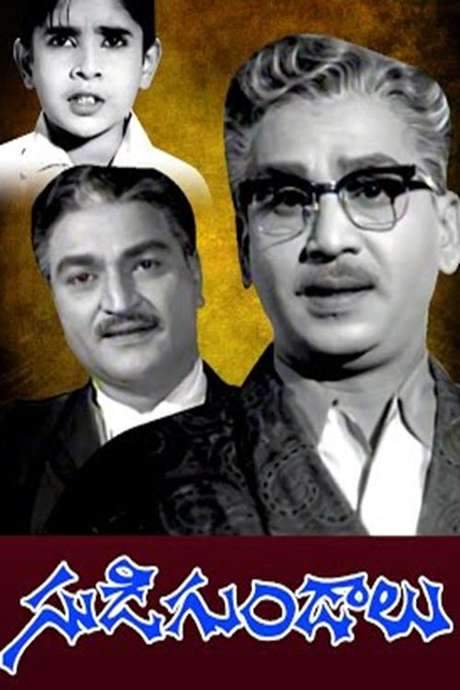



Sudigundalu Plot Summary
Read the complete plot summary and ending explained for Sudigundalu (1968). From turning points to emotional moments, uncover what really happened and why it matters.
Justice Chandra Shekaram is a noble and generous judge who shelters the families afflicted by his judgments. Under his loving care, these households grow into a close, conjugal unit and raise Raja, a motherless infant, with an outpouring of affection. As Raja blossoms into a bright, beloved boy, the home becomes a beacon of warmth and trust, where the line between dispense of justice and personal duty blurs in the best possible way.
Years pass, and Raja attends school on his birthday, only to vanish without a trace. The sudden disappearance throws the family into a tremor of fear and confusion, and the next day the police recover Raja’s body, shattering the peace that had surrounded them. The community reels from the tragedy, and a profound inquiry begins to peel back the layers of this quiet, prosperous world.
The investigation uncovers two minors, Vikram Kumar and Sandhya Rani, who come from starkly different corners of high society. Vikram is the son of Panakala Rao, a politician who speaks for the poor, while Sandhya is the daughter of a wealthy businessman, Koteswara Rao. The two are romantically involved, adding a complicated dimension to the case. Vikram’s world includes his stepmother Pankajam, who is around his age, and the two share a tense, uneasy relationship.
In a dramatic courtroom turn, Justice Chandra Shekaram steps forward to defend the accused, startling everyone. He dismantles the surface appearances and presents a chilling motive, arguing that the killings were acts born of madness rather than malice. He reveals that a school-play moment—where Raja and Sandhya’s younger brother competed for a prize—seeded jealousy, and Vikram had vowed to kill Raja to win Sandhya’s affection. To justify the crime, Vikram mimics the method he had read in crime novels that Pankajam had read, planning to lure Raja to a swimming pool and drown him. He confesses that the act began as a sensation-seeking spree and grew into a grim certainty.
Through relentless cross-examination of Panakala Rao, Koteswara Rao, and their wives, the judge demonstrates that the youths’ fates were shaped by their upbringings. Vikram’s parents failed to instill morality, while Sandhya’s household used wealth and influence to shield her from consequence, letting her drift toward vice even as a minor. The defense underscores a larger truth: the environment forged the children’s choices more than any single act of rebellion.
Chandra Shekaram’s proclamation that parents bear a fundamental duty to raise responsible, moral citizens resonates with the jury and the audience. His words prompt a moment of self-reflection among the accused families, and the jurors revise their stance in response to the moral reckoning he presents. Yet, even as the courtroom drama points toward reform, the film grounds its tragedy in the personal cost borne by the judge himself.
The narrative culminates in a heartrending climax as Chandra Shekaram’s moral crusade ends in tragedy within the court hall, reminding viewers that justice and sacrifice can coexist with personal ruin. The story remains a stark meditation on duty, privilege, and the responsibilities of parenthood in shaping the next generation.
The film also features a notable cameo by Nagarjuna Akkineni and includes the presence of two Gumasta officers, Nageshwara Rao Akkineni and Sakshi Ranga Rao in the cast, reinforcing the social and institutional landscape that frames the drama.
Sudigundalu Timeline
Follow the complete movie timeline of Sudigundalu (1968) with every major event in chronological order. Great for understanding complex plots and story progression.
Raja is raised by the judge's conjugal family
Chandra Sekharam, a noble judge, shelters the families afflicted by his judgments and provides a loving home for Raja. Under their care, Raja grows into a cherished child who receives affection and stability. This bond sets the foundation for later events.
Raja grows into a beloved and bright boy
Over the years, Raja becomes lovely and intelligent, adored by everyone around him. He seems to have a secure, peaceful life, supported by his guardian family. His future looks hopeful.
Raja disappears on his birthday
On his birthday, Raja attends school but does not return home. The sudden disappearance shocks his guardians and prompts a nationwide search. The mystery unsettles the community.
Raja's body is found and society panics
The next day the police discover Raja's dead body, plunging the city into grief and fear. The public demands answers as rumors swirl about possible culprits. The case triggers a profound crisis in the community.
Two minors identified as killers
In a deep police inquiry, Vikram Kumar and Sandhya Rani are identified as Raja's killers. They are revealed to be the offspring of powerful high society figures, complicating public perception of the crime. The findings shock both the elite and the ordinary people.
Vikram and Sandhya come from privileged worlds
Vikram is the son of politician Panakala Rao, who campaigns for the poor, while Sandhya is the daughter of millionaire Koteswara Rao. Their wealth and status shape the investigation and the expectations of society. The couple's relationship adds a layer of complexity to the motive.
Pankajam, Vikram's stepmother, enters the portrait
Vikram's stepmother Pankajam, who is about the same age as him, has a strained relationship with him. Her presence highlights family tensions and moral questions within the household. The film hints at a troubled upbringing behind the crime.
Chandra Sekharam volunteers to defend the accused
In court, the judge unexpectedly offers to argue for Vikram and Sandhya, shocking the courtroom and the public. He believes that revealing the true motive will rectify the truth and expose the impact of upbringing. His intervention reframes the case as about responsibility rather than mere guilt.
Motive revealed: the killing was a thrill for fun
Chandra Sekharam reveals that the murder was driven by a desire for entertainment. Vikram had studied crime novels and planned to replicate the murder by taking Raja to a swimming pool and drowning him. The admission shows a dangerous mix of fascination and unstable impulses.
Cross-examination exposes negligent parenting
The judge cross-examines Panakala Rao, Koteswara Rao, and their wives to show how parenting failures fostered recklessness. He argues that Vikram's parents failed to teach morality, while Sandhya's parents allowed wealth to shield her from responsibility. The truth emerges that upbringing played a central role in the tragedy.
Moral appeal: parents must raise principled heirs
Chandra Sekharam delivers a passionate plea that parents should raise their children as moral citizens. His words aim to reform the culprits and awaken society to the consequences of lax parenting. The courtroom listens as he reframes justice as a social duty.
Jury reconsiders and reforms its stance
Inspired by the judge's words, the jury rethinks its earlier edict and acknowledges the need for accountability and reform. The verdict shifts as moral considerations take precedence over simple punishment. The momentum signals a broader societal call for responsibility.
Final tragedy: the judge dies in court
Despite the attempts at reform, the case ends in tragedy as Chandra Sekharam collapses in the court hall and dies. His sacrifice underscores the limits of justice in the face of human frailty. The community mourns his loss as the moral debate lingers.
Sudigundalu Characters
Explore all characters from Sudigundalu (1968). Get detailed profiles with their roles, arcs, and key relationships explained.
Chandra Shekaram (Judge)
A noble and generous judge who shelters families afflicted by his judgments and presides over a case that tests his conscience. He values morality over rigid law and is willing to defend the accused when a deeper truth emerges. His ultimate sacrifice in the courtroom underscores his lifelong commitment to justice.
Raja
A motherless infant raised by Chandra Shekaram’s family, growing into a bright and well-loved boy. His apparent happiness masks the vulnerability of a child in a society that watches with suspicion when tragedy strikes. His memory becomes a catalyst for examining parental responsibility and public perception.
Vikram Kumar
The son of a powerful politician, Vikram’s charm hides a dangerous impulse to kill for amusement. His relationship with Sandhya exposes how privilege can erode morality, and how a single careless act can ripple into a life-altering crime.
Sandhya Rani
Daughter of a wealthy magnate, she embodies wealth-induced decadence while remaining emotionally connected to Vikram. Her upbringing and social status influence her choices and the tension within their relationship.
Panakala Rao
A politician who campaigns for the welfare of the poor, yet his family environment lacks moral guidance for Vikram. His status and expectations contribute to the complex dynamics of the case.
Koteswara Rao
A wealthy businessman, father of Sandhya who wields influence that shapes her behavior and the public’s view of justice. His wealth serves as a backdrop to the social critique on privilege.
Pankajam
Vikram’s stepmother, a figure around Vikram's age who influences him and reveals the raw edge of familial tensions. Her apathetic stance toward wrongdoing highlights harmful behavior in a wealthy milieu.
Sudigundalu Settings
Learn where and when Sudigundalu (1968) takes place. Explore the film’s settings, era, and how they shape the narrative.
Location
Court hall, School, City
The story unfolds largely within an urban Indian setting, centered on a courtroom drama and the social environment that nurtures it. Court proceedings anchor the narrative, while the school and city neighborhood reveal the upbringing and pressures that shape the characters. The city is depicted as a place where wealth, politics, and public perception influence justice and everyday life.
Sudigundalu Themes
Discover the main themes in Sudigundalu (1968). Analyze the deeper meanings, emotional layers, and social commentary behind the film.
⚖️
Justice & Morality
The film probes how law seeks truth while exposing the biases shaped by upbringing and class. A noble judge reframes a seemingly straightforward case by examining motives, showing that justice is inseparable from moral responsibility. The climax questions whether formal verdicts suffice without addressing the roots of crime.
👪
Parenting & Upbringing
Central to the drama is how parents shape their children's ethics and choices. Vikram and Sandhya’s actions reveal how neglect, privilege, and permissiveness can twist young lives. The judge argues that responsible parenting is essential to raise citizens with integrity. The film suggests reform starts in the home as much as in the courtroom.
💰
Wealth & Privilege
Wealth and social status create powerful incentives and blind spots for the characters. The movie demonstrates how the affluent couple use money and influence to shield bad behavior, complicating justice. It contrasts material power with moral accountability, showing the dangerous edge of privilege in a society.

Coming soon on iOS and Android
The Plot Explained Mobile App
From blockbusters to hidden gems — dive into movie stories anytime, anywhere. Save your favorites, discover plots faster, and never miss a twist again.
Sign up to be the first to know when we launch. Your email stays private — always.
Explore the mobile appSudigundalu Spoiler-Free Summary
Discover the spoiler-free summary of Sudigundalu (1968). Get a concise overview without any spoilers.
In the bustling towns of 1960s Andhra Pradesh, a world of ordinary streets and quiet homes is painted with a gentle, almost lyrical realism. The film’s tone is contemplative yet resonant, letting everyday gestures—shared meals, lingering glances, the rustle of curtains in a summer breeze—speak louder than any grand spectacle. Within this grounded tapestry, the story orbits around a single, steadfast figure whose reputation for mercy has become almost legendary.
Chandrasekharam, a judge whose judgments are tempered by genuine compassion, has built his life on the principle that law should serve as a shelter rather than a stern tower. He opens the doors of his own modest home to the families touched by his rulings, fostering an unexpected extended household where affection flows freely across bloodlines. In this haven, the loss of his beloved wife during childbirth leaves a poignant void, yet the warmth of the community continues to nurture his young son, Raja, who grows up under the watchful eyes of a multitude of caring strangers.
The narrative steadies itself on the subtle currents that pull at this fragile equilibrium. As the characters navigate the delicate balance between public duty and private grief, questions of parental responsibility and societal influence begin to surface, hinting at deeper undercurrents without revealing their full shape. The atmosphere is thick with quiet tension, as the judge’s unyielding moral compass prepares to confront forces that challenge the very foundations of his belief in redemption.
Against this backdrop, the courtroom emerges not merely as a venue for legal battles but as a stage where ideals clash with reality. The film’s measured pacing, its muted color palette, and a hauntingly restrained score amplify the sense that every spoken word carries weight, inviting the audience to reflect on the intricate dance between justice, sacrifice, and the unseen whirlpools that shape human lives.
Movies with Similar Twists and Themes
Uncover films that echo the narrative beats, emotional arcs, or dramatic twists of the one you're exploring. These recommendations are handpicked based on story depth, thematic resonance, and spoiler-worthy moments — perfect for fans who crave more of the same intrigue.







Featured on this page

What's After the Movie?
Not sure whether to stay after the credits? Find out!
Check out our other apps:

SAT Sphere
Build confidence for the Digital SAT.

Mori Atlas
Discover wild places worth protecting.

Luntero
Search smarter for a home in Amsterdam.

Plot Explained
Unravel movie endings and hidden clues.

Pokechamp
Dive into Pokémon data and battle logic.

Driving Theory
Get ready for your European theory test.

Movie Dust
Plan your next cinema trip with ease.

Musemap
Find art and culture as you travel.

Selkobase
Compare credentials before committing.

Local Manual
Turn an unfamiliar country into practical next steps.

Lernavi
Compare school systems before your next move.

GymRoam
Find a workout stop wherever your plans take you.
Explore Our Movie Platform
New Movie Releases (2026)
Famous Movie Actors
Top Film Production Studios
Movie Plot Summaries & Endings
Major Movie Awards & Winners
Best Concert Films & Music Documentaries
Movie Collections and Curated Lists
© 2026 What's After the Movie. All rights reserved.
Privacy Policy