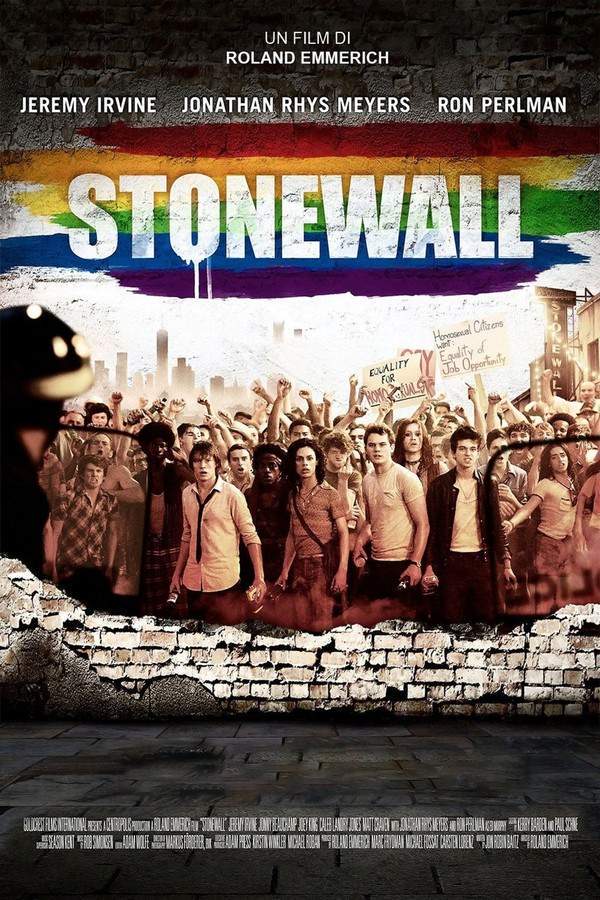
Stonewall 2015


Directed by

Roland Emmerich
Made by

Roadside Attractions
Where to Watch Stonewall
See current US streaming, rental, and purchase options for Stonewall (2015) via JustWatch.









Stonewall Plot Summary
Read the complete plot summary and ending explained for Stonewall (2015). From turning points to emotional moments, uncover what really happened and why it matters.
Danny Winters, a gay boy from Indiana, flees the conservative countryside in the late 1960s and heads to New York City to seek a new life. His father is upset, and while his mother loves her son, she does not stand up to her husband. The family dynamic is tense, and the looming tension of parental disapproval complicates Danny’s aspirations. Before leaving, he says goodbye to his supportive little sister, Phoebe, who offers a quiet encouragement that contrasts with the louder objections he faces at home. The departure marks the start of a difficult, hopeful journey as Danny aims to carve out space for himself in a city that promises possibility but also exposes him to danger and prejudice.
In Greenwich Village, Danny is drawn into a loose, multiracial circle of young, gay, and gender-fluid street people and drag queens who navigate love, survival, and identity in a period of social upheaval. He witnesses police violence directed at his new friends, a stark reminder that right and safety remain contested for people like him even as the city becomes a hub of subculture and resistance. The Village’s energy is electric and watchful, a place where community can feel like both refuge and risk.
When Danny and his new friends visit the Stonewall Inn, a famous gay bar, he meets a man who asks him to dance, a member of the Mattachine Society known for trying to advance gay rights by working within mainstream institutions. The encounter places Danny in the orbit of a broader movement, one that believes in gradual, organized change even as it clashes with the gritty realities of city life. That same night, a police raid shakes the bar and leads to the arrest of several customers, including Danny’s friend Ray. The event crystallizes the precariousness of safety for people who live on the margins and foreshadows how communities will respond to oppression.
After the raid, Danny, who narrowly avoids arrest because he isn’t cross-dressing, reconnects with Ray at the police station the next day. With few practical prospects and a hunger for independence, Danny makes difficult choices about survival. He tries prostitution as a means to support himself, an experience that exposes him to exploitation and vulnerability, yet also underscores his determination to stay afloat in a world that often denies him dignity.
Danny’s involvement with the Mattachine Society deepens; at a meeting, he reconnects with Trevor, a figure within the movement whose politics differ from Danny’s but whose presence awakens something meaningful in him. The two spend a night together, sharing a moment of closeness that stands in contrast to the harsh realities he faces outside the meeting room. The budding romance is complicated by Trevor’s entanglements, and Danny’s own sense of belonging is tested as he negotiates love, longing, and the political stakes of queer life in the city.
Heartbreak follows quickly when Danny discovers Trevor with another man. Feeling betrayed, he decides to leave the Village, seeking distance from the emotional turbulence that accompanies his search for connection and safety. But his departure is interrupted in a brutal way: he is abducted and forced into a high-class prostitution operation managed by Ed Murphy, a man who runs the Stonewall Inn and who has colluded with corrupt policemen to exploit homeless gay youth for profit and power. Ed Murphy is depicted as a shadowy figure whose influence corrupts institutions meant to protect or assist marginalized people, illustrating the intertwining of crime and policing in the era.
Danny escapes with the help of Ray, and the two return to the bar to confront Murphy. A police raid ensues again, and this time Danny is thrown back into the street, along with the other customers who have already suffered at the hands of those who presume to control their lives. In the heat of the moment, Danny—driven by a blend of anger, fear, and the desperate need to resist—hurls a brick through one of the bar’s windows and shouts, > Gay power! The cry is more than a reaction; it is a rallying statement that resonates with the emerging mood of resistance and solidarity among the patrons and their allies. The crowd’s anger spills into a confrontation with the police, who retreat and lock themselves inside the bar as tensions flare.
A year passes, and Danny returns home after completing his first year at the university he had hoped to attend when his father initially blocked that path. He shares with his sister that he plans to participate in the gay liberation march on Christopher Street, signaling his resolve to join a broader, more visible movement for equality. The film’s final images follow Danny as he marches alongside friends, a procession bound by memory, risk, and hope. In the crowd, he looks to the sidewalk and sees that his mother and sister have come to support him, offering a quiet, powerful moment of familial witness to a life of courage, persistence, and the gradual gains of a community fighting for its rights.
Throughout this journey, the film threads together personal longing, family dynamics, the thrill and danger of urban life, and a historical moment when a community began to demand visibility and justice. The narrative’s careful balance between intimate moments and collective struggle presents a portrait of resilience, the costs of seeking authenticity, and the slow, persistent march toward greater freedom for queer people. The arc—from discovery and uprooting to exploitation, resistance, and a turning point toward public advocacy—offers a sobering yet hopeful view of a pivotal era in civil rights history, anchored by the everyday bravery of those who chose to live openly in the face of risk.
Stonewall Timeline
Follow the complete movie timeline of Stonewall (2015) with every major event in chronological order. Great for understanding complex plots and story progression.
Escape from Indiana to New York City
Danny Winters, a gay boy from Indiana, is discovered by friends while making love with his boyfriend. His father becomes furious and refuses to sign his Columbia University scholarship, but Danny leaves for New York anyway, leaving behind his supportive sister Phoebe.
Arrival in Greenwich Village and meeting a diverse queer community
Upon reaching Christopher Street in Greenwich Village, Danny is befriended by a multiracial group of young gay and genderfluid street people and drag queens. He begins to feel at home in a vibrant but precarious world of chosen family and nightlife.
Witnessing police violence against his new friends
Danny witnesses police brutality directed at his new friends, highlighting the dangers faced by queer people in the city. The moment marks a turning point that hardens his awareness of systemic oppression and the struggle for safety.
First visit to Stonewall Inn and a dance with Trevor
Danny goes with his new friends to the Stonewall Inn, where Trevor, a Mattachine Society member, asks him to dance. The moment bridges his hunger for connection with the political currents around him and foreshadows later interactions.
Police raid and arrests at Stonewall Inn
That night the police raid the bar and arrest several customers, including Danny's friend Ray. Danny avoids arrest because he is not cross-dressing, but the scene exposes the height of risk within the community.
The day after: meeting Ray at the police station; prostitution as survival
The next day Danny meets Ray at the police station where the arrested friends are processed. With bleak job prospects, he tries prostitution to survive and receives oral sex from a man, illustrating the precarious options available to a young gay man.
Mattachine Society meeting; Trevor connection
Danny attends a Mattachine Society meeting, seeking rights through mainstream channels. He reconnects with Trevor, and though their political views differ, they end up spending the night together.
Trevor's betrayal and Danny's decision to leave the Village
Danny discovers Trevor with another man, breaking his trust and prompting a painful decision to leave the Village in search of a new path. The turning point pushes him toward greater independence and risk.
Abduction into a prostitution ring; escape with Ray
Soon after leaving the Village, Danny is abducted and forced into a high-class prostitution business run by Ed Murphy, who colludes with corrupt police. He escapes with Ray's help and they return to confront Murphy.
Second raid and the "Gay power" moment
The police raid the bar again, arresting customers as chaos erupts. Danny is thrown onto the street, and despite Trevor's attempts to intervene, he hurls a brick through a window shouting \"Gay power!\" which catalyzes the crowd to resist the police.
One year later: return home and plan a march
After finishing his first year at the university, Danny returns to his parents' home and tells his sister that he will attend the gay liberation march on Christopher Street. He speaks of hope, community, and the ongoing fight for rights.
The march day: Danny joins the gay liberation march
On the day of the march, Danny marches with his friends along Christopher Street, embodying pride and resistance. His mother and sister come to support him, signaling a personal moment of acceptance and solidarity.
Stonewall Characters
Explore all characters from Stonewall (2015). Get detailed profiles with their roles, arcs, and key relationships explained.
Danny Winters (Jeremy Irvine)
A gay boy from Indiana who flees conservatism for New York City. He navigates parental disapproval, poverty, and sexual exploitation while seeking belonging and his own voice. His journey blends vulnerability with growing resolve as he confronts danger and fights for visibility and rights.
Trevor (Jonny Beauchamp)
A member of the Mattachine Society who embodies a blend of advocacy and romantic complexity. He introduces Danny to activist circles while complicating their personal connection through political differences. His presence highlights the tensions between assimilation strategies and street-level activism.
Ray (Vladimir Alexis)
Danny’s resourceful friend and ally who helps him navigate dangers in the Village. Ray embodies street-smarts and loyalty, offering practical support and a sense of shared history within the waterfront of street life. His courage reinforces the theme of chosen family.
Ed Murphy (Ron Perlman)
The proprietor of the Stonewall Inn who colludes with corrupt police to exploit homeless LGBTQ youth. He represents the depths of exploitation and the systemic rot that the community must confront. His actions catalyze the central confrontation that sparks the riot.
Phoebe Winters (Joey King)
Danny’s supportive sister who embodies familial love and a hope for ordinary life. She represents the possibility of acceptance and the strength gained from family ties. Her presence reinforces the film’s emotional core about belonging and protection.
Dad Winters (Matt Craven)
A conservative father who initially blocks Danny’s Columbia scholarship and resists his son’s sexuality. His arc reflects the generational and cultural pressures faced by LGBTQ youths. His eventual stance underscores the possibility of change and understanding.
Mom Winters (David Cubitt)
A mother who loves her son and loves him enough to be conflicted by his choices. She vacillates between ambivalence and support, eventually showing up for the march. Her evolving stance mirrors the broader shifts happening in the community.
Stonewall Settings
Learn where and when Stonewall (2015) takes place. Explore the film’s settings, era, and how they shape the narrative.
Time period
Late 1960s
The film is set in the closing years of the 1960s, a period of social conservatism and escalating tension around LGBTQ visibility. Police raids on gay venues and the emergence of early rights movements frame the daily reality of the characters. The narrative culminates in a collective push toward gay liberation and public demonstration on Christopher Street.
Location
Greenwich Village, New York City, Christopher Street, Stonewall Inn
The story unfolds across Greenwich Village in New York City, centering on Christopher Street and the Stonewall Inn as a hub of queer life. The late-1960s city atmosphere is charged with tension from police raids, nightlife, and a growing sense of community among gay youth, drag performers, and their allies. The locations themselves shape the characters’ experiences, from bar raids to street marches that mark a turning point in their lives.
Stonewall Themes
Discover the main themes in Stonewall (2015). Analyze the deeper meanings, emotional layers, and social commentary behind the film.
🏳️🌈
Gay Liberation
The film centers on a community beginning to demand recognition and rights. It portrays the courage to claim space in public life, even in the face of police oppression and social stigma. The Stonewall moment serves as a catalyst for personal and collective emancipation, illustrating how individual stories converge into a broader fight for equality.
🤝
Community & Belonging
Danny finds a makeshift family among a diverse group of street youth, performers, and friends who support one another. The story explores chosen kinship, mutual aid, and the tension between love, trust, and betrayal. This sense of belonging helps characters survive persecution and seek a future beyond secrecy.
🚨
Oppression & Resistance
The plot centers on police brutality, exploitation, and systemic corruption that prey on vulnerable LGBTQ youths. It documents how characters resist through solidarity, protest, and defiance, culminating in a public act of resistance. The narrative frames oppression as a catalyst that accelerates collective action and personal resolve.

Coming soon on iOS and Android
The Plot Explained Mobile App
From blockbusters to hidden gems — dive into movie stories anytime, anywhere. Save your favorites, discover plots faster, and never miss a twist again.
Sign up to be the first to know when we launch. Your email stays private — always.
Explore the mobile appStonewall Spoiler-Free Summary
Discover the spoiler-free summary of Stonewall (2015). Get a concise overview without any spoilers.
In the waning summer of 1969, Danny Winters flees the rigid expectations of his Indiana hometown, propelled by a yearning to live authentically. His departure is marked by a fraught farewell with a supportive younger sister, Phoebe, whose quiet encouragement contrasts sharply with the disapproval that has shaped his family’s dynamic. The journey northward promises both freedom and uncertainty, setting the tone for a personal odyssey that unfolds amid a city humming with possibility and hidden peril.
Landing in New York’s Greenwich Village, Danny steps into a vibrant, multiracial tapestry of young people navigating love, identity, and survival. The neighborhood throbs with an electric mix of jazz clubs, sidewalk cafés, and whispered conversations in dimly lit bars—most notably the iconic Stonewall Inn, a refuge where outcasts gather to share stories and find solace. Here, Danny encounters a loose-knit community that offers the camaraderie he craved, while also exposing him to the stark realities of a world still hostile to his very existence.
Amid the bustle, Danny is drawn toward nascent activist circles, including members of the historic Mattachine Society, where he meets Trevor, a figure whose convictions spark both admiration and inner conflict. The atmosphere is charged with a simmering tension: police presence looms, discrimination surfaces in everyday encounters, and the collective yearning for visibility begins to coalesce into something louder. This undercurrent hints at a spark of rebellion that promises to reshape the lives of those gathered within the Village’s narrow streets.
The film balances intimate moments of self‑discovery with the broader pulse of a city on the brink of change. Through Danny’s eyes, viewers experience the clash of hope and hardship, the allure of newfound belonging, and the quiet resolve of a generation poised to claim its voice. The tone remains simultaneously raw and lyrical, inviting curiosity about how personal courage can ignite a larger movement toward equality.
Movies with Similar Twists and Themes
Uncover films that echo the narrative beats, emotional arcs, or dramatic twists of the one you're exploring. These recommendations are handpicked based on story depth, thematic resonance, and spoiler-worthy moments — perfect for fans who crave more of the same intrigue.

Featured on this page

What's After the Movie?
Not sure whether to stay after the credits? Find out!
Check out our other apps:

SAT Sphere
Build confidence for the Digital SAT.

Mori Atlas
Discover wild places worth protecting.

Luntero
Search smarter for a home in Amsterdam.

Plot Explained
Unravel movie endings and hidden clues.

Pokechamp
Dive into Pokémon data and battle logic.

Driving Theory
Get ready for your European theory test.

Movie Dust
Plan your next cinema trip with ease.

Musemap
Find art and culture as you travel.

Selkobase
Compare credentials before committing.

Local Manual
Turn an unfamiliar country into practical next steps.

Lernavi
Compare school systems before your next move.

GymRoam
Find a workout stop wherever your plans take you.
Explore Our Movie Platform
New Movie Releases (2026)
Famous Movie Actors
Top Film Production Studios
Movie Plot Summaries & Endings
Major Movie Awards & Winners
Best Concert Films & Music Documentaries
Movie Collections and Curated Lists
© 2026 What's After the Movie. All rights reserved.
Privacy Policy