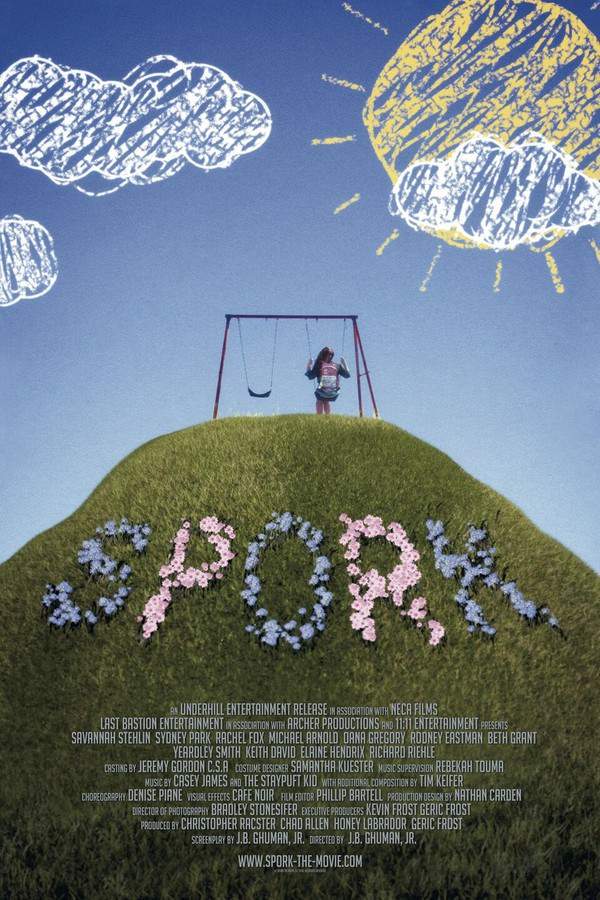
Spork 2011

Directed by

J.B. Ghuman Jr.
Made by

Wrekin Hill Entertainment
Where to Watch Spork
See current US streaming, rental, and purchase options for Spork (2011) via JustWatch.

Fawesome
HD
Fandango at Home Free
HD
Plex
HD
Plex Channel
HD
The CW
SD
The Roku Channel
HD
Tubi TV
SD Streaming availability powered by 
Spork Plot Summary
Read the complete plot summary and ending explained for Spork (2011). From turning points to emotional moments, uncover what really happened and why it matters.
Set in Los Angeles, California, a 14-year-old girl nicknamed “Spork” navigates the rough edges of middle school life. Quiet, soft-spoken, and often overlooked by her peers, she watches as her world tilts when her next-door neighbor and best friend, known as “Tootsie Roll,” hatches a plan to enter the school Dance-Off. The prize money—$236—becomes a means to an end: a chance to visit her father in prison.
When a hair-product–related dancing accident sidelines Tootsie Roll and leaves her unable to compete, the opportunity shifts in an unexpected direction. Spork steps up, choosing to enter the Dance-Off herself, and her decision resonates through the school, surprising friends, rivals, and teachers alike. The moment marks a turning point as she discovers a different side of herself and begins to claim a space she hadn’t claimed before.
The movie explores a placing of time and taste that highlights a clash of eras and attitudes. The two friends drift through a soundtrack rooted in early 1990s hip-hop and dress in 1990s fashion, while the antagonist, Betsy Byotch, and her circle cling to 1980s garb and 1980s tunes, even as their pop fandom grows with Britney Spears. Amid the schoolyard rivalries and fashion wars, Charlie stands out, obsessed with Justin Timberlake, whose career began in the mid-1990s, a detail that anchors the story’s mid-1990s sensibility.
A recurring and provocative thread in the film is the use of language as a window into identity; the term “hermaphrodite” appears as a descriptor and qualifier, signaling a particular era’s conversations about intersexuality and identity—an aspect that helps situate the story in its 1990s milieu. The dialogue and character dynamics are carefully pinned to this period, inviting viewers to consider how language shapes perception and inclusion.
There’s a fond, ongoing reference to classic cinema through the interests the characters share in The Wizard of Oz universe. Spork’s affection for the 1978 film The Wiz contrasts with Charlie’s devotion to the 1939 The Wizard of Oz, while both threads reinforce a larger theme: the comfort of stories that offer escape, hope, and a blueprint for navigating difficult social landscapes.
As the narrative unfolds, Spork’s ascent from quiet bystander to determined participant becomes the heart of the story. The Dance-Off becomes more than a contest; it’s a test of confidence, resilience, and the power of friendship to transform a tense, sometimes cruel social world into a space where a young girl can voice her own strength. The film balances humor with sincerity, painting a portrait of adolescence that respects the tempo of its era while honoring the universal ache to belong.
Spork Timeline
Follow the complete movie timeline of Spork (2011) with every major event in chronological order. Great for understanding complex plots and story progression.
Spork's life in Los Angeles
In Los Angeles, Spork is a 14-year-old who is unpopular and mistreated by her classmates. She is soft-spoken and often overlooked, which sets the stage for a high-stakes social dynamic at her school. The setting underscores the personal challenges she faces before a big school competition even begins.
Tootsie Roll is Spork's best friend and neighbor
Spork's next-door neighbor and best friend, Tootsie Roll, plans to enter the school Dance-Off to win money and visit her father in prison. The prize of $236 gives the competition a tangible incentive and personal stakes. The two girls dream together, forging their bond around this shared goal.
Dance-Off preparation and music taste
Tootsie Roll and Spork discuss their plans while listening to hip-hop from the early 1990s. They adopt 1990s fashion to embody the era's vibe, while Betsy Byotch and her friends lean into 1980s garb. The cultural clash adds texture to the school rivalry at the heart of the film.
Tootsie Roll's accident
During a hair-product-related dancing practice, Tootsie Roll injures her ankle and cannot compete in the Dance-Off. The setback puts the dream of the prize in jeopardy and forces Spork to reconsider her place in the contest. The incident heightens the emotional stakes for both girls and the audience.
Spork signs up for the Dance-Off
Seeing her friend sidelined, Spork rises to the occasion and signs up to participate in the Dance-Off. Her choice to step into the spotlight challenges how others perceive her and shifts the school’s social dynamics. The act redefines her role within the competition and signals a new chapter for her character.
Betsy Byotch and the 1980s vibe
Betsy Byotch, the antagonist, and her friends dress in 1980s fashion and listen to 1980s music, creating a stark stylistic contrast with Spork and Tootsie Roll. Their look underscores the ongoing rivalry between rival cliques at school. The cross-era aesthetic reinforces the film’s playful tension.
Cultural soundtrack: 1990s hip-hop vs 1980s nostalgia
Spork and Tootsie Roll lean into early 1990s hip-hop as their soundtrack and fashion, while Betsy’s group clings to 1980s nostalgia. The contrast highlights different identities within the same school and how music and style shape friendships and rivalry. Britney Spears is referenced as part of the era’s pop culture currents.
The Oz obsession across the cast
Spork remains devoted to The Wiz (1978) while Charlie loves The Wizard of Oz (1939), a through-line that frames their fantasies and aspirations. This Oz obsession recurs throughout the narrative, anchoring their identities in nostalgic storytelling. The motif links friendship, dreams, and the pressures of growing up.
Charlie’s Justin Timberlake obsession
Charlie is obsessed with Justin Timberlake, whose career began in the mid-1990s, adding a pop-culture layer to his school life. This fixation helps define his persona as the Dance-Off approaches. The fan devotion highlights how contemporary icons influence adolescent identity.
The Dance-Off looms as a turning point
With the Dance-Off approaching, the school prepares for a pivotal event that could redefine friendships and reputations. Spork's entry injects new energy into the competition, challenging Betsy and the rival group. The atmosphere is charged with anticipation and a sense of possibility.
Spork's Dance-Off performance unfolds
Spork steps into the spotlight and delivers a routine that defies expectations. The crowd's surprised cheer signals a major shift in the school's dynamic and in Spork’s own confidence. The moment marks a turning point in her relationship with peers and the competition.
Ending note: era, friendship, and self-expression
The film closes with a celebration of personal bravery and the era’s cultural vibes, reinforcing the 1990s setting and the Oz-inspired perspectives of the characters. Spork’s rise from misfit to a more confident presence mirrors themes of self-expression and resilience. The Oz and pop-culture references frame the ending as a celebration of individuality.
Spork Characters
Explore all characters from Spork (2011). Get detailed profiles with their roles, arcs, and key relationships explained.
Spork
A 14-year-old girl who is unpopular and very soft-spoken. Her quiet demeanor masks resilience and a growing willingness to take initiative, culminating in her signing up for the Dance-Off when her friend is sidelined. She navigates school social dynamics with kindness and determination, challenging expectations placed on her by peers.
Tootsie Roll
Spork’s next-door neighbor and best friend who plans to enter the Dance-Off to fund a visit to her father in prison. After injuring her ankle, she becomes reliant on Spork’s courage and support. She remains spirited and determined, but her circumstances add emotional depth to the friendship.
Betsy Byotch
The antagonist who bullies Spork and her circle, dressing in 1980s garb and embodying social vanity and rivalry. She creates conflict and pressure to conform, serving as a foil that motivates Spork to prove herself. Her actions drive the school's social dynamics and heighten the stakes of the Dance-Off.
Charlie
A character captivated by Justin Timberlake and the broader pop culture landscape, providing comedic tension and a lens into teen fandom. He fits into the friend group surrounding Spork, contributing to the movie’s lighthearted, era-specific atmosphere.
Spork Settings
Learn where and when Spork (2011) takes place. Explore the film’s settings, era, and how they shape the narrative.
Time period
1990s
The events take place during the 1990s, a decade marked by evolving hip-hop influences, distinctive fashion, and a culture of school-style competitions. Characters reference early 1990s music and 1980s aesthetics, anchoring the period in teen life. Pop culture touchstones like The Wiz and references to artists of the era help situate the story firmly in its time.
Location
Los Angeles, California
The story unfolds in Los Angeles, a sprawling Southern California city known for its entertainment industry and diverse neighborhoods. The setting provides a vivid backdrop of urban teen life and school culture. The film uses local school dynamics and city vibes to heighten the energy of the Dance-Off competition.
Spork Themes
Discover the main themes in Spork (2011). Analyze the deeper meanings, emotional layers, and social commentary behind the film.
💪
Empowerment
Spork’s transformation from a quiet, overlooked girl to a proactive participant in the Dance-Off emphasizes personal empowerment. The film explores how courage can grow from adversity and how taking initiative can challenge social hierarchies. It highlights resilience as a catalyst for self-worth and change.
🤝
Friendship
Spork and Tootsie Roll’s friendship anchors the narrative, with Spork stepping up when Tootsie Roll is injured. Their bond showcases loyalty, sacrifice, and the complexities of adolescence under social pressure. The Dance-Off becomes a test of trust and collaborative spirit between friends.
🎭
Identity & Culture
The film uses 1990s music, fashion, and intergenerational film references to explore how teens shape identity through media. The contrast between Spork’s hip-hop influenced group and Betsy Byotch’s retro style comments on belonging and inclusion. Iconic cinema references (The Wiz, The Wizard of Oz) serve as offbeat touchstones for personal meaning and self-definition.

Coming soon on iOS and Android
The Plot Explained Mobile App
From blockbusters to hidden gems — dive into movie stories anytime, anywhere. Save your favorites, discover plots faster, and never miss a twist again.
Sign up to be the first to know when we launch. Your email stays private — always.
Explore the mobile appSpork Spoiler-Free Summary
Discover the spoiler-free summary of Spork (2011). Get a concise overview without any spoilers.
In the sun‑splashed streets of Los Angeles, junior high feels like a stage where every hallway echoes with the beats of early‑1990s hip‑hop and the flash of neon‑bright fashion. The school’s social hierarchy is a living collage of eras, with the latest pop anthems clashing against retro tunes, creating a backdrop that is both nostalgic and fiercely present. The comedy rolls through this world with a wink, letting absurdity and earnest teenage yearning dance together in equal measure.
At the heart of the chaos is Spork, an awkward, soft‑spoken fourteen‑year‑old who navigates the swirl of lockers and whispers with a shy resilience. Though she often blends into the background, an irrepressible spark pushes her to find her own rhythm in a place that seems determined to keep her muted. By her side is Tootsie Roll, her next‑door neighbor and best friend, whose own hopes and dreams add urgency to every shared moment. Their bond is a quiet rebellion against the indifferent tide of middle‑school life.
The school’s social scene is ruled by a clique of popular girls whose confidence borders on intimidation, setting the stage for an undercurrent of rivalry. Against this, Spork discovers an unlikely mentor living in a nearby trailer park, a character whose unconventional wisdom and love of dance become a catalyst for self‑discovery. Together they explore sassy choreography that feels almost magical, hinting at a hidden power within the art of movement itself. The promise of the dance floor becomes a metaphor for taking control, inviting Spork to step out of the shadows.
Against the kaleidoscope of music, fashion, and teenage drama, the film teases a journey of confidence and belonging. With humor as its compass and rhythm as its map, the story invites viewers to wonder how far a determined spirit can glide when the beat drops and the world watches.
Movies with Similar Twists and Themes
Uncover films that echo the narrative beats, emotional arcs, or dramatic twists of the one you're exploring. These recommendations are handpicked based on story depth, thematic resonance, and spoiler-worthy moments — perfect for fans who crave more of the same intrigue.


Featured on this page

What's After the Movie?
Not sure whether to stay after the credits? Find out!
Check out our other apps:

SAT Sphere
Build confidence for the Digital SAT.

Mori Atlas
Discover wild places worth protecting.

Luntero
Search smarter for a home in Amsterdam.

Plot Explained
Unravel movie endings and hidden clues.

Pokechamp
Dive into Pokémon data and battle logic.

Driving Theory
Get ready for your European theory test.

Movie Dust
Plan your next cinema trip with ease.

Musemap
Find art and culture as you travel.

Selkobase
Compare credentials before committing.

Local Manual
Turn an unfamiliar country into practical next steps.

Lernavi
Compare school systems before your next move.

GymRoam
Find a workout stop wherever your plans take you.
Explore Our Movie Platform
New Movie Releases (2026)
Famous Movie Actors
Top Film Production Studios
Movie Plot Summaries & Endings
Major Movie Awards & Winners
Best Concert Films & Music Documentaries
Movie Collections and Curated Lists
© 2026 What's After the Movie. All rights reserved.
Privacy Policy