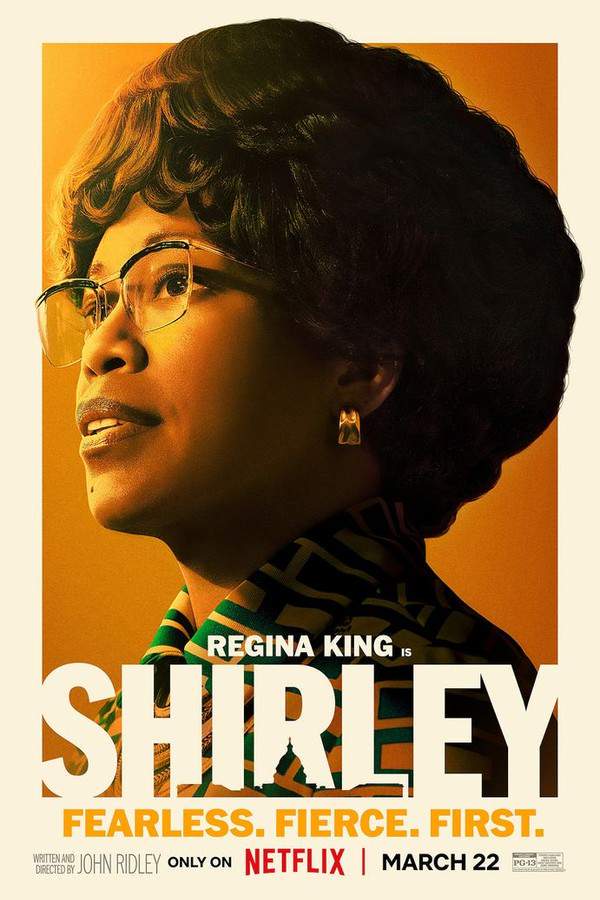
Shirley 2024


Directed by

John Ridley
Made by

BCD Travel
Where to Watch Shirley
See current US streaming, rental, and purchase options for Shirley (2024) via JustWatch.


Streaming availability powered by 
Shirley Plot Summary
Read the complete plot summary and ending explained for Shirley (2024). From turning points to emotional moments, uncover what really happened and why it matters.
Shirley Chisholm, Shirley Chisholm, enters Congress as the first Black woman representing Brooklyn and immediately finds herself in a challenging, confrontational environment. A colleague repeatedly belittles her by pointing out that everyone earns the same high salary, and she is told that as a new congressperson she’s automatically assigned to an agricultural committee—despite representing an urban borough. It becomes clear that many expect her to “tow the line,” a pressure she refuses to accept.
At Christmas 1971, after learning voters raised double what she had requested to put herself on the ballot, she makes a bold decision: she will run for president in 1972, becoming the first Black candidate to seek a major-party nomination and the first woman to pursue the Democratic Party’s nomination. Present are her husband Conrad Chisholm, Mac Holder as security, and Arthur Hardwick Jr. as campaign advisor and head of finances, respectively, marking the start of a high-stakes, nationwide push.
Shirley then reaches out to the next generation of voters by recruiting Robert Gottlieb, a Cornell student, to serve as national student coordinator since 18-year-olds now have the right to vote. A seasoned hand on the ground, Stanley Townsend is brought on as campaign manager, and the team begins to map out a strategy that must stretch across a vast country with limited time and resources.
As the campaign unfolds, the schedule is grueling. Shirley travels across the nation, but time and money constrain her ability to visit every state. In Florida, she earns only a fractional share of the Democratic vote, which leads to negotiations with Walter Fauntroy. He promises to support her and to pass along delegates, a gesture that complicates her plans when she later withdraws from the D.C. vote to avoid splitting its delegation.
National media presents another hurdle: the major networks NBC, ABC, and CBS exclude her from televised debates. In response, the campaign leans heavily on grassroots organizing and on Robert Gottlieb to pursue legal avenues that might secure her airtime and ensure her platform is heard.
As a profile in The New York Times looms, Shirley turns to her sister Muriel St. Hill for support, hoping she and the family will rally behind her. Yet the family’s concerns surface—some feel she’s been favored by their father, and Muriel suggests they avoid talking to the press and eventually steps back from public support. The distance within the community and the campaign’s fundraising pressures begin to weigh on Shirley.
At a high-profile fundraiser, donations go missing, testing the campaign’s resilience. Stanley Townsend quits in frustration, and Shirley confronts him in the office, making clear she won’t tolerate undermining behavior. She fires him, a decision that shows her willingness to stand firm despite mounting pressure. Arthur offers quiet, steady support during the upheaval, whether she continues or not.
Meanwhile, Shirley explains to Conrad Chisholm that additional funds are needed to push the campaign through California and into the DNC process; he ultimately steps back, handing her the reins in a moment of tense disagreement. The campaign adapts, and Robert’s legal effort against the networks bears fruit, granting her crucial airtime and debate exposure.
A pivotal moment arrives when the campaign secures the endorsement of the Black Panthers, signaling broader support even as California remains unwon in the winner-takes-all format. Momentum grows as Shirley mobilizes Black delegates to influence the Democratic National Committee, only to learn that Walter Fauntroy has withdrawn his endorsement and delegates, complicating the math of her bid. Ron Dellums also retracts his support, framing those not backing McGovern as cynical or out of touch.
Facing these reversals, Shirley decides to officially pass on her remaining delegates to McGovern, explaining that her goal was to be a catalyst for change rather than to secure a single nomination. Her time in Congress continues for several terms, and her career leaves a lasting imprint on American politics, inspiring countless others to pursue public service and to challenge the status quo.
Ultimately, the arc underscores a relentless commitment to representation, equity, and social progress, highlighting how one fearless run helped open doors for future generations and broaden the conversation around who can lead the nation.
Shirley Timeline
Follow the complete movie timeline of Shirley (2024) with every major event in chronological order. Great for understanding complex plots and story progression.
Elected as the first Black woman to Congress
Shirley Chisholm is elected to represent Brooklyn in the U.S. House of Representatives, becoming the first Black woman to serve in Congress. She immediately faces a culture of belittling and resistance from colleagues who remind her that everyone earns the same salary. She also confronts a restrictive committee assignment that keeps her away from urban issues she represents.
Conflict over committee assignment
Newly elected and outspoken, she informs the leadership that her urban district deserves a seat on relevant committees, not an agrarian panel. The pushback signals that she must decide whether to toe the line or push back against the status quo. The struggle foreshadows the determination that defines her early years in Congress.
Decides to run for President
During Christmas 1971, after voters raise double what she asked to certify her ballot, Shirley announces her candidacy for the 1972 Democratic nomination. She would become the first Black candidate to seek a major-party presidential nomination and the first woman to do so for the Democratic Party. Her decision sets in motion a nationwide campaign against entrenched congressional norms.
Staffing the national campaign
Shirley tracks down Robert Gottlieb, a Cornell student, to serve as national student coordinator as 18-year-olds gain the right to vote. Stanley Townsend is brought on as campaign manager to handle the growing operation. The team begins shaping a national platform and strategy.
Campaigning across the country with limits
As she campaigns to build momentum, time and money constrain where she can go, and she declines several states. After a disappointing showing in Florida, she reluctantly agrees to work with Walter Fauntroy who promises to pass his delegates and endorse her. The strategic compromises reveal the practical obstacles facing a groundbreaking campaign.
Debate access blocked by major networks
NBC, ABC and CBS exclude her from the national debates, curtailing her platform exposure. The campaign pushes back by turning to the legal route, with Robert Gottlieb intending to sue for her right to be heard. The stakes rise as visibility becomes central to credibility.
Family dynamics and NYT profile
The New York Times plans a profile, prompting Shirley to seek support from her sister Muriel and their siblings. She learns that many in her family and neighborhood feel she’s received special treatment from their father and worry she is alienating them. Muriel refuses to speak to the press, adding personal strain to her public campaign.
Fundraiser scandal and Stanley quits
At a campaign fundraiser, someone pockets most of the donations, undermining morale and prompting a public sense that the campaign is a joke. Stanley Townsend quits, and Shirley asks him to accompany her to the office, where she confronts him before firing him. Arthur Harwick Jr. remains vocal in supporting her during the upheaval.
Conrad funds the campaign despite costs
Shirley explains the additional expenses needed to push the campaign through California and build leverage at the Democratic National Convention. After a tense discussion, Conrad Chisholm ultimately hands her the reigns to continue steering the bid. The moment marks a turning point in keeping the campaign alive.
Airtime secured and Panthers endorsement
Robert's lawsuit against the networks pays off, earning Shirley much-needed airtime to present her platform. A meeting with the Black Panthers yields their endorsement, though the California primary ultimately does not go to her. The campaign gains momentum but faces remaining obstacles.
Black delegates build momentum; Fauntroy drops out
As Shirley rubs shoulders with Black delegates, momentum grows to influence the Democratic Convention. Word arrives that Fauntroy has withdrawn, failing to pass his delegates to her as promised. Ron Dellums also withdraws his endorsement, signaling tough, cynical opposition to candidates who are not McGovern loyalists.
Decision to endorse McGovern
Facing narrowing paths to victory, she officially passes on the remaining delegates to George McGovern and releases a statement that her goal was to be a catalyst for change. The campaign ends its bid, but she continues to influence politics from Congress. The move reframes her legacy and future advocacy.
Legacy: continued congressional influence
Though not elected president, Shirley remains in Congress for several terms, shaping legislation and inspiring others to seek public service. Her persistence helps widen opportunities for Black women in politics and civic engagement. The film closes with the enduring impact of her early challenges and leadership.
Shirley Characters
Explore all characters from Shirley (2024). Get detailed profiles with their roles, arcs, and key relationships explained.
Shirley Chisholm (Regina King)
A trailblazing congresswoman who challenges sexism and racial barriers within the Democratic Party. She pursues a bold path for national leadership, balancing idealism with pragmatic campaign decisions. Her resilience, clarity of purpose, and willingness to confront opposition define her leadership style.
Conrad Chisholm (Michael Cherrie)
Shirley’s husband who, despite tensions over campaign expenses, ultimately supports her bid and takes a stand when the campaign burden intensifies. He embodies loyalty and the personal costs that accompany political life. His decisions reflect the pressures of sustaining a groundbreaking candidacy.
Mac Holder (Lance Reddick)
The security chief and trusted ally who helps shield Shirley from political attacks. He represents the steadiness and protection required in a high-stakes campaign. His presence signals the seriousness with which Shirley confronts systemic opposition.
Arthur Harwick Jr. (Terrence Howard)
Head of finances for the campaign, responsible for managing dwindling resources and mounting expenses. He provides steadfast organizational support even as the campaign faces financial strain. His role highlights the often unseen logistical backbone of political organizing.
Robert Gottlieb (Lucas Hedges)
A law student recruited as national student coordinator who helps secure airtime by challenging networks legally. He becomes a pivotal figure in expanding Shirley’s reach and ensuring her message is heard. His strategic thinking and advocacy drive campaign exposure.
Walter Fauntroy ( André Holland)
A key ally whose endorsement and delegates shape the campaign’s trajectory. His decisions significantly impact Shirley’s leverage within the party, illustrating the complexities of coalition-building. His choices reflect the tensions between loyalty and broader electoral strategy.
Stanley Townsend (Brian Stokes Mitchell)
Campaign manager who navigates the practicalities of running a national campaign. He plays a crucial role in shaping strategy, fundraising, and day-to-day operations. His departure and subsequent reassessment of priorities highlight the fragile balance of power in political campaigns.
Muriel St. Hill (Reina King)
Shirley’s sister who embodies family dynamics and the personal cost of public life. She articulates concerns about favoritism and the press, illustrating the strain a public figure’s meteoric rise places on family and community ties.
Ron Dellums (Dorian Missick)
A political figure whose endorsement evolves during the campaign, signaling shifting alliances and the broader implications of loyalty within the Democratic landscape. His stance influences how Shirley’s delegates are perceived by supporters and rivals alike.
Shirley Settings
Learn where and when Shirley (2024) takes place. Explore the film’s settings, era, and how they shape the narrative.
Time period
Early 1970s (1971-1972)
The story unfolds during the 1971–1972 period, a time of rapid civil rights progress and heightened political activism. It centers on Shirley’s decision to run for the Democratic nomination in 1972, making history as the first Black major-party presidential candidate and the first woman to seek the nomination. The era features media gatekeeping, shifting alliances, and a transforming electorate. The events capture the momentum and obstacles of a landmark political campaign.
Location
Brooklyn, New York City, USA
Brooklyn, New York City serves as the urban backdrop where Shirley’s political career begins and grows. The borough’s diverse communities frame the challenges she faces as a new congresswoman. The setting reflects the friction between local urban issues and national political ambitions. It is depicted as a living, working ground for a groundbreaking candidate pushing against established norms.
Shirley Themes
Discover the main themes in Shirley (2024). Analyze the deeper meanings, emotional layers, and social commentary behind the film.
🎯
Political ambition
Shirley Chisholm’s decision to run for president embodies bold political ambition in a landscape that underestimates Black women. The narrative tracks the personal and public costs of pursuing a national platform, from fundraising to delegate strategy. Ambition is tested by party politics, media exclusion, and internal campaign conflicts. The film frames ambition as a catalyst for change, even when victory remains uncertain.
🗳️
Election strategy
The campaign unfolds as a calculated effort to influence the Democratic Party’s nomination through delegates and key states. The film shows the importance of building alliances, navigating internal party dynamics, and leveraging endorsements. Time and resources constrain where Shirley can campaign, shaping strategic decisions. The depiction highlights the art of coalition-building in a historically constrained political arena.
🎭
Media portrayal
A central tension is Shirley’s struggle to gain airtime and recognition in a media landscape that sidelines her. The effort to sue for debate access illustrates how visibility shapes political viability. The narrative also explores how public perception is influenced by family, community, and endorsements. These media dynamics underscore the gap between a candidate’s platform and the channels that broadcast it.

Coming soon on iOS and Android
The Plot Explained Mobile App
From blockbusters to hidden gems — dive into movie stories anytime, anywhere. Save your favorites, discover plots faster, and never miss a twist again.
Sign up to be the first to know when we launch. Your email stays private — always.
Explore the mobile appShirley Ending Explained
Unravel the ending of Shirley (2024) with our detailed explanation. Understand the final scenes, character fates, and unresolved questions.
**The film “Shirley” concludes with Shirley Chisholm’s audacious 1972 presidential run, embodying her relentless spirit and unwavering commitment to change. Despite facing numerous setbacks—such as lack of funding, political betrayal, and societal prejudice—Shirley remains resilient. Her campaign, though ultimately unsuccessful in securing the nomination, ignites a powerful wave of hope and inspiration among marginalized communities and young voters. The ending shows Shirley’s last-minute loss at the convention, notably with Ron Dellums’ betrayal, as he endorses McGovern instead of her. Yet, Shirley’s response is not one of bitterness but of grace; she understands that her true victory lies in having opened doors and challenged the status quo. Her campaign proved that her fight for equality and representation was worth every sacrifice. In the end, Shirley’s legacy isn’t solely about winning the election but about stirring a movement—empowering others to believe in the possibility of change and inspiring future generations to continue her struggle for justice. The film closes with Shirley knowing that her efforts have left an indelible mark on American politics, making her a timeless symbol of courage and resilience.}
Shirley Spoiler-Free Summary
Discover the spoiler-free summary of Shirley (2024). Get a concise overview without any spoilers.
In the charged atmosphere of early‑1970s America, a groundbreaking voice rises from the streets of Brooklyn to the marble halls of the U.S. Capitol. Shirley Chisholm—the first Black woman elected to Congress—carries the weight of history while confronting a political landscape that often seems designed to keep her in line. The film paints a vivid picture of a nation in transition, where civil‑rights victories still echo against entrenched expectations, and every hallway whispers both possibility and resistance.
Inside the Capitol, Shirley quickly learns that her presence challenges long‑standing norms. A seasoned colleague’s condescending remarks and an assignment to an unexpected committee hint at the subtle forces urging her to “toe the line.” Yet her resolve is unshakable; she meets each slight with quiet confidence, turning the very walls that seek to contain her into a stage for her emerging leadership. The tone is simultaneously gritty and hopeful, reflecting the tension between institutional inertia and the relentless push for representation.
When the idea of a presidential run takes hold, the story expands beyond the Capitol to a nation sprawling with diverse communities and fierce ambition. Conrad Chisholm, her supportive husband, stands beside her as she begins to assemble a small but determined team—Arthur Hardwick Jr., a financial strategist, and a young, idealistic coordinator named Robert Gottlieb. Their grassroots efforts contrast sharply with the polished world of televised politics, highlighting the uphill battle of gaining visibility without the usual platform. The film’s style merges intimate moments of strategy with sweeping scenes of campaign travel, underscoring the enormity of the task while keeping the focus on personal conviction.
Amid the public spotlight, Shirley’s relationships with family and allies reveal the personal cost of breaking barriers. Moments of encouragement and doubt from loved ones weave through the narrative, painting a portrait of a leader whose ambition is rooted in a deeper desire to open doors for future generations. The tone remains inspiring and earnest, inviting viewers to feel the pulse of a historic moment while celebrating the courage required to step into uncharted territory.
Movies with Similar Twists and Themes
Uncover films that echo the narrative beats, emotional arcs, or dramatic twists of the one you're exploring. These recommendations are handpicked based on story depth, thematic resonance, and spoiler-worthy moments — perfect for fans who crave more of the same intrigue.



Featured on this page

What's After the Movie?
Not sure whether to stay after the credits? Find out!
Check out our other apps:

SAT Sphere
Build confidence for the Digital SAT.

Mori Atlas
Discover wild places worth protecting.

Luntero
Search smarter for a home in Amsterdam.

Plot Explained
Unravel movie endings and hidden clues.

Pokechamp
Dive into Pokémon data and battle logic.

Driving Theory
Get ready for your European theory test.

Movie Dust
Plan your next cinema trip with ease.

Musemap
Find art and culture as you travel.

Selkobase
Compare credentials before committing.

Local Manual
Turn an unfamiliar country into practical next steps.

Lernavi
Compare school systems before your next move.

GymRoam
Find a workout stop wherever your plans take you.
Explore Our Movie Platform
New Movie Releases (2026)
Famous Movie Actors
Top Film Production Studios
Movie Plot Summaries & Endings
Major Movie Awards & Winners
Best Concert Films & Music Documentaries
Movie Collections and Curated Lists
© 2026 What's After the Movie. All rights reserved.
Privacy Policy