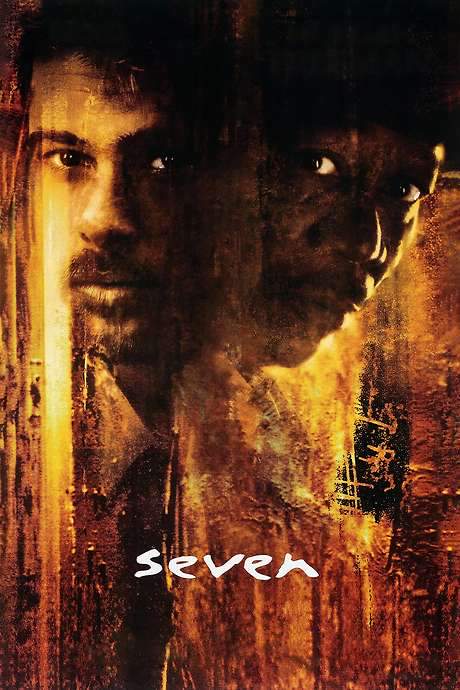
What Is Se7en About?
The premise of Se7en in 290 words, with nothing given away. The full story follows below.
In a rain‑slick, unnamed metropolis where decay seeps from every alley, two homicide detectives are thrust into a grim hunt that feels as much like a philosophical puzzle as a police procedure. The city’s relentless grime mirrors the darkness of the crimes they pursue, giving the film a relentless, noir‑tinted atmosphere that never lets the audience settle into comfort. Every streetlamp flickers with the promise of another unsettling clue, and the oppressive mood hangs heavy over each whispered conversation in cramped precinct rooms.
Detective Lieutenant William Somerset is a weary veteran, one week from retirement, whose world‑weary eyes have seen the city’s worst and whose methodical mind seeks patterns in the chaos. He is paired with the hot‑headed, idealistic newcomer Detective David Mills, fresh from a different life and eager to prove himself, yet skeptically dismissive of the symbolic weight his partner attributes to the case. Their partnership crackles with tension: Somerset’s measured, almost academic approach clashes with Mills’s impulsive drive, creating a dynamic that pushes both men to the edge of their convictions.
Adding another layer, Tracy, Mills’s pregnant wife, brings a fragile humanity into the gritty procedural world. Her presence reveals the detectives’ personal stakes, exposing their vulnerabilities and the quiet desperation that lurks beneath badge and gun. The trio’s interactions hint at deeper questions about duty, sacrifice, and the moral cost of confronting evil.
Against this backdrop, a mysterious killer stages murders that echo the ancient concept of the seven deadly sins, turning the city into a macabre tableau of moral reckoning. The hunt forces Somerset and Mills to confront not only the elusive perpetrator but also the unsettling reflections of their own inner darkness, setting the stage for a tense, character‑driven battle of wits and will.
What Happens in Se7en?
The complete story of Se7en, from the first scene to the last, in 1,180 words (about 5 minutes). Spoilers throughout.
Spoilers ahead
Detective Lieutenant [Morgan Freeman] Somerset is one week from retirement, and he is partnered with Mills, a young, hot-headed, idealistic detective who recently relocated to the city with his wife, [Gwyneth Paltrow] Tracy. The two men could not be more different in temperament or outlook, yet they share a stubborn dedication to justice in a city roiled by violence and corruption. The unnamed metropolis feels like a living puzzle, every alleyway and tenement whispering of crime, and Somerset carries the weight of experience, while Mills brings a drive that sometimes borders on recklessness. Their uneasy bond becomes the quiet center of a case that will push them to the edge of both their professional limits and their personal beliefs.
On Monday, the pair investigate a bizarre and gruesome murder: an obese man who was forced to eat until his stomach ruptured. The scene is macabre and meticulously documented, with the word “gluttony” scrawled on a wall like a grim signature. The brutality is clinical, almost ritualistic, and it prompts Somerset to question whether this assignment is suitable for his last days on the force. His professional instinct tells him that they are dealing with something far more than random violence, but his request for reassignment—an attempt to shield himself from a case that feels both unspeakable and unsatisfying—meets stubborn resistance from the bureaucratic machine of the department. Mills, eager to prove himself, throws himself into the investigation with a mixture of zeal and fury, driven by a need to demonstrate his competence in a city that has never welcomed him with open arms.
The next day brings another dead end, and a second victim who has been deprived of a pound of flesh from his body. The crime scene is marked with the word “greed,” and the clues begin to cohere into a darker pattern. As the newspapers whisper about the case, Somerset and Mills press deeper into the mystery, following the threads to a third victim that appears to be the opposite of gluttony—a man who was emaciated, restrained to a bed, and left to suffer in a methodical, almost clinical way. Photographs reveal the victim was restrained for precisely one year, suggesting a long premeditation and an eerie, almost theatrical patience. Somerset’s intuition crystallizes the idea that the killings spring from the Christian concept of the seven deadly sins, a theory that fits the meticulous nature of the crimes and the way each scene seems to indict a particular vice.
A sense of uneasy camaraderie blossoms as Mills invites Somerset to share a quiet supper at Tracy’s apartment, a gesture meant to bridge the professional divide and ease the tension between the two men. Tracy, a woman who has just moved to the city, opens up about her unhappiness with the move and the looming pregnancy that has altered the fabric of her life. She wonders whether this new city is a place where she can raise a child, and her confession echoes past regrets that Somerset himself has carried for years—his decision to persuade a former partner to terminate a pregnancy and the ache that followed. He counsels Tracy with a rare gentleness, advising her to tell Mills about the pregnancy only if she intends to keep the child. The moment subtly reveals the emotional weight behind the investigative armor worn by the two men, and it foreshadows how the case will test every boundary they have built around themselves.
A sharp remark from Mills spurs Somerset to broaden their search into libraries and catalogs, looking for anyone who has checked out books related to the seven deadly sins. This leads them to the apartment of a man known only as John Doe. The unexpected return of the suspect, who incapacitates Mills with a tire iron and holds him at gunpoint, adds a jolt of danger to the pursuit. Doe shows an unsettling restraint in choosing to leave Mills alive, and he retreats into the night, leaving behind a staggering cache: stacks of money, hundreds of notebooks, and photographs that include images of Somerset and Mills themselves, as though Doe has been stalking them all along. The discovery intensifies the sense that the killer intends to communicate a broader message, a message about the ubiquity of sin and society’s apathy toward it. Doe also telephones the apartment to express his admiration for Mills, a chilling reminder of his ability to manipulate those around him.
By Saturday, the investigators confront the fourth victim, a prostitute who has been raped with a custom-made, bladed strap-on. The brutality of the crime underscores the lurid and dangerous depth of the sin they are pursuing, and the case tightens the pace of the investigation. The next day brings another shock: a model, the Pride victim, who has been facially disfigured by Doe and, unable to endure a life altered by violence, takes her own life. The sins, it seems, are not simply abstract moral categories but tangible wounds that tear at the fabric of individual lives.
When Doe surfaces again, he arrives covered in blood and surrenders, issuing a chilling ultimatum. He threatens to plead insanity at his trial, a gambit meant to deflect punishment, unless Mills and Somerset escort him to a hidden location where they will encounter the envy and wrath victims. As they travel, Doe speaks with a disturbing calm, insisting that God chose him to wake society to the pervasiveness of sin and the hardened indifference that people show toward it. He is utterly devoid of remorse, taking pleasure in his role as a catalyst for others’ fear and anger.
Doe guides them to a remote location far beyond the city’s edge, where a delivery van approaches under ominous circumstances. The driver’s instructions are to deliver a package to Mills at the exact moment the detectives arrive, a plan that fills Mills with dread as he confronts a sight he would rather forget. Doe, in a calculated confrontation, reveals that he embodies envy because he coveted Mills’s life with Tracy and implies that the package contains Tracy’s severed head. He pushes Mills toward wrath, telling him that Tracy begged for her life and that of her unborn child—an revelation that crushes Mills’s world and exposes the fragile line between justice and vengeance. Despite Somerset’s pleas and his own mounting horror, Mills is overwhelmed by grief and rage and shoots Doe dead, completing the killer’s meticulously crafted arc.
In the aftermath, Mills is removed from the scene, catatonic under the weight of what he has done, while Somerset—ever the observer and survivor—tells his captain that he will “be around.” The detective then speaks with the world-weariness of someone who has witnessed too much yet remains committed to some sense of duty. In a final voiceover, he quotes Ernest Hemingway, acknowledging the darker truth that the world is a fine place, and worth fighting for—the second part, at least, something he continues to believe even as the city’s shadows linger.
Ernest Hemingway once wrote: “The world is a fine place, and worth fighting for.” I agree with the second part.
Se7en Timeline: Every Key Event in Order
13 key events in the order they happen, from “Gluttony murder sparks investigation” to “Aftermath and a glimmer of hope”. 13 events name a place, across 10 locations.
- 1
Gluttony murder sparks investigation
A grotesque murder of an obese man who was forced to eat until his stomach burst is investigated by Detectives Somerset and Mills. The crime scene bears the word gluttony, signaling a deliberate tie to the seven deadly sins. Somerset, nearing retirement, asks to be reassigned, but his request is denied.
When:Monday Where:Unnamed city
- 2
Greed murder discovered
The following day, another victim is found, forced to cut one pound of flesh from his body and marked with greed. Clues at the scene point toward the sin motif and the pursuit of the next lead. The investigation gradually narrows toward the killer's staged sins.
When:Tuesday Where:Unnamed city
- 3
Sloth victim found
The clues at the second crime scene lead them to the sloth victim, a drug-dealing pederast who has been emaciated and restrained to a bed. Photographs reveal the victim was restrained for precisely one year, underscoring the calculated nature of the crimes. Somerset surmises that the murders are based on the seven deadly sins.
When:Tuesday Where:Sloth victim's apartment
- 4
Tracy invites Supper
Tracy invites Somerset and Mills to share supper, hoping to ease their mutual hostility. The gesture helps the two detectives temporarily settle their uneasy professional dynamic.
When:Friday Where:Tracy's apartment
- 5
Tracy reveals pregnancy
Tracy privately informs Somerset that she is pregnant and unhappy about moving, doubting the city as a place to raise a child. Somerset recalls his own past regret after pressuring his girlfriend to abort, urging her to decide how to proceed with Mills.
When:Friday Where:Tracy's apartment
- 6
Lead to John Doe
An offhand remark by Mills prompts Somerset to search libraries for people checking out books on the seven deadly sins. Their cross-referencing leads them to the apartment of a man known only as John Doe. Inside, they find money, notebooks, and photographs of victims, including images of Somerset and Mills.
When:Friday Where:John Doe's apartment
- 7
John Doe confronts Mills
Doe returns home and is pursued by Mills. He incapacitates Mills with a tire iron and holds him at gunpoint, but chooses to leave him alive and flees. The police then investigate the apartment and uncover a large cache of money, hundreds of notebooks, and photographs of victims, including images of the detectives.
When:Friday night Where:John Doe's apartment
- 8
Lust murder discovered
On Saturday, the fourth victim, a prostitute, is found and raped with a custom-made bladed strap-on by a man held at gunpoint. The atrocity highlights the killer's perverse fixation on punishing sins. The case begins to strongly connect to the broader seven sins motif.
When:Saturday Where:Red-light district
- 9
Pride murder and suicide
The following day, the pride victim—a model disfigured by Doe—finds living without her beauty unbearable and commits suicide. The murder underscores the killer's desire to annihilate vanity as punishment for pride.
When:Sunday Where:Model's location
- 10
Doe surrenders and sets a final trap
Doe arrives at the police station covered in blood and surrenders. He threatens to plead insanity at trial unless Mills and Somerset escort him to an undisclosed location where they will find the envy and wrath victims. He seems satisfied by the prospect of his message finally being delivered.
When:Sunday night Where:Police station
Show the other 3 events of Se7en Hide the last 3 events
- 11
Drive to the remote location
Doe leads the detectives to a remote location outside the city limits, where a delivery van approaches at a precise time. The driver is instructed to deliver a package to Mills at this location, foreshadowing a final, chilling reveal. Somerset intercepts the van and realizes something horrific awaits.
When:Sunday night Where:Remote location outside city limits
- 12
Envy revealed; Tracy's fate
Doe declares that he embodies envy, admitting he coveted Mills's life with Tracy and implying the package contains her severed head. He taunts Mills by suggesting Tracy begged for her life and her unborn child. Overcome with wrath and despair, Mills shoots Doe dead, fulfilling Doe's design.
When:Sunday night Where:Remote location
- 13
Aftermath and a glimmer of hope
Police remove Mills, and Somerset tells his captain that he will stay in the city. He closes with a Hemingway line about fighting for the world, signaling a possible hope beyond darkness while acknowledging the danger that remains in the city.
When:Aftermath Where:Remote location / city
Who Are the Main Characters in Se7en?
4 characters, among them Detective William Somerset (Morgan Freeman), Detective David Mills (Brad Pitt) and Tr Tracy Mills (Gwyneth Paltrow): who each one is and the part they play in the story. Every profile links to the actor’s page.
-

Detective William Somerset (Morgan Freeman)
Played by Morgan Freeman
A weary, near-retirement detective who believes experience and philosophy illuminate the truth, yet doubts the city’s morality. He relies on measured reasoning and restraint, even as the case grows more disturbing. His dynamic with Mills provides balance, challenging impulsive instincts with long-form perspective.
- 🧭 Investigator
- 🕯️ Philosopher
- 🗝️ Veteran
-

Detective David Mills (Brad Pitt)
Played by Brad Pitt
A young, hot-tempered detective recently relocated to the city with his wife. He brings urgency and emotion to the investigation, sometimes acting on impulse. His partnership with Somerset exposes clashes between instinct and experience.
- 🔥 Hot-headed
- 🧭 Optimist
- 🗝️ Loyal
-

Tr Tracy Mills (Gwyneth Paltrow)
Played by Gwyneth Paltrow
Tracy Mills is Mills's wife, pregnant and unsettled by the city’s influence. Her conversations reveal vulnerability and foreshadow the personal stakes of the killer's plan. Her presence grounds the detectives' humanity amid the darkness.
- 💑 Hope
- 🤰 Expectant
- 🕊️ Vulnerable
-

John Doe (Kevin Spacey)
Played by Kevin Spacey
A meticulous, emotionless killer who embodies the seven deadly sins, selecting victims to deliver a moral indictment on society. He views himself as a messenger seeking reform through calculated acts of violence. His confrontation with Mills reveals the fragility of restraint and the danger of provocation.
- 🧩 Enigmatic
- 🗝️ Sinister
- 🎭 Manipulative
Where and When Is Se7en Set?
Where and when the story of Se7en unfolds, and why it matters.
When
The story unfolds in a contemporary urban setting with a late-20th-century mood. Police procedure, forensics, long stakeouts, and bureaucratic hurdles define the investigation, reflecting the era's cynicism. The atmosphere is gritty, with moral ambiguity driving the narrative.
Where
The action unfolds in a dense, unnamed metropolis plagued by brutal crimes and systemic corruption. The cityscape itself feels like a character, shaping the detectives' sense of futility and moral compromise. Rain-soaked streets, stark apartment blocks, and anonymous crowds provide a claustrophobic backdrop for a killer who models his acts on the seven deadly sins.
- 🕵️ Crime
- 🏙️ City
- 🗝️ Mystery
What Are the Themes of Se7en?
3 ideas the story keeps returning to, among them Moral Decay, Justice and Fate.
-
01
Moral Decay
The seven deadly sins serve as a lens to reveal a city and its institutions seemingly bending to violence and indifference. Somerset and Mills confront not only a killer but a system that tolerates brutality. Victims are chosen to expose society's willingness to overlook horror. The film asks what true justice looks like when corruption stains every layer of power.
-
02
Justice
Pursuit of justice becomes a dangerous game of calculation and impulse. Doe's plan tests whether punishment can be moral when driven by revenge. The detectives must decide how far they will go to stop a killer who manipulates them. The ending asks whether institutional justice can withstand such a moral calculus.
-
03
Fate
Doe crafts a narrative that seems to steer Mills toward wrath, suggesting a predestined moral path. The film probes whether individuals can escape a scripted destiny. Mills's choice at the climax shows how emotion can override restraint. Somerset offers a counterpoint about resilience and the possibility of meaningful action.
What Kind of Film Is Se7en?
Dark in tone, with steady pacing and a moderate story, going by the plot summary.
- Tone
- Dark
- Pacing
- Steady
- Story
- Moderate
- Intensity
- High
- Ending
- Bleak
An overwhelmingly grim and tense descent into moral darkness, methodically paced to build unbearable dread as detectives confront a serial killer whose horrific crimes expose the rot within society and themselves.
- oppressive
- grim
- anxious
- sinister
- morose
- unsettling
- serial killer
- crime investigation
- good vs evil
- moral decay
Content notes: gore, torture, decapitation, mutilation, sexual assault, suicide.
Where to Watch Se7en
Stream it on fuboTV and Paramount Plus Essential, or rent or buy it from Amazon Video and Apple TV Store. US availability and prices from JustWatch.
 fuboTV
  Paramount Plus Essential
  Paramount Plus Premium




Streaming availability in the US, powered by